

In this Article
Flight and hotel prices are among the most aggressively personalized data on the open web: airlines change fares up to 15 times a day, a single seat can reprice up to 35 times before departure, and an airline’s revenue system can recalibrate within ~30 minutes of a competitor moving. On top of that volatility sits geography — independent analyses find an average ~28% variance in airfares across geographic markets, and airlines and OTAs routinely serve different prices by country, currency, device, and login state. That combination is exactly why you can’t collect travel pricing from a datacenter IP in one location and call it “the price.” To see the fare a traveler in São Paulo, Frankfurt, or Mumbai actually sees, you have to query from a residential IP in that market, in that currency, at that moment.
This guide ranks the 8 best proxies for scraping flight and travel prices in 2026 — Google Flights, Skyscanner, Booking.com, Expedia, Kayak and the airlines directly. It covers why residential proxies and geo-targeting are non-negotiable for fare data, the per-site anti-bot reality (Google WAF on Google Flights, DataDome on the booking layer), how managed SERP/travel APIs compare to raw proxies on cost, and the legal landscape after American Airlines v Skiplagged and Ryanair v PR Aviation. Jump to the quick comparison for a thirty-second shortlist.
Key Facts
Flight and travel scraping is its own proxy problem because the prices move constantly, vary by geo, and sit behind enterprise anti-bot. Six things to know up front:
- There is no public Google Flights API. Google shut down the QPX Express API on April 10, 2018; the ITA Matrix interface still exists but has no API, and enterprises rely on GDS/NDC/contracted feeds. For Google Flights data specifically, your options are headless-browser scraping or a third-party SERP/travel API — there is no clean official endpoint.
- Prices are geo-, currency-, and device-personalized. Airfares vary by roughly 28% across geographic markets on average, mobile and desktop are frequently priced differently (and 60%+ of travel bookings are mobile in key markets), and an estimated 60-70% of OTA users are logged in and can see member rates that break published parity. Country-targeted residential IPs in the buyer’s market are the only way to capture true displayed prices.
- Residential is the floor; datacenter is effectively unusable on live travel sites. Google Flights fingerprints datacenter IPs within a handful of requests (Google WAF), and the booking layer (Booking.com and many hotel sites) runs DataDome — a bot platform protecting 1,200+ companies with 85,000+ per-customer models and 2025-era intent-based detection that flags automated navigation even with a perfect browser fingerprint. Residential or mobile proxies plus a real headless browser are the baseline.
- The market is huge and data-hungry. The global online travel market is roughly $566B in 2026 (heading toward ~$740B by 2033) and the OTA segment alone is ~$107B. OTAs, metasearch engines, travel management companies, fare-prediction apps, travel fintech, and hotel revenue managers all run continuous price-collection pipelines.
- The legal line is public vs. contractual. Scraping public fare data is CFAA-safe post-hiQ v LinkedIn (9th Cir. 2022) and Meta v Bright Data (Jan 2024), but airline/OTA terms of service can contractually prohibit scraping even of unprotected data (Ryanair v PR Aviation, CJEU 2015), and reselling or hidden-city tactics draw real damages (American Airlines v Skiplagged, $9.4M jury verdict, Oct 2024). Public read-only price monitoring is the defensible lane; booking, reselling, and logged-in flows are not.
- DataImpulse is the value pick at $1/GB residential, pay-as-you-go, traffic that never expires, 90M+ IPs across 195 countries with country targeting included and city/ZIP/ASN as a paid add-on — the geo grid travel pricing work needs, at a fraction of managed-API per-record cost.
How We Selected These Flight & Travel Proxies
We picked these 8 providers because they have credible residential or mobile coverage that survives the travel anti-bot stack in 2026 (Google WAF on Google Flights, DataDome on the booking layer), public pricing as of June 2026, and features that matter specifically for fare work: granular geo-targeting down to country/city so you can see market-specific prices, mobile pools for app-fare and mobile-price checks, sticky sessions for multi-step search-to-results flows, and — for teams that would rather not maintain a headless Google Flights parser — managed SERP or travel scraping APIs. We weighed live PAYG residential price per GB, geo granularity, mobile availability, managed-API options, and legal posture. Providers without verifiable travel-scraping coverage were cut.
Why You Need Proxies to Scrape Flight & Hotel Prices
Travel pricing breaks the naive “fetch the page, read the price” model in three ways at once. Volatility: fares change up to 15 times a day and as many as 35 times before departure, so a price is only true for the moment and market you captured it in — you need continuous, parallel collection, not one-off pulls. Geo and currency personalization: the same flight or hotel room is shown at materially different prices depending on the visitor’s country, currency, and sometimes device; with ~28% airfare variance across markets, a fare scraped from a US datacenter tells you nothing about what a customer in Germany or Brazil sees. You need a residential IP physically in the target market, requesting in the local currency. Anti-bot: Google Flights runs behind Google’s WAF and rate-limiting, and the booking/hotel layer runs DataDome and Akamai-class protection that flag datacenter ranges and automated cadence instantly. Residential and mobile proxies that present as ordinary travelers are the only IPs that sustain collection. Put together: proxies aren’t an optimization for travel scraping — they’re the precondition for getting correct data at all.
Quick Comparison: Best Proxies for Flight & Travel Scraping at a Glance
| Provider | Best for | Residential price | Geo targeting | Travel-specific notable |
|---|---|---|---|---|
| DataImpulse | Best value, in-house fare/rate pipelines | $1/GB PAYG | Country incl; city/ZIP/ASN add-on | 90M+ pool, mobile $2/GB for app-fare checks, never-expires |
| Bright Data | Enterprise + managed SERP/Unlocker | ~$2.50/GB promo; $5/GB regular | Country/city/ZIP/ASN | SERP API for Google Flights + Web Unlocker $1.50/1K, travel datasets |
| Oxylabs | Enterprise + Web Scraper/SERP API | from $6/GB | Country/state/city | SERP & Web Scraper APIs cover Google Flights; SLA support |
| Decodo | Mid-market, full geo grid | $3.75/GB starter; ~$2/GB at 1TB+ | Country/city/ZIP/ASN | Web Scraping API + Google template; sticky to 24h |
| IPRoyal | Long search-to-results sessions | from $7.35/GB | Country/region/city/ISP | Sticky up to 7 days; Web Unblocker for defended endpoints |
| SOAX | Mixed residential + mobile fare work | $3.60/GB Starter | Country/region/city/ISP/ASN | 33M+ mobile pool for app/mobile pricing; unified credits |
| ScraperAPI | Outcomes via SERP/Google API | from $49/mo (100K credits) | Country on Business ($299/mo) | Managed Google/SERP scraping, JS render, retries |
| Apify | No-code travel actor marketplace | residential from $8/GB | Location/coordinates/URLs | Ready Skyscanner/Google Flights/Booking/Kayak actors, PPE pricing |
Which Proxy Type Should You Use for Travel Scraping?
Travel scraping splits into a few lanes — broad metasearch/fare sweeps, market-specific price checks, mobile-app pricing, and long search-to-results flows. Each maps to a different proxy posture.
Residential Proxies — Default for Flight & Hotel Prices
Residential proxies are the right default for almost all travel work — Google Flights fare sweeps, Skyscanner and Kayak metasearch results, Booking.com and Expedia hotel rates, airline-direct pricing, and rate-parity monitoring. Real consumer-ISP IPs in the target country read as ordinary travelers to Google’s WAF and to DataDome, and — critically — they return the geo- and currency-localized prices that a buyer in that market actually sees. Country targeting is the minimum; city/ZIP targeting matters when prices or availability differ sub-nationally.
Mobile Proxies — App and Mobile-Web Pricing
Mobile proxies route through real carrier networks and earn their place for two travel cases: capturing mobile-web and in-app pricing (airlines and OTAs frequently price mobile differently, and app-exclusive deals are real, with 60%+ of bookings now mobile), and clearing the hardest anti-bot surfaces where residential gets challenged. They cost more per GB ($2-$10), so reserve mobile for app-fare validation and the most defended endpoints rather than bulk desktop sweeps.
ISP / Static Residential — Session-Stable Flows
ISP (static residential) proxies combine consumer-ISP authenticity with a stable, long-lived IP — useful for multi-step search-to-results flows where the same session must persist across the query, the polling, and the results render without the IP rotating mid-flow. IPRoyal (7-day sticky), Decodo, SOAX, Bright Data, and Oxylabs all offer ISP lines.
Datacenter Proxies — Avoid for Live Travel Sites
Datacenter proxies are essentially unusable against Google Flights and DataDome-protected booking sites in 2026 — they flag within a handful of requests. Reserve datacenter for cheap, unprotected adjacent layers: parsing already-collected JSON, hitting your own infrastructure, or low-defense reference data. For anything live on Google Flights, Booking, Skyscanner, Expedia, or airline sites, use residential or mobile.
Rotating vs Sticky for Fare Work
The rule: rotate for breadth, stick for a flow. Rotating residential handles wide fare sweeps — many routes, many dates, many markets, where each request is independent. Sticky sessions (15-30 min is usually enough; longer for slow metasearch polling) handle the multi-step flows where a search submits, polls for results, and renders — Google Flights and metasearch results often arrive asynchronously and you want the same IP across the sequence. Most travel stacks run mostly rotating with a sticky pool for the search-to-results flows.
Best Proxies for Flight & Travel Scraping — Full Reviews
The picks below are ranked on value for travel scraping — the balance of residential authenticity, geo granularity, mobile availability, managed-API options, anti-bot success, and price per successful scrape. DataImpulse leads on value for in-house pipelines; Bright Data and Oxylabs lead the managed-API route for Google Flights; Apify is the fastest no-code path via ready travel actors.
1. DataImpulse
DataImpulse is the best-value pick for in-house teams running their own flight and hotel price collection — fare aggregation, rate-parity monitoring, travel-fintech pricing feeds, competitive fare intelligence, and metasearch-style pipelines. Residential starts at $1/GB, pay-as-you-go, with traffic that never expires — a fraction of what managed travel APIs charge per record. The pool is 90M+ ethically sourced IPs across 195 countries with country targeting included and state/city/ZIP/ASN available as a paid add-on, which is exactly the geo grid fare work needs: airfares vary ~28% across markets, so collecting from a residential IP in each target country, in local currency, is the whole point. It supports HTTP, HTTPS, and SOCKS5, rotating and sticky sessions, full API access, and standard stacks (Scrapy, Selenium, Playwright); pair it with a real headless browser to clear Google Flights’ WAF and DataDome on the booking layer. Mobile is available at $2/GB for app-fare and mobile-price checks; datacenter at $0.50/GB for the parsing/enrichment layer.
What makes it the default for serious travel collection is the price-to-geo ratio. At $1/GB you can sustain continuous, multi-market fare and rate monitoring without the per-record charges that managed APIs accumulate at scale, and PAYG means experimenting with new routes, markets, or hotel sets doesn’t lock you into a subscription. Support is 24/7 human; published success rate is 99.51%; G2 is 4.8/5. There’s no dedicated travel endpoint here — DataImpulse sells clean proxy infrastructure and lets your team build the Google Flights or Booking parser on top.
Quick specs — Types: residential, mobile, datacenter · Pool: 90M+ residential, 195 countries · Rotation: rotating + sticky · Geo: country (city/ZIP/ASN as paid add-on) · Price: $1/GB res, $0.50/GB DC, $2/GB mobile · Published success: 99.51% · Rating: G2 4.8.
2. Bright Data
Bright Data is the enterprise pick if you want travel data as a managed product. Beyond raw residential at $5/GB pay-as-you-go (currently discounted to about $2.50/GB on a promo) with a 400M+ monthly IP pool and free city/ZIP targeting, Bright Data ships a SERP API that returns Google results — including Google Flights and Google Hotels surfaces — as structured data, and a Web Unlocker at $1.50 per 1,000 results on PAYG (down to ~$1/1K on subscriptions) that handles WAF and DataDome-class protection at request time. Pre-collected travel datasets are also available for teams that want bulk historical pricing without running collection themselves. It’s the right call when you’d rather hit a managed endpoint than maintain a headless Google Flights parser, at enterprise pricing with procurement-style buying.
Quick specs — Types: residential, DC, ISP, mobile + SERP API + Web Unlocker + datasets · Pool: 400M+ monthly residential · Rotation: rotating, sticky, dedicated · Geo: country/city/ZIP/ASN · Price: ~$2.50/GB res (promo), $5/GB regular; Web Unlocker $1.50/1K PAYG (~$1/1K on subscriptions); SERP API priced per 1K results.
3. Oxylabs
Oxylabs sits next to Bright Data at the enterprise top with a strong managed-API line. Residential starts around $6/GB on the entry plan with a 175M+ pool across 195 countries, and its SERP API and Web Scraper API cover Google surfaces including Google Flights and Google Hotels, returning parsed JSON with JavaScript rendering handled server-side. Sessions are flexible with unlimited concurrent connections, and Oxylabs leans hard on SLA-grade support and an audit-ready compliance posture. Pick Oxylabs when reliability, contractual SLAs, and compliance documentation matter more than entry price — the typical fit for larger OTAs, TMCs, and revenue-management vendors with procurement requirements.
Quick specs — Types: residential, DC, ISP, mobile + SERP API + Web Scraper API · Pool: 175M+ residential, 195 countries · Rotation: flexible, sticky, unlimited concurrency · Geo: country/state/city · Price: from $6/GB residential; SERP/Web Scraper APIs priced per 1K results · Published success: ~99.9%.
4. Decodo
Decodo (formerly Smartproxy) is the balanced mid-market pick for travel work that needs a full geo grid without enterprise pricing. Residential starts at $3.75/GB on the 3GB starter plan, with PAYG at $8.50/GB on the public pricing page, dropping to about $2/GB at the 1,000 GB subscription tier. Its Web Scraping API includes a Google template that handles the rendering and anti-bot layer for Google surfaces, and sticky sessions are configurable up to 24 hours — long enough for slow metasearch polling. Country, city, ZIP, and ASN targeting are all included, which is the geo granularity multi-market fare collection needs.
Quick specs — Types: residential, DC, ISP, mobile + Web Scraping API (Google template) · Pool: 115M+ residential · Rotation: per-request, sticky up to 24h · Geo: country/city/ZIP/ASN · Price: $3.75/GB (3 GB starter), $8.50/GB PAYG, ~$2/GB at 1 TB+.
Best for: mid-market travel teams that want a full geo grid and a managed Google template at a per-GB price.
5. IPRoyal
IPRoyal earns its spot for travel teams running long search-to-results or session-stable flows. Residential PAYG runs $7.35/GB at entry (cheaper at volume) with a 32M+ pool across 195+ countries, country/region/city/ISP targeting, and — its real differentiator — sticky sessions up to 7 days, the longest on this list. Its Web Unblocker handles defended endpoints (CAPTCHA + anti-bot bypass) at per-request pricing for the harder travel sites. For pipelines that need a single IP to persist across a multi-step booking-engine search, slow asynchronous results polling, or multi-day price-tracking on specific routes/hotels, IPRoyal’s session continuity is unique.
Quick specs — Types: residential, ISP, mobile, DC + Web Unblocker · Pool: 32M+ residential, 195+ countries · Rotation: rotating, sticky up to 7 days · Geo: country/region/city/ISP · Price: from $7.35/GB residential PAYG.
Best for: travel teams running long session-stable flows and multi-day route/hotel price tracking.
6. SOAX
SOAX is the pick when geo-precise travel work and mixed proxy types matter together. Residential starts at $3.60/GB on the Starter plan (25GB included), and the unified credit model means you can spend the same budget on residential, mobile, ISP, or datacenter. The pool is one of the larger in the mid-tier — 155M+ residential, 33M+ mobile, 2.6M+ ISP — with country, region, city, ISP, and ASN targeting. That mobile pool matters for travel specifically: it lets you check mobile-web and in-app fares (priced differently from desktop) and clear the hardest anti-bot surfaces, while running desktop fare sweeps on residential, all from one account.
Quick specs — Types: residential, mobile, ISP, DC + Web Data API · Pool: 155M+ residential, 33M+ mobile, 2.6M+ ISP · Rotation: per request or interval, sticky supported · Geo: country/region/city/ISP/ASN · Price: $3.60/GB Starter.
7. ScraperAPI
ScraperAPI is the right answer when you want travel data as outcomes rather than raw proxies. Its managed scraping endpoints handle rotation, retries, anti-bot bypassing, and JavaScript rendering, and its Google/SERP scraping covers Google Flights and Google Hotels surfaces without you maintaining the protobuf-query and headless-browser plumbing. Plans start at $49/month for 100,000 API credits on the Hobby tier; Google and JS-render requests consume credits with multipliers. Country-level geo targeting is restricted to the Business tier ($299/mo) per the current docs — worth noting, since geo is essential for fare work, so budget for at least Business if you need market-specific prices.
Quick specs — Type: managed scraping API + Google/SERP endpoints · Pool: 40M+ proxies, 50+ countries · Rotation: automatic, API-managed · Geo: country-level on Business ($299/mo) · Price: from $49/month (100K credits).
8. Apify
Apify is the fastest route for no-code or low-code travel teams. The Apify marketplace has ready-made actors for nearly every travel target — Google Flights, Skyscanner, Booking.com, Kayak, Expedia, and Google Hotels scrapers covering fares, hotel rates, availability, and rate-parity comparisons — with the anti-bot strategies baked into the maintained actors. Pricing is mostly Pay-Per-Event or per-result, typically in the ~$1-$5 per 1,000 results range depending on actor and plan, and Apify Proxy residential is available from $8/GB if you also want raw infrastructure. The combination — actor marketplace, scheduling, exports, API access, and maintained scraping logic — makes Apify the fastest path from “we need flight prices” to “we have a CSV” for teams that don’t want to build and maintain parsers against Google’s and DataDome’s moving targets.
Quick specs — Type: actor marketplace + managed proxies · Travel actors: Google Flights, Skyscanner, Booking, Kayak, Expedia, Google Hotels (multiple) · Geo: location/coordinates/URLs · Pricing: ~$1-$5/1K results (PPE/per-result) · Proxy: residential from $8/GB.
How to Scrape Google Flights, Skyscanner & Booking.com
Each major travel target has its own anti-bot profile, and the proxy choice follows from it.
Google Flights is the hardest of the common targets (rated “hard” by most scraping guides). There is no JSON endpoint and no public API since QPX Express shut down in 2018; the search state is encoded in a base64 protobuf ?tfs= parameter, results render asynchronously via heavy client-side JavaScript, and Google’s WAF plus rate-limiting flag datacenter IPs and aggressive cadence fast. The working pattern in 2026: a real headless browser (Playwright/Chromium) with a country-specific residential proxy, a pool of 50+ genuine user-agents rotated per request, randomized human-like delays, and exponential backoff when you hit a 429. If you’d rather skip the plumbing, a managed SERP API (Bright Data, Oxylabs, ScraperAPI) returns Google Flights data as structured JSON.
Skyscanner and Kayak are metasearch engines behind Akamai-class anti-bot, and their official APIs are partner-gated (affiliate/B2B only). For public results, residential proxies plus a headless browser and patient polling (results stream in over several seconds) work; sticky sessions help keep the search-to-results flow on one IP.
Booking.com and Expedia/Hotels.com sit behind DataDome and similar platforms that, since 2025, score navigation intent — meaning even a clean fingerprint gets flagged if the click/scroll cadence looks robotic. Their official routes (Booking.com Demand API, Expedia Rapid) are partner-gated. For rate-parity monitoring and public hotel pricing, use residential or mobile proxies in the target market and currency, slow the cadence to human speed, and capture both public and (where lawful and authorized) member rates, since an estimated 60-70% of OTA users are logged in and member rates break published parity.
Across all of them, the constant is the same: residential or mobile IP in the buyer’s market, a real browser fingerprint, and human-like pacing. The proxy is half the equation; the client behavior is the other half.
How Much Does Flight & Travel Scraping Cost?
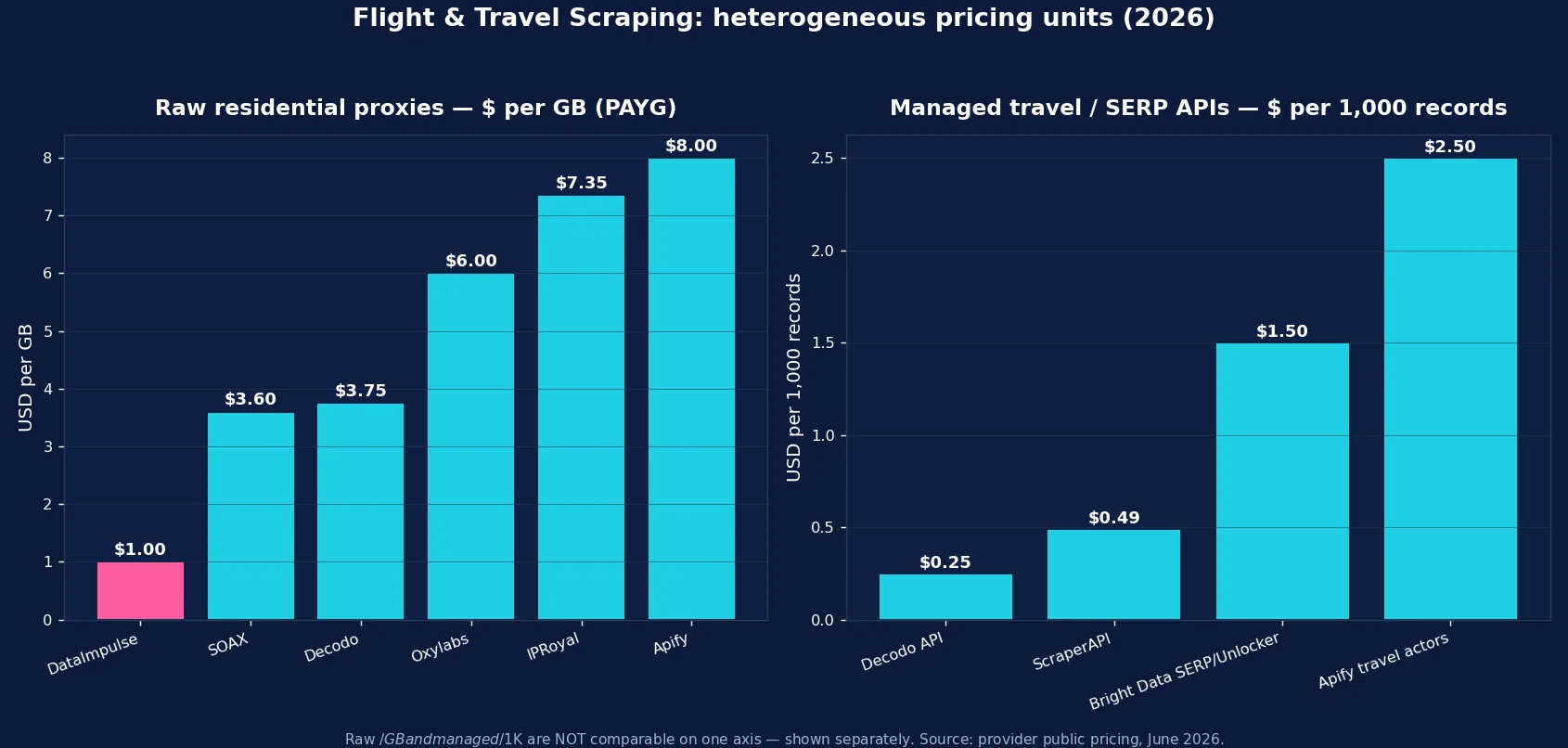
Travel scraping costs split into two pricing models that can’t be compared on one axis. Raw residential proxies are priced per GB of traffic: DataImpulse at $1/GB is the value floor, SOAX $3.60, Decodo $3.75 (down to ~$2 at volume), Oxylabs from $6, IPRoyal $7.35, Apify residential $8. With raw proxies you also pay for the engineering to build and maintain parsers against Google’s WAF and DataDome — but at scale the per-GB model is dramatically cheaper than per-record. Managed SERP/travel APIs are priced per 1,000 results (Bright Data Web Unlocker $1.50/1K, ScraperAPI credit-based, Apify travel actors ~$1-$5/1K) and bundle the anti-bot fight into the price — you pay more per record but skip the maintenance.
The rule of thumb: for continuous, high-volume, multi-market fare and rate monitoring where you control the parser, raw residential ($1/GB) wins decisively on cost — a single Google Flights or Booking page is a small fraction of a GB, so per-GB economics beat per-record at scale. For occasional pulls, no-code teams, or when you’d rather not maintain parsers against Google’s and DataDome’s moving defenses, a managed travel API is worth the per-record premium. Many production travel teams run both: raw residential for the bulk daily sweeps, a managed API for the hardest targets.
Is Scraping Flight & Travel Data Legal?
Scraping publicly displayed flight and hotel prices is, in the US, broadly defensible on the computer-access question: hiQ Labs v LinkedIn (9th Cir. 2022) established that scraping public web data is not a Computer Fraud and Abuse Act violation, and Meta v Bright Data (N.D. Cal., Jan 2024) found that scraping public data without logging in doesn’t breach terms of service. That’s the green lane for read-only price monitoring of public fare and rate pages.
The exposure is contractual and content-based, and travel has more case law than most verticals. In Ryanair v PR Aviation (CJEU, Jan 15, 2015), the court held that even though Ryanair’s fare data wasn’t protected by database or copyright law, Ryanair could still prohibit screen-scraping through its terms of service — a cornerstone EU precedent for price-comparison sites. In Southwest Airlines v Kiwi.com, a Texas court granted a preliminary injunction (Sep 2021) and the case ended with Kiwi permanently barred from scraping and republishing Southwest fares (settled, terms confidential). And in American Airlines v Skiplagged (Fort Worth federal jury, Oct 2024), American won $9.4 million — $4.7M in copyright damages plus $4.7M in disgorged revenue — against a site built on “hidden-city” ticketing, though the jury awarded nothing on the trademark claim.
The practical line: public, read-only price monitoring from residential IPs, respecting robots.txt and rate limits, with no booking, reselling, or logged-in account access, is the defensible posture most fare-intelligence and rate-parity teams operate in. Reselling tickets, hidden-city tactics, booking automation, scraping behind a login, or republishing an airline’s protected content move you into the litigated zone. Personal traveler data triggers GDPR/CCPA obligations. This is general information, not legal advice — get tech-transactions counsel before scaling a commercial travel-data pipeline, especially one touching airline or OTA terms of service.
How to Start Flight Scraping with DataImpulse
Step 1. Create a DataImpulse account and grab your residential proxy credentials from the dashboard. Start with the $5 / 5GB intro — traffic never expires, so it’s a real test budget, not a clock.
Step 2. Set country targeting for each market you need to price (the fare a customer sees depends on their country and currency), and pair the proxy with a headless browser — Playwright or Selenium — so you render Google Flights’ JavaScript and present a real fingerprint. Use rotating residential for broad route/date sweeps and a sticky session for slow search-to-results flows.
Step 3. Run your collection at human cadence (randomized delays, exponential backoff on 429s), capture prices in local currency per market, and store with timestamps — fares move up to 15 times a day, so the timestamp and market are part of the data. Add mobile proxies ($2/GB) when you need app or mobile-web pricing. See the residential proxies page for setup and the price comparison use case for pipeline patterns.
FAQ
Is there an official Google Flights API in 2026?
No. Google shut down the QPX Express API on April 10, 2018, and there has been no public Google Flights API since. The ITA Matrix interface still exists as a UI but offers no API, and enterprises use GDS/NDC or contracted feeds. For Google Flights data specifically, your options are headless-browser scraping with residential proxies or a third-party SERP/travel API (Bright Data, Oxylabs, ScraperAPI). Amadeus offers an official Self-Service flight API with a free tier if its content coverage fits your need.
Is scraping flight and hotel prices legal?
Scraping publicly displayed prices is broadly CFAA-safe in the US after hiQ v LinkedIn (2022) and Meta v Bright Data (2024). But airline and OTA terms of service can contractually prohibit scraping even of unprotected data (Ryanair v PR Aviation, CJEU 2015), and reselling or hidden-city tactics draw real damages (American Airlines v Skiplagged, $9.4M, Oct 2024; Southwest v Kiwi.com permanent injunction). Public, read-only price monitoring without booking, reselling, or logged-in access is the defensible lane. Personal data triggers GDPR/CCPA. This isn’t legal advice — consult counsel before scaling.
Why do I need residential proxies — can’t I use datacenter?
Datacenter proxies are flagged almost immediately on travel targets. Google Flights runs behind Google’s WAF and fingerprints datacenter ranges within a handful of requests; Booking.com and most hotel sites run DataDome, which protects 1,200+ companies and (since 2025) scores navigation intent even on clean fingerprints. Residential and mobile IPs present as ordinary travelers and sustain collection. Just as important, fares are geo- and currency-personalized — you need a residential IP physically in the target market to see the price a buyer there actually sees.
Why do flight prices differ by country and IP?
Airlines and OTAs personalize fares by the visitor’s country, currency, device, and login state. Independent analyses find roughly a 28% average variance in airfares across geographic markets, and mobile is often priced differently from desktop. To capture the true displayed price for a given market, you must query from a residential IP in that country, in the local currency — which is why country (and sometimes city) geo-targeting is essential for fare collection, not optional.
How often do flight prices change?
Constantly. Airlines adjust fares up to 15 times a day, a single seat can reprice up to 35 times before departure, and pricing systems can recalibrate within ~30 minutes of a competitor’s change. That volatility is why travel scraping has to be continuous and timestamped — a price is only valid for the moment and market you captured it in. One-off pulls are nearly useless for fare intelligence; you need scheduled, parallel collection across routes, dates, and markets.
Do I need sticky or rotating proxies for travel scraping?
Both, for different jobs. Rotating residential handles broad sweeps — many routes, dates, and markets where each request is independent. Sticky sessions handle multi-step search-to-results flows: Google Flights and metasearch engines return results asynchronously, so you want the same IP across the search, the polling, and the render. 15-30 minutes of stickiness is usually enough; IPRoyal offers up to 7 days for long flows. Most stacks run mostly rotating with a sticky pool for the search-to-results sequences.
Do I need mobile proxies for flight scraping?
For most desktop fare and rate sweeps, residential is enough and cheaper. Use mobile proxies in two cases: capturing mobile-web and in-app pricing (airlines and OTAs frequently price mobile differently, and over 60% of travel bookings are mobile), and clearing the hardest anti-bot surfaces where residential gets challenged. Mobile costs more per GB ($2-$10), so reserve it for app-fare validation and defended endpoints rather than bulk collection. SOAX (33M+ mobile pool) and DataImpulse ($2/GB mobile) are good options.
What’s the cheapest way to scrape flight prices at scale?
For continuous, high-volume, multi-market collection where you maintain your own parser, raw residential proxies win decisively — DataImpulse at $1/GB pay-as-you-go, traffic never expires. A single flight or hotel page is a small fraction of a GB, so per-GB economics beat the per-1,000-record pricing of managed APIs at scale. Managed SERP/travel APIs (Bright Data, ScraperAPI, Apify actors) cost more per record but save engineering time — worth it for occasional pulls, no-code teams, or the hardest targets. Many teams run both.
Can I scrape Skyscanner and Booking.com directly?
Their public results can be scraped with residential or mobile proxies plus a headless browser, but both have partner-gated official APIs (Skyscanner Travel APIs, Booking.com Demand API) that are the cleaner route if you qualify as an approved partner. Skyscanner and Kayak sit behind Akamai-class anti-bot; Booking.com runs DataDome with intent-based detection. For public rate-parity monitoring, use target-market residential IPs, local currency, and human-paced cadence, and respect each site’s terms of service — they are contractually enforceable even on public data.
 State/City/Zip/ASN Targeting