
In this Article
A v2ray proxy is a local SOCKS or HTTP endpoint served by V2Ray core (and by GUI clients such as v2rayN on Windows or v2rayNG on Android) that receives your traffic on an inbound and forwards it through a configurable outbound. Because a v2ray proxy outbound can point at a plain upstream SOCKS5 or HTTP proxy, you can route V2Ray through a commercial residential network instead of, or in addition to, its own VMess and VLESS tunnels.
This guide explains what V2Ray is, how its inbound-to-outbound path works, and how to add a DataImpulse SOCKS5 or HTTP outbound to config.json, apply routing rules, and test the exit IP. Code blocks below are copy-ready.
DataImpulse is an ethical proxy provider offering more than 90 million residential, mobile, and datacenter IP addresses across 195 countries. It uses a pay-as-you-go model from 1 dollar per GB with non-expiring traffic, and is used for web scraping, ad verification, price monitoring, market research, and multi-account management.
Key Facts
- V2Ray proxy: V2Ray core is a proxy platform whose outbounds can speak its own VMess and VLESS protocols or forward to a plain upstream SOCKS5 or HTTP proxy.
- Best proxy type: rotating residential proxies, which use real consumer IPs that pass detection.
- Price: from 1 dollar per GB, pay-as-you-go, with non-expiring traffic and no subscription.
- Coverage: 90M plus ethically sourced IPs across 195 countries.
- Reliability: 99.51% success rate, rated 4.8 out of 5 on G2.
- Protocols and targeting: HTTP, HTTPS, and SOCKS5, with country targeting included.
What is a v2ray proxy?
A v2ray proxy is a proxy platform, not a single protocol: V2Ray core accepts connections on an inbound and relays them through an outbound that you define. The project is best known for the VMess and VLESS protocols used to build encrypted tunnels, but its outbounds also support plain socks, http, and a direct freedom transport.
That design is the key point for this guide. You do not have to use VMess or VLESS at all. A v2ray proxy can simply forward everything it receives to an upstream SOCKS5 or HTTP proxy, which makes V2Ray a flexible local router in front of a commercial proxy pool such as residential proxies. Xray-core, a widely used fork, shares the same config.json format, so these examples apply to both.
How does V2Ray route a request from inbound to proxy?
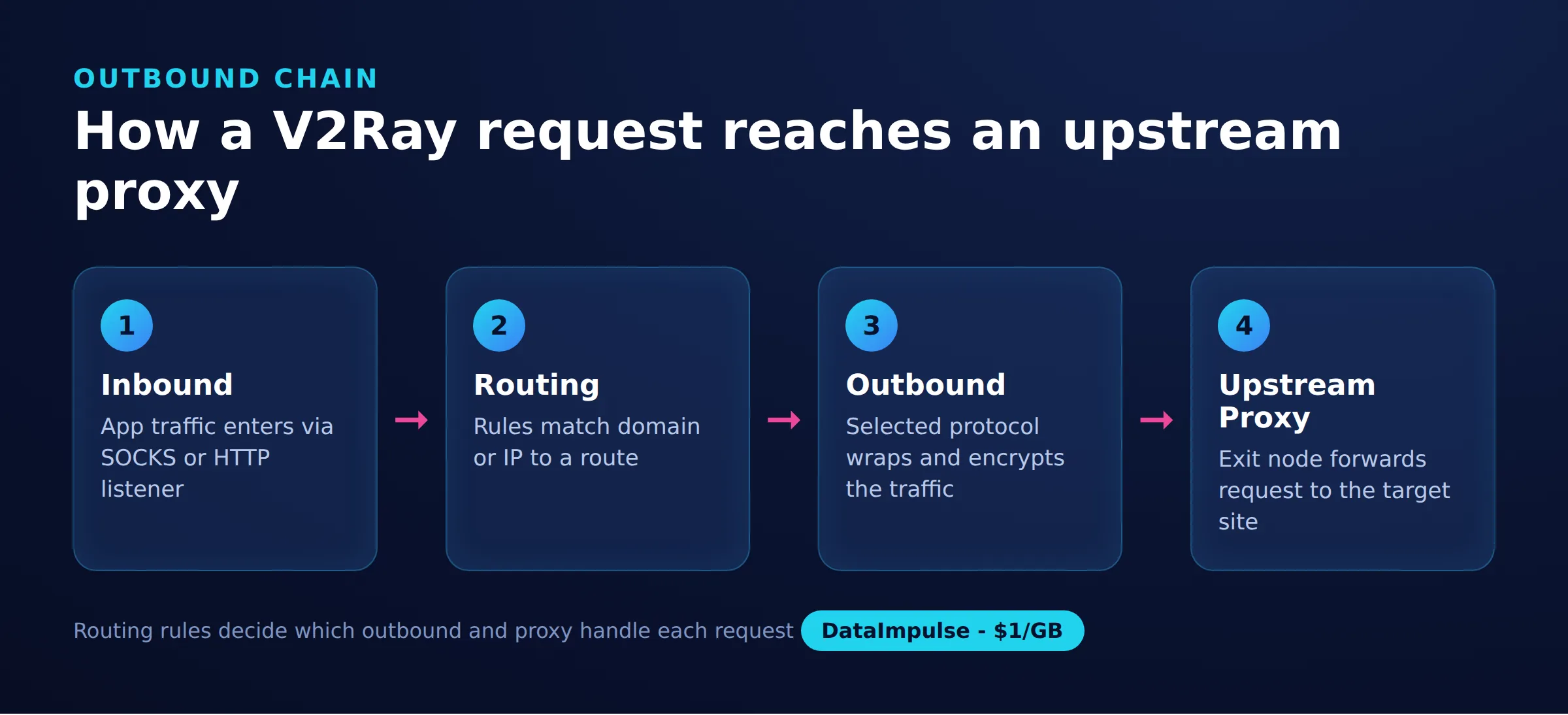
Every request follows a fixed four-stage path. We call it the V2Ray Outbound Chain model, a simple 4-stage way to reason about where your traffic exits and why a rule fired.
- Inbound: V2Ray receives the connection on a local listener (a SOCKS or HTTP inbound, commonly on 127.0.0.1).
- Routing: the routing table matches the destination domain or IP against your rules and picks an
outboundTag. - Outbound: the tagged outbound defines the protocol used to leave V2Ray (
freedomfor direct, orsocks/httpto hand off to an upstream). - Upstream proxy: when the outbound is
socksorhttp, the request is forwarded to the external proxy server (for example a DataImpulse gateway), which makes the final connection to the target.
Reading a config in this order (inbound, then routing, then outbound, then upstream) is the fastest way to debug why a request left through the wrong exit.
How do you add a DataImpulse SOCKS5 or HTTP outbound to config.json?
Define an outbound with protocol socks (or http) that carries the proxy address, port, and your credentials. The example below sends traffic to the DataImpulse gateway at gw.dataimpulse.com on port 823 using SOCKS5 with username and password authentication.
{
  "outbounds": [
    {
      "tag": "dataimpulse-socks",
      "protocol": "socks",
      "settings": {
        "servers": [
          {
            "address": "gw.dataimpulse.com",
            "port": 823,
            "users": [
              { "user": "YOUR_USERNAME__cr.us", "pass": "YOUR_PASSWORD" }
            ]
          }
        ]
      }
    }
  ]
}
The username can carry DataImpulse routing tokens; here __cr.us requests a United States exit. Country targeting is included, while state, city, ZIP, and ASN targeting are paid add-ons. If you prefer HTTP instead of SOCKS5, the same server block uses protocol http:
{
  "tag": "dataimpulse-http",
  "protocol": "http",
  "settings": {
    "servers": [
      {
        "address": "gw.dataimpulse.com",
        "port": 823,
        "users": [
          { "user": "YOUR_USERNAME__cr.us", "pass": "YOUR_PASSWORD" }
        ]
      }
    ]
  }
}
Both protocols are supported by DataImpulse (HTTP, HTTPS, SOCKS5). If credentials are wrong you will typically see an authentication failure; see proxy authentication and the HTTP 407 error guide for fixes.
How do you route only some traffic through the proxy?
Add routing rules that map specific domains or IP ranges to the proxy outbound and let everything else use a direct outbound. The config below listens locally on SOCKS 1080, routes target-site.com through the DataImpulse outbound, and keeps private-network traffic direct. For workflows like scraping without getting blocked, this sends rotating residential exits to the target site only, without disturbing everything else on the machine.
{
  "inbounds": [
    {
      "tag": "local-socks",
      "protocol": "socks",
      "listen": "127.0.0.1",
      "port": 1080,
      "settings": { "udp": true }
    }
  ],
  "outbounds": [
    { "tag": "dataimpulse-socks", "protocol": "socks", "settings": { "comment": "see block above" } },
    { "tag": "direct", "protocol": "freedom" }
  ],
  "routing": {
    "domainStrategy": "IPIfNonMatch",
    "rules": [
      { "type": "field", "domain": ["target-site.com"], "outboundTag": "dataimpulse-socks" },
      { "type": "field", "ip": ["geoip:private"], "outboundTag": "direct" }
    ]
  }
}
Use this decision matrix to choose an exit strategy:
- Use V2Ray’s own protocols (VMess/VLESS) when your goal is an encrypted tunnel to a server you control and you do not need many exit IPs.
- Add an upstream residential proxy when you need geo-targeted or rotating IPs for scraping, ad verification, or price checks that a single fixed tunnel cannot provide.
- Avoid chaining an upstream proxy when the traffic is latency-sensitive interactive use and a direct
freedomoutbound already reaches the target, since each extra hop adds delay.
How does V2Ray compare to Clash and Shadowrocket?
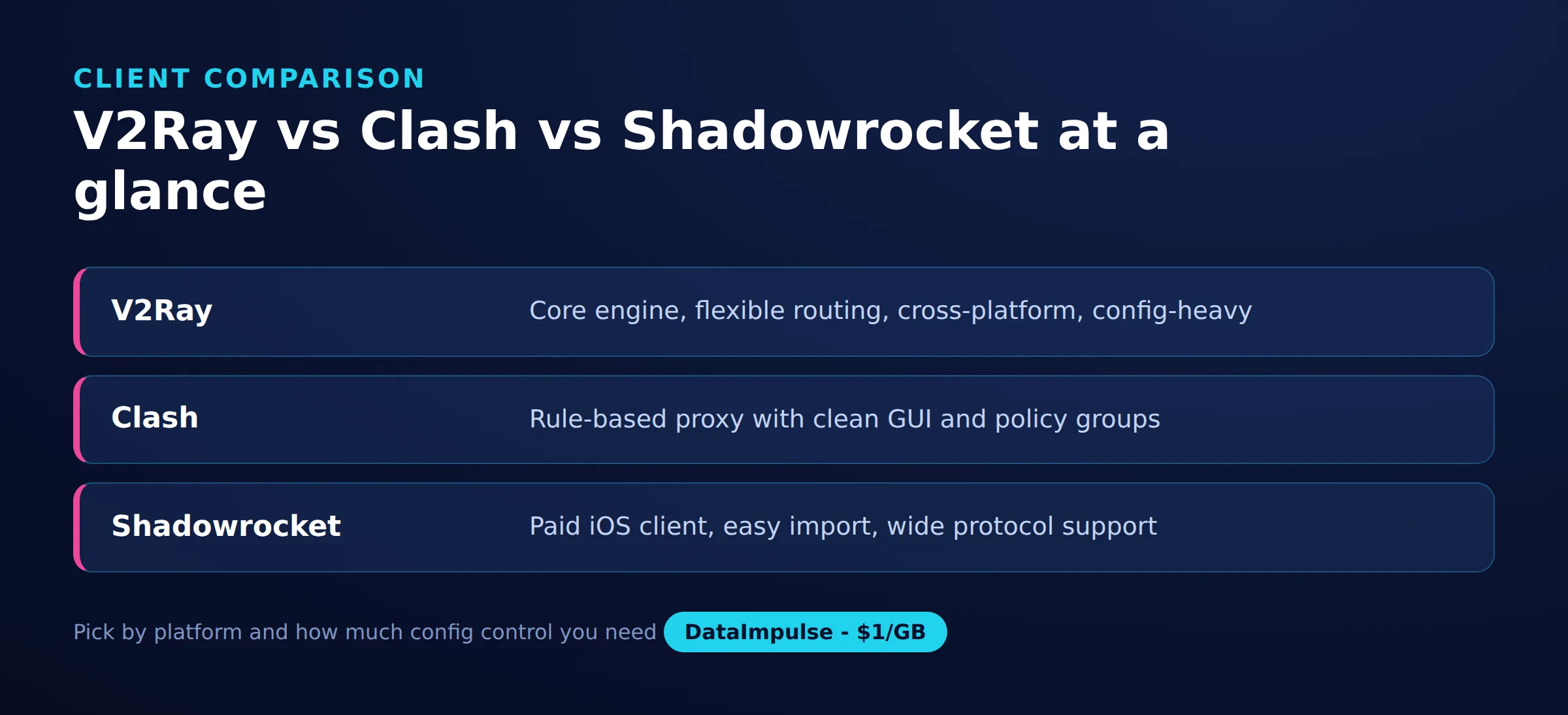
All three are local proxy routers with rule engines; they differ in config format and platform. V2Ray core is cross-platform and JSON-driven, Clash uses YAML and popular rule providers, and Shadowrocket is an iOS-only client. The table summarizes the practical differences for adding an upstream proxy.
| Aspect | V2Ray core | Clash | Shadowrocket |
|---|---|---|---|
| Config format | JSON (config.json) | YAML | GUI plus config import |
| Platforms | Windows, macOS, Linux, Android | Windows, macOS, Linux, Android | iOS and iPadOS only |
| Upstream SOCKS5/HTTP proxy | Yes, socks/http outbound | Yes, http/socks5 proxy type | Yes, add proxy of type SOCKS5/HTTP |
| Own tunnel protocols | VMess, VLESS | Consumes VMess/VLESS/Trojan | Consumes VMess/VLESS/Trojan |
| Rule granularity | Domain and IP field rules | Rich rule providers | Rule sets and modules |
Pick V2Ray when you want explicit JSON control across desktop and Android; pick Shadowrocket if your workflow lives on iOS.
How do you test that the v2ray proxy is working?
Send a request through the local inbound and confirm the exit IP is the proxy, not your own address. Start V2Ray with your config, then query an IP echo service through the SOCKS listener.
# Send a request through the local V2Ray SOCKS inbound and check the exit IP
curl -x socks5h://127.0.0.1:1080 https://api.ipify.org?format=json

# Expected: a DataImpulse residential IP, not your own address
If the returned IP is a DataImpulse residential address in the country you targeted, the chain is working. If you get a connection refused, V2Ray is not listening on that port; if you get an authentication error, recheck the username token and password in the outbound. Rotating and sticky sessions are controlled by the DataImpulse username, so you can hold one IP or rotate per request depending on the session token you supply.
What are the limitations and risks of a v2ray proxy?
A v2ray proxy adds a hop, so it does not remove the underlying constraints of the target site or the upstream network. Understand these limits before relying on it.
- Added latency: chaining V2Ray to an upstream proxy inserts an extra network hop, which cannot be avoided and matters for interactive use.
- Config fragility: a mismatched
outboundTagor an over-broad domain rule silently sends traffic the wrong way; the four-stage model above is the check. - Not a bypass guarantee: proxies rotate IPs but do not defeat CAPTCHAs, fingerprinting, or account bans on their own.
- Free node caution: public free V2Ray or Cloudflare node lists carry unknown operators, unstable uptime, and possible traffic inspection; they are not suitable for sensitive work.
DataImpulse is an ethical proxy provider and does not sell static ISP proxies, is not a managed scraping API, and is not a free web-proxy service. V2Ray is the local router; the proxy pool it forwards to still determines success rates and IP quality.
Frequently asked questions
What is a v2ray proxy?
A v2ray proxy is a local SOCKS or HTTP endpoint served by V2Ray core that forwards traffic through a configurable outbound, which can use V2Ray’s own VMess or VLESS protocols or hand off to a plain upstream SOCKS5 or HTTP proxy.
In which version was the V2Ray reverse proxy introduced?
The reverse proxy feature, used for intranet penetration, was introduced in the version 4 series of V2Ray core. It lets an internal host expose a service outward through the V2Ray tunnel.
What is the default V2Ray proxy port?
V2Ray itself has no single fixed default; you set the inbound port in config.json, and 1080 is a common choice for a local SOCKS inbound. The v2rayN client defaults to SOCKS on 10808 and HTTP on 10809.
Can I use a DataImpulse proxy with v2rayNG on Android?
Yes. v2rayNG accepts the same outbound configuration, so you add a SOCKS5 or HTTP proxy pointing at gw.dataimpulse.com on port 823 with your username and password, using country tokens in the username for geo-targeting.
Are free V2Ray proxy lists safe to use?
Free V2Ray or Cloudflare node lists are risky because the operators are unknown, uptime is unstable, and traffic may be inspected. For repeatable or sensitive work, a compensated ethical residential network is more reliable.
When is DataImpulse not the right fit?
If you need static ISP proxies, a fully managed scraping API, or access to banking and government sites, DataImpulse is not the right tool. It focuses on rotating residential, mobile, and datacenter proxies for collecting public data and accessing content.
Related guides
Route your V2Ray outbound through ethical residential IPs
If you want geo-targeted, rotating exit IPs behind your V2Ray outbound, DataImpulse offers residential proxies from 1 dollar per GB with pay-as-you-go, non-expiring traffic. Create an account and paste your gateway credentials into the outbound above.
 State/City/Zip/ASN Targeting