
In this Article
A rotating proxy gives you a fresh IP on every request (or every few minutes), so a scraper or bot spreads its traffic across thousands of addresses instead of hammering a target from one — which is what keeps your success rate up at scale. But “cheap” and “rotating” pull in opposite directions: the cheapest IPs are often datacenter ranges that get flagged fast, while the residential IPs that stay block-resistant usually cost more. This guide ranks the best cheap rotating proxies in 2026 — the providers that give you genuinely affordable rotation and a pool good enough to not get blocked, across both rotating residential and rotating datacenter. DataImpulse leads the value lane at $1/GB rotating residential, pay-as-you-go.
One distinction decides which “cheap” you want: rotating residential (real consumer IPs, billed per GB, the most block-resistant choice) versus rotating datacenter (server IPs, billed per IP or per GB, far cheaper but easier to block). We rank both, and tell you which job each fits.
Key Facts
- Rotating = a new IP per request or per interval. It spreads traffic across a large pool so no single IP draws rate limits or bans — the default for scraping at scale.
- Two kinds of “cheap.” Rotating residential (real consumer IPs, billed per GB, block-resistant on hard targets) and rotating datacenter (server IPs, much cheaper per unit, fine on soft targets but flagged fast on protected sites).
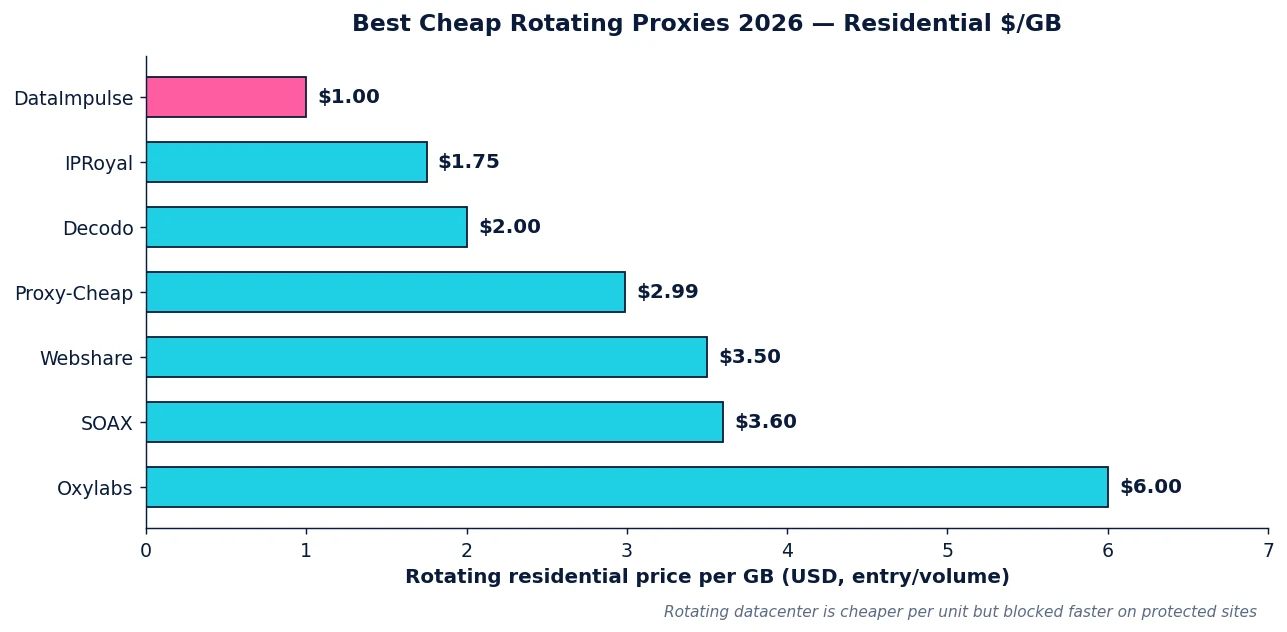
- Per-GB is where residential value lives. The cheapest credible rotating residential in 2026 starts around $1-1.75/GB (DataImpulse $1, IPRoyal ~$1.75 at volume), versus $3-8/GB at the premium end.
- Cheap-but-useless is the trap. Free and ultra-cheap proxy lists are slow, dead, or malicious; “cheap” only counts if the pool is large and clean enough to keep your success rate up. Price per successful request is the real metric.
- Match the proxy to the target. Soft target (no aggressive anti-bot)? Rotating datacenter is the cheapest that works. Hard target (marketplaces, sneakers, SERPs, social)? You need rotating residential.
- DataImpulse is the value pick — rotating residential at $1/GB on a 90M+ pool across 195 countries, automatic rotation, country/city/ASN targeting, HTTP/HTTPS/SOCKS5, pay-as-you-go (no subscription) with traffic that never expires.
How Rotating Proxies Work (and How They’re Priced)
A rotating proxy sits behind a single endpoint; each time you connect, the provider assigns a different IP from its pool. Per-request rotation gives a new IP every call — best for breadth (scraping thousands of independent pages). Timed/sticky rotation holds an IP for a set window (e.g. 10-30 minutes) — best for multi-step flows that need the same IP across requests (login → cart → checkout). Most providers offer both off one gateway.
Pricing splits by type. Rotating residential is billed per GB of traffic — you pay for data moved, and the IP pool is effectively unlimited, which is why it’s the value metric to compare. Rotating datacenter is often billed per IP (a pool you rent) or per GB, and costs a fraction of residential because the IPs are cheap server addresses — but they share subnets that anti-bot systems block in bulk.
How We Picked
We ranked providers on effective affordability — not the lowest sticker, but the lowest price for rotation that actually keeps your success rate up. We weighed pay-as-you-go price per GB (residential) and per IP (datacenter), pool size and cleanliness, rotation flexibility (per-request and sticky), geo targeting, protocol support, and whether there’s a real no-large-minimum entry point. Free-proxy lists and providers without a verifiable pool were excluded — cheap that doesn’t work isn’t cheap.
Best Cheap Rotating Proxies at a Glance
| Provider | Best cheap rotating for | Rotating residential | Rotating datacenter | Notable |
|---|---|---|---|---|
| DataImpulse | Best overall value, PAYG | $1/GB | Available | 90M+ pool, no subscription, never-expires, SOCKS5 |
| IPRoyal | True PAYG + long sticky | from $7.00/GB (to ~$1.75 volume) | Available | Sticky up to 7 days, pay-as-you-go |
| Webshare | Cheapest datacenter, free tier | ~$3.50/GB (promo ~$1.40) | from $2.99/mo | Free tier, self-serve, very cheap DC |
| Decodo | Mid-market, full geo grid | from ~$2/GB | Available | 115M+ pool, sticky to 24h |
| SOAX | Flexible credits, mixed types | $3.60/GB Starter | Available | Unified credits across types |
| Rayobyte | Cheap rotating datacenter | Available | from ~$0.30/GB | Large DC range, free trial |
| Proxy-Cheap | Budget entry | from ~$1.50/GB | Available | Low entry pricing |
| Oxylabs | Premium when budget allows | from $6/GB | Available | 175M+ pool, enterprise SLA |
The Picks, Briefly
DataImpulse is the value pick for cheap rotating proxies — rotating residential at $1/GB, the lowest credible per-GB rate, on a 90M+ pool across 195 countries with automatic per-request rotation and optional sticky sessions, country/city/ASN targeting, and HTTP/HTTPS/SOCKS5. Pay-as-you-go (no subscription, $5/5GB intro to start), traffic never expires — so cheap rotation doesn’t come with a monthly plan you burn whether you use it or not. IPRoyal is the other true pay-as-you-go pick, from $7.00/GB dropping toward ~$1.75 at volume, with sticky sessions up to 7 days for stateful flows. Webshare is the cheapest entry for rotating datacenter (from $2.99/mo; rotating residential ~$3.50/GB) and has a free tier — ideal for soft targets on a tight budget. Decodo (from ~$2/GB, sticky to 24h) and SOAX ($3.60/GB, unified credits) are solid mid-market options with full geo grids. Rayobyte and Proxy-Cheap compete hard on cheap rotating datacenter and budget entry. Oxylabs (from $6/GB) is the premium pool to reach for when reliability outweighs budget.
Cheap Rotating Residential vs. Cheap Rotating Datacenter
| Factor | Rotating residential | Rotating datacenter |
|---|---|---|
| IP type | Real consumer IPs | Server IPs |
| Cost | Per GB (from $1) | Per IP / per GB (cheapest) |
| Block resistance | High — looks like real users | Low — flagged in subnets |
| Best for | Marketplaces, SERPs, social, sneakers | Soft targets, APIs, internal tools |
| Pool size | Effectively unlimited | Limited (rented range) |
| Speed | Fast | Fastest |
The rule: start with the cheapest type that survives your target. If a rotating datacenter proxy isn’t getting blocked, it’s the cheapest answer. The moment block rates climb — which happens fast on any protected site — switch to rotating residential. Many teams run datacenter for soft endpoints and residential for the hard ones, on the same provider.
Why “Free Rotating Proxies” Are a False Economy
Search “free rotating proxy” and you’ll find endless public lists. Avoid them for anything real: free proxies are overwhelmingly slow, short-lived (dead within hours), shared by thousands so already rate-limited or banned, and frequently malicious — public proxy servers can log and modify your traffic, steal credentials, and inject content. For scraping or automation, the only safe cheap option is a paid rotating proxy from a provider with a verifiable, ethically sourced pool. The right comparison isn’t “$0 vs $1/GB” — it’s “0% success rate and a security risk vs. a working pipeline.” Cheap-that-works wins every time.
How to Start with DataImpulse Rotating Proxies
Step 1. Create a DataImpulse account and grab your credentials. The $5 / 5GB intro never expires.
Step 2. Point your scraper at the rotating endpoint — YOUR_LOGIN:[email protected]:823 rotates the IP automatically on each request. Add __cr.us for a country, ;city.xxx for a city, or ;sessid.xxxx to hold one IP for a sticky window.
Step 3. Throttle politely and scale with concurrency. For soft targets, try the cheaper datacenter option first; move to residential when block rates rise. Full syntax in the DataImpulse tutorials; see also static vs rotating proxies, the cheapest proxies overall, and our web scraping guide.
FAQ
What’s the cheapest rotating proxy in 2026?
For rotating residential, DataImpulse at $1/GB is the lowest credible pay-as-you-go rate, with IPRoyal dropping toward ~$1.75/GB at volume. For rotating datacenter, Webshare (from $2.99/mo) and Rayobyte (from ~$0.45/GB) are cheapest. The catch: only count a price as “cheap” if the pool keeps your success rate up — cheap proxies that get blocked cost more in failed requests than a slightly pricier pool that works.
What is a rotating proxy?
A proxy that assigns a different IP on each request (or every few minutes) from a large pool, so your traffic is spread across many addresses instead of one. This avoids the rate limits and bans that hit a single IP scraping at volume. Rotation can be per-request (a new IP every call, best for breadth) or sticky/timed (one IP held for a window, best for multi-step flows like login and checkout).
Are cheap rotating proxies any good?
Cheap rotating residential from a credible provider (DataImpulse $1/GB, IPRoyal at volume) is genuinely good — same pool quality, lower price. Cheap rotating datacenter is good for soft targets but gets blocked fast on protected sites. What’s not good is free or ultra-cheap proxy lists: slow, dead, shared, and often malicious. Judge by price per successful request, not the sticker.
Rotating residential or rotating datacenter — which is cheaper?
Datacenter is cheaper per unit (server IPs cost little), so for soft targets with no aggressive anti-bot, rotating datacenter is the cheapest that works. But on protected sites — marketplaces, SERPs, social, sneakers — datacenter IPs get blocked in bulk, and rotating residential becomes the only option that succeeds, making it cheaper per successful request despite the higher per-GB price. Match the type to the target.
Should I use free rotating proxies?
No, not for anything real. Free public rotating proxies are slow, usually dead within hours, shared by thousands (so already rate-limited), and frequently malicious — they can log your traffic, steal credentials, and inject content. For scraping or automation, a paid rotating proxy from a provider with a verifiable, ethically sourced pool (from $1/GB) is the only safe cheap option.
How does per-GB rotating proxy pricing work?
Rotating residential is billed by data transferred, not by IP — you pay per GB and draw from an effectively unlimited pool, rotating freely. So $1/GB means you pay only for the traffic your scraper actually moves; lightweight HTML scraping uses little, image/media-heavy jobs use more. Pay-as-you-go providers like DataImpulse don’t expire your traffic, so you buy data and use it whenever — no monthly burn.

 State/City/Zip/ASN Targeting