
In this Article
AI agents have moved from demos to production: tools like OpenAI’s Operator and ChatGPT Agent, Claude’s computer use, and browser-automation frameworks (Browser Use, Stagehand, Playwright) now drive real browsers to research, shop, book, and gather data on the open web. But the web treats an agent like any other bot — geo-gating content, throwing CAPTCHAs, rate-limiting, and blocking datacenter IPs. To let an agent (or a fleet of them) act on the web reliably and at scale, you route it through proxies. This guide ranks the 8 best proxies for AI agents in 2026 — covering why agents need residential and mobile IPs, why concurrency (not just price) is the new buying criterion, and how to wire proxies into agent frameworks. DataImpulse at $1/GB is the value pick for agent fleets.
One framing up front: a human runs one browser session; an agent fleet runs hundreds or thousands at once. So for AI agents the question isn’t only “how cheap per GB” — it’s “how many clean, geo-correct sessions can I run in parallel without getting blocked.” That makes residential IP quality and concurrency the two specs that matter most.
Key Facts
- The web blocks agents like bots. Anti-bot systems flag datacenter IPs, fingerprint browsers, and throw CAPTCHAs — so an AI agent acting on the web needs residential or mobile IPs that look like a real user, or it stalls on blocks.
- Concurrency is the new buying criterion. Agent fleets run many sessions in parallel, each needing its own clean IP at the same moment. A provider can be cheap per GB but cap concurrent sessions low — for agents, “max concurrent sessions” matters as much as $/GB.
- Agents act per-geography. An agent shopping, checking prices, or verifying content must see what a local user sees — so country/city targeting is essential, and a session’s geo must stay consistent through a multi-step task.
- Sticky sessions keep multi-step tasks alive. Login → navigate → cart → checkout flows must hold one IP; rotating mid-task looks like account takeover and gets the agent blocked.
- Clean sourcing decides success rate. AI pipelines are punished by failed fetches, so an ethically sourced, low-abuse residential pool (less likely to be pre-flagged) means higher checkout/extraction success than a cheap recycled one.
- DataImpulse is the value pick for agent fleets — a 90M+ ethically sourced pool across 195 countries with country/city/ASN targeting, sticky sessions, and mobile IPs, at $1/GB pay-as-you-go with traffic that never expires — the cost-efficient, geo-accurate exit layer for AI agents at scale.
Why AI Agents Need Proxies
An AI agent is, underneath the model, a browser making requests — and the web defends against automated browsers exactly as it does against scrapers. Three things force proxies into the stack. Anti-bot blocking: sites flag datacenter IP ranges instantly and challenge anything that looks non-human, so an agent on a raw server IP gets CAPTCHA-walled or banned within minutes. Residential and mobile IPs read as ordinary users and keep the agent moving. Geo-gating: prices, availability, search results, and content render by the visitor’s location, so an agent that needs to act as a user in a specific country must exit from that country’s IP. Scale and concurrency: the point of agents is running many in parallel — and many simultaneous sessions from one IP is the clearest bot signal there is, so each session needs its own clean IP. Proxies are what let an agent fleet act on the web at scale without collapsing under blocks.
Best Proxies for AI Agents at a Glance
| Provider | Best for agents | Residential price | Geo & IP types | Notable |
|---|---|---|---|---|
| DataImpulse | Best value, high-concurrency fleets | $1/GB PAYG | Country/city/ASN; res + mobile | 90M+ pool, sticky, never-expires |
| Bright Data | Enterprise + managed unblocking | ~$4/GB promo; ~$8 standard | All IP types; full geo | Web Unlocker, Agent Browser, datasets |
| Oxylabs | Enterprise + compliance | ~$8/GB standard | Country/city; res + ISP | 175M+ pool, Scraper APIs, MCP |
| Decodo | Mid-market, full geo grid | ~$4/GB PAYG (~$2 volume) | Country/city/ASN | 115M+ pool, scraping API |
| SOAX | Residential + mobile mix | $3.60/GB Starter | Country/region/city/ASN | Clean opt-in pool, carrier IPs |
| IPRoyal | Long sticky sessions | from ~$7.35/GB | Country/city/ISP | Sticky up to 7 days |
| NetNut | ISP-residential stability | from ~$15/GB (to ~$1.59 volume) | Country/city; ISP-static | Static consumer-ISP IPs |
| Webshare | Budget / prototyping | ~$3.50/GB (promo ~$1.40) | Country; datacenter + res | Free tier, cheapest entry |
The Picks, Briefly
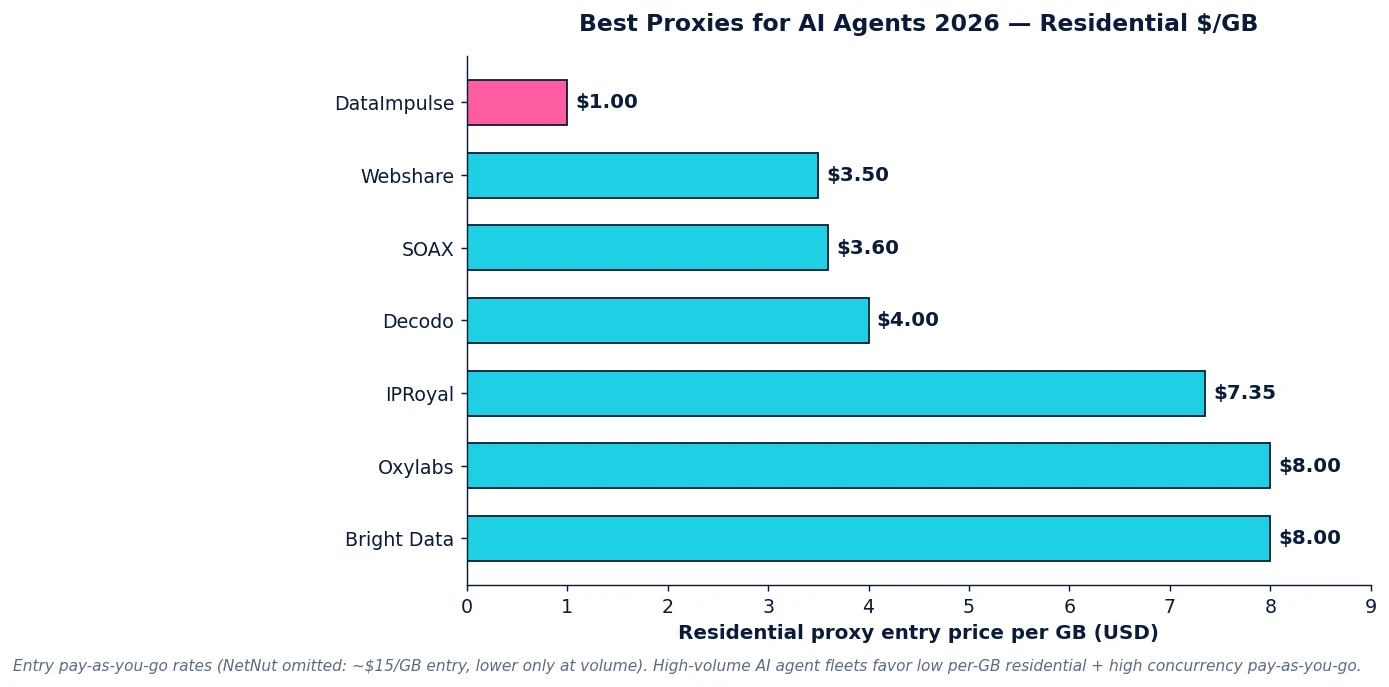
DataImpulse is the value pick for AI agents — a 90M+ ethically sourced pool across 195 countries with country/city/ASN targeting, sticky sessions, and mobile IPs, at $1/GB pay-as-you-go with traffic that never expires. For agent fleets that burn residential data across many parallel, geo-targeted sessions, paying $1/GB rather than $4–8 keeps the economics workable as you scale concurrency. Bright Data (~$8/GB standard) is the enterprise pick with managed unblocking and an agent-oriented browser product, and Oxylabs (~$8/GB) brings Scraper APIs, compliance docs, and an MCP integration. Decodo (~$4/GB PAYG) and SOAX ($3.60/GB, plus mobile) are strong mid-market options. IPRoyal (from ~$7.35/GB, 7-day sticky), NetNut (ISP-static stability), and Webshare (budget, free tier for prototyping) round out the field.
What to Look for in a Proxy for AI Agents
- Concurrency headroom. Agent fleets run many sessions at once — confirm the provider supports the number of concurrent connections your fleet needs, not just total bandwidth.
- Residential and mobile IPs. The IP types that read as real users and survive anti-bot; datacenter is fine only for soft targets and prototyping.
- Geo targeting (country/city). So each agent can act as a user in the right location and see correct prices, content, and results.
- Sticky sessions. To hold one IP through a multi-step task (login → navigate → checkout) without breaking continuity.
- High success rate & clean sourcing. Failed fetches break agent runs; an ethically sourced, low-abuse pool means more actions complete first try.
- Easy framework integration. A standard
http://user:pass@host:portendpoint drops straight into Playwright, Puppeteer, Browser Use, Stagehand, and most agent stacks — no custom plumbing. - Per-GB economics. Agent fleets are bursty and high-volume, so per-GB pricing that never expires beats fixed monthly plans you under-use.
How to Connect Proxies to Your AI Agent with DataImpulse
Step 1. Create a DataImpulse account and grab your residential credentials. The $5 / 5GB intro never expires — enough to wire up and test an agent before scaling the fleet.
Step 2. Point your agent’s browser at the gateway with the target country — YOUR_LOGIN__cr.us:[email protected]:823 — and add a session ID (;sessid.xxxx) to hold one IP through a multi-step task. In Playwright/Stagehand/Browser Use this is just the proxy server setting; assign a distinct session per agent so parallel agents don’t share an IP.
Step 3. Scale concurrency by running each agent on its own session, target the right geo per task, throttle politely, and monitor success rate. Full syntax is in the DataImpulse tutorials; see also best proxies for AI scraping and our guide to proxy rotation best practices.
FAQ
What are the best proxies for AI agents?
Residential and mobile proxies with strong geo targeting, sticky sessions, high concurrency, and per-GB pricing fit AI agents best. DataImpulse ($1/GB) is the value pick for agent fleets; Bright Data and Oxylabs are the enterprise picks (Bright Data has managed unblocking and an agent browser, Oxylabs brings an MCP integration). Decodo (~$4/GB) and SOAX ($3.60/GB) are strong mid-market options. The key specs are IP quality (residential/mobile), concurrency headroom, geo accuracy, and success rate.
Why do AI agents need proxies?
Because the web defends against automated browsers. Sites block datacenter IPs, fingerprint browsers, throw CAPTCHAs, and rate-limit — so an agent on a raw server IP gets blocked fast. Proxies give the agent residential or mobile IPs that read as real users, the right country’s IP for geo-gated content, and a separate clean IP per session so a fleet of agents can run in parallel without all looking like one bot.
What is concurrency, and why does it matter for AI agents?
Concurrency is how many sessions you run through the proxy network at the same time — distinct from bandwidth ($/GB). A human runs one browser session; an agent fleet runs hundreds or thousands in parallel, each needing its own clean IP simultaneously. A provider can be cheap per GB but cap concurrent sessions low, which bottlenecks a fleet. For AI agents, concurrency headroom is as important as price.
Do AI agents need residential proxies or is datacenter enough?
For most real targets, residential (or mobile). Datacenter IPs are flagged quickly by anti-bot systems, so an agent acting on protected sites — marketplaces, search, social, travel — needs residential IPs that look like ordinary users. Datacenter is fine for soft, unprotected targets and for prototyping. Mobile IPs are the lowest-detection class for the most defended sites. DataImpulse offers residential ($1/GB) and mobile ($2/GB) for exactly this.
How do I add a proxy to an AI agent (Operator, Playwright, Browser Use)?
Most agent frameworks accept a standard proxy endpoint — http://user:[email protected]:823 — as the browser’s proxy setting, so it drops into Playwright, Puppeteer, Stagehand, and Browser Use with no custom code. Assign a distinct session (e.g. a session ID) per agent so parallel agents use separate IPs, target the country each task needs, and use a sticky session to hold one IP through multi-step flows.
How much do proxies for AI agents cost?
It depends on volume and concurrency. Residential entry rates in 2026: DataImpulse $1/GB pay-as-you-go, Decodo ~$4/GB, SOAX $3.60/GB, IPRoyal from ~$7.35/GB, Oxylabs/Bright Data ~$8/GB standard, NetNut from ~$15/GB (lower at volume). Because agent fleets are high-volume and bursty, the lowest per-GB rate with traffic that never expires (DataImpulse $1/GB) keeps costs workable as you scale the number of concurrent agents.

 State/City/Zip/ASN Targeting