In this Article
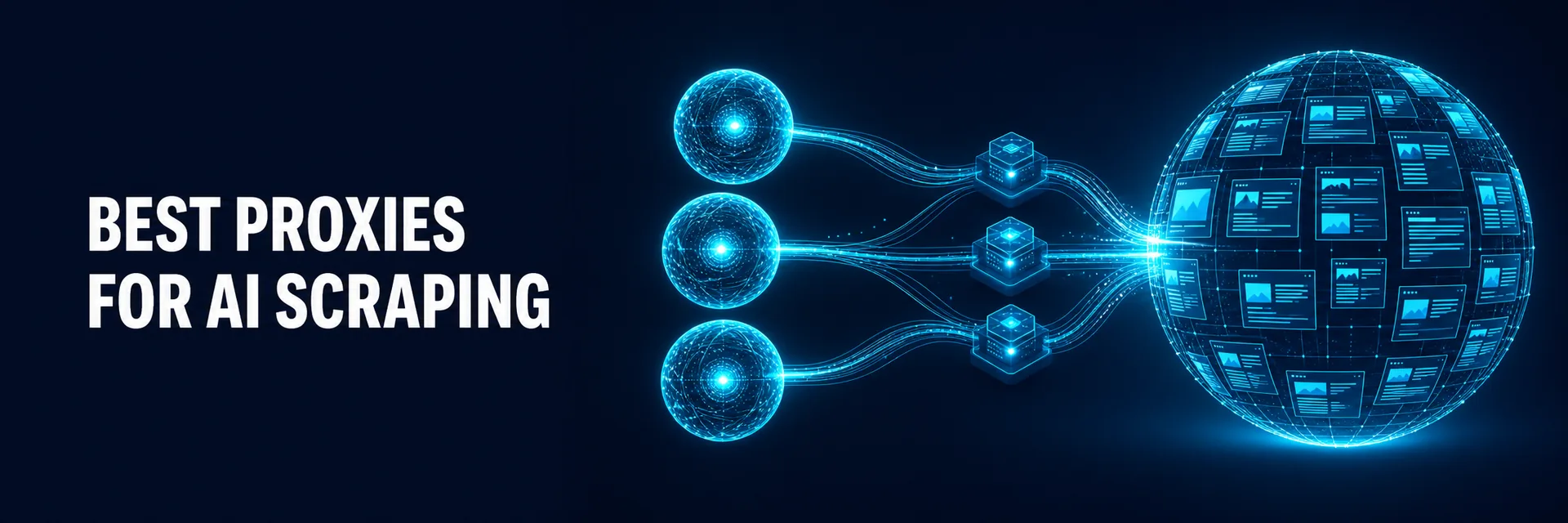
ChatGPT, Claude, and Gemini can’t reliably scrape the open web on their own — the consumer apps browse a few pages slowly and get blocked or rate-limited on anything at scale, and the APIs don’t fetch arbitrary sites for you. To collect web data for or with an LLM — feeding a model, running an AI agent that browses, or scraping at volume — you route requests through residential proxies so they look like real users instead of a datacenter bot. This guide covers what ChatGPT and Claude can and can’t scrape in 2026, the workflow that actually works, and the 8 best proxies for AI scraping — across residential, datacenter, and mobile.
I’m Andrii Byzov, an AI-Native Fractional CMO and operator who runs AI-driven data pipelines daily. Below: the capability reality, why proxies are required, and how to pick one — with DataImpulse residential at $1/GB as the value baseline.
Key Facts
- ChatGPT, Claude, and Gemini don’t bulk-scrape. The apps’ browsing is slow and gets blocked; the APIs generate text but don’t fetch arbitrary pages. Real scraping happens in your own code (or an AI agent) that you point at the web — and that’s what needs proxies.
- Residential proxies are the requirement for scale. Most sites block datacenter IPs fast; residential IPs from real ISPs let an AI scraping pipeline collect at volume without being flagged.
- Two jobs: (1) collecting web data to feed an LLM (training, RAG, enrichment), and (2) AI agents that browse/act on the web. Both route through proxies.
- Pair proxy + real browser. Proxies alone don’t beat modern anti-bot; pair with a headless browser (Playwright) or a managed scraper API.
- DataImpulse is the value pick — residential $1/GB, pay-as-you-go, 90M+ IPs, 195 countries, mobile $2/GB; a fraction of per-record managed-API cost for high-volume AI data collection.
Can ChatGPT and Claude scrape websites?
Not in the way people mean by “scraping.” ChatGPT’s browsing and Claude’s web features can open and summarize a handful of pages interactively, but they’re slow, rate-limited, and blocked by most anti-bot systems — useless for collecting hundreds or thousands of pages. The APIs are worse for this: they generate and reason over text you give them, but they don’t crawl the web for you. So “use ChatGPT to scrape a site” really means: write a scraper (or run an AI agent) that fetches the pages through proxies, then hand the data to the model to parse, structure, or analyze. The LLM is the brain; the proxy-backed fetcher is the hands.
This is why “best proxies for ChatGPT/Claude” is a real search: the proxy is the part that actually touches the web, and getting it right is what lets an AI pipeline collect data at scale without bans.
Why AI scraping needs residential proxies
Two reasons. First, anti-bot: e-commerce sites, SERPs, social platforms, and most targets flag datacenter IP ranges within a handful of requests. Residential IPs belong to real consumer ISPs, so AI-driven collection reads as ordinary traffic and sustains volume. Second, geo-accuracy: prices, search results, and content are localized, so an AI pipeline analyzing a market needs to collect from IPs in that market. For AI agents that browse and act, the same applies — the agent’s requests need to look human, which means residential or mobile IPs plus a real browser fingerprint.
The workflow that actually works
The practical 2026 stack for AI scraping is: a headless browser (Playwright/Chromium) or a managed scraper API to fetch and render pages, residential proxies to avoid blocks and localize, and an LLM (ChatGPT/Claude) to parse the messy HTML into structured data, classify, or summarize. AI agents (OpenAI’s computer-use, Claude’s tool use, browser agents) slot into the fetch layer and still depend on proxies underneath. The model makes parsing and orchestration dramatically easier than the old write-a-CSS-selector-for-every-site approach — but it doesn’t remove the need for clean IPs. Get the proxy layer right and the AI layer compounds on top of it.
ChatGPT, Claude, Claude Code, Codex — which does what for scraping
The “AI” you’d use for web data falls into three roles, and the proxy need is the same across all of them — what changes is the job:
- ChatGPT (GPT-5 / GPT-5 Pro), Claude, and Gemini — the reasoning brains. You feed them HTML or text your scraper collected (through proxies) and they parse it into structured data, classify it, or summarize it. They don’t fetch pages at scale themselves.
- AI agents — OpenAI’s computer-use / Operator-style agents and Claude’s tool-use agents that actually browse and click. These touch the live web, so they need residential or mobile IPs plus a real browser fingerprint or they get blocked and fed misleading, bot-detected content. Long tasks benefit from sticky sessions.
- Claude Code and Codex (CLI coding agents) — these don’t scrape; they build and run your scraper. You use them to write the Playwright/Scrapy scraper that then routes through residential proxies like DataImpulse — they build the tool, your proxy is what it runs on. So they’re upstream of the proxy layer, not a replacement for it.
Bottom line: whether the LLM is the brain (ChatGPT/Claude/Gemini), the hands (an agent), or the engineer (Claude Code/Codex), the part that touches the open web at scale runs on proxies — and for anything beyond a handful of pages, that means residential.
Best Proxies for ChatGPT & Claude Scraping at a Glance
| Provider | Best for AI scraping | Residential price | Notable |
|---|---|---|---|
| DataImpulse | Best value, high-volume AI data collection | $1/GB PAYG | 90M+ pool, mobile $2/GB, traffic never expires |
| Bright Data | Managed AI/scraper APIs + datasets | ~$2.50/GB promo; $5 regular | Web Unlocker $1.50/1K, SERP API, AI-ready datasets |
| Oxylabs | Enterprise AI pipelines | from $6/GB | Web Scraper API, 175M+ pool, SLA |
| Decodo | Mid-market, full geo grid | $3.75/GB starter; ~$2 at 1TB+ | Web Scraping API, sticky to 24h |
| IPRoyal | Long agent sessions | from $7.35/GB | Sticky up to 7 days, Web Unblocker |
| SOAX | Mixed residential + mobile | $3.60/GB Starter | 155M+ res, 33M+ mobile for app/agent data |
| ScraperAPI | AI scraping as an outcome | from $49/mo | Managed render+retries; geo on Business $299/mo |
| Apify | No-code AI scraping actors | residential from $8/GB | Actor marketplace + LLM-ready outputs |
The picks, briefly
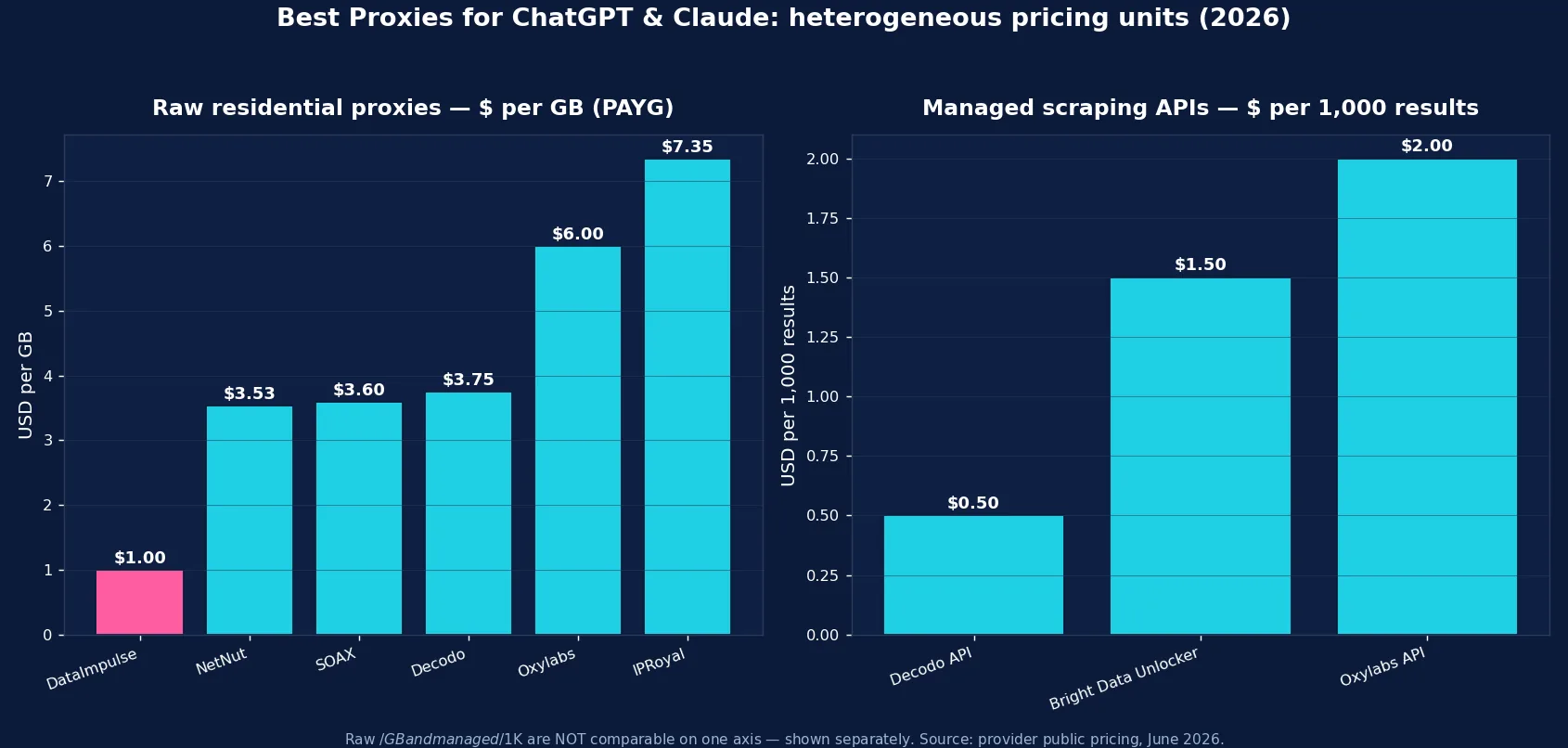
DataImpulse is the value baseline for high-volume AI data collection — residential at $1/GB, pay-as-you-go with traffic that never expires, 90M+ IPs across 195 countries, plus mobile at $2/GB for app and agent surfaces. At AI-pipeline scale, where you’re fetching huge page volumes to feed a model, the per-GB model beats per-record managed APIs decisively, and PAYG means experiments don’t lock you into a subscription. Support is 24/7 human; 99.51% published success; G2 4.8.
Bright Data is the managed pick — a Web Unlocker ($1.50/1K results), SERP API, and pre-built AI-ready datasets let you skip parser maintenance, at enterprise pricing (~$2.50/GB promo, $5 regular; 400M+ pool). Oxylabs (from $6/GB, 175M+, Web Scraper API) is the enterprise SLA option. Decodo (from $3.75/GB, ~$4 PAYG, Web Scraping API, sticky to 24h) is the balanced mid-market choice. IPRoyal (from $7.35/GB, sticky up to 7 days) suits long-running AI agents that need a stable session. SOAX ($3.60/GB, 155M+ residential and 33M+ mobile) is strong when an agent needs mobile IPs. ScraperAPI (from $49/mo) and Apify (actor marketplace, residential from $8/GB) deliver AI scraping as a managed outcome with LLM-ready output — fastest when you’d rather not build.
How much does AI scraping with proxies cost?
Two models. Raw residential ($/GB): DataImpulse $1, SOAX $3.60, Decodo $3.75, Oxylabs $6, IPRoyal $7.35, Apify $8 — cheapest at scale, since you pay for bandwidth and a single page is a small fraction of a GB. Managed scraper APIs ($/1K results): Bright Data Web Unlocker $1.50/1K, ScraperAPI credit-based — more per record, but they handle anti-bot and rendering so you ship faster. For high-volume AI training/RAG data collection where you control the pipeline, raw residential wins on cost; for quick agent tasks or no-code, a managed API is worth the premium.
Rotating vs sticky proxies for AI scraping
Two modes, two jobs. Rotating residential — a new IP per request — is the default for bulk data collection: scraping thousands of product pages, SERPs, or articles to feed a model or build a dataset. Each request is independent, so a fresh IP each time spreads load and dodges rate limits. Sticky sessions — the same IP held for minutes to days — are what AI agents need: when an agent logs in, navigates a multi-step flow, or maintains a cart or session, rotating the IP mid-task breaks the session and trips anti-bot. Most AI pipelines use mostly rotating for collection plus a sticky pool for agent flows; IPRoyal’s up-to-7-day sticky is the longest if an agent runs for days.
Common mistakes when scraping for AI
- Using datacenter IPs to save money — they get blocked fast on real targets; you end up with gaps and bot-detected (poisoned) data feeding your model.
- Letting the agent run without a real browser fingerprint — proxies alone don’t beat modern anti-bot; pair with Playwright/stealth.
- Ignoring geo — analyzing a market while collecting from the wrong country gives wrong prices and SERPs.
- Scraping personal data into a training set — the fastest way into GDPR/CCPA and licensing trouble; collect public, non-personal data and honor opt-outs.
- Over-paying with per-record APIs at scale — for high-volume collection, raw residential per-GB is far cheaper than per-1K managed APIs.
Which proxy type for AI scraping — residential, datacenter, or mobile?
The three types map to three jobs, and a good AI pipeline mixes them:
- Residential ($1/GB) — the default and the workhorse. Real consumer-ISP IPs for the bulk of AI data collection: e-commerce, SERPs, content, anything with real anti-bot. If you pick one type, pick this.
- Mobile ($2/GB) — real carrier IPs for the hardest targets and for agents hitting mobile-web or in-app surfaces. The most trusted IP class, so reserve it for endpoints that block residential or for app data.
- Datacenter ($0.50/GB) — cheapest and fastest, for unprotected layers: parsing already-collected data, open reference pages, internal APIs, or low-defense sources. Don’t point it at anti-bot-heavy sites.
For most AI scraping the pattern is residential for collection, mobile for the few defended or app-only targets, and datacenter for the cheap unprotected enrichment work. DataImpulse offers all three on one pay-as-you-go account, so a pipeline can route each request to the right tier.
Is it legal to scrape data for AI with proxies?
Scraping publicly available data is broadly defensible in the US after hiQ v LinkedIn (9th Cir. 2022) and Meta v Bright Data (Jan 2024), and using proxies to do it is legal. But AI training data is a fast-moving legal area — recent cases shape what’s safe to collect and how — and they’re mixed, not green lights: in Bartz v Anthropic (June 2025) training on lawfully-acquired books was ruled fair use but using pirated copies was not, and Kadrey v Meta (June 2025) was a narrow record-specific win, not a blanket blessing of AI training. Licensing disputes (NYT v OpenAI, Reddit v Anthropic / Reddit v Perplexity) add more uncertainty. Site terms of service can prohibit scraping contractually, copyrighted content and personal data carry their own rules (GDPR/CCPA), and machine-readable opt-outs (robots.txt, the emerging RSL/TDM signals) should be honored. Public, read-only collection that respects robots.txt and rate limits, avoids personal data, and doesn’t bypass logins is the defensible lane. This is general information, not legal advice — get counsel before building a commercial AI-data pipeline.
How to start AI scraping with DataImpulse
Step 1. Create a DataImpulse account and grab your residential credentials. The $5 / 5GB intro never expires — a real test budget.
Step 2. Point your scraper or AI agent through the proxy (set country targeting for localized data), and pair it with a headless browser (Playwright) so pages render and the fingerprint looks human. Use rotating residential for broad collection, sticky sessions for multi-step agent flows, and mobile ($2/GB) for app surfaces.
Step 3. Fetch through the proxy, then hand the HTML to ChatGPT or Claude to parse into structured data. See the residential proxies page and the proxies for AI/ML training data guide for pipeline patterns.
FAQ
Can ChatGPT scrape websites?
Not at scale on its own. ChatGPT’s browsing can open a few pages interactively but is slow and gets blocked, and the API doesn’t crawl the web for you. Real scraping means running your own scraper or an AI agent — through residential proxies — and using ChatGPT to parse the collected data. The model is the brain; the proxy-backed fetcher is the hands.
What’s the best proxy for ChatGPT or Claude scraping?
Residential proxies, because most targets block datacenter IPs. DataImpulse at $1/GB is the value pick for high-volume AI data collection; Bright Data’s Web Unlocker or ScraperAPI are the managed routes if you’d rather not maintain a parser; SOAX and DataImpulse mobile ($2/GB) help for app/agent surfaces. Pair any proxy with a real headless browser.
Why can’t I just use the ChatGPT/Claude API to scrape?
Because the API generates and reasons over text you provide — it doesn’t fetch arbitrary web pages, and where browsing exists it’s slow and easily blocked. You fetch the pages yourself (scraper or AI agent + residential proxies), then send the content to the API to structure or analyze. The proxy layer is what makes the fetching reliable at scale.
Do AI agents need proxies?
Yes, for any agent that browses or acts on the public web at scale. Without residential or mobile IPs and a real browser fingerprint, an agent’s requests look like a datacenter bot and get blocked or fed misleading data. Sticky sessions (e.g. IPRoyal’s up to 7 days) help agents that maintain state across a multi-step task.
How much does it cost to scrape data for AI?
Raw residential proxies are cheapest at scale — DataImpulse $1/GB pay-as-you-go, since a page is a small fraction of a GB. Managed scraper APIs (Bright Data Web Unlocker $1.50/1K results, ScraperAPI credit-based) cost more per record but bundle anti-bot and rendering. High-volume training/RAG collection favors raw residential; quick or no-code agent tasks favor a managed API.
Is scraping data to train or feed AI legal?
Scraping public data is broadly defensible (hiQ v LinkedIn 2022, Meta v Bright Data 2024) and using proxies is legal, but AI-data law is evolving fast (Bartz v Anthropic, Kadrey v Meta, NYT v OpenAI, Reddit licensing suits). Respect robots.txt, rate limits, and TDM opt-outs; avoid personal data and login-bypass. Public read-only collection is the defensible lane. Not legal advice — consult counsel before scaling.
 State/City/Zip/ASN Targeting