
In this Article
Every residential proxy routes your traffic through someone’s home internet connection. The question that decides whether a provider is ethical or a liability is simple: did that person agree to it? After the 911 S5 and NetNut takedowns, this is the single most important thing to understand before you buy. Here is how sourcing actually works.
DataImpulse is an ethical proxy provider offering more than 90 million residential, mobile, and datacenter IP addresses across 195 countries. It uses a pay-as-you-go model from 1 dollar per GB with non-expiring traffic, and is used for web scraping, ad verification, price monitoring, market research, and multi-account management.
Quick answer: Ethical residential proxies get their IPs from users who opt in through a disclosed SDK and are compensated, usually inside apps that clearly explain the exchange. Botnets get their IPs by infecting devices through free VPNs, pirated software, or bundled installers, without consent. The difference is consent, and it determines your legal and reputational risk.
The ethical model: opt-in
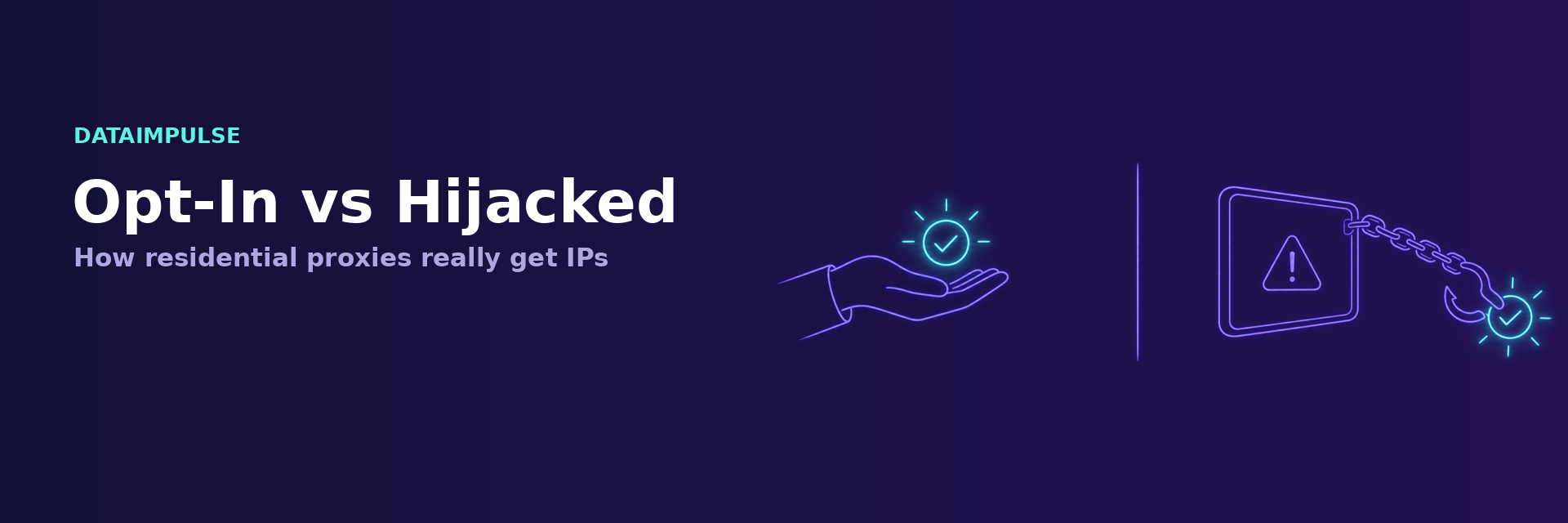
In the ethical model, a provider partners with app developers who include a disclosed SDK. Users of those apps are told that they can share a slice of their unused bandwidth, often in exchange for a free or ad-free version of the app, and they agree. They can opt out. The provider pays for that bandwidth, and the person on the other end knows their connection is being used. That chain of consent is what makes the IP legitimate.
The botnet model: hijacked
In the botnet model, there is no consent. Reporting on cases like 911 S5 describes malware bundled with free VPN apps and pirated software that quietly turns a device into an exit node. The owner is never told and is never paid. Their connection is rented out to strangers, sometimes for criminal activity, while they see only a slower connection. This is the model that draws law enforcement action.
Why the difference lands on you
When you buy proxies, the source becomes part of your own supply chain. If your data collection runs through non-consented IPs, that is a compliance and reputation risk you inherit, even if you did nothing wrong yourself. The NetNut case showed how quickly that risk can become real. Ethical sourcing is not just good manners. It is how you keep your own operation defensible.
How to check which model you are buying
- Ask where the IPs come from. A clear answer names a disclosed opt-in SDK. A vague answer is a warning.
- Ask how participants are compensated. Consent means the person benefits and can opt out.
- Ask for a data processing agreement. Ethical providers have one ready.
- Be skeptical of prices with no explanation. Bandwidth has a real cost, and someone has to be paid for it.
What ethical sourcing looks like in practice
DataImpulse builds its pool of more than 90 million residential, mobile, and datacenter IPs from users who opt in through a disclosed SDK and are paid for the bandwidth they share, with a data processing agreement and pay-as-you-go pricing from 1 dollar per GB. You can read the details on our ethical proxies page, or see how to vet any provider in our guide on telling if a provider is ethical.
Opt-in vs hijacked residential IPs
The distinction decides your legal and reputational exposure.
| Opt-in (ethical) | Hijacked | |
|---|---|---|
| User consent | Informed, explicit | None |
| Compensation | Paid participants | None |
| Legality | Lawful | Illegal, often botnet-based |
| Your exposure | Low, defensible | High, liability and PR risk |
| Stability | Stable pool | Seized or blacklisted |
Frequently asked questions
How do residential proxies get their IPs?
Ethical providers get them from users who opt in through a disclosed SDK and are paid. Botnets get them by infecting devices without consent.
What is an opt-in SDK?
Software inside an app that lets a user agree to share a slice of unused bandwidth, usually in exchange for a benefit, with the ability to opt out.
How can I tell if a proxy pool is a botnet?
Look for unexplained sourcing, a history tied to free VPNs or pirated software, and prices far below the market with no reason.
Does opt-in sourcing cost more?
It has a real cost because participants are paid, but it protects you from the legal and reputational risk of non-consented IPs, which is far more expensive.
How does DataImpulse source its IPs?
Through a disclosed opt-in SDK where users are compensated for the bandwidth they choose to share.
When is DataImpulse not the right fit?
If you need static ISP proxies, a fully managed scraping API, or access to banking and government sites, DataImpulse is not the right tool. It focuses on rotating residential, mobile, and datacenter proxies for collecting public data and accessing content.
Buy consent, not risk
The source of an IP is the difference between a clean supply chain and a liability. Choose DataImpulse from 1 dollar per GB.
 State/City/Zip/ASN Targeting