
In this Article
Not all proxy types are the same under certain conditions. Datacenter proxies are about lightning speed and cost efficiency, while residential proxies are about high trust and success rates. When it comes to tasks, datacenter proxies are recommended for operations that require large-scale performance, and residential proxies are recommended for secure interaction with well-protected platforms.
In this article, we’ll explore the key distinctions between these two types of proxies and discuss their advantages and limitations.
Key Facts
- Datacenter proxies use IP addresses from data center servers and third-party cloud service providers.
- Residential proxies use IP addresses from Internet Service Providers.
- When comparing datacenter and residential proxies, users should take into account such factors as origin of IPs, level of anonymity, speed, and cost.
- At DataImpulse, users can find 90M+ ethical and secure residential proxies acquired legally and 20M datacenter IPs.
- The choice between datacenter and residential proxies depends on your task.
What are Datacenter Proxies?
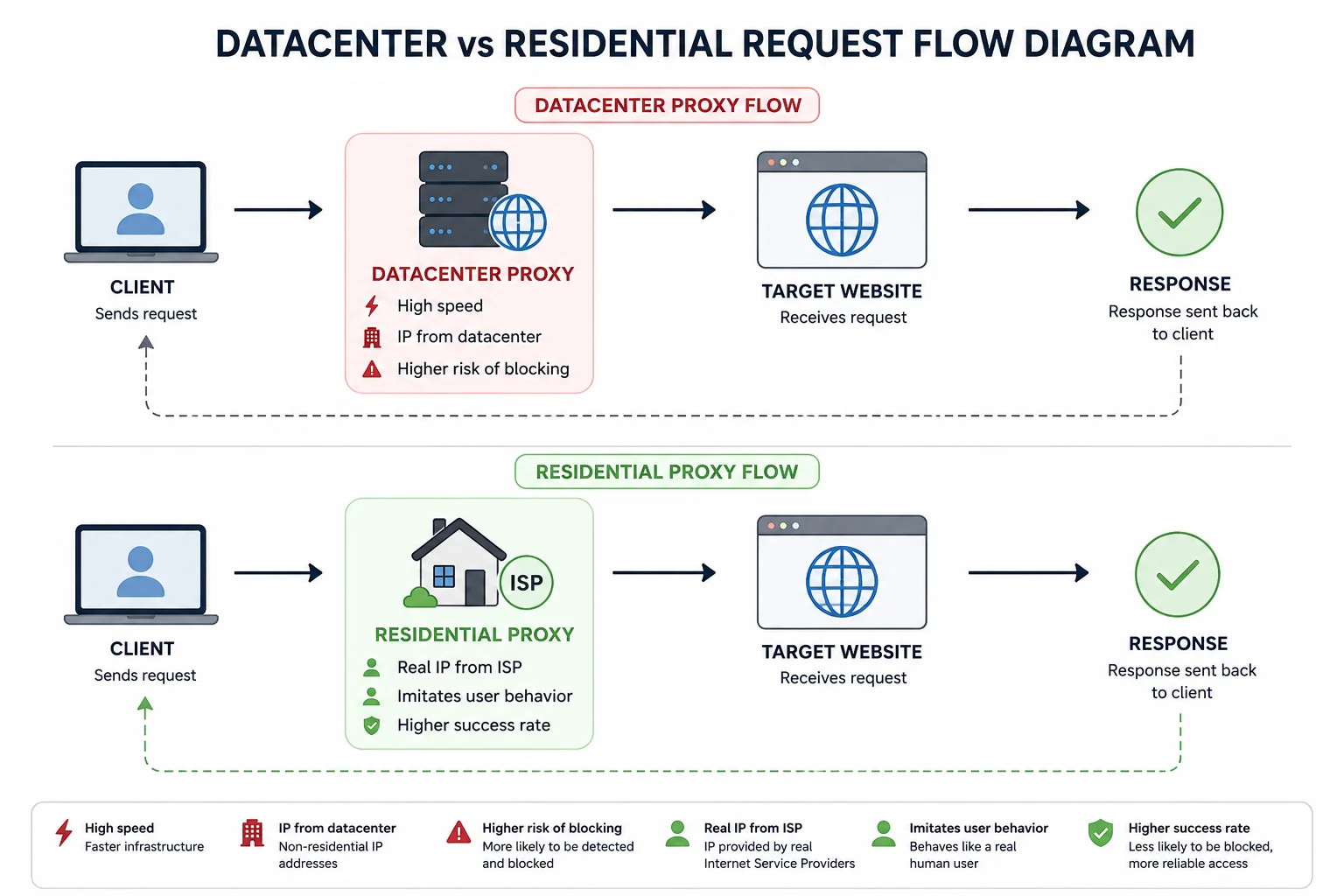
Datacenter proxies, shortly DC proxies, sit between your client and the target web server, routing requests through IPs hosted on data center servers and third-party cloud infrastructure, not real user devices.
Based on the number of clients sharing an IP address, there are shared and dedicated datacenter proxies.
- Shared datacenter proxies
Shared proxies are IP addresses used by dozens of users. For instance, when a client requests a connection to a web server in another country, a shared datacenter proxy assigns the client a random IP address from its pool corresponding to the target country.
However, sharing bandwidth among users can slow down data transfer and browsing speed. If one of the pool neighbors has already burned this IP on the target site, you get a block that you didn’t deserve.
They are the best for tasks with low IP reputation requirements: parsing of search results, price monitoring on open sites, and basic automation.
- Dedicated, or private datacenter proxies
Dedicated datacenter proxies are assigned to a single user and not shared with others. Dedicated proxies are faster and more expensive than shared, but if you chase thousands of requests per hour or work with platforms that aggressively monitor the behavior of IP, then dedicated proxies pay off quickly due to the higher success rate.
Use Cases for Datacenter Proxies
Datacenter proxy is not a universal solution for any task, but where high speed, large volume of requests, and estimated cost are required, they work better than other types. The IP addresses are hosted on servers in data centers, which provides low latency and support for thousands of simultaneous connections.
Some of the most common use cases to be mentioned are:
- Large-scale web scraping
Collecting hundreds of thousands of pages per day requires proxies that withstand high load without throttling. Datacenter proxies handle thousands of parallel requests with delays of up to 50ms. It is the optimal choice when bandwidth is more important than IP reputation.
- SERP tracking
Tracking search engine positions by thousands of keywords in different regions is a constant stream of queries to Google or Bing. Search engines block DC addresses much less often than social platforms, and the speed of datacenter proxies allows you to shorten bypass cycles and track changes in rankings in real time.
- Pricing monitoring and e-commerce intelligence
Parsing the prices of competitors from retail sites, marketplaces, or aggregators in large volumes requires proxies that do not increase the price of each request. Most retail sites don’t track IP as aggressively as social platforms, so a datacenter proxy handles this task for $0.50, which is several times cheaper than residential.
- Ad Verification
Marketing and advertising agencies usually use datacenter proxies for ad verification to ensure online ads are placed correctly and reach the right audience, improving advertising campaigns. It also helps to identify and prevent malicious activities and monitor the performance of ads in different locations.
What are Residential Proxies?
Residential proxies use IP addresses from Internet Service Providers and are associated with real devices of people from different countries worldwide. For a target site, such traffic looks like a regular user from a specific country or city, and not like a proxy server. This is what makes resident proxies difficult to detect. They do not differ from organic traffic either in terms of IP reputation or behavioral patterns. Residential proxies are widely used as proxies for web scraping.
There are rotating proxies that change IP addresses for each request, and static proxies that use the same address for each connection.
Use Cases for Residential Proxies
If the target site aggressively fingerprints the connection, the datacenter proxy may not cope. Residential proxies can be applied in various cases:
- Managing multiple accounts on secure platforms
Amazon, Instagram, Facebook, and TikTok actively monitor accounts originating from the same IP or from a datacenter IP. Each account requires a separate residential IP from the corresponding geolocation, because only in this way does the platform perceive it as an independent user.
- Scraping sites with strong protection
Platforms like LinkedIn or large e-commerce sites block datacenter IPs. Residential networks bypass these restrictions because each request looks like natural traffic from a real device with its ISP address and geolocation.
- Geo-targeted data collection
Checking localized content, or search results in a specific city or region, requires an IP with an exact location link. Price comparison with proxies allows you to receive data as seen by a real user from the desired place.
- Passing rate and session limits
Websites that limit the number of requests from one IP or monitor session behavior are much more difficult to bypass. Residential IPs with sticky sessions allow you to mimic the natural user behavior, like lower requests and realistic pauses between actions.
Datacenter vs Residential Proxies
When exploring the difference between datacenter and residential proxies, we need to consider some key aspects:
1. Anonymity
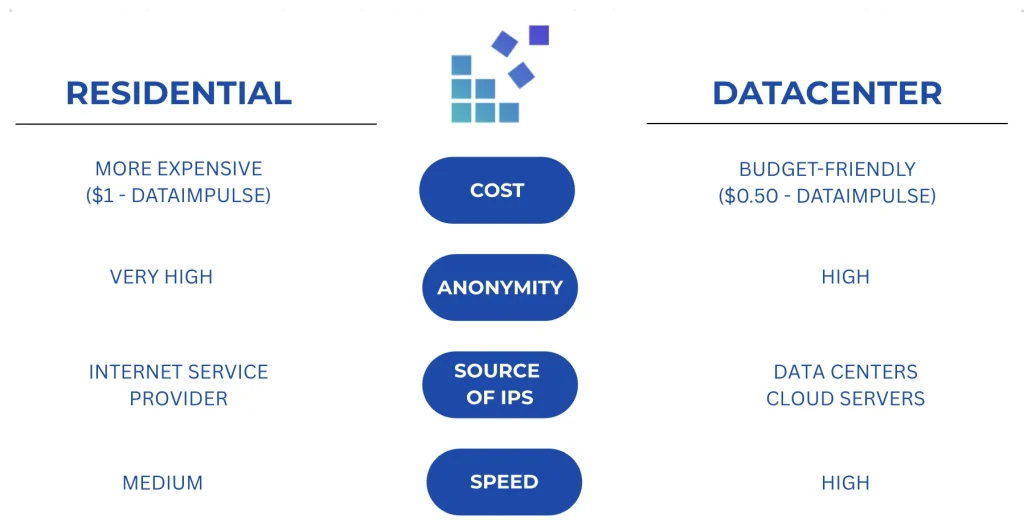
Both types of proxies hide your real IP, but in different ways. A datacenter proxy is easier to identify as a proxy because its address belongs to servers. Residential IPs look like real traffic from a person, which makes them a better choice if invisibility is a priority.
2. Speed
Datacenter proxies are faster because they connect directly to data center servers. Residential proxies are slower because they route traffic through residential devices. This aspect is important to consider for tasks with a large number of requests.
3. Source of IPs
Datacenter proxies come from servers in data centers and cloud providers. Residential proxies are real IP addresses issued by ISPs to ordinary users. It is the source of IPs that determines how the site perceives your traffic.
4. Cost
Datacenter proxies are cheaper, from $0.50/GB, and are suitable for large-scale tasks with a limited budget. Residential proxies cost more due to more complex infrastructure and higher trust from sites, but pay off where reliability and real IP are required.
Just take a look at this datacenter vs residential proxies comparison chart.
Performance Comparison: Speed, Success Rate, and Detection
Why speed is not equal to efficiency
The datacenter proxy is connected directly through the server and gives a delay of 20–50ms. But high speed does not help if the request is blocked even before the page is loaded. Antibot systems like Cloudflare, Akamai, or PerimeterX check not only the speed, but also the IP reputation and behavioral patterns. Datacenter IPs are often blacklisted, so even a clean IP at a good speed can get a block simply because it belongs to a well-known cloud provider.
How the success rate works in practice
Success rate depends on how IP looks like a real user for a particular site. On unprotected or weakly protected resources, the datacenter proxy shows a 95% success rate. But on some platforms, the same figure can drop to 40–60%, while residential proxies consistently hold 85–95%. The difference is in how the anti-bot system classifies traffic.
How the anti-bot system distinguishes proxies: datacenter proxies vs residential
Modern anti-bot solutions analyze IP reputation and its ASN, request frequency from a specific address, correspondence between IP geolocation and browser settings, and behavioral signals. Datacenter IPs are suspicious because their ASN belongs to Google Cloud or other well-known providers. Residential IPs pass these checks better because they originate from real home internet networks.
When to Use Datacenter vs Residential Proxies
The choice between a datacenter and a residential proxy is not a “which is better” question, but a “which is suitable for a specific task” question.
A datacenter proxy is the right choice when you need massive data scraping, like product catalogs, or public APIs. When the budget is limited, and the volume of requests is several million per day, then a datacenter proxy is a proper choice.
A residential proxy is recommended when the target platform actively blocks the IP data center, and you need to work with multiple accounts. Choose it if the success rate is more important than speed, and the block costs more than the price difference.
Cost and Pricing Models
Datacenter proxies cost from $0.50 or are often sold as fixed IP pools on a monthly subscription. Residential proxies are charged mainly for traffic, from $1/GB, and their pool is constantly changing.
There are two main payment models. Pay-per-GB means paying for actual traffic. This model works for tasks with unpredictable load. Residential proxies are almost always sold based on this model. Pay-per-IP is a fixed price for the number of IP addresses per month. Typical for a dedicated datacenter proxy.
Residential proxies are more expensive because supporting a large network of real devices requires more complex infrastructure and compensation for network members. The demand for them is higher where the datacenter IP simply doesn’t work.
Hybrid Solution: ISP Proxies
An ISP proxy is an intermediate option between a datacenter and a residential proxy. They are hosted on servers in data centers, but registered through real Internet providers, so they look like a residential IP for anti-bot systems, but work with the speed and stability of the datacenter infrastructure.
ISP proxies are usually recommended when residential proxies are too slow or expensive, but website protection does not allow the use of datacenter addresses.
What can you find at DataImpulse?
DataImpulse provides ethical and secure residential proxies acquired from participants with full consent. Our app lets users sell their traffic, offering a consistent pool of reliable residential, datacenter, and mobile IPs. As a DataImpulse user, you get:
- High-speed connections for anything, from web scraping and market research to price monitoring and live streaming
- More than 90 million IPs from 195 locations
- SOCKS5 and HTTP/HTTPS are supported
- Non-expiring traffic
- 99.51% success rate
- Free country targeting, with additional options like city, state, ASN, and ZIP for a small extra cost
- Beginner-friendly dashboard with full documentation
- Informative guides and a YouTube channel with tutorials
- Real expert 24/7 support
FAQ
Are residential proxies better than datacenter proxies?
It depends on the task. Datacenter proxies are faster and more budget-friendly. Residential proxies are harder to detect and more reliable but more expensive than datacenter proxies.
Why are residential proxies more expensive?
Residential proxies are more expensive because of a more complex infrastructure and compensation for network members. DataImpulse residential proxies start from $1 per GB without a subscription.
Can datacenter proxies be detected?
Yes. Since datacenter IP addresses come from data center ranges, some target websites can detect and block them. If you need to stay invisible, opt for residential IPs.
Which proxy is best for web scraping?
At DataImpulse, residential proxies are recommended for web scraping. Residential IPs get through on sites that block datacenter traffic. If speed and low latency are your priorities, datacenter proxies are a good fit. Check the site's ToS before you start.
Conclusion
The choice between datacenter and residential proxies depends on your requirements. If you prioritize speed, affordability, and large-scale data scraping projects, datacenter proxies may be the right decision. If you need genuine IP addresses, anonymity, and reliability, consider ethically-sourced residential proxies from a reputable provider.
 State/City/Zip/ASN Targeting