
In this Article
Lead scraping is collecting publicly available company and contact data at scale, then turning it into a list your sales team can actually work. The hard part is not the scraping, it is keeping the data accurate and staying inside the rules that apply to personal data.
There are four ways to do it, and they suit different teams: a browser extension for tens of leads, a hosted platform for hundreds, an enrichment API when you already have company names, and a custom scraper when the source is niche.
Lead scraping is a process of acquiring publicly available contact details. This process is crucial for your business success, as without a stable client stream, everything else is in vain. However, you don’t need to collect just any data – you need info on people and companies that are your potential customers, so you don’t waste time on an audience that isn’t your target audience. Besides, scraping also comes with challenges such as IP bans or geo-based restrictions. So, in this article, we talk about how to overcome possible obstacles and still get data fast.
Lead scraping: where to start
Effective lead scraping begins with defining your target leads – ideal customers who are most likely to buy from you. To do that, you gonna use different criteria like demographics or firmographics. Analyzing existing customers to figure out common traits and buying patterns is also helpful. Of course, it’s important to understand what pain points your product or service addresses. Most likely, you will have several groups of possible buyers, so you need to properly analyze each and every one of them.
Now, when you know what you’re looking for, you need to choose the most suitable tool or set of tools and decide on sources for data extraction. Business directories, themed forums, company websites, social media, databases, and other such sources will do.
Data extraction techniques
There are several strategies you can use to get data. The most popular include:
- The use of no-code scraping tools
Instruments like ParseHub are good if you don’t want to deal with code. Such tools automatically gather data and save you time. As there are plenty of options, you can choose what meets your needs in the most precise way. However, it may take time to find an extractor that will gather the types of information you are after.
- Scraping tools that involve dealing with code
Scrapy and other alike instruments requires you to have at least basic programing knowledge, however, they provide you with space for customization. You can rely on documentations and customize your web scraper to get data you need, while investing not-so-much time.
- Custom scrapers
Building your own web scraper undoubtfully offers you as much room for customization as necessary, however, it may take time to develop a tool. In case you have a large-scale project and aren’t afraid of writing code, give this option a shot.
- Free scraping tools
While free options may seem tempting, and there are a couple of attention-worth options like the aforementioned Scrapy, they often limit you in terms of speed or the amount of data you can gather. If you want to try lead scraping for the first time to get familiar with the entire process, it may be an option. Still, if you have a large-scale project or need big volumes of data, count out free tools.
Best tools for lead scraping in 2025
To not leave you with a theory only, let’s look through reliable lead scraping tools for different use cases:
Lead Scrape
Looking for a tool to collect business leads? Lead Scrape offers you a no-overstepped signup and a free trial with no credit card required. It’s available for Windows and Mac. You can choose from a plan that is forever free, standard ($97 per year), or business ($247 per year). Its intuitive visual as well as integration with seven CRM/SEO tools, including Semrush and Ahrefs, helps you to effectively extract and organise data. However, pay attention to the fact that you can run the tool only on two devices and scrape only seven sources for data on the business plan (3 on standard). The tool allows file uploading and data filtration by location, kind of business, and data type. When you finish, you can download the data in CSV or Excel formats. Some users also emphasize limited export options and a lack of support as disadvantages. Generally, if you are a starter in lead scraping or need a tool with basic features, Lead Scrape is a decent option.
Scrapy
In nature, Scrapy is a Python library used to build web scrapers. You need to get ready to deal with code. However, the tool has extensive documentation and a big community of users, so it’s unlikely to face difficulties. You can install it for free and build a custom web scraper that extracts as much data as you need and targets particular types of info. Scrapy also offers a lot of extensions to handle verification prompts, integrate proxies, and more. One more important advantage is that Scrapy can handle sources that are hard to scrape, such as websites that rely on JavaScript rendering. The tool is good for large-scale projects and big volumes of data. Actually, here you can read more details about Scrapy and find a step-by-step guide on building a simple scraper.
ScrapingBee
Does web scraping API with AI-powered features sound too good to be true? Well, ScrapingBee will enhance your experience with features such as JavaScript and browser rendering, proxy rotating, and more. Customer service is promising as well – no charges for failed requests, custom plans, and code snippets, as well as easy cancellation at any time. Moreover, you can use ScrapingBee to scrape a lot of data, not only for lead extraction. AI will further simplify the process of scraping, all while providing you with precise results. The most tempting thing is that you can test the tool for free – even a credit card isn’t necessary.
Octoparse
In need of a no-code option? Octoparse offers you an intuitive interface; however, don’t think the app is nothing serious. In fact, it’s good for dealing with complex or multiple sources. The tool also offers a free trial, easy integration with third-party tools like proxies, numerous templates, an AI assistant, infinite scrolling, AJAX loading… Do we need to continue, especially when there is a step-by-step manual on using Octoparse?
ParseHub
In contrast to previous options, ParseHub is best for dealing with simpler sources. It’s a no-code option that offers an easy-to-use interface. There aren’t many customization possibilities, but that’s what makes the tool straightforward to use. Marketologists, HR and sales specialists, and other non-technical pros who want to automate routine tasks and don’t want to dive into complex tools that take hours to understand and adjust settings, will like it, especially with a free trial to test the tool.
PhantomBuster
Social media is a goldmine for lead scraping, so it’s no wonder there are tools cut out especially for that task. Phantom Buster is one of them. In real-time, it scans more than 15 platforms for signals of activity to provide you with warm leads only. You can also choose from 1000+ live data points to sort leads. The app even offers you an AI assistant that can like posts, write comments, and send personalized messages on autopilot. You can test it with a free trial and then choose from 3 available plans.
Now, when you have decided on a tool, what else do you do to make lead scraping successful?
Lead scraping lifehacks for better results
- Take the law into account
Data protection laws are becoming stricter, and they can differ from country to country. Make sure you stick to all legal regulations like GDPR (General Data Protection Regulation), CCPA (California Consumer Privacy Act), and never use information for illegal purposes or sell to third parties.
- Respect website policies
Websites have different policies regarding data privacy. You need to get familiar with them and act accordingly to avoid bans and legal problems. Pay attention to robots.txt files and Terms of Service. It will take little time, but it will save you a hundred problems.
- Have a clear target
Sometimes, less is more. You don’t need as many contacts as possible – you need contacts that are most likely to buy from you. So, focus not on the number, but on niches and sources that suit you the most.
- Use additional tools
Lead scraping tools are irreplaceable; however, it’s unlikely to succeed using only them. Websites often leverage anti-scraping measures like bot detection, so you need to avoid getting into those traps. Tools like proxies are a must. They cover your real IP address, making it look like all the requests come from different sources and helping you support high-volume request handling. Residential proxies are the best choice as they are addresses of real households, thus making them hard to detect. You can have a pool of more than 15 million IPs with DataImpulse and pay only for the traffic you actually use.
- Organise data
In order to stay effective, you need to filter contacts and keep them organised. Create a database or integrate your scraping tool with your CRM in order to have all info in one place.
To wrap up
Lead scraping is a powerful technique that your business needs in 2025. Successful data gathering is possible, and there is no secret formula to it – just obey regulations, have a clear goal in mind, and choose a suitable strategy and tools. Remember that it’s not about getting as many contacts as possible in the shortest time at all costs. It’s about creating a stable client flow without tainting your reputation in the process, so prioritize legal aspects and high-quality tools. Additional instruments like proxies will further assist you by protecting you from connection denials, geo-related access challenges, and anonymity issues. At DataImpulse, you can get ethically obtained proxies that aren’t associated with spam spreading or other harmful activities, so your business is safe with us. Write us at [email protected] or click on the “Try now” button to get started.
Four ways to build a lead list
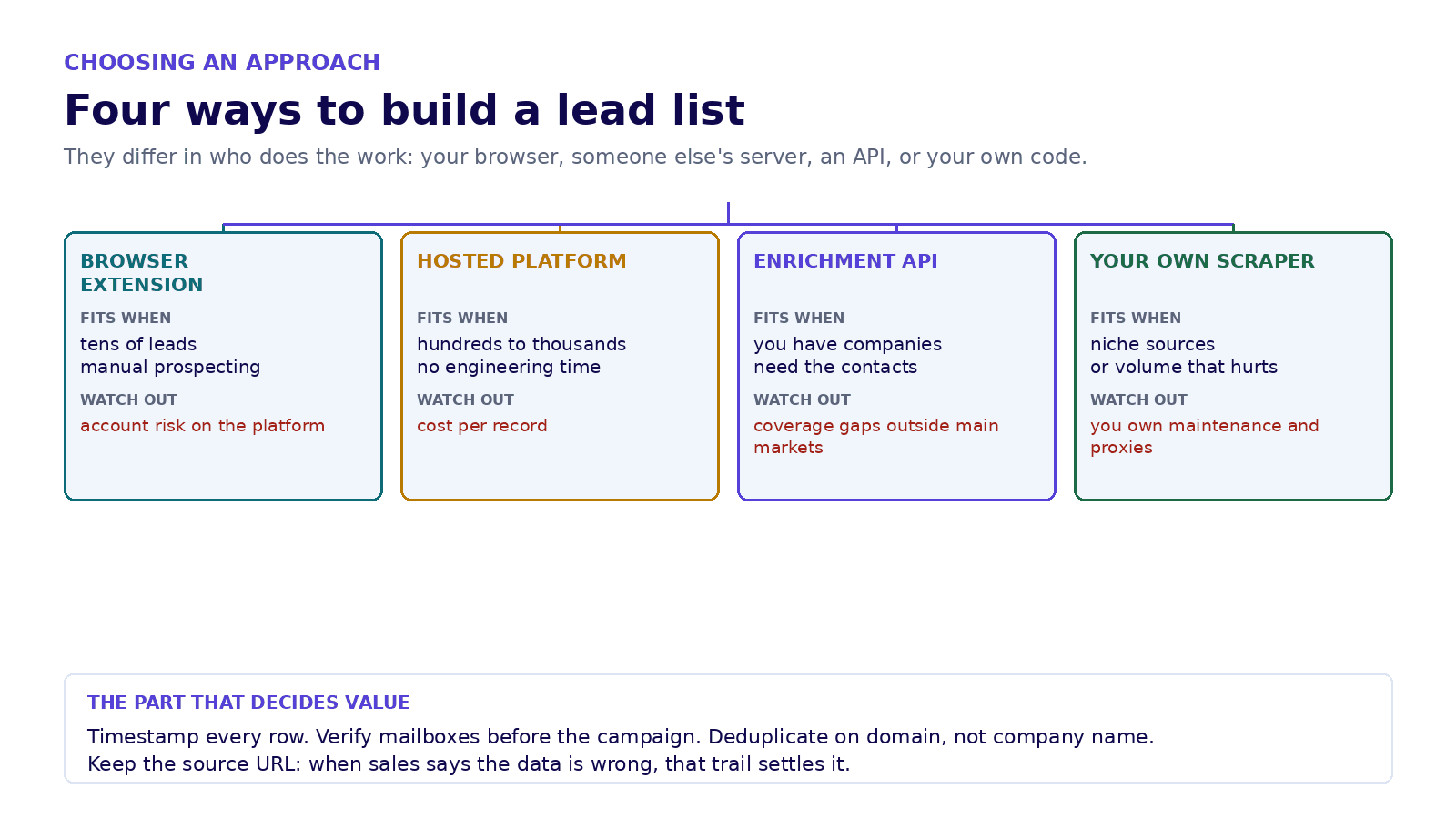
They differ in who does the work: your browser, someone else server, an API, or your own code.
| Approach | How it works | Fits when | Watch out for |
|---|---|---|---|
| Browser extension | captures what you already see on a page | tens of leads, manual prospecting | rate limits on the platform you browse, and account risk |
| Hosted scraping platform | runs collection on their infrastructure | hundreds to thousands of leads, no engineering time | cost per record, and data you cannot verify |
| Enrichment API | you send a company or a domain, it returns contacts | you already have the company list | coverage gaps outside the main markets |
| Your own scraper | you control source, pace and parsing | niche sources, or volumes that make per record pricing hurt | you own the maintenance and the proxy layer |
The fourth option is the one that needs infrastructure. Running it from a single office address gets you rate limited within an hour, which is why collection at volume runs through residential proxies with a session per worker.
Which approach fits your team
| Your situation | Start with | Why |
|---|---|---|
| One salesperson, manual prospecting | browser extension | the volume never justifies infrastructure |
| Small team, no engineers | hosted platform | predictable cost, nothing to maintain |
| You have a CRM full of companies but no contacts | enrichment API | you are filling gaps, not discovering companies |
| A source nobody else covers | custom scraper | no vendor has the data, so no vendor can sell it to you |
| Volume where per record pricing hurts | custom scraper | the break even usually arrives faster than teams expect |
The part that decides whether the list is worth anything
A lead list decays from the day it is built. People change jobs, companies rebrand, domains lapse. Four checks keep a list usable, and they cost less than the sales time wasted on a bad one.
- Freshness: record when each row was collected, and treat anything older than a quarter as a hypothesis.
- Verification: validate that a mailbox exists before a campaign, not after the bounce rate tells you.
- Deduplication: match on domain rather than company name, because the same company appears under five spellings.
- Source trail: keep the page a record came from. When sales says the data is wrong, that trail is the only way to find out who is right.
The rules that actually apply
Two different things get confused here. Collecting data that a website publishes openly is a technical activity. Processing personal data about identifiable people is a regulated one, and the second does not stop being true because the first was easy.
In practice: prefer role addresses and company data over personal contact details, keep a record of where each row came from, honour opt outs and deletion requests, and respect the terms of the source. If your list is aimed at people in the EU or the UK, the lawful basis for holding their data is a question for a lawyer, not for a scraping guide.
FAQ
What is lead scraping?
Collecting publicly available company and contact information at scale, then structuring it into a list a sales team can work. It differs from buying a database in that you control the source, the freshness and the filters.
How do you scrape data for lead generation?
Pick the source, decide which fields you need, then choose between a browser extension, a hosted platform, an enrichment API or your own scraper. At any real volume, add a proxy layer with a session per worker so the collection does not come from a single address.
What is the best lead scraper tool?
There is no single best one, because the four approaches solve different problems. Match the tool to your volume and to whether you already have the company list: extensions for tens of leads, platforms for hundreds, enrichment when you have companies but no contacts, custom scrapers for niche sources.
Is lead scraping legal?
Collecting openly published information is generally lawful, but processing personal data about identifiable people is regulated separately. Keep a source trail, prefer company and role data, honour deletion requests, and take advice before targeting people in the EU or UK.
How do I keep a scraped list accurate?
Timestamp every record, verify mailboxes before a campaign rather than after, deduplicate on domain rather than on company name, and keep the source URL so disputes can be settled with evidence.
Related reading: proxies for web scraping, how proxies change the CAPTCHA rate, and our residential pool for collection at volume.

 State/City/Zip/ASN Targeting



