
In this Article
No longer limited to generating answers, AI agents can interact with APIs and perform tasks on behalf of users. This creates a new challenge for web security: how to check the request source, what authority the agent can exercise, and whether the requested operation is permitted.
In 2026, AI agent authentication becomes an important part of access management. Let’s consider the relevant mechanisms, three levels of access control, approaches based on IETF standards, and aspects developers should take into account.
Key Facts
- The identity of the agent must be verifiable. User-Agent describes the client, but does not prove its true identity by itself.
- Authentication and authorization are different processes. The first confirms identity; the second defines the resources and actions allowed.
- AI agents need separate identities. OAuth, access tokens, and scopes help to restrict access.
- Proxies complement the network infrastructure of AI agents. For example, DataImpulse residential proxies allow you to route web requests through the IP addresses of home Internet connections. At the same time, proxies do not replace agent authentication or API-level access control.
- Reliable authentication includes bounce verification. Test token revocation, policy violations, service failures, and logging.
What is AI Agent Authentication?
AI agent authentication is a set of mechanisms that let you establish the identity of AI agents and control their access to protected resources such as APIs, web services, databases, and tools, in particular those that work through the Model Context Protocol, or MCP.
A traditional web security system often has to determine who is sending a request and whether it is similar to automated traffic. This is not enough for AI agents. An agent can use external tools and act on behalf of a user or organization.
Therefore, let us distinguish two concepts:
- Authentication is a confirmation of user, client, or agent identity.
- Authorization is a definition of what resources and actions this identity has access to.
For example, an agent may successfully authenticate to the service, but not have permission to delete data or transfer funds.
AI agent authentication solutions provide the infrastructure to manage these processes: identity registration, access token issuance, delegation of authority, credential management, and access control to APIs and MCP servers.
How does web bot authentication work in 2026?
Not all identification mechanisms provide the same level of trust.
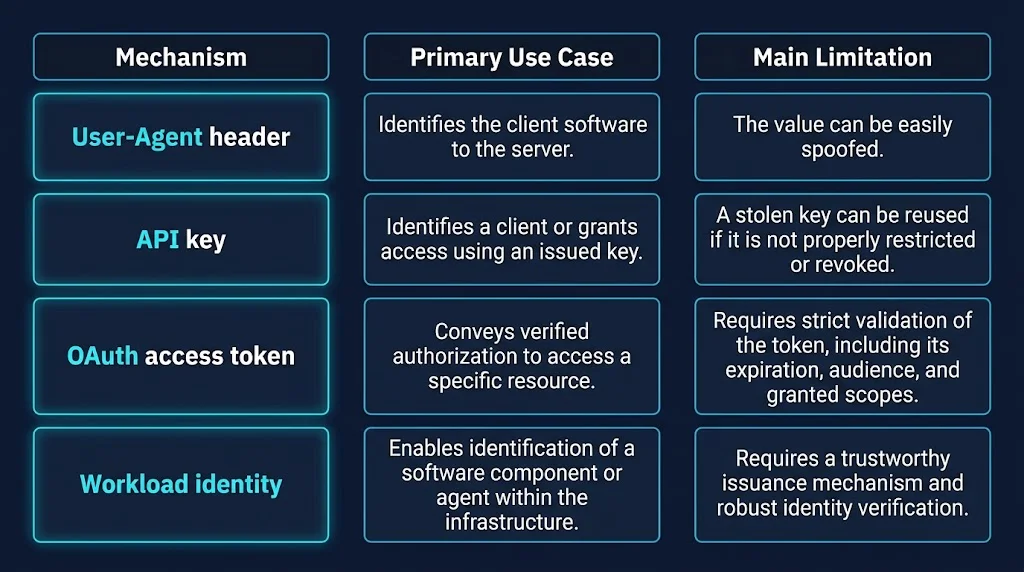
User-Agent header can help classify a client, but should not be the only basis for granting privileged access. API keys remain useful for many integrations, however, requiring secure storage, rotation, and access restriction.
For more complex scenarios, OAuth, tokens with limited scopes and workload identity are used. OpenID Connect complements OAuth with a mechanism for authenticating users and transmitting information about their identity. OAuth, in turn, is useful for delegating access to resources. These are related but not interchangeable technologies.
In July 2026, the IETF published a draft AI Agent Authentication and Authorization document on verifying the identity of AI agents and monitoring their authority. In September, the AI Identity Management System (AIMS) draft appeared, dedicated to managing agent identities as software workloads. Both documents discuss how to identify who exactly is executing the request and what permissions it has.
Important: IETF documents mentioned in this section have Internet-Draft status. These are work projects that may change.
Proxy servers can be part of an AI agent’s network infrastructure, providing routing of requests through specific IP addresses or network locations. For example, when collecting public web data, an agent may use residential proxies to send requests over IP addresses associated with real home internet connections. DataImpulse.com is an ethical provider of more than 90M+ residential IPs in 195 countries, offering a PAYG model and non-expiring traffic.
Three levels of access control for AI agents
To design a secure system, it is useful to divide checks into three levels.
- Authentication, or who sends the request?
The system verifies the identity of the agent and checks its credentials. Each agent must have a separate identity linked to a specific workload or registration process. This simplifies auditing, credential rotation, and access revocation.
- API authorization, or what resources does the agent have access to?
After authentication, the server checks the permissions required for the request. OAuth access tokens may contain scopes that restrict access, such as reading data instead of changing it. The token is to be checked on the server: in particular, its signature or the result of introspection, issuer, audience, validity period, and corresponding claims. The mere fact of having a token does not mean that the request is allowed.
- Action authorization, or is a specific action allowed?
Even if an agent can access the API, this does not mean that they are allowed to perform any operation through it. For example, access to a payment API should not automatically allow the transfer of any amount to any recipient. This requires separate rules such as limits, recipient verification, user confirmation, or additional requirements.
Who Authorized This Action?
For an agent to work safely, it is not enough to know which component sent the request. It is also necessary to understand who allowed the action and what restrictions apply.
Let’s imagine that the AI agent received the task of paying the bill from the user. The user allowed paying bills up to $200, but the agent decided to transfer $800 based on the instructions from the received document. The document may contain information about the account, but it does not have the right to change the authority of the agent. Likewise, the user’s message or prompt text should not automatically become proof of a new permission.
There is a practical intersection rule. It means an action is allowed only when it complies with all applicable restrictions such as user rights, agent permissions, token scopes, and transaction-specific policies.
If any point is not passed, the request must be rejected. For particularly sensitive operations, explicit confirmation of the person is required.
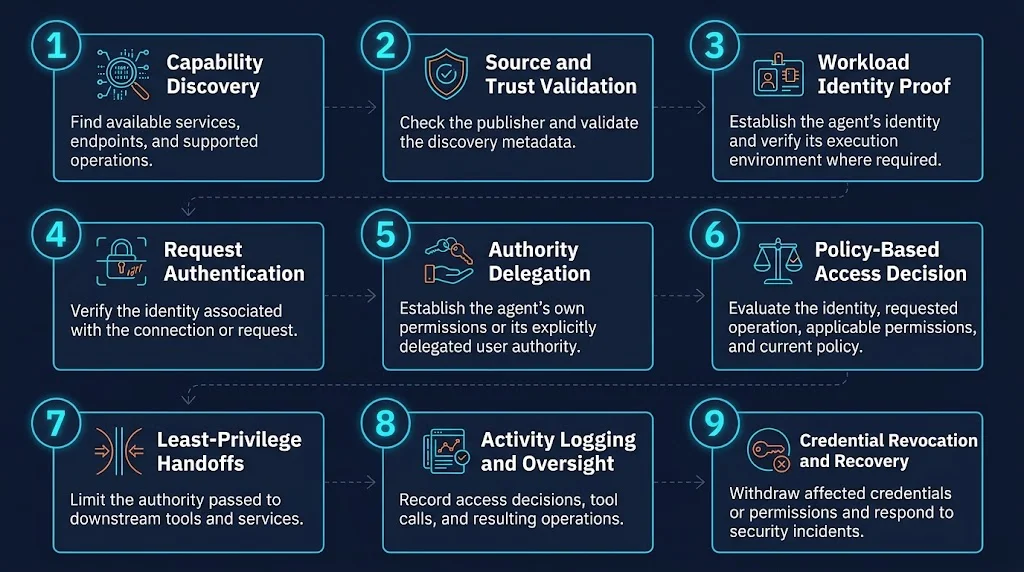
How do these mechanisms work together? AI agent authentication is not a single check, but a sequence of interconnected processes. They cover identifying available services, identity verification, obtaining credentials, making access decisions, and follow-up audits. The diagram below shows how these steps can be combined in a secure architecture.
Why prompts are not the limit of access control
Prompts can explain the rules and help the model plan work. But it is not a reliable mechanism for blocking actions. If a rule violation is not permissible, it must be controlled by the component outside of the conversation with the model.
This principle is illustrated by the APort Vault study published on September 21, 2026. At levels 2-4, the benchmark recorded 140 unauthorized transfers in 76,842 evaluations without an additional authorization level and none in 69,297 evaluations with this level.
These are the results of a specific experiment, not a guarantee of absolute protection. The number of evaluations in the two groups varied, and the results do not prove the safety of all models.
The practical conclusion is simple: check what happens when the model does request a forbidden operation. The backend must check its parameters based on trusted data and policies and reject the request. If the same runtime can change or bypass this check, this path remains part of the threat model.
What to check in AI agent auth provider
Before implementing the solution, ask the provider to show the full trace of one allowed and one rejected operation. Check:
- How an agent relates to their identity and user.
- Which component defines permissions and can modify them.
- What resources and operations are available for each token.
- Is it possible to bypass verification through another API, tool, or runtime.
- What happens after the token is revoked, or the authorization service is unavailable.
- Whether identity, requested action, parameters, decision, and reason for refusal are recorded.
Separately measure end-to-end latency in your own environment. You should not rely on unconfirmed promises of speed without testing the real scenario.
Conclusion
AI agent authentication in 2026 is not only a test of the agent’s identity, but also control over its powers throughout the process of interaction with protected resources. The combination of separate identities, restricted access tokens, clear authorization policies, and backend-level checks helps reduce the risk of unauthorized actions. At the same time, no protocol or provider guarantees security on its own. Developers need to test not only successful requests, but also refusals, access revocations, and attempts to circumvent established restrictions. It is the ability of the system to reliably control who initiated the action, on what basis, and within what limits that determines the effectiveness of AI agent authentication.
FAQ
What is AI agent authentication?
It verifies an agent’s identity before allowing it to access protected resources and perform specific operations.
How does authentication differ from authorization?
Authentication confirms who or what is sending the request. Authorization determines which resources and actions that identity can access. For example, DataImpulse proxies can route an AI agent’s web requests through particular IP addresses, but they don’t verify the agent’s identity or grant access.
Is the User-Agent header or an API key enough to authenticate an agent?
No, the User-Agent header can be forged, so it is not reliable proof of identity. An API key can identify a client, but it must be protected, restricted, and revoked as needed. When using services like DataImpulse, proxy credentials should also be protected.
How are OAuth 2.1 and OpenID Connect used for AI agents?
OAuth ensures delegated access to resources through tokens and permissions. OpenID Connect adds a layer of user authentication and information about their identity. OAuth 2.1 is a proposed update to OAuth 2.0 that remains a draft standard.
How to prevent unauthorized actions of an AI agent?
Use distinct agent identities, narrowly scoped permissions, short-lived tokens, and server checks for sensitive operations. For critical actions, require explicit human confirmation. If the agent uses DataImpulse proxies, remember that proxies manage request routing, not permissions.
What is AIMS, and is it a finalized standard?
AIMS, or AI Identity Management System, is the subject of an IETF Internet-Draft, published in September 2026. It describes an approach to managing AI agents and explains how existing technologies can work together to secure AI agent interactions. It is a draft, not a finalized standard.
 State/City/Zip/ASN Targeting