
In this Article
Key Highlights:
- AI-powered workflow: AI speeds up routine tasks and predicts customer needs to increase the ROI.
- Privacy-focused personalization: Adopt an individual approach without compromising users’ privacy.
- Omnichannel data: Gather data from various platforms in one place to create a consistent and appropriate interaction.
- Interactive approach: Engage customers through meaningful messages.
- Authenticity and relevance: Create messages that speak to the audience’s present interests and aspirations.
It’s been a while since even simple email schedulers felt like a luxury in the marketing industry. Teams had to manually send campaigns, track responses in spreadsheets, and repeat the same activities again and again. Later, digital channels multiplied, so it became apparent that manual workflows couldn’t keep up. Modern marketing depends on automation platforms and infrastructure tools. DataImpulse (dataimpulse.com) proxies help teams collect market data without limitations.
Many everyday marketing processes depend on automation — the procedure of automating your systems to modernize operations and support digital marketing campaigns across channels. Marketing automation is moving far beyond basic scheduling. In 2026, new trends will change the way businesses view MarTech. Keep reading to get the actual data.
What is DataImpulse?
DataImpulse (dataimpulse.com) is a proxy provider with over 90 million IP addresses from residential, mobile, and datacenter sources across 195 countries. They sourced through partnerships and consenting users. For marketing automation, including personalization, scraping competitor insights, or running test traffic, reliable and fast proxies are worth the investment. Proxies enable uninterrupted multichannel automation, prevent IP limitations, and guarantee data flow across systems. Additionally, they can obtain geo-specific data for regional A/B testing or advertising. DataImpulse may not be the ideal choice for teams that require access to banking or government resources, because those are blocked from the DataImpulse side.
1. AI-powered workflow
AI integration for work optimization is such a usual thing today. Thanks to AI-powered apps, marketing campaigns are personalized and, as a result, more profitable. These campaigns are usually for short-term gains, while the long-term impact of AI on consumer trust requires more investigation. AI can help to identify customers who are likely to convert and detect users who may stop using a product. Some members of the company can directly benefit from using such tools. AI can free up time that teams will use for their own development and concentrate on more business-critical activities. For example, some AI tools improve content workflow, so content teams may focus more on creativity, and integration of chatbots may lower the pressure on the support professionals and let them focus on solving more complex tech requests.
There are certain types of AI in marketing; they’re classified based on the ways they are used in marketing strategies:
- Mechanical AI for automation of frequent tasks (data collection and analysis);
- Thinking AI for processing of unstructured data (reasoning and multi-step analysis);
- Feeling AI for interpretation and responding to human emotions (virtual assistants).
As AI systems are taking part in the customization of content and prediction of customer behavior, the scarcity of strict ethical guidelines for AI use could lead to privacy violations and loss of client trust. Many tools analyze a mountain of personal data, such as browsing habits or online interactions. Users don’t fully understand how this info is being processed. Without transparent data policies, companies may overexploit such data, so customers may face risks of unauthorized data sharing. Thus, there must be clear policies to make sure customers are safe.
After all, with AI, businesses can increase the level of customer satisfaction and ultimately enhance their return on investment, or shortly ROI. And that is one of the priorities.
2. Advanced privacy-focused personalization
What criteria show when the business is successful? High demand and customer trust are in that list for sure. Accountability and security are the foundation of any successful business. However, personalization is another aspect to consider. An individual approach is gold in modern marketing, but it requires access to the client’s data. This has led to a trend toward privacy-sensitive personalization. The goal is to engage meaningfully without making clients feel that their privacy is at risk. Customers get recommendations and offers that match their interests and have more control over their data.
Of course, there are exceptions, and not every user feels comfortable when messages are very targeted. The question may arise: ‘Where did they get my info?’, and this may negatively impact the reputation. The solution is keeping a balance between active personalization and respect for privacy. Collect only essential, precise data and be transparent about collection methods.
3. Centralization of data
Omnichannel marketing isn’t merely being on many platforms; it unifies touchpoints (email opens, social interactions) and lets teams automate tasks such as email scheduling, post management, and follow-ups. Thus, they have additional time on strategic planning and creative campaigns. With all data in one place, companies better understand customer preferences and challenges. This method not only makes marketing campaigns more effective but also strengthens relationships.
In addition, a centralized data storage system facilitates more informed decision-making across various teams. Marketing, sales, and customer support can all operate from the same set of information, ensuring that messaging remains consistent and relevant. It also enables predictive analytics to identify customer needs before they become apparent.
4. More interactive content
Each interaction – be it an email, a social media update, or a website visit – presents an opportunity. Customized video experiences are driving it: teams can generate automated, personalized videos based on user actions, location, or interests, to create a sense of one-on-one communication.
However, interactive content extends far beyond videos. Platforms now use AR try-on tools and story-driven quizzes to help shoppers review products and decide. Interactive content strengthens emotional ties with customers. Users tend to trust a business, discuss their experiences with friends, and become loyal when they feel involved.
5. Authenticity and relevance
Brands that speak honestly and openly draw attention because people can tell right away whether the message is forced or excessively polished. This goes beyond just “being authentic”; it means showing a human side, telling stories about the people behind the brand, and celebrating successes and failures. Another important factor is relevant content that is tailored to each person’s preferences. Companies can skip traditional advertising and create messages that speak to the audience’s present interests, concerns, or aspirations.
Additionally, this tendency emphasizes the importance of channel stability. Maintain a coherent voice across channels (social media, email, website) to ensure that authenticity isn’t lost in translation. Next, master the art of timing and messaging. Brands gain trust and loyalty when they know how to communicate at the right time and in the right way. They give answers precisely when the audience needs them. For example, you can produce educational content that answers urgent questions, or connect campaigns with cultural moments that matter to your audience.
What are the challenges of marketing automation?
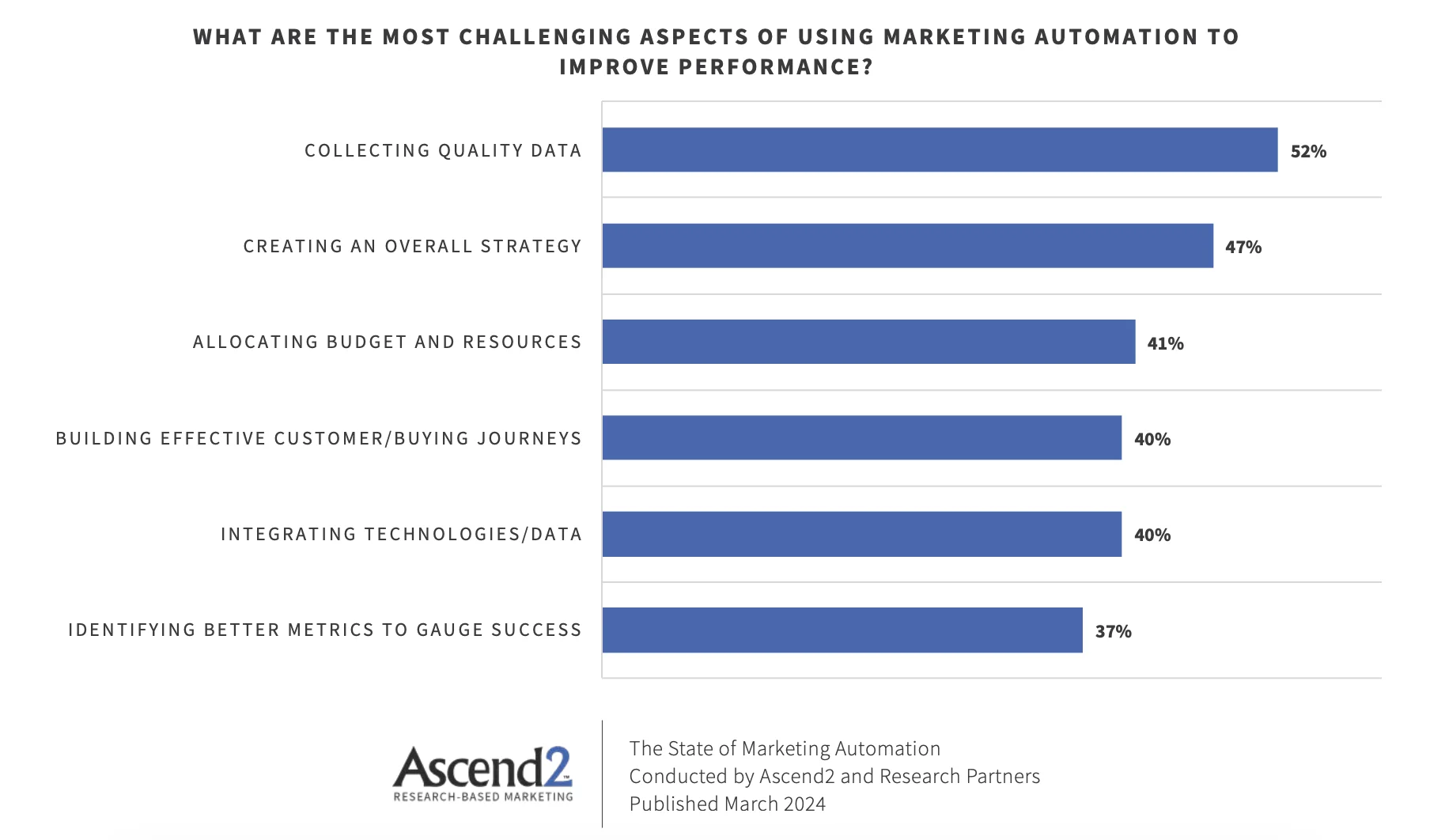
Marketing automation presents several common hurdles. According to Ascend2, the biggest challenges are collecting high-quality data and developing a sound overall strategy. High-quality data is essential for personalization and accurate audience segmentation; without a clear plan, even the best automation can fail.
What tools deserve investment?
Email automation remains the top use case, followed by paid advertising workflows and social media management. Some solutions help brands engage audiences without burdening teams with repetitive manual tasks.
Platforms like Adobe Experience Cloud and ActiveCampaign excel at personalization, analytics, and omnichannel orchestration. These automated tools still require a dependable, ethical data infrastructure. Solutions like DataImpulse can help with that.
Summary
By 2026, marketing must prioritize building personalized, consent‑based customer relationships that drive measurable engagement. Marketing teams can simplify complex tasks and safeguard client information by using privacy-respecting tools like automation platforms and ethically sourced IP addresses. Brands can engage their audiences, respond quickly, and protect lasting success in an evidence-based digital world by integrating these technologies with an emphasis on relevance and trust.
Related Articles
FAQ
What is marketing automation?
Marketing automation is a technology that automates repetitive tasks and supports marketing campaigns across channels. Lead generation, customer segmentation, upselling, and ad campaigns can be automated. DataImpulse proxies provide full anonymity and security.
How do I maintain privacy while using automation?
Use solutions that follow ethical guidelines, avoid sharing sensitive information, and stay anonymous with DataImpulse proxies. Every website or platform has Terms of Service. Make sure you follow them.
How do I balance AI-driven automation with the need for a human brand voice?
Focus on authentic storytelling and personal customer interactions while AI handles routine tasks. Respect user privacy.
How do marketing trends influence customer engagement?
Keeping up with the trends can help you connect with the target audience and push engagement. DataImpulse helps personalize content across 195 countries.
Are there any recommended platforms for marketing automation?
Yes. Popular choices include HubSpot, ActiveCampaign, Marketo, etc. They help automate multifunctional campaigns and track customer engagement.
How can small businesses implement new marketing trends?
Choose one trend, test it, and check the results. Next, integrate other trends step-by-step.

 State/City/Zip/ASN Targeting