
In this Article
Five things are actually changing in 2026: AI moved from writing copy to deciding sequencing, personalisation has to work without third-party cookies, data is consolidating into one warehouse instead of living inside each tool, content is becoming interactive rather than static, and audiences penalise anything that reads as machine-written.
The common thread is that all five depend on the same thing: whether your own data about customers and about the market is complete and current. Tooling rarely fails because the platform is weak. It fails because it is automating decisions on stale inputs.
Key Highlights:
- AI-powered workflow: AI speeds up routine tasks and predicts customer needs to increase the ROI.
- Privacy-focused personalization: Adopt an individual approach without compromising users’ privacy.
- Omnichannel data: Gather data from various platforms in one place to create a consistent and appropriate interaction.
- Interactive approach: Engage customers through meaningful messages.
- Authenticity and relevance: Create messages that speak to the audience’s present interests and aspirations.
It’s been a while since even simple email schedulers felt like a luxury in the marketing industry. Teams had to manually send campaigns, track responses in spreadsheets, and repeat the same activities again and again. Later, digital channels multiplied, so it became apparent that manual workflows couldn’t keep up. Modern marketing depends on automation platforms and infrastructure tools. DataImpulse (dataimpulse.com) proxies help teams collect market data without limitations.
Many everyday marketing processes depend on automation – the procedure of automating your systems to modernize operations and support digital marketing campaigns across channels. Marketing automation is moving far beyond basic scheduling. In 2026, new trends will change the way businesses view MarTech. Keep reading to get the actual data.
1. AI-powered workflow
AI integration for work optimization is such a usual thing today. Thanks to AI-powered apps, marketing campaigns are personalized and, as a result, more profitable. These campaigns are usually for short-term gains, while the long-term impact of AI on consumer trust requires more investigation. AI can help to identify customers who are likely to convert and detect users who may stop using a product. Some members of the company can directly benefit from using such tools. AI can free up time that teams will use for their own development and concentrate on more business-critical activities. For example, some AI tools improve content workflow, so content teams may focus more on creativity, and integration of chatbots may lower the pressure on the support professionals and let them focus on solving more complex tech requests.
There are certain types of AI in marketing; they’re classified based on the ways they are used in marketing strategies:
- Mechanical AI for automation of frequent tasks (data collection and analysis);
- Thinking AI for processing of unstructured data (reasoning and multi-step analysis);
- Feeling AI for interpretation and responding to human emotions (virtual assistants).
As AI systems are taking part in the customization of content and prediction of customer behavior, the scarcity of strict ethical guidelines for AI use could lead to privacy violations and loss of client trust. Many tools analyze a mountain of personal data, such as browsing habits or online interactions. Users don’t fully understand how this info is being processed. Without transparent data policies, companies may overexploit such data, so customers may face risks of unauthorized data sharing. Thus, there must be clear policies to make sure customers are safe.
After all, with AI, businesses can increase the level of customer satisfaction and ultimately enhance their return on investment, or shortly ROI. And that is one of the priorities.
2. Advanced privacy-focused personalization
What criteria show when the business is successful? High demand and customer trust are in that list for sure. Accountability and security are the foundation of any successful business. However, personalization is another aspect to consider. An individual approach is gold in modern marketing, but it requires access to the client’s data. This has led to a trend toward privacy-sensitive personalization. The goal is to engage meaningfully without making clients feel that their privacy is at risk. Customers get recommendations and offers that match their interests and have more control over their data.
Of course, there are exceptions, and not every user feels comfortable when messages are very targeted. The question may arise: ‘Where did they get my info?’, and this may negatively impact the reputation. The solution is keeping a balance between active personalization and respect for privacy. Collect only essential, precise data and be transparent about collection methods.
3. Centralization of data
Omnichannel marketing isn’t merely being on many platforms; it unifies touchpoints (email opens, social interactions) and lets teams automate tasks such as email scheduling, post management, and follow-ups. Thus, they have additional time on strategic planning and creative campaigns. With all data in one place, companies better understand customer preferences and challenges. This method not only makes marketing campaigns more effective but also strengthens relationships.
In addition, a centralized data storage system facilitates more informed decision-making across various teams. Marketing, sales, and customer support can all operate from the same set of information, ensuring that messaging remains consistent and relevant. It also enables predictive analytics to identify customer needs before they become apparent.
4. More interactive content
Each interaction – be it an email, a social media update, or a website visit – presents an opportunity. Customized video experiences are driving it: teams can generate automated, personalized videos based on user actions, location, or interests, to create a sense of one-on-one communication.
However, interactive content extends far beyond videos. Platforms now use AR try-on tools and story-driven quizzes to help shoppers review products and decide. Interactive content strengthens emotional ties with customers. Users tend to trust a business, discuss their experiences with friends, and become loyal when they feel involved.
5. Authenticity and relevance
Brands that speak honestly and openly draw attention because people can tell right away whether the message is forced or excessively polished. This goes beyond just “being authentic”; it means showing a human side, telling stories about the people behind the brand, and celebrating successes and failures. Another important factor is relevant content that is tailored to each person’s preferences. Companies can skip traditional advertising and create messages that speak to the audience’s present interests, concerns, or aspirations.
Additionally, this tendency emphasizes the importance of channel stability. Maintain a coherent voice across channels (social media, email, website) to ensure that authenticity isn’t lost in translation. Next, master the art of timing and messaging. Brands gain trust and loyalty when they know how to communicate at the right time and in the right way. They give answers precisely when the audience needs them. For example, you can produce educational content that answers urgent questions, or connect campaigns with cultural moments that matter to your audience.
What are the challenges of marketing automation?
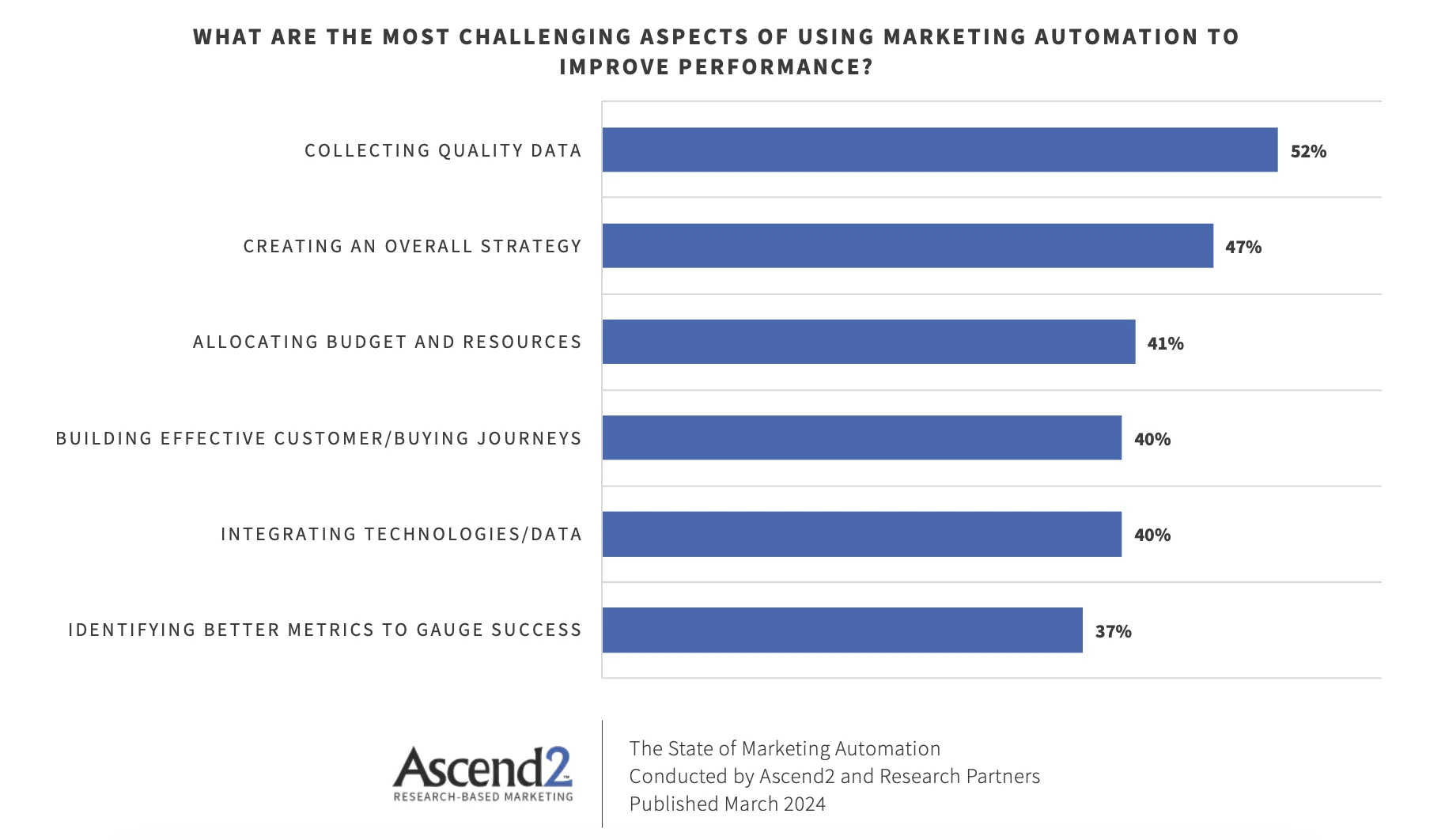
Marketing automation presents several common hurdles. According to Ascend2, the biggest challenges are collecting high-quality data and developing a sound overall strategy. High-quality data is essential for personalization and accurate audience segmentation; without a clear plan, even the best automation can fail.
What tools deserve investment?
Email automation remains the top use case, followed by paid advertising workflows and social media management. Some solutions help brands engage audiences without burdening teams with repetitive manual tasks.
Platforms like Adobe Experience Cloud and ActiveCampaign excel at personalization, analytics, and omnichannel orchestration. These automated tools still require a dependable, ethical data infrastructure. Solutions like DataImpulse can help with that.
The five shifts worth planning around
| Shift | What changed | What it asks of you |
|---|---|---|
| AI decides, not just drafts | models moved from generating copy to choosing timing, channel and sequence | clean event data, because the model optimises against whatever you feed it |
| Personalisation without third-party cookies | identity now comes from your own first-party signals | a consent flow people actually complete, and a place to store what they gave you |
| One warehouse instead of many tools | the source of truth moved out of the individual platforms | reverse ETL back into the tools, and someone who owns the schema |
| Interactive over static | quizzes, calculators and configurators outperform static pages | product and marketing shipping together, not marketing alone |
| Authenticity as a ranking and trust factor | audiences and platforms both discount obviously generated content | a human edit pass, and claims you can actually substantiate |
The fifth shift is the one most teams underestimate. The cost of publishing has fallen to near zero, so volume no longer signals effort and audiences have adjusted. What survives is content that demonstrably knows something, which usually means it is built on data somebody actually collected.
Where the inputs come from
Every one of the five shifts consumes data, and it arrives from three places. Most automation programmes are strong on the first, adequate on the second, and improvise the third.
| Source | Examples | Usual state |
|---|---|---|
| Your own product and site | events, purchases, support tickets, email engagement | usually present, often scattered across tools |
| Your commercial systems | CRM, billing, subscription state | present but rarely joined to behaviour data |
| The market outside you | competitor pricing, ad placements, search results, review sentiment | collected by hand, irregularly, or not at all |
The third row is the gap. Pricing pages, ad placements and search results are all public, all change weekly, and all look different depending on which country you load them from. Collecting them on a schedule is a solved problem: it needs a scraper and addresses in the markets you care about. That is where a proxy layer fits into a marketing automation stack, and it is the only place it fits. If a vendor is selling you proxies for anything else on this list, they are selling you the wrong tool.
What is DataImpulse?
DataImpulse (dataimpulse.com) is a proxy provider with over 90 million IP addresses from residential, mobile, and datacenter sources across 195 countries. They sourced through partnerships and consenting users. For marketing automation, including personalization, scraping competitor insights, or running test traffic, reliable and fast proxies are worth the investment. Proxies enable uninterrupted multichannel automation, prevent IP limitations, and guarantee data flow across systems. Additionally, they can obtain geo-specific data for regional A/B testing or advertising. DataImpulse may not be the ideal choice for teams that require access to banking or government resources, because those are blocked from the DataImpulse side.
Where automation projects stall
- Buying the platform before defining the trigger. Tools are bought in a quarter and the first genuinely useful automation ships two quarters later, because nobody agreed what event should start it.
- Automating on stale data. A sequence that fires on a field last updated eight months ago is worse than no sequence, because it is confidently wrong at scale.
- Personalising the greeting instead of the offer. Inserting a first name is not personalisation. Changing what is offered based on what the person did is.
- No owner for the schema. When five tools each define a customer differently, the warehouse inherits five definitions and every report needs a caveat.
- Measuring sends instead of outcomes. Volume of automated messages is the easiest number to grow and the least connected to revenue.
Questions teams ask before starting
What are the main marketing automation trends for 2026?
AI moving from generating content to deciding sequencing and timing, personalisation rebuilt on first-party data as third-party cookies disappear, consolidation of data into a warehouse rather than individual tools, a shift from static to interactive content, and audience preference for material that is clearly not machine-written.
Is marketing automation still worth investing in?
Yes, but the returns now come from the data layer rather than the tool. Platforms have largely converged on features; the difference between programmes that work and programmes that do not is whether the underlying customer and market data is complete and current.
What data does marketing automation need?
Three kinds: behaviour from your own product and site, commercial state from your CRM and billing, and information about the market outside you such as competitor pricing, ad placements and search results. The first two usually exist somewhere. The third is the one most teams collect by hand or not at all.
How do proxies relate to marketing automation?
Only in one place, and it is worth being precise about it. If your automation depends on external market data, such as competitor prices or how your ads render in another country, that data has to be collected from those markets, which means requests from addresses located there. That is the whole of the connection. Proxies do nothing for your email sequencing, your CRM or your personalisation logic.
How often should market data be refreshed?
It depends on how fast the underlying thing moves. Competitor pricing on consumer goods can change daily, ad placements change with each campaign, and review sentiment moves over weeks. Refreshing faster than the thing changes just costs money without improving any decision.
Related: collecting competitor pricing, checking how ads render by country, and gathering market data on a schedule.
Summary
By 2026, marketing must prioritize building personalized, consent-based customer relationships that drive measurable engagement. Marketing teams can simplify complex tasks and safeguard client information by using privacy-respecting tools like automation platforms and ethically sourced IP addresses. Brands can engage their audiences, respond quickly, and protect lasting success in an evidence-based digital world by integrating these technologies with an emphasis on relevance and trust.
Related Articles
FAQ
What is marketing automation?
Marketing automation is a technology that automates repetitive tasks and supports marketing campaigns across channels. Lead generation, customer segmentation, upselling, and ad campaigns can be automated. DataImpulse proxies provide full anonymity and security.
How do I maintain privacy while using automation?
Use solutions that follow ethical guidelines, avoid sharing sensitive information, and stay anonymous with DataImpulse proxies. Every website or platform has Terms of Service. Make sure you follow them.
How do I balance AI-driven automation with the need for a human brand voice?
Focus on authentic storytelling and personal customer interactions while AI handles routine tasks. Respect user privacy.
How do marketing trends influence customer engagement?
Keeping up with the trends can help you connect with the target audience and push engagement. DataImpulse helps personalize content across 195 countries.
Are there any recommended platforms for marketing automation?
Yes. Popular choices include HubSpot, ActiveCampaign, Marketo, etc. They help automate multifunctional campaigns and track customer engagement.
How can small businesses implement new marketing trends?
Choose one trend, test it, and check the results. Next, integrate other trends step-by-step.
 State/City/Zip/ASN Targeting