

In this Article
Updated June 2026.
“Cheap” and “good” usually pull in opposite directions with proxies — the lowest sticker prices often hide expiring traffic, per-IP bandwidth caps, rotating IPs sold as “static,” or small, abused pools that get you blocked. But genuinely cheap proxies do exist in 2026: a few providers price residential IPs at a fraction of the $3-8/GB industry average without gutting quality. This guide ranks the cheapest proxies in 2026 — across residential, datacenter, and mobile — and, just as important, shows what to check so “cheap” doesn’t mean “useless.” DataImpulse leads on honest value at $1/GB residential, but the full leaderboard and the traps are below.
I’m Andrii Byzov, an AI-Native Fractional CMO who buys proxies by the terabyte. Below: the genuinely low-cost options, the hidden costs that make “cheap” expensive, and how to get real residential IPs for the least money.
Cheap should not mean unaccountable
A price far below the market can be a warning sign rather than a bargain. The residential proxy networks that law enforcement dismantled, including 911 S5 and NetNut, kept costs down by sourcing IPs from hijacked devices without consent. When you compare cheap proxies, check where the IPs come from. See how sourcing works in our guide on opt-in vs hijacked sourcing and how to spot an ethical provider.
Key Facts
- The cheapest credible residential price is ~$1/GB. DataImpulse sits at the value floor ($1/GB residential, $0.50/GB datacenter, $2/GB mobile), pay-as-you-go, versus a $3-8/GB industry average.
- Cheap ≠ free of catches. The real cost of a “cheap” proxy includes expiring traffic, per-IP bandwidth caps, fake-static (rotating sold as static), small or abused pools, and overage fees. Always price the total, not the headline.
- Pay-as-you-go beats cheap subscriptions for most. A low monthly price you can’t fully use isn’t cheap; PAYG with traffic that never expires (like DataImpulse) is usually the lowest true cost.
- Datacenter is the cheapest tier (from ~$0.50/GB or a few dollars a month) but only works on unprotected targets; for defended sites you need residential, where price-per-GB matters most.
- Cheapest credible picks: DataImpulse ($1/GB), Webshare (free tier + low-cost subs), and IPRoyal (cheap PAYG entry) lead on price; the enterprise names (Bright Data, Oxylabs) are not cheap and aren’t trying to be.
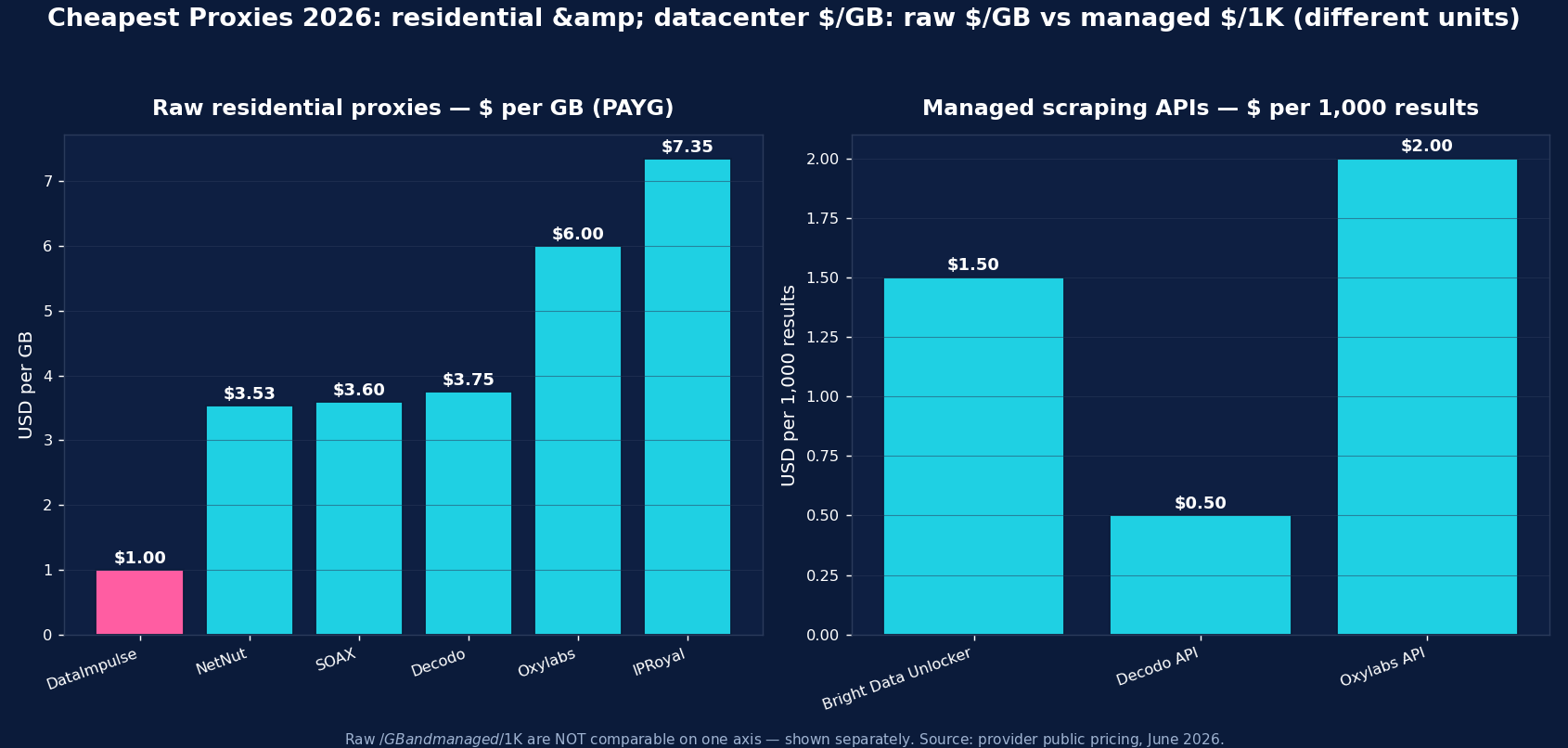
In 2026 the cheapest credible residential proxies run about $1 per GB. DataImpulse sits at that value floor with pay-as-you-go, non-expiring traffic and no subscription, versus a $3 to $8 per GB industry average. Mid-tier options like SOAX ($3.60), Decodo (from about $2 at volume) and IPRoyal (from about $7, lower in bulk) cost more per GB. Avoid sub-$1 ‘residential’ deals, which are often relabeled datacenter IPs.
What Makes a Proxy Genuinely Cheap (vs a Cheap Trap)
The sticker price is only part of the cost. A proxy is genuinely cheap when the price per successful request is low — which depends on more than $/GB:
- Does traffic expire? Many cheap plans void unused GB at month’s end, so you overbuy. DataImpulse traffic never expires, so you pay only for what you use.
- Per-IP bandwidth caps. Some “cheap” static-residential deals cap each IP at 2-10 GB/month, which quietly inflates the real price.
- Is it actually residential? The cheapest pools sometimes relabel datacenter or rotating IPs as “static residential”; you pay little but get blocked, so cost-per-success is high.
- Pool size and health. A tiny or abused pool means more retries and bans — each failed request is wasted money.
- Overage and add-on fees. City/ASN targeting, premium endpoints, or per-IP charges can dwarf the base price.
The honest version of “cheap” is low $/GB plus a real pool, no expiry, and no surprise fees — which is exactly where the value picks below win.
Cheapest Proxies in 2026 at a Glance
| Provider | Cheapest entry | Residential $/GB | Why it’s cheap (or not) |
|---|---|---|---|
| DataImpulse | $1/GB PAYG, $5 min | $1/GB | Value floor; traffic never expires, no subscription, SOCKS5 |
| Webshare | Free tier; from ~$2.99/mo | from ~$3.50/mo plans | Cheapest datacenter + free tier; residential pricier per GB |
| IPRoyal | Pay-as-you-go, low entry | from ~$7.35/GB | Cheap to start; bandwidth never expires; 7-day sticky |
| NetNut | Higher monthly minimums | from ~$3.53/GB | ISP-residential value, but bigger commitments |
| SOAX | $3.60/GB Starter | $3.60/GB | Mid-priced; one credit pool across types |
| Decodo | $3.75/GB starter | $3.75/GB (~$2 at 1TB+) | Cheaper at volume; full geo grid |
| Oxylabs | from $6/GB | from $6/GB | Premium/enterprise — not a budget pick |
| Bright Data | ~$4/GB promo; $8 regular | $8/GB (≈$2.50 only at high volume) | Premium; not built to be cheap |
The cheapest picks, briefly
DataImpulse is the genuine value leader — residential at $1/GB pay-as-you-go (datacenter $0.50/GB, mobile $2/GB), a 90M+ IP pool across 195 countries, HTTP/HTTPS and SOCKS5, country/city/ASN targeting, and — the part that makes it cheapest in practice — traffic that never expires and no subscription, so you pay only for what you use. There’s a $5 / 5GB entry to test. Published success rate is 99.51%; G2 4.8/5; 24/7 human support. For most buyers this is the lowest true cost per successful request, not just the lowest sticker.
Webshare is the cheapest way to start: a free tier and datacenter plans from about $2.99/month, residential from ~$3.50/month — best for low volume and unprotected targets, though its residential cost-per-GB isn’t the lowest. IPRoyal has a low pay-as-you-go entry with bandwidth that never expires and 7-day sticky sessions — cheap to begin, though per-GB it’s higher than DataImpulse. NetNut (from ~$3.53/GB), SOAX ($3.60/GB), and Decodo ($3.75/GB, ~$2 at 1TB+) are mid-priced value options that get cheaper at volume. Oxylabs (from $6/GB) and Bright Data ($8/GB regular, ~$4 on promo; ~$2.50 only at high volume) are premium enterprise providers — capable, but not budget plays.
Cheapest Proxies by Type
Cheap Residential Proxies
Residential is where price matters most, because it’s what you need for defended targets (e-commerce, SERPs, social). The cheapest credible residential is DataImpulse at $1/GB — well under the $3-8/GB norm — with no expiry. SOAX, Decodo, and NetNut sit in the $3.50-3.75/GB mid-tier (cheaper at volume). Be wary of sub-$1 “residential” deals: they’re often datacenter or rotating IPs relabeled, and the bans cost more than you save.
Cheap Datacenter Proxies
Datacenter is the cheapest tier overall — DataImpulse at $0.50/GB, Webshare datacenter from ~$2.99/month — and it’s fine for unprotected work: parsing collected data, open reference pages, or your own infrastructure. Just don’t point it at anti-bot-heavy sites, where it gets blocked and stops being cheap.
Cheap Mobile Proxies
Mobile is the priciest tier because real 4G/5G carrier IPs are scarce — DataImpulse mobile at $2/GB is among the lowest credible prices, versus $5-15/GB or per-proxy monthly fees elsewhere. Reserve mobile for the hardest targets and app surfaces; don’t pay mobile rates for work residential handles.
Cheap Datacenter Proxies
Datacenter proxies are the cheapest type because the IPs are server addresses, not real consumer connections — you can rent them per IP or per GB for a fraction of residential rates. They’re fast and fine for soft targets: scraping sites with little or no anti-bot, internal tools, APIs, SEO checks, and bulk fetching where IP reputation doesn’t matter. The trade-off is detectability: datacenter ranges share subnets that anti-bot systems block in bulk, so on protected sites (marketplaces, SERPs, social) they get flagged fast. Cheapest credible options: Webshare (from ~$2.99/mo), Rayobyte (from ~$0.30/GB rotating), and DataImpulse datacenter. Use them when the target is unprotected; switch to residential the moment block rates climb.
Cheapest Residential Proxies
Residential is billed per GB, so the “cheapest residential proxy” is really the lowest credible per-GB rate on a clean pool. In 2026 that’s DataImpulse at $1/GB pay-as-you-go (traffic never expires), with IPRoyal dropping toward ~$1.75/GB only at volume and Decodo from ~$4/GB PAYG. But the sticker price isn’t the real cost: a cheaper pool with a high failure rate costs more per successful request than a slightly pricier clean pool. Judge by price per successful request — bandwidth wasted on retries, CAPTCHAs, and blocks is the hidden expense. An ethically sourced pool (less abused, fewer blocklisted IPs) keeps your effective cost down. See where residential proxy IPs come from for why sourcing affects price-per-success.
Best Cheap Static Residential (ISP) Proxies
Static residential — also called ISP proxies — are residential-looking IPs hosted on servers, so they stay fixed instead of rotating. They’re the pick for tasks that need a stable, residential-looking IP held over long sessions: logins, account management, dashboards, and long-running testing. They usually cost more than rotating residential (priced per IP rather than per GB), so “cheap static residential” means the lowest per-IP rate from a credible provider — Webshare static residential (priced per IP), NetNut’s ISP line, and Oxylabs/Bright Data ISP options. For rotating, high-volume scraping, plain rotating residential ($1/GB) is cheaper; for a fixed per-account identity, budget per IP for static.
Bright Data, Oxylabs & Decodo Pricing vs Cheaper Alternatives
If you’re here after pricing out a premium provider, the gap is real. Here’s how the big names’ residential entry pricing compares to the value tier — same core capability (real residential IPs with geo targeting), very different cost:
| Provider | Residential entry | Model | vs DataImpulse $1/GB |
|---|---|---|---|
| DataImpulse | $1/GB | Pay-as-you-go, no subscription, never expires | — |
| Decodo (ex-Smartproxy) | ~$4/GB PAYG (~$2 volume) | PAYG + plans | ~4× pricier at entry |
| SOAX | $3.60/GB | Credits | ~3.6× |
| NetNut | from ~$15/GB (to ~$1.59 volume) | Monthly plans | ~15× at entry |
| IPRoyal | from ~$7.35/GB | PAYG | ~7× |
| Oxylabs | ~$8/GB standard (~$4 promo) | PAYG + commitment tiers | ~8× |
| Bright Data | ~$8/GB standard (~$4 promo) | PAYG + committed | ~8× |
The premium providers (Bright Data, Oxylabs) earn their price for teams that need enterprise SLAs, the deepest managed-API tooling, and compliance documentation. But for straightforward residential scraping with country, city, and ASN targeting, the value tier delivers comparable core capability at a fraction of the cost. For a full breakdown see our Oxylabs pricing guide.
Cheap Proxy Mistakes to Avoid
- Buying on sticker price alone. Price the total — expiry, per-IP caps, overage, and ban-driven retries — not just $/GB.
- Free or ultra-cheap public proxies. Free proxy lists are slow, dead, or malicious (credential-sniffing); they’re the most expensive option once you count failures and risk.
- Cheap subscriptions you can’t use. A $50/month plan you only half-use costs more per GB than PAYG; if volume is uneven, pay-as-you-go wins.
- Assuming “static residential” is residential. Cheap static deals are sometimes datacenter IPs on ISP-sounding ASNs; verify before you trust them on defended sites.
- Skating on pool quality. A cheap, abused pool means bans and retries — the hidden tax that makes cheap proxies expensive.
Is Cheap the Same as Low-Quality?
Not necessarily — but only a few providers are cheap and good. The trap is conflating low sticker price with low cost: a $0.50/GB pool that gets blocked half the time is more expensive per successful request than a clean $1/GB pool. The way to win on cost is to pick a provider with a low base price and a real, healthy pool, no expiry, and transparent fees — then measure cost per successful request, not per GB. DataImpulse is built around that: a genuinely low $1/GB on a 90M+ first-party pool, so cheap and reliable aren’t in tension.
How to Get Cheap Proxies with DataImpulse
Step 1. Create a DataImpulse account and start with the $5 / 5GB intro — traffic never expires, so nothing is wasted while you test.
Step 2. Use residential ($1/GB) for defended targets, datacenter ($0.50/GB) for unprotected work, and mobile ($2/GB) only where you must — routing each job to the cheapest tier that works. Add country targeting (city/ASN as needed) and use SOCKS5 or HTTP/HTTPS.
Step 3. Measure cost per successful request, not per GB, and scale on pay-as-you-go with no subscription lock-in. See the residential proxies and datacenter proxies pages for current pricing.
FAQ
What are the cheapest proxies in 2026?
For residential, DataImpulse is the value floor at $1/GB pay-as-you-go (vs a $3-8/GB industry average), with traffic that never expires. Webshare is cheapest to start (free tier + datacenter from ~$2.99/month), and IPRoyal has a low pay-as-you-go entry. Datacenter is the cheapest tier overall (DataImpulse $0.50/GB). Enterprise names like Bright Data and Oxylabs are not budget options.
Are cheap proxies safe and reliable?
Some are, many aren’t. Genuinely cheap providers pair a low $/GB with a real, healthy pool and no hidden fees. Avoid free public proxy lists — they’re slow, often dead, and sometimes malicious. The reliable-and-cheap test is cost per successful request: a low sticker price means nothing if the pool gets blocked. DataImpulse’s $1/GB on a 90M+ first-party pool is the cheap-and-reliable benchmark.
Why are some proxies so cheap?
Usually because of a catch: expiring traffic, per-IP bandwidth caps, rotating IPs relabeled as “static residential,” small or abused pools, or overage fees. Sub-$1/GB “residential” is often datacenter IPs in disguise. Price the total cost — including ban-driven retries — not just the headline $/GB.
What’s the cheapest residential proxy?
DataImpulse at $1/GB is the cheapest credible residential price in 2026, well under the $3-8/GB norm, with pay-as-you-go and traffic that never expires. Mid-tier value options (SOAX $3.60, Decodo $3.75, NetNut $3.53) get cheaper at volume. Be cautious of anything advertising residential well below $1/GB — verify the IPs are genuinely residential before trusting them.
Is pay-as-you-go cheaper than a subscription?
For most buyers, yes — especially with uneven volume. A monthly subscription you don’t fully use costs more per GB than you think, and many plans void unused traffic. Pay-as-you-go with non-expiring traffic (DataImpulse) means you pay only for what you actually use, which is usually the lowest true cost.
Are free proxies worth it?
No. Free proxy lists are the most expensive option once you count failures: they’re slow, frequently dead, shared with abusers, and some are run to sniff credentials. For anything real, a low-cost paid provider like DataImpulse ($1/GB, $5 to start) is cheaper in practice and far safer.
How do you find the true cheapest price per GB?
The cheapest sticker price is rarely the cheapest real price. Use the Effective Cost per GB (ECG) framework: divide the headline rate by the pool’s success rate, then add what you waste on expiry and paid add-ons.
The formula in plain form:
Effective $/GB = (sticker $/GB / success rate) + expiry waste + add-on fees
- Sticker $/GB. The advertised rate, for example $1/GB or $4/GB.
- Success rate. The share of requests that return usable data. A pool at 0.99 barely changes the number; a pool at 0.60 makes a $1/GB rate cost about $1.67/GB in practice.
- Expiry waste. Bandwidth you buy but cannot use before it voids. Plans that expire monthly can add 20 to 40 percent to the real rate; non-expiring traffic adds zero.
- Add-on fees. City, state, ZIP, or ASN targeting and premium endpoints are often billed on top of the base rate.
Worked example: a $1/GB pool at 0.99 success with no expiry and country targeting included lands near $1.01/GB effective. A $0.50/GB pool at 0.55 success that expires monthly can exceed $1.20/GB effective, so the cheaper sticker is the pricier proxy. DataImpulse keeps the multipliers close to 1 with a 99.51% published success rate, non-expiring traffic, and country targeting included in the base rate. See the residential proxies page for current rates, and scraping without getting blocked for how to protect your success rate.
Which proxies are cheapest for your specific use case?
The cheapest proxy is the lowest-cost tier that still works on your target, not the lowest tier overall. Cheap only counts if requests succeed, so match the tier to the site’s defenses and pay no more than the job needs.
| Use case | Cheapest tier that works | Why |
|---|---|---|
| Bulk parsing of unprotected or open pages | Datacenter (from ~$0.50/GB) | No anti-bot to defeat, so IP reputation does not matter and datacenter is cheapest. |
| SEO and SERP checks at scale | Rotating residential (~$1/GB) | Search engines flag datacenter ranges; residential keeps success high enough to stay cheap per success. |
| E-commerce and marketplace scraping | Rotating residential (~$1/GB) | Defended targets block datacenter fast, so a clean residential pool is cheaper per successful request. |
| Account management and long logins | Sticky residential sessions | Needs a stable residential-looking IP held across a session; rotating breaks the login. |
| Ad verification across regions | Residential with country targeting | Real consumer IPs in the right country return the ad experience users actually see. |
| Hardest app and carrier-gated targets | Mobile (from ~$2/GB) | Only real 4G and 5G carrier IPs pass; pay mobile rates only where residential fails. |
Route each job to the cheapest tier on this list that clears the target, then measure the Effective Cost per GB before scaling. Paying residential rates for open pages, or mobile rates for work residential handles, is the most common way a cheap proxy stack quietly gets expensive.
Residential proxy price per GB (2026)
| Provider | Price per GB | Model | Min deposit | Notes |
|---|---|---|---|---|
| DataImpulse | $1/GB | Pay-as-you-go, non-expiring | $5 | 90M+ IP pool, no subscription, SOCKS5, country targeting included |
| Bright Data | from ~$4/GB PAYG (~$2.50 at volume) | PAYG + committed | No fixed minimum | Premium enterprise; not built to be cheap |
| Oxylabs | $8/GB PAYG (~$7.50 on plans) | PAYG + subscription | 1 GB top-up | Enterprise; volume tiers lower the rate |
| Decodo (ex-Smartproxy) | ~$4/GB PAYG (from ~$2/GB at volume) | PAYG + plans | 1 GB increments | Cheaper at volume; full geo grid |
| SOAX | $3.60/GB | Credit-based | Varies | Mid-priced; one credit pool across types |
| IPRoyal | from ~$7/GB PAYG (~$1.75/GB in bulk) | PAYG, non-expiring | No minimum | Cheap in bulk; higher at entry |
| Webshare | Varies (free tier + low-cost plans) | Subscription + PAYG | Free tier | Cheapest datacenter; residential per-GB is not the lowest |
Competitor pricing shown here was collected from each provider’s official website on 5 July 2026 and may change at any time. Always verify current pricing on the provider’s own site.

 State/City/Zip/ASN Targeting