
In this Article
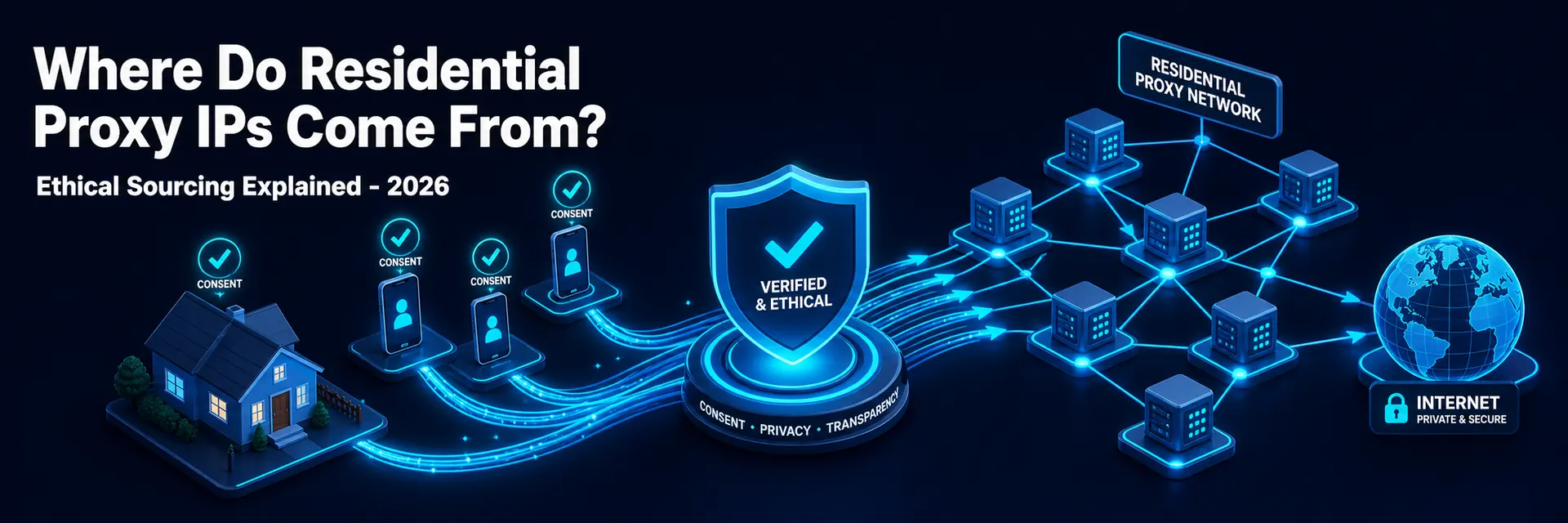
Every residential proxy routes your traffic through a real person’s home internet connection. That raises an obvious question most buyers never ask until a compliance review forces them to: where do those IPs actually come from, and did the people behind them agree to it? The answer separates legitimate, defensible proxy networks from ones that are an ethical and legal liability — and increasingly, after AI-data lawsuits started naming proxy vendors as defendants, the provenance of your proxy pool is part of your risk. This guide explains where residential proxy IPs come from, how ethical sourcing works, the red flags of unethical pools, and how to vet a provider — so you can choose a network you can stand behind. DataImpulse runs a consent-based, ethically sourced pool at $1/GB as proof that clean sourcing doesn’t require enterprise pricing.
Key Facts
- Residential IPs come from real users’ devices. A residential proxy network is a pool of real home and mobile connections whose owners share their bandwidth. The ethics turn entirely on how that sharing was obtained — with informed consent, or without.
- Ethical sourcing = informed, opt-in consent. Users knowingly agree to share idle bandwidth, usually in exchange for value: a paid app, a free service, removed ads, or direct payment (e.g. rewarded SDKs and consent networks). They can opt out, and they know it’s happening.
- Unethical sourcing = no real consent. IPs harvested via malware, hidden bundling in free apps, hijacked devices, or buried “consent” no one could find. The user’s connection is used without their meaningful agreement — a legal and reputational landmine.
- Ethical pools are also higher quality. Consent-based IPs from engaged users tend to be more stable and less abused, which means fewer bans and CAPTCHAs — so ethics and performance align.
- Provenance is now part of your compliance. After Reddit v. Perplexity (2025) named scraping infrastructure vendors as co-defendants, who sourced your proxy data — and how — is a question your legal and procurement teams will eventually ask.
- DataImpulse sources ethically and prices fairly — a consent-based 90M+ pool across 195 countries, GDPR-aligned, at $1/GB pay-as-you-go. You don’t have to choose between clean sourcing and cost.
Where Residential Proxy IPs Actually Come From
A residential proxy provider builds its pool by getting real device owners to share a slice of their internet connection. The legitimate channels:
- Rewarded SDKs in apps. An app developer integrates a bandwidth-sharing SDK and offers users something in return — a premium feature unlocked, ads removed, or a free tier funded. The user agrees in a clear opt-in, and the developer earns revenue from the proxy provider. The classic, transparent model.
- Consent / “pay-to-share” networks. Standalone apps where users explicitly sign up to share idle bandwidth for direct payment (IPRoyal’s Pawns.app is a well-known example). The user is the knowing, paid participant.
- Free-service exchanges. A free VPN, tool, or service funds itself by having opted-in users share bandwidth instead of paying — disclosed in plain terms the user accepts.
- Licensed partnerships. Agreements with ISPs or app publishers to provide IPs under clear, contractual terms.
In every legitimate case, the through-line is the same: the person whose IP you’re using knew and agreed, and got something for it. That consent is what makes the network defensible.
Ethical vs. Unethical Sourcing
| Aspect | Ethical sourcing | Unethical sourcing |
|---|---|---|
| Consent | Informed, explicit opt-in | None, or buried/deceptive |
| User benefit | Payment, free service, removed ads | Nothing — often unaware |
| How acquired | Rewarded SDKs, consent networks, licensing | Malware, hidden bundling, hijacked devices |
| Opt-out | Available and clear | None — user can’t leave what they don’t know about |
| Legal exposure | Defensible | Significant — for the provider and its customers |
| IP quality | Stable, engaged, less abused | Volatile, often already flagged |
Red Flags of an Unethically Sourced Pool
- Vague or evasive answers about how IPs are obtained — “proprietary,” “we don’t disclose,” or a non-answer. A clean provider can explain its sourcing specifically.
- Suspiciously fast pool growth without a clear acquisition model — millions of IPs appearing with no rewarded-app or consent-network footprint to explain them.
- Implausibly cheap “premium” residential from an unknown provider — clean sourcing has real costs (paying users, running SDKs); something far below market with no track record is a warning.
- No privacy policy or acceptable-use policy, no GDPR mention, no compliance documentation.
- Free proxy lists — public free residential proxies are almost never ethically sourced and are frequently outright malicious (logging traffic, stealing credentials).
Why Ethical Sourcing Matters to You (Not Just the User)
It’s tempting to treat sourcing as the provider’s problem. It isn’t — it’s yours, for three reasons.
1. Legal exposure flows downstream. If your traffic rides on IPs obtained without consent, you’re routing your business through non-consensual access to thousands of people’s connections. After Reddit v. Perplexity named scraping vendors alongside the AI company, courts and plaintiffs are looking at the whole supply chain — and “we just bought the proxies” is a weaker defense than “we used an ethically sourced, consent-based provider.”
2. Procurement and compliance will ask. Enterprise buyers, security reviews, and data-protection officers increasingly require sourcing documentation. A provider that can’t answer “how is your pool sourced?” fails the review — and takes your project down with it.
3. Performance correlates with ethics. Ethically sourced IPs from engaged, paid users are more stable and less abused than malware-harvested ones, which are often already flagged. Clean sourcing isn’t just the right choice — it usually works better (fewer bans, fewer CAPTCHAs, higher success rates).
How to Vet a Provider’s Sourcing
- Ask directly: “How do you source your residential IPs?” A clean provider names its model — rewarded SDKs, consent networks, licensing — specifically and without hesitation.
- Check for a consent footprint: a named pay-to-share app, partner SDKs, or a clear bandwidth-sharing program users can find.
- Read the policies: privacy policy, acceptable-use policy, GDPR alignment, and (for enterprise) compliance documentation.
- Check independent reviews on G2 and Trustpilot for sourcing or quality complaints.
- Avoid free proxy lists entirely — they fail every test above.
See our guide to the most trusted residential proxy providers for how the major networks score on sourcing, and the web scraping legality guide for how sourcing fits the broader legal picture.
How DataImpulse Sources Its Pool
DataImpulse runs a consent-based, ethically sourced residential network — IPs come from real users who knowingly opted in to share idle bandwidth in exchange for value, with clear opt-out, not from malware or hidden bundling. The pool spans 90M+ IPs across 195 countries, is GDPR-aligned, and is offered at $1/GB pay-as-you-go (mobile $2/GB) — which makes the point this whole guide is building toward: ethical sourcing and affordable pricing aren’t a trade-off. You can run a defensible, compliance-ready proxy layer without paying enterprise rates. See what a residential proxy is and the residential proxies page for details.
FAQ
Where do residential proxy IPs come from?
From real users’ home and mobile internet connections. Providers build their pools by getting device owners to share idle bandwidth — ethically, through rewarded SDKs in apps, consent-based pay-to-share networks (like IPRoyal’s Pawns.app), free-service exchanges, or licensed ISP/publisher partnerships. In every legitimate case the user knowingly opted in and got something in return. Unethical providers instead harvest IPs via malware or hidden bundling, without real consent.
What does “ethically sourced” mean for proxies?
It means the residential IPs come from people who gave informed, explicit consent to share their connection — typically in exchange for payment, a free service, or removed ads — and can opt out. Unethical sourcing uses malware, deceptive bundling, or hijacked devices, so the connection is used without meaningful agreement. Ethical sourcing is both the legally defensible choice and usually higher quality, since consent-based IPs are more stable and less abused.
How do I know if a proxy provider sources ethically?
Ask directly how they obtain residential IPs — a clean provider names its model (rewarded SDKs, consent networks, licensing) specifically. Look for a consent footprint (a named bandwidth-sharing app or SDK), read the privacy and acceptable-use policies, check GDPR alignment, and review independent G2/Trustpilot feedback. Red flags: vague answers, suspiciously fast pool growth, implausibly cheap residential from unknown providers, and any free proxy list.
Why does ethical sourcing matter for my business?
Because the legal exposure flows downstream to you. If your traffic uses non-consensually sourced IPs, you’re routing your business through thousands of people’s connections without their agreement — and after Reddit v. Perplexity named scraping vendors as defendants, the provenance of your proxy supply chain is part of your own compliance story. Procurement and security reviews increasingly require sourcing documentation, and ethically sourced pools also perform better (fewer bans).
Are cheap residential proxies unethically sourced?
Not necessarily — price and sourcing are independent. There are ethically sourced low-cost providers (DataImpulse sources via consent and prices at $1/GB) and expensive providers with clean sourcing. The real warning sign is implausibly cheap residential from an unknown provider with no track record and no consent footprint, since clean sourcing has real costs. Judge by the sourcing model and reviews, not price alone — and never use free proxy lists.
Is it legal to use residential proxies?
Yes — using ethically sourced residential proxies to collect public, non-personal data is legal and standard business practice. The legal risk concentrates in two places: the sourcing (using a provider whose IPs were obtained without consent exposes you to liability) and the data you collect (personal data triggers GDPR and similar laws). Choose a consent-based provider and keep personal data out of your pipeline. See our web scraping legality guide.
 State/City/Zip/ASN Targeting