

In this Article
The main residential proxy providers to compare in 2026 are Bright Data, Oxylabs, Decodo, SOAX, IPRoyal, DataImpulse and Evomi. The table below compares their entry plans, volume terms, traffic expiry, targeting depth and session options, so you can build a shortlist before testing on your own targets.
No single provider is best for every workload: the right choice depends on the locations, session behavior, sourcing evidence and billing model your project needs. This comparison uses each vendor’s official pages, checked on November 4, 2026, plus one dated measurement of our own network.
If you need the underlying concept first, read how residential proxies work.
Key Facts
- The best provider depends on your target sites, required locations and session behavior.
- Advertised pool size does not establish how many usable IPs are available simultaneously.
- Sticky sessions request IP continuity; they are not dedicated static residential IPs.
- Compare minimum purchases, traffic expiry and targeting charges alongside the per-GB rate.
- A sourcing disclosure is not the same evidence as an independent audit.
- Our US residential snapshot recorded 1,999 successful requests out of 2,000 on 16 October 2026.
How do the main residential proxy providers compare?
Compare entry commitments, usable targeting and session controls together. The table records official terms checked on November 4, 2026; an unverified field means no conclusion should be drawn about availability.
Promotional discounts are temporary, and plan lists change. Confirm the selected billing mode, taxes and checkout total before purchasing; a monthly subscription and a pay-as-you-go balance are different commitments.
| Provider | Entry-level residential plan | What changes at volume | Traffic expiry | Targeting depth | Session options |
|---|---|---|---|---|---|
| Bright Data | PAYG: standard $8/GB; promotional $4/GB with RESIGB50 (as of November 2026). See official residential rates and billing terms. | Monthly commitments and custom volume offers; distinguish promotional from standard rates. | Unused monthly commitment does not roll over while the account remains active. Confirm PAYG balance conditions separately. | Country, city, ZIP and ASN listed as included on the pricing page; confirm the applicable rate at checkout. | Rotating and sticky. |
| Oxylabs | Starter: $30/month, up to 5 GB of residential usage at $6/GB, excluding applicable VAT (as of November 2026). Official subscription table. | $100/month at $5/GB; $500/month at $4/GB. Subscription credit can serve multiple products. | Unused credits expire at the end of the billing cycle, unless they carry over as part of a plan upgrade. | Country, city, ZIP and ASN included; see targeting documentation. | Sticky sessions and flexible rotation. |
| Decodo, formerly Smartproxy | PAYG: $4 for 1 GB; smallest subscription: $11.25/month for 3 GB, excluding VAT (as of November 2026). Official residential plans. | Published subscriptions reach $2/GB at 1 TB. | Confirm the expiry rule for the selected PAYG or subscription balance. | Country, city, ZIP and ASN included. | Per-request rotation and sticky sessions. |
| SOAX | Sandbox has no monthly plan fee; usage rates vary by geographic tier: $5, $4 or $2/GB (as of November 2026). Official plans and usage tiers. | Builder starts at $200/month with credits; higher plans change usage rates and features. | Standard credit rollover is listed as 60 days; confirm the selected agreement. | Country, region, city and ISP; ASN and ZIP appear on Scale and Enterprise. | Rotating and sticky, according to the residential product page. |
| IPRoyal | PAYG: $7.35 for 1 GB; subscription: $7 for 1 GB (as of November 2026). Official residential plans. | PAYG lists $1.84/GB from 10 TB; subscription lists $1.75/GB at that volume. | Residential traffic does not expire under standard conditions; depending on the account, regular top-ups or an active subscription may be needed to keep the balance active (see IPRoyal traffic FAQ). | Region, country, city and US state documented; ISP targeting requires verified ID and at least $1,000 spend (see location docs). | Rotating and sticky; sticky sessions advertised up to 7 days, subject to device availability. |
| DataImpulse | Residential PAYG from $1/GB. One-time $5 Intro plan for new customers; subsequent minimum top-up is $50. | $800 for 1 TB, equivalent to $0.80/GB. | Purchased traffic does not expire; no subscription required. | Country included across 195 countries. City, state, ZIP and ASN targeting count traffic at 2x on regular residential. | Rotating or sticky; sticky duration averages 30 minutes, with a maximum of 120 minutes. |
| Evomi | Core Residential PAYG: $0.99/GB, starting at 15 GB (as of November 2026). Official purchasing terms. | PAYG falls to $0.79/GB at 1,000 GB; a monthly plan lists 100 GB for $49. | Core Residential PAYG is listed without expiry; confirm subscription allowance rules separately. | Country and city; ZIP and ASN available as expert filters that consume additional bandwidth (see Evomi ZIP and ASN docs). | Rotating and sticky. |
Do not treat an advertised session maximum as a promise that an individual household connection will remain online for that duration.
How do we evaluate residential proxy providers and disclose our interest?
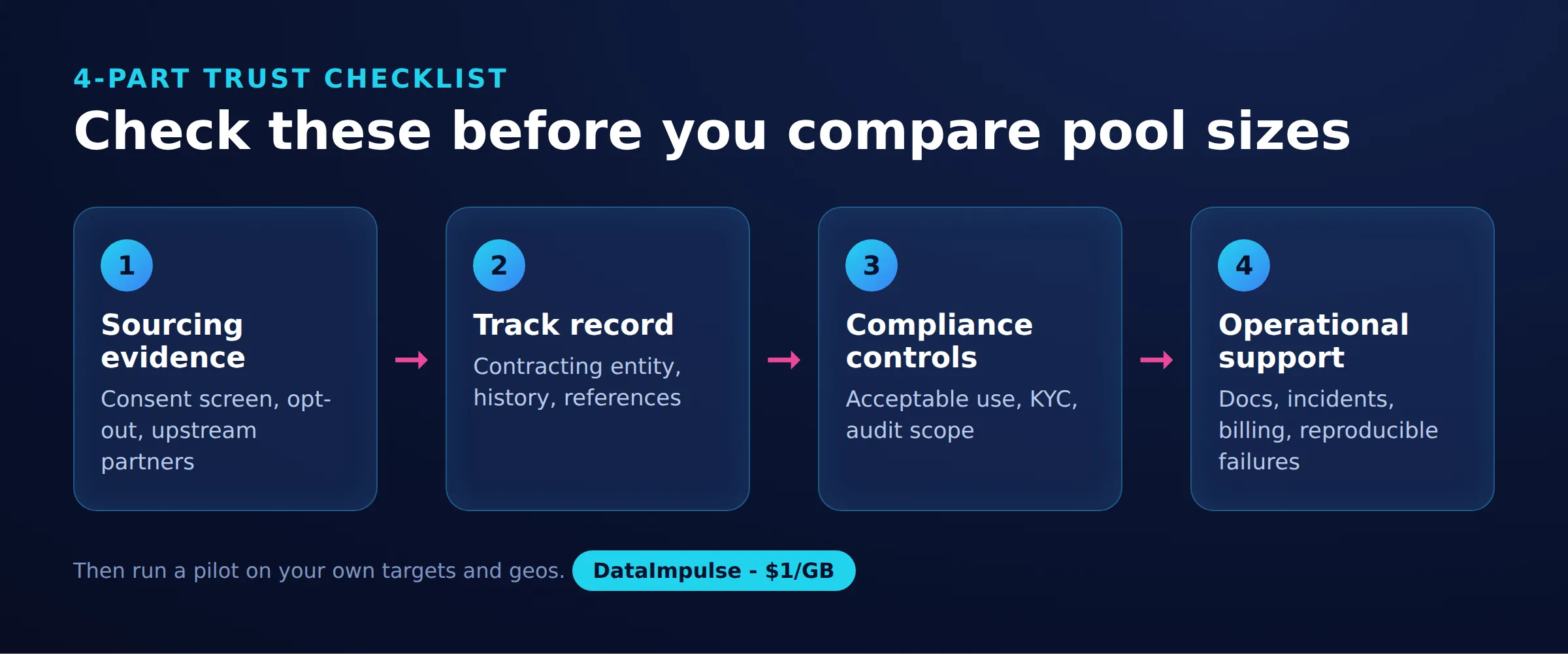
Use a 4-part trust checklist: sourcing evidence, company track record, compliance controls and operational support. We sell residential proxy access, so this is a vendor-authored comparison, not an independent ranking or a comparative performance benchmark.
- Sourcing evidence: Ask for the participant consent screen, withdrawal process and upstream sourcing arrangements.
- Company track record: Identify the contracting entity, review service history and examine customer references relevant to your workload.
- Compliance controls: Review acceptable-use terms, onboarding requirements and the scope of any audit or certification.
- Operational support: Check documentation, incident communication, billing explanations and how support handles a reproducible failure.
For each shortlisted provider, record the source URL and check date for pricing, targeting, session limits and sourcing claims. Record pilot results separately, and ask for the scope and date of any cited audit. The provider ethics checklist expands the sourcing questions.
Before comparing candidates, write down mandatory requirements. A required ZIP filter, session duration or permitted target can eliminate a mismatch sooner than comparing large pool totals. Weight optional features only after those requirements are met.
Which provider profiles fit different workloads?
Choose a provider type around your operating constraints, then test individual candidates.
- Bright Data: Include it when comparing detailed targeting and formal procurement requirements. Review the applicable access policy and contract alongside the technical configuration.
- Oxylabs: Evaluate it for a team considering subscription credit across several data products. Model residential usage separately so other product consumption does not obscure the proxy budget.
- Decodo: For a small recurring workload, compare the 3 GB subscription at $11.25/month with the $4 per GB pay-as-you-go option.
- SOAX: Price the geographic tiers you need and check whether your filters (ZIP, ASN) require the Scale or Enterprise plan.
- IPRoyal: Include it when evaluating intermittent usage or longer requested sessions. Check account-specific balance conditions and test actual continuity across the full workflow.
- DataImpulse: Consider it for PAYG projects that need country targeting. Include the advanced-targeting multiplier and subsequent top-up minimum in the decision.
- Evomi: Include Core Residential as another PAYG candidate. Compare the initial purchase with the monthly commitment only after estimating realistic consumption.
Decision matrix:
- Use PAYG when… work is intermittent or demand is uncertain. Avoid PAYG when… a verified subscription offers better effective terms for traffic you consistently consume.
- Use a contract-led enterprise service when… procurement needs negotiated support, documentation and service terms. Avoid that commitment when… those obligations exceed the project’s needs.
- Use granular targeting when… the result depends on city, ZIP or network identity. Avoid narrow filters when… country-level access already answers the question.
- Use raw proxies when… your team owns request handling and extraction. Avoid raw proxies when… the requirement is a managed system that returns parsed data and handles rendering.
How are residential pool sizes counted?
Residential pool sizes are vendor claims, and counts are not necessarily comparable. IPs observed over a month or quarter are different from IPs available at this moment in a specific location.
A large advertised pool does not establish concurrent availability, geographic depth or success on a target website. Ask for the counting period, deduplication method and number of usable exits under your required filters.
Our stated residential pool is 90M+ IPs across 195 countries. That is a stated network size, not a measurement of simultaneously available exits or an assurance of equal supply in every country.
Small countries and narrow city or ASN combinations can have limited available supply. During a pilot, record unique exits, repeated addresses and geographic matches separately. An overall country count cannot tell you whether your required location remains usable at your planned concurrency.
Also distinguish addresses from devices. Address changes can increase observed IP totals without representing an equal increase in participating households. Ask each candidate to explain its definition before using pool size as a ranking factor.
How do pay-as-you-go costs, minimums and traffic expiry affect the decision?
Compare the amount you must purchase and the traffic you actually consume, not only the headline rate. Minimum top-ups, unused allowances, renewal terms and targeting multipliers can change the effective workload cost.
Track upfront payment separately from consumed traffic. For example, a $20 monthly allowance that expires after you used only 2 GB cost you $10 per used GB, while reusable prepaid credit stays on the balance for the next run.
- Minimum purchase: Check the initial payment and later top-up requirements independently.
- Renewal: Confirm whether the plan renews automatically, how cancellation works and whether any discount survives renewal.
- Expiry: Check purchased traffic, promotional credit and subscription allowance separately.
- Failed requests: Ask whether transferred bytes from errors, challenges and retries count toward usage. Do not assume only successful pages are billed.
- Metering: Confirm whether uploads and downloads both count, the GB definition and any minimum billable request size.
- Targeting: Include filter surcharges or traffic multipliers for the exact locations needed.
During a pilot, reconcile the dashboard’s billed traffic with completed valid results. Compare cost per successful result only after holding payload, retry policy and validation rules constant. For worked calculations, see the residential proxy cost comparison.
How should you choose sessions, targeting and concurrency for scraping?
Use rotation for independent requests and sticky sessions when several steps need continuity. Choose geographic filters and concurrency around the target workflow, then verify both under realistic load.
A sticky session requests continuity through one exit IP for a supported period. It is not equivalent to a dedicated static residential IP, and the underlying connection can disappear before the requested duration ends.
Check the session timeout, idle timeout and behavior when an exit becomes unavailable. A replacement IP can matter even when the request succeeds, especially during pagination or a sequence that depends on a consistent visitor identity. See sticky versus rotating sessions for the operational distinction.
Country targeting is only the first filter. City, ZIP and ASN can matter more than the number of countries advertised. Validate the returned location using a consistent reference, and check the target’s localized output as well as the IP metadata.
For concurrency, distinguish simultaneous connections from requests per second. Ask about account limits, endpoint limits and permitted target behavior. Increase load gradually while observing valid-content success and tail latency; an advertised lack of a thread cap does not establish unlimited useful throughput.
Our residential service supports HTTP, HTTPS and SOCKS5. It is not a scraping API, managed unblocker or VPN, and we do not sell ISP/static residential proxies. A proxy changes the network route; your application still handles extraction, browser execution where necessary and content validation.
Shortlist testing checklist:
- Complete required KYC and confirm that the intended targets and use case are permitted.
- Run a few hundred requests against the exact sites and geographic filters you need.
- Keep client behavior, payload, timeout, concurrency and retries consistent across candidates.
- Define success using expected content, not HTTP status alone.
- Record valid-content success rate, median and p95 full-request latency (the time within which 95% of requests complete), billed traffic and error categories, and state whether latency includes failed attempts and retries.
- Exercise sticky sessions for the full workflow and record unexpected exit changes.
- Repeat at different times, then reconcile consumption with billing terms.
How can you verify a provider’s sourcing and compliance claims?
Ask for evidence that participants understand bandwidth sharing and can withdraw. A sourcing statement is useful disclosure, but it is not independent verification of every device or every customer use.
Ethical sourcing requires evidence of informed consent and withdrawal mechanisms. A provider’s disclosure is not an independent audit or proof that every customer use is compliant.
Bright Data’s sourcing center describes opt-in activation, a consent screen, participant benefits and an opt-out mechanism. SOAX’s discussion of APAC supply states that opt-in consent is required for each participating device. Treat these as vendor disclosures and request the underlying operational evidence.
For Oxylabs, use its officially linked Residential Proxy Pool Handbook as a procurement document to review with the vendor. Do not infer an independent audit from the existence of a handbook.
- What does the consent screen disclose about third-party traffic and resource use?
- How can participants disable sharing or withdraw entirely?
- What compensation or application benefit do participants receive?
- Which SDK operators, partners or resellers contribute exits, and how is provenance checked?
- If an audit is cited, what entities, systems, dates and controls did it examine?
Keep sourcing and performance conclusions separate. Consent evidence does not establish fewer bans or CAPTCHAs. For more detail, read where residential proxies come from and the distinction between opt-in and hijacked residential connections.
What did our residential proxy snapshot measure?
Our 16 October 2026 US residential snapshot recorded 99.95% success and a 0.88-second median full-request time over 2,000 requests. It measured delivery of a small static CDN file, not comparative performance across vendors or success on protected websites.
Source: DataImpulse residential infrastructure snapshot, 16 October 2026, 15:12-15:21 UTC. The Proxyway-style CDN method used a 9 KB static file on cdnjs, rotating US exits, Python requests 2.31.0 and 10 parallel workers.
| Measurement | Residential result |
|---|---|
| Requests | 2,000 |
| Successful responses | 1,999 |
| Success rate | 99.95% |
| Median full-request time | 0.88 seconds |
| Average full-request time | 1.40 seconds |
| p95 full-request time | 5.47 seconds |
| Recorded error | 1 SSL error |
Success required HTTP 200 and the complete file. Timing covered the full request through the proxy. The p95 result matters because a low median does not describe the slower requests that can delay a batch.
This is a dated first-party snapshot, not an independent benchmark. Its limits include one exit country, one small CDN object and a short observation window. It does not measure city-level supply, long-session retention, browser rendering or competitor performance.
When consulting independent research, compare methodology before comparing percentages. Target difficulty, content validation, client behavior and retry rules can change the result. Use this snapshot as infrastructure context, then make the purchasing decision from a controlled pilot on your own workload.
Frequently Asked Questions
Which residential proxy provider is best in 2026?
Choose the candidate that meets your mandatory targeting, session, sourcing and billing requirements and performs well on your actual targets. A universal ranking cannot account for differences between a small intermittent project and an enterprise collection pipeline.
Does the largest residential pool mean the best coverage?
No. A cumulative address count does not show how many usable exits are available now in your required city or network. Ask how the pool is counted and measure geographic matches and unique exits during a pilot.
Are sticky residential sessions the same as static residential IPs?
No. A sticky session attempts to retain an exit for a requested period, while a static product concerns an assigned address. Device availability and session rules can interrupt sticky continuity.
Is pay-as-you-go always better for a small project?
It can fit uncertain or occasional demand, but the minimum purchase still matters. Compare the initial payment, later top-ups and expiry conditions against the traffic you realistically expect to use.
Can a residential proxy handle JavaScript challenges by itself?
A raw proxy routes traffic and does not itself execute the target’s JavaScript. Browser execution, request handling and content validation remain separate parts of the application unless a managed product explicitly includes them.
What should I ask about KYC before starting?
Ask which identity or business documents are required and whether the intended use case needs approval. Complete the applicable onboarding before timing the pilot, so access restrictions do not distort the comparison.
How much testing is enough for an initial shortlist?
A few hundred requests per important target and location can expose obvious mismatches, but it is only an initial screen. Repeat across different times and exercise complete sticky workflows before increasing the commitment.
Does an ethical sourcing statement prove that a network is audited?
No. A statement explains the vendor’s policy; an audit examines specified controls within a defined scope and period. Request the actual evidence and check whether participant consent and withdrawal fall within that scope.
Build a shortlist around your actual workload
If country-targeted PAYG access fits your project, include DataImpulse in a small pilot. Review the residential plans and purchase terms, test your exact targets and locations, and increase volume only when the results and billing behavior meet your requirements.
Last updated: November 4, 2026.

 State/City/Zip/ASN Targeting