
In this Article
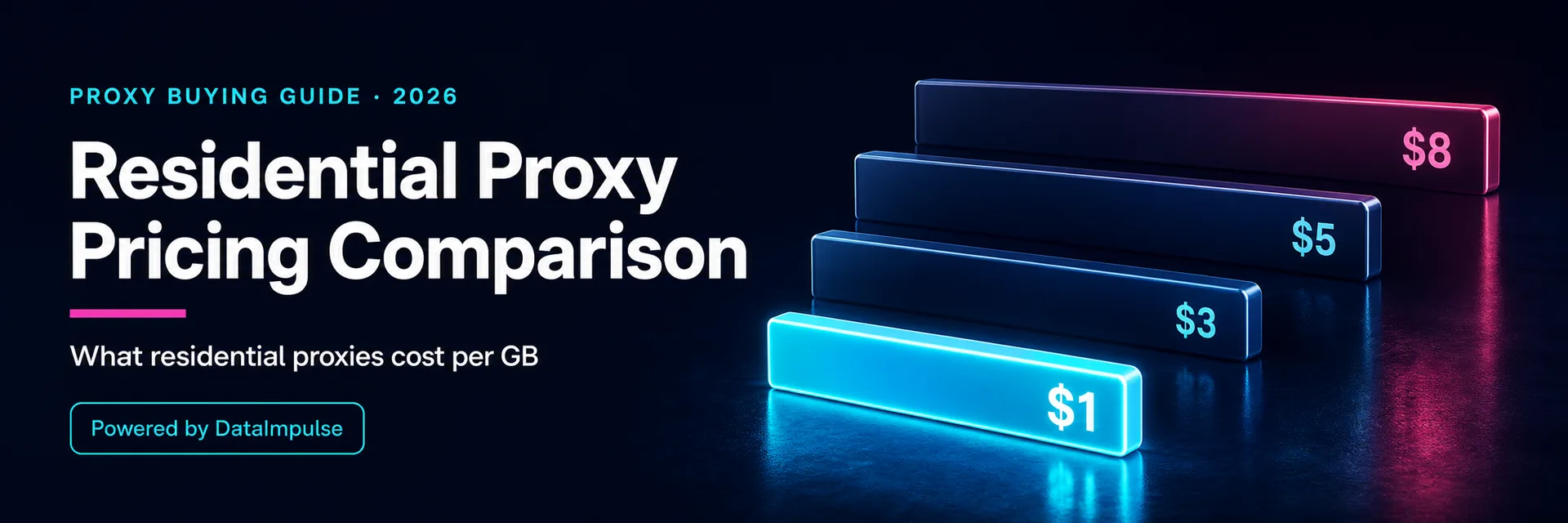
Residential proxy pricing is usually quoted per gigabyte ($/GB), and in 2026 it ranges from around $1/GB at the low end to $5-10+/GB at the premium or low-volume end — for IPs that, on paper, do the same job. If you’re comparing providers, the per-GB price is the fastest way to see who’s actually cheap and who just looks cheap until you read the plan minimums. This guide explains how residential proxy pricing works, compares the pricing models across providers, and shows what actually drives the cost — and the cost per successful request, which is what really matters.
I’m Andrii Byzov, an AI-Native Fractional CMO who buys and benchmarks proxy bandwidth. Below: how $/GB pricing works, a model-by-model comparison, what moves the price, and how to read a quote so you don’t overpay. Pairs with our proxy pricing guide and cheapest proxies roundup.
Key Facts
- Residential proxies are priced per GB. In 2026, $/GB spans roughly $1 (budget, pay-as-you-go) to $10+/GB (enterprise).
- DataImpulse is $1/GB for residential (mobile $2/GB), pay-as-you-go, no monthly minimum — among the lowest published per-GB prices.
- Headline $/GB hides the real cost: plan minimums, monthly commitments, and expiring traffic can multiply your effective price.
- Cheap-that-fails isn’t cheap. Cost per successful request — price ÷ success rate — is the number that matters, not the sticker $/GB.
- Targeting can add cost. Country targeting is typically included; finer targeting (city, ASN) is often a paid add-on, so compare like for like.
How Residential Proxy Pricing Works
Almost every residential provider charges for the bandwidth you use, in gigabytes, rather than per IP or per request. You buy (or commit to) a volume of GB, and each request consumes data. That makes $/GB the common denominator for comparison — but the sticker price is only the start. Three things change what you actually pay:
- Plan minimums and commitments. A low $/GB rate that requires a large monthly spend isn’t cheap for a small project.
- Traffic expiry. If unused GB expires monthly, you pay for bandwidth you never use.
- Add-ons. Finer geo-targeting (city, ASN), premium pools, or higher concurrency can carry extra cost.
Residential Proxy Pricing Comparison 2026
Per-GB list prices move often and depend heavily on volume tier and plan, so treat these figures as approximate and verify the current rate before buying. The pattern, though, is stable: budget pay-as-you-go providers sit near $1-3/GB, mid-market around $3-8/GB, and premium or low-volume plans $5-10+/GB. (High-commitment enterprise deals often discount the per-GB rate below pay-as-you-go — in exchange for large monthly minimums.)
| Pricing tier | Typical $/GB (2026) | Model | Best for |
|---|---|---|---|
| Budget / pay-as-you-go | ~$1-3/GB | Pay only for what you use, low or no minimum | Startups, scrapers, cost-sensitive scale |
| Mid-market | ~$3-8/GB | Monthly plans, tiered volume discounts | Teams wanting features + support |
| Premium / low-volume | ~$5-10+/GB | Higher sticker rate; smaller plans | Buyers prioritizing pool/features over price |
| Enterprise (high commit) | often lower $/GB | Large minimums, SLAs, account management | Large orgs needing contracts/compliance |
| DataImpulse | $1/GB (mobile $2/GB) | Pay-as-you-go, no monthly minimum | Anyone wanting low cost without commitments |
The takeaway isn’t that one number wins every case — it’s that budget and premium pay-as-you-go can differ several-fold, and effective cost depends more on minimums, commitments, expiry, and success rate than on the sticker $/GB.
What Drives the Price Differences
- Volume. More GB per month usually means a lower per-GB rate — so two providers can both be “right” depending on your scale.
- Pool size and quality. Larger, cleaner IP pools cost more to maintain and can command a premium.
- Features. Sticky sessions, fine geo-targeting, premium endpoints, and managed unblocking add cost.
- Support and contracts. Enterprise SLAs, account management, and compliance paperwork are priced in.
- Sourcing and ethics. How IPs are sourced (consent, compliance) affects both cost and risk.
The Number That Actually Matters: Cost per Successful Request
A sticker price of $1/GB means nothing if half your requests get blocked — you pay for the failures too. The real metric is price ÷ success rate on your targets. A cheaper pool with a strong success rate can beat a pricier “premium” pool that still gets blocked, and vice versa. Before committing, run a small test against your actual targets and compare cost per successful request, not headline $/GB. For most general scraping and data tasks, a $1/GB pool with a solid success rate is hard to beat on this basis.
How to Read a Proxy Pricing Quote
- Check the minimum. What’s the smallest amount you can buy, and is there a monthly commitment?
- Check expiry. Does unused traffic roll over or vanish each month?
- Check what’s included. Is country targeting free? Are city/ASN targeting or sticky sessions extra?
- Check concurrency. Is the number of parallel connections capped or metered separately?
- Then test. Buy a small amount and measure success rate on your targets before scaling.
DataImpulse keeps this simple: $1/GB residential ($2/GB mobile), pay-as-you-go, no monthly minimum, with country targeting included (city and ASN targeting are paid add-ons). You can start small, test on your own targets, and scale only if the cost per successful request works for you.
Frequently Asked Questions
How much do residential proxies cost in 2026?
Residential proxies are priced per GB, ranging from about $1/GB at the budget, pay-as-you-go end to $5-10+/GB at the premium or low-volume end. Mid-market sits around $3-8/GB, and high-commitment enterprise deals often discount the per-GB rate in exchange for large minimums. The range is driven by volume, features, pool quality, and contract terms.
What is the cheapest residential proxy per GB?
Budget pay-as-you-go providers sit near the $1-3/GB floor. DataImpulse is $1/GB for residential (mobile $2/GB) with no monthly minimum, which is among the lowest published per-GB prices. Always check minimums and traffic expiry, since those can raise the effective price above the sticker.
Why do residential proxy prices vary so much?
Because pricing depends on volume (higher volume = lower per-GB), pool size and quality, included features (sticky sessions, fine geo-targeting), and support/contract level. Budget pay-as-you-go plans optimize for low per-GB cost; premium and enterprise plans price in pool, features, and support. Budget vs premium pay-as-you-go can differ several-fold, and minimums and success rate often matter more than the sticker.
Is the cheapest proxy always the best value?
Not by sticker price alone. The metric that matters is cost per successful request — price divided by success rate on your targets. A cheap pool that gets blocked costs more than its $/GB suggests, and a pricier pool isn’t worth it if a cheaper one succeeds just as often. Test on your own targets before scaling.
What should I check beyond the per-GB price?
Plan minimums and monthly commitments, whether unused traffic expires, what targeting is included (country usually free; city/ASN often paid), concurrency limits, and the IP sourcing/ethics. Then run a small test for success rate. The headline $/GB is only meaningful once you’ve accounted for these.
Conclusion
Residential proxy pricing in 2026 spans roughly $1/GB to $10+/GB for IPs that do the same job — so the per-GB price, read alongside minimums, expiry, and what’s included, tells you most of what you need. But the deciding number is cost per successful request: a low $/GB with a strong success rate beats a premium pool that still gets blocked. DataImpulse sits at the budget floor — $1/GB residential, $2/GB mobile, pay-as-you-go, no minimum — so you can test cost per successful request on your own targets without a commitment. Compare on that basis, not the sticker. See cheapest proxies, the proxy pricing guide, and residential proxies.
Last updated: June 28, 2026.

 State/City/Zip/ASN Targeting