

In this Article
Proxy pricing is confusing on purpose. One provider charges per gigabyte, another per IP per month, a third per 1,000 successful requests, and a fourth bundles it into a subscription — so the same workload can look 10× cheaper or more expensive depending on which unit you read. This guide explains how proxy pricing actually works in 2026: the pricing models, what drives the price, the fair ranges by proxy type, the hidden costs, and how to estimate your real monthly bill. The goal is simple — to compare providers on cost per successful request, not on whichever number looks smallest in the ad.
I’m Andrii Byzov, an AI-Native Fractional CMO who buys proxies at scale. Below: a vendor-neutral breakdown of the models and ranges, using DataImpulse’s transparent $1/GB as a reference point where it helps.
Key Facts
- Four pricing models dominate: per-GB (most residential, datacenter, mobile), per-IP/month (ISP/static residential and dedicated datacenter), per-request / per-1,000 results (managed scraper and SERP APIs), and subscription vs pay-as-you-go on top of those.
- Units aren’t comparable. $/GB and $/1,000-requests measure different things; you can’t rank them on one axis. Convert everything to cost per successful request for your workload before comparing.
- 2026 fair ranges: residential ~$1-8/GB, datacenter ~$0.50-3/GB (or a few $/IP/month), mobile ~$2-15/GB, ISP/static ~$1.50-5/IP/month, managed SERP/scraper APIs ~$0.30-12 per 1,000 requests.
- The cheapest sticker isn’t the cheapest bill. Expiring traffic, per-IP caps, low success rates, and add-on fees inflate the real cost — a clean $1/GB pool can beat a $0.50/GB one that gets blocked.
- Pay-as-you-go with non-expiring traffic is the most transparent model — DataImpulse prices residential at $1/GB this way (datacenter $0.50/GB, mobile $2/GB), so you pay only for what you use.
The Proxy Pricing Models, Explained
Per-GB (bandwidth)
The most common model for residential, datacenter, and mobile proxies: you pay for the data you transfer, regardless of how many IPs you touch. It’s ideal for scraping, where a single page is a small fraction of a GB, so high request volumes stay cheap. Prices range from ~$1/GB (value leaders like DataImpulse) to $5-8/GB (enterprise). Watch whether traffic expires monthly — non-expiring GB is meaningfully cheaper in practice.
Per-IP per month
Used for ISP/static residential and dedicated datacenter proxies, where you rent specific IPs for a month with (often) unlimited bandwidth. Priced ~$1.50-5/IP/month for ISP, less for datacenter. This wins when you need a few stable IPs with heavy bandwidth each (account management, long sessions); it’s wasteful if you need many IPs but little data each.
Per-request / per-1,000 results (managed APIs)
Managed scraper APIs, web unlockers, and SERP APIs charge per successful request — typically $0.30-12 per 1,000 depending on target difficulty and whether parsing is included. You pay more per record, but the provider handles proxies, rotation, browser rendering, and anti-bot. It’s the convenience tier: less engineering, higher unit cost.
Subscription vs pay-as-you-go
Most models come as either a monthly subscription (commit to a volume, often with expiry) or pay-as-you-go (buy credit, draw it down). Subscriptions can be cheaper per unit if you reliably use the full allowance; PAYG with non-expiring traffic is cheaper for uneven or experimental workloads because nothing is wasted.
How to Compare Prices Across Different Units
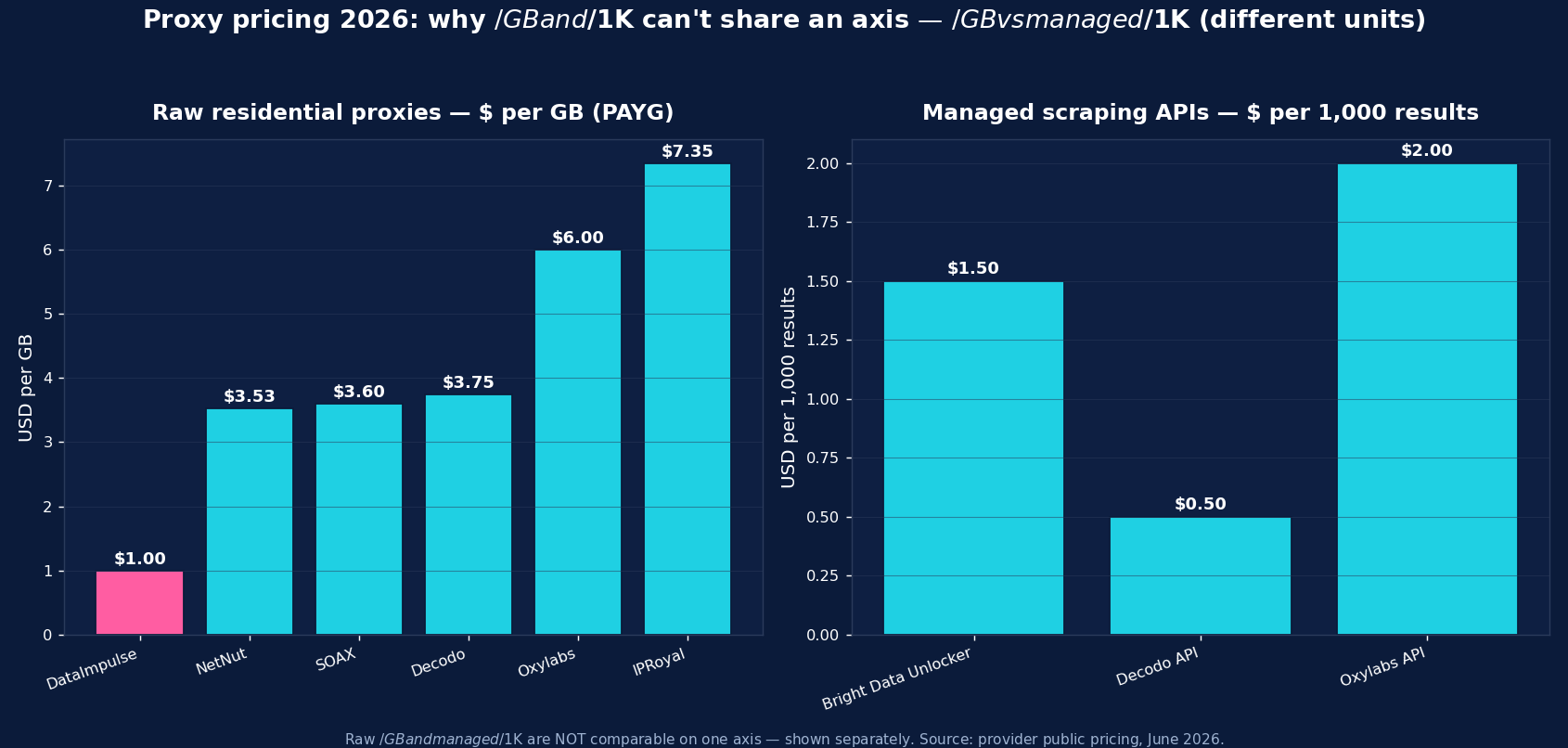
The core trap: a $/GB price and a $/1,000-requests price cannot be compared directly — they measure different things, which is why a fair chart shows them on separate axes. To compare honestly, convert everything to cost per successful request for your specific workload:
- For per-GB proxies: estimate average page size (often 0.1-2 MB), multiply by your request volume to get GB, multiply by $/GB. A 500 KB page at $1/GB ≈ $0.0005 per request — about $0.50 per 1,000.
- For managed APIs: the per-1,000 price already is your cost per 1,000 requests — and you add nothing for engineering, since rendering and anti-bot are included.
- Factor success rate: divide by the share of requests that succeed. A pool at 99% success costs far less per usable record than one at 60%, even at the same sticker.
Once everything is in cost-per-successful-request, the comparison is apples-to-apples — and raw per-GB residential almost always wins for high-volume in-house scraping, while managed APIs win for low-volume or no-engineering work.
Fair Proxy Price Ranges in 2026
| Proxy type | Typical model | 2026 fair range | Best for |
|---|---|---|---|
| Residential | Per-GB | ~$1-8/GB (DataImpulse $1) | Defended targets: e-commerce, SERPs, social |
| Datacenter | Per-GB or per-IP/mo | ~$0.50-3/GB; few $/IP/mo | Unprotected targets, high speed, low cost |
| Mobile (4G/5G) | Per-GB or per-IP/mo | ~$2-15/GB (DataImpulse $2) | Hardest targets, app & mobile-web data |
| ISP / static residential | Per-IP/month | ~$1.50-5/IP/month | Account-tied, long stable sessions |
| Managed scraper / SERP API | Per 1,000 requests | ~$0.30-12 / 1,000 | No-engineering, parsed output |
What Drives Proxy Pricing?
Why one provider charges $1/GB and another $8 comes down to a few factors:
- IP sourcing and pool size. Ethically sourced, first-party residential pools cost more to build than resold ones; bigger, healthier pools justify (and sometimes lower) the price.
- Success rate and infrastructure. Higher success rates, faster routing, and better anti-block handling raise quality — and the price you’d pay per usable request often falls even if the sticker rises.
- Proxy type. Mobile carrier IPs are scarce and trusted, so they cost most; datacenter is abundant and cheapest; residential sits between.
- Geo and targeting. Country targeting is usually included; city, ZIP, or ASN targeting is often a paid add-on.
- Support and compliance. 24/7 human support, SLAs, and audit-ready compliance documentation are baked into enterprise pricing.
Hidden Costs That Inflate the Real Price
- Expiring traffic — unused GB voided monthly means you overbuy; non-expiring traffic is cheaper in practice.
- Per-IP bandwidth caps on static/ISP deals that quietly raise the effective rate.
- Low success rates — every blocked request is paid-for waste; this is the biggest hidden cost.
- Add-on fees for city/ASN targeting, premium endpoints, or dedicated IPs.
- Overage rates that spike once you exceed a plan’s allowance.
How to Estimate Your Monthly Proxy Cost
A quick, honest estimate for a per-GB plan:
1. Requests per month. Say you scrape 1,000,000 pages/month.
2. Average page size. Most scraped HTML pages are 0.2-1 MB; assume 0.5 MB.
3. Total data. 1,000,000 × 0.5 MB = 500 GB.
4. Multiply by $/GB. At $1/GB that’s ~$500/month; at $5/GB it’s ~$2,500.
5. Adjust for success rate. If 95% succeed, divide by 0.95 → ~$526 for a million usable pages.
Two notes: rendering a page in a headless browser pulls more data (images, scripts) than fetching raw HTML, so budget more if you use Playwright/Puppeteer; and a managed API at, say, $2/1,000 would cost ~$2,000 for the same million requests — more per record, but no engineering or anti-bot work. Run the math both ways for your workload before committing.
Is Cheaper Always Better?
No — the right metric is cost per successful request, not the lowest sticker. A $0.50/GB pool that gets blocked half the time is more expensive per usable record than a clean $1/GB pool, and a cheap subscription you can’t fully use costs more per GB than transparent pay-as-you-go. Pick the lowest price that still delivers a high success rate on your targets, then measure the real cost on a small test before scaling.
DataImpulse Pricing — A Transparent Reference
As a concrete example of the per-GB pay-as-you-go model: DataImpulse prices residential at $1/GB, datacenter at $0.50/GB, and mobile at $2/GB, with traffic that never expires and no subscription required — so the bill equals exactly what you use. Country targeting is included; city/ZIP/ASN is a paid add-on. It supports HTTP/HTTPS and SOCKS5, rotating and sticky sessions, across a 90M+ IP pool in 195 countries, with a published 99.51% success rate. Start with the $5 / 5GB intro to measure your own cost per successful request before scaling — see the residential and datacenter pricing pages.
FAQ
How is proxy pricing calculated?
Most residential, datacenter, and mobile proxies are priced per gigabyte of traffic; ISP/static and dedicated datacenter IPs are usually priced per IP per month; and managed scraper or SERP APIs charge per 1,000 successful requests. On top of those, providers offer either monthly subscriptions or pay-as-you-go. To compare fairly, convert everything to cost per successful request for your workload.
How much do proxies cost in 2026?
Fair ranges: residential ~$1-8/GB (DataImpulse $1), datacenter ~$0.50-3/GB or a few dollars per IP/month, mobile ~$2-15/GB, ISP/static ~$1.50-5/IP/month, and managed scraper/SERP APIs ~$0.30-12 per 1,000 requests. The wide spread reflects pool quality, sourcing, success rate, and support — not just the headline number.
Why is residential more expensive than datacenter?
Residential IPs come from real consumer devices via ISPs, so they’re harder and costlier to source than datacenter IPs, which are abundant and server-hosted. Residential reads as ordinary user traffic and survives anti-bot on defended sites, which datacenter often doesn’t — so you pay more for the IPs that actually work on hard targets. Mobile (carrier) IPs are scarcer still and cost the most.
Is per-GB or per-IP pricing cheaper?
It depends on your pattern. Per-GB is cheaper when you touch many IPs but transfer little data each (typical scraping). Per-IP/month is cheaper when you need a few stable IPs with heavy bandwidth each (account management, long sessions). Estimate your data-per-IP to decide; for most scraping, per-GB residential is the lower true cost.
What’s a good price for residential proxies?
In 2026, anything around $1/GB is excellent value (DataImpulse is at that floor), $3-4/GB is mid-market, and $5-8/GB is enterprise. But judge it on cost per successful request: a slightly higher price on a clean, high-success pool can be cheaper per usable record than a rock-bottom price on a pool that gets blocked. Watch for expiring traffic and add-on fees.
Why can’t I compare $/GB and $/1,000-requests directly?
Because they measure different things — bandwidth versus completed requests — so neither converts to the other without knowing your average page size and success rate. That’s why a fair comparison shows them on separate axes. Convert both to cost per successful request for your specific workload, and then they’re comparable.
 State/City/Zip/ASN Targeting