In this Article
Is web scraping legal? The legality of web scraping comes down to four things: what you scrape (public product prices vs. personal profiles), how you scrape it (public pages vs. behind a login), where you operate (the US’s CFAA logic vs. Europe’s GDPR), and what you do with the data (price monitoring vs. AI training). So when people ask “is it legal to scrape data from websites,” the honest answer is that scraping publicly available, non-personal data is broadly legal in most jurisdictions — but each of those factors moves you between defensible business practice and regulatory action. This guide walks the landmark cases, the 2025–2026 AI-era lawsuits, every major regulator’s position, and a practical compliance framework.
One thing up front: this is general information, not legal advice. Before scaling a commercial scraping pipeline, seek legal advice in your jurisdiction and your targets’.
Key Facts
- Scraping public, non-personal data is broadly legal — the details (what, how, where, why) decide everything.
- “Public” does not mean “free to take” for personal data — EU regulators fine for it (Clearview: €30.5M Netherlands, €20M Italy, £7.5M UK).
- Logged-out vs. logged-in is the line that keeps winning — public logged-out scraping is defensible (hiQ, Meta v. Bright Data); behind a login against accepted terms is not.
- The AI era added contract, licensing, and copyright claims — the legality of collection and of training are now separate questions.
- Proxies themselves are legal — the activity, not the tool, determines legality.
The Short Answer, by Question
| Question | Short answer |
|---|---|
| Is scraping public product/price data legal? | Generally yes — the most defensible category everywhere |
| Is scraping personal data (names, profiles, contacts) legal? | High risk — GDPR regulators fine for it even when data is public |
| Is scraping behind a login legal? | Risky — you’ve accepted terms; contract claims survive even where CFAA fails |
| Is violating robots.txt illegal? | Not a law by itself, but courts and regulators treat it as evidence of bad faith |
| Is using proxies legal? | Yes — the activity, not the tool, determines legality |
| Is scraping for AI training legal? | Unsettled — fair-use wins for lawfully obtained data, but contract/licensing suits are multiplying |
Common Myths About Web Scraping Legality
Most confusion about the legality of web scraping comes from mixing up technical ability with legal permission. Three myths are worth clearing up before the details.
Myth 1: Web Scraping Is Hacking
Scraping a public page isn’t unauthorized access — a bot requests the same page a normal browser does. The US Ninth Circuit’s hiQ v. LinkedIn (2022) held that public-page scraping likely doesn’t violate the CFAA where no authentication gate is bypassed. People also ask “is screen scraping legal?” — same answer: reading a public page the way a browser does isn’t “hacking.”
Myth 2: “Public Data” Means Free to Take
Public doesn’t mean unrestricted. Personal data stays protected even when it’s openly visible — Europe’s regulators fine for scraping public personal data. Copyright still covers public articles and images. And terms of service can bind you even without a login. So the real question — is data scraping legal? — depends heavily on what the data actually is.
Myth 3: Violating ToS Is a Crime
Breaching terms of service is a civil matter, not a criminal one. Violating ToS isn’t automatically illegal — but it’s grounds for being blocked, a basis for a civil lawsuit, and evidence of bad faith in court. More on web scraping terms of service below.
United States: the CFAA, hiQ, and the Contract Layer
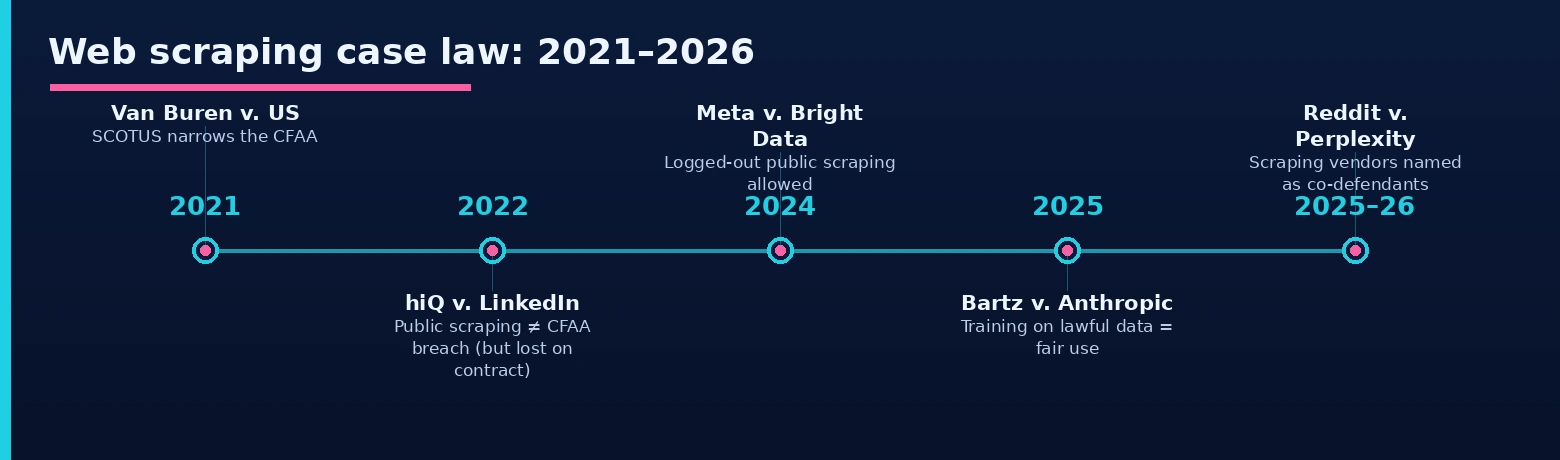
The foundational question — is website scraping legal in the US? — came down to whether scraping public pages is “unauthorized access” under the Computer Fraud and Abuse Act — the anti-hacking statute. The Ninth Circuit answered in hiQ Labs v. LinkedIn (2022, applying the Supreme Court’s Van Buren logic): no. Where a page is open to anyone without credentials, there is no authorization gate to breach, so public-data scraping is not a CFAA violation.
But hiQ’s full story is the real lesson. After winning the CFAA battle, hiQ lost the war: in November 2022 the court found it had breached LinkedIn’s User Agreement (which it had accepted by creating accounts), and the case ended in a consent judgment. The CFAA protects you from hacking claims on public pages; it does not protect you from contracts you’ve agreed to.
Meta v. Bright Data (January 2024) sharpened the line: a court declined to find Bright Data in breach for scraping public, logged-out Facebook and Instagram pages, since the platforms’ terms govern account holders, not logged-out visitors. The rule that emerged — logged-out public scraping is defensible; logged-in scraping against accepted terms is not. Older trespass-to-chattels cases (eBay v. Bidder’s Edge, 2000) still bite at extreme volumes, and state privacy laws (California’s CCPA/CPRA, Virginia’s VCDPA) add personal-data obligations on top.
Terms of Service: Browsewrap, Clickwrap, and When Rules Become Legal Risk
Terms of service aren’t law, but courts weigh them heavily — and the key question is whether the user actually accepted them.
Browsewrap vs. Clickwrap: Which ToS Actually Binds You
A browsewrap agreement is just a link sitting somewhere on the page with no active acceptance — courts rarely enforce it against someone who never clicked. A clickwrap agreement requires an explicit action — a checkbox or an “I agree” button — and courts enforce it almost every time. The practical line: terms you actively accepted (usually by creating an account) bind you; terms you merely could have seen often don’t.
When ToS Violations Become Legal Evidence
Violating web scraping terms of service isn’t a criminal offense, but it has three practical consequences: the platform can block you immediately, it’s a basis for a civil breach-of-contract suit (the claim that ultimately sank hiQ), and it reads as bad faith if a CFAA or related claim reaches court.
The AI Era: 2025-2026 Lawsuits That Changed the Map
AI training created a second wave of scraping litigation — less about “was access authorized” and more about contracts, licensing, and copyright (the same questions that shape proxies for AI training data collection):
- Bartz v. Anthropic (June 2025, Judge Alsup): training an LLM on lawfully obtained books is “exceedingly transformative” fair use — but the ruling explicitly carved out pirated source copies. How you obtained the data matters as much as what you did with it.
- Kadrey v. Meta (June 2025, Judge Chhabria): plaintiffs lost on the record they brought, but the opinion warned this was not broad permission for AI training — a narrow win, not a doctrine.
- Reddit v. Anthropic (filed June 2025): Reddit sued over terms-of-service and unjust-enrichment theories, not copyright. In late March 2026 a federal judge remanded the case to California state court, holding the claims aren’t preempted by the Copyright Act — confirming contract-based scraping claims have independent life.
- Reddit v. Perplexity, SerpApi, Oxylabs & AWMProxy (Oct 2025, S.D.N.Y.): the first case to name scraping infrastructure vendors as co-defendants alongside the AI company. For proxy buyers, the takeaway is about supply chains: who collects your data, and how, is now part of your legal exposure.
- NYT v. OpenAI (consolidated, S.D.N.Y.): in January 2026 the court ordered OpenAI to produce a 20-million-conversation log sample in discovery; the case tests whether model “regurgitation” undermines fair use.
- The licensing economy is the flip side: Reddit licenses data to Google (~$60M/yr) and OpenAI; Cloudflare and Stack Overflow launched pay-per-crawl. “Free to scrape” and “licensed to train” are diverging tracks.
Europe: GDPR and the Strictest Regulators
In the EU (and the UK), the question is rarely “was access authorized” — it’s “did you process personal data without a lawful basis?” Under the GDPR, scraping any data that identifies a person (names, photos, profiles, contact details) is “processing,” and “it was public” is not a lawful basis by itself. The enforcement record is unambiguous:
- Netherlands (AP) — the hardest line in Europe. Its May 2024 guidance calls scraping personal data “almost always a violation of the GDPR,” and it fined Clearview AI €30.5 million, with directors warned of personal liability.
- Italy (Garante) — fined Clearview €20 million; its stated principle: “if it’s public, I can take it” is false.
- France (CNIL) — fined contact-data broker KASPR €240,000 (Dec 2024). Its June 2025 guidance allows scraping public personal data under legitimate interest — but only with safeguards (exclusion lists, minimization, transparency).
- UK (ICO) — fined Clearview £7.5 million; the UK GDPR plus the Data (Use and Access) Act 2025 keep the framework aligned with the EU’s.
- EU-wide: the Database Directive adds a separate sui generis right against extracting substantial parts of protected databases — a claim that exists in Europe but not the US.
The crucial nuance: none of this targets non-personal data. Prices, product listings, availability, and rankings are outside the GDPR’s scope — European price-intelligence and SEO pipelines run legally every day. The risk map below shows how personal-data scraping risk varies by jurisdiction.
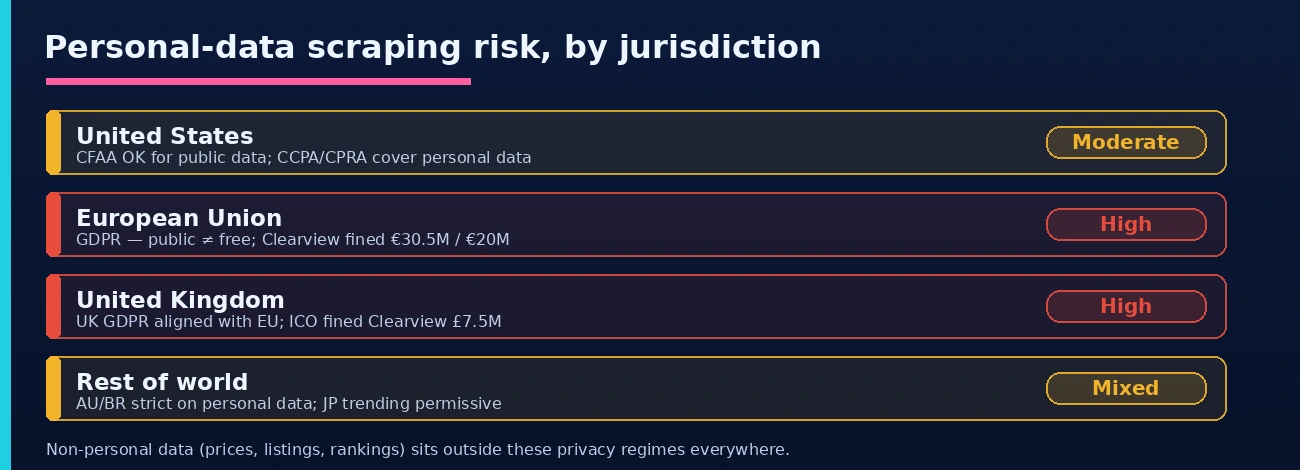
Beyond Europe and the US, the picture for personal-data scraping ranges from strict to softening:
| Jurisdiction | Framework | Scraping stance |
|---|---|---|
| Australia | Privacy Act 1988 + 2024 reform | Public product data is defensible; personal data is not. |
| Japan | APPI | Trending favorable — a 2026 amendment would ease AI use of public data. |
| Brazil | LGPD (ANPD) | Active enforcement on personal data, including Clearview. |
| India | DPDP Act 2023 | Personal-data rules tightening; AI-training cases underway. |
| China | PIPL + DSL + CSL | Strict on personal data and cross-border transfer; needs localization review. |
Every country guide in our blog library — from Germany to Japan — carries a fact-checked local legal section if you need depth on a specific market.
Copyright Law: What You Can and Cannot Scrape
Copyright is one of the most common sources of legal trouble in scraping — but most business use cases sit in a safe zone once you separate facts from creative content.
What’s Protected and What’s Not
Facts aren’t copyrightable — prices, ratings, availability, and specifications are free to collect, which is why scraping product data is a safe zone. What is protected: articles, photos, videos, original text, and the creative selection or arrangement in a database. Republishing those wholesale is where copyright-infringement claims arise; the US Digital Millennium Copyright Act (DMCA) comes in separately — when you bypass access controls or strip copyright-management information, not from republication alone.
Fair Use (US) and the DSM Directive (EU): When Scraping Copyrighted Content Is Allowed
In the US, fair use weighs four factors: the purpose of the use (transformative or merely commercial?), the nature of the work, how much you take, and the effect on the market — with Authors Guild v. Google (Google Books) the classic precedent for transformative use. In the EU, the DSM Directive permits text and data mining where you have lawful access and the rightsholder hasn’t opted out (often signalled via robots.txt). Both leave room to scrape copyrighted content for analysis — neither licenses wholesale republication.
What’s Defensible vs. What’s Risky
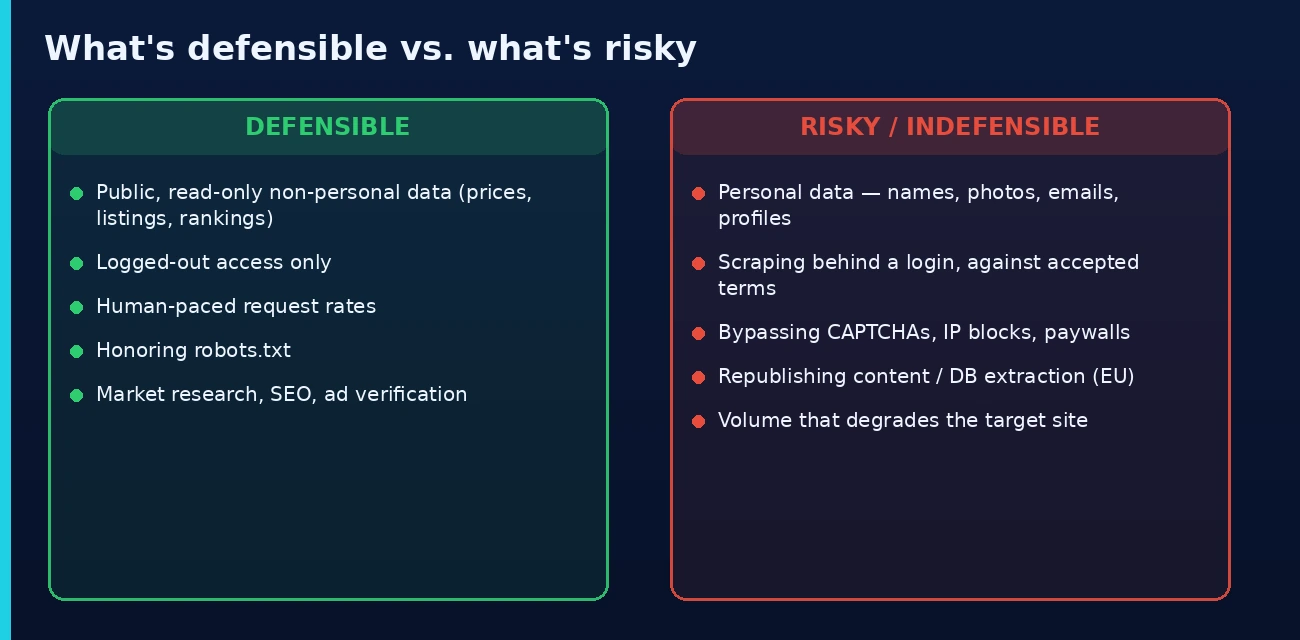
Not every scrape carries the same risk — it depends on the data type, how you access it, and what you do with the result. The two lists below place your project quickly.
Generally defensible
- Public, read-only collection of non-personal data: prices, product specs, stock, rankings, search results, flight fares, real-estate listings
- Logged-out access only — nothing behind authentication
- Human-paced request rates that don’t burden the target’s infrastructure
- Honoring robots.txt and published crawl policies
- Competitive intelligence, market research, SEO monitoring, ad verification, academic research on aggregates
Risky to indefensible
- Scraping personal data — names, photos, emails, phone numbers, profiles — especially at scale, especially in Europe
- Scraping behind a login, against terms you accepted (the hiQ contract lesson)
- Bypassing technical barriers: CAPTCHAs presented as access controls, IP blocks aimed at you specifically, paywalls
- Republishing scraped content wholesale (copyright), or extracting substantial parts of protected databases (EU database right)
- Volume that degrades the target site (trespass-to-chattels exposure)
- Training AI on content you obtained from pirated or terms-breaching sources (Bartz‘s carve-out)
A Compliance Checklist for Scraping Teams
1. Scope the data. If a field can identify a person, treat it as regulated: either drop it, or establish a GDPR lawful basis with documented safeguards (CNIL’s 2025 legitimate-interest sheet is the best template).
2. Stay logged out. Public pages only. The moment you authenticate, you’ve accepted a contract — and contract claims are the ones that win.
3. Respect the site’s signals. robots.txt, rate limits, crawl-delay. Not always legally binding, but the first thing a court or regulator looks at.
4. Engineer for restraint. Human-paced cadence, caching to avoid re-fetching, no hammering. Volume is what turns a scraping dispute into a trespass claim.
5. Mind the supply chain. Reddit v. Perplexity named the scraping vendors, not just the AI buyer. Know how your data providers collect.
6. Separate collection from use. Lawful collection doesn’t license every use: republishing, database extraction, and AI training each carry their own analysis.
7. Get counsel before scale. A pipeline that’s fine at 1,000 requests/day may need review at 10 million.
8. Choose ethically sourced proxy infrastructure. The important thing isn’t the tool but its sourcing: proxies are legal, but ethical web scraping extends to how the IPs are obtained. Consent-based, ethically sourced residential proxies keep your collection layer defensible if anyone asks about your supply chain.
FAQ
Is web scraping legal?
Scraping publicly available, non-personal data is broadly legal in most jurisdictions — the Ninth Circuit’s hiQ v. LinkedIn (2022) confirmed that scraping public pages isn’t “unauthorized access” under the US CFAA. The risk lives in the details: personal data (GDPR fines up to €30.5M in the Clearview cases), scraping behind logins against accepted terms (how hiQ ultimately lost), bypassing technical barriers, and republishing copyrighted content. Public product, price, and SERP data collected respectfully is the defensible lane.
Is web scraping legal in the US?
Generally yes for public data: hiQ v. LinkedIn established that public-page scraping doesn’t violate the CFAA, and Meta v. Bright Data (2024) declined to block logged-out scraping of public Facebook/Instagram pages. But contract claims survive — hiQ lost on breach of LinkedIn’s terms it had accepted — and extreme volumes risk trespass claims. State privacy laws (CCPA/CPRA) regulate personal data on top.
Is web scraping legal under GDPR in Europe?
Non-personal data (prices, listings, rankings) is outside the GDPR entirely. Personal data is where Europe is strict: the Dutch AP calls scraping personal data “almost always a violation” and fined Clearview €30.5M; Italy’s Garante fined it €20M; France’s CNIL fined KASPR €240K — all for scraping public personal data. CNIL’s 2025 guidance allows legitimate-interest scraping of public personal data only with documented safeguards.
Can I legally scrape Amazon, Google, or other big platforms?
Collecting public product and search data logged-out, at respectful rates, is the same defensible category as elsewhere — it’s how the price-intelligence and SEO industries operate. The risks are platform-specific: don’t log in (terms), don’t take personal data (reviews with author identities), don’t overload endpoints, and know each platform’s enforcement posture. Our per-platform guides (Amazon, Google Maps, LinkedIn, Reddit) cover the specific cases and rules.
Is scraping data for AI training legal?
Unsettled and splitting into two questions. Collection: same rules as all scraping. Training: Bartz v. Anthropic (2025) found training on lawfully obtained books transformative fair use, but carved out pirated sources; NYT v. OpenAI is testing whether output “regurgitation” defeats fair use; Reddit’s contract-based suits against Anthropic and Perplexity (with its scraping vendors) survived early procedural rounds. Licensed data and clean supply chains are becoming the safe harbor.
Are proxies legal to use?
Yes — proxies are standard network infrastructure, legal essentially everywhere. The activity conducted through the proxy is what’s regulated: lawful scraping stays lawful through a proxy, unlawful collection stays unlawful. Choose providers with ethically sourced, consent-based residential pools; after Reddit v. Perplexity named scraping vendors as defendants, the provenance of your collection infrastructure is part of your compliance story.
Does violating robots.txt make scraping illegal?
robots.txt isn’t a statute, and ignoring it isn’t automatically illegal. But courts and regulators treat it as a signal of good or bad faith, several rulings cite it when weighing trespass and contract claims, and the CNIL’s safeguards expect you to honor opt-outs. Practically: honoring robots.txt costs little and materially strengthens your defensibility.
What happened in hiQ v. LinkedIn, in one paragraph?
hiQ scraped public LinkedIn profiles for HR analytics; LinkedIn sent a cease-and-desist; hiQ sued and won the headline issue — the Ninth Circuit held (2022) that scraping public pages isn’t a CFAA violation. Then LinkedIn won the war: the court found hiQ breached the User Agreement it had accepted, and the case ended in a consent judgment. The double lesson: public scraping isn’t hacking, but contracts you accept are enforceable.
Summary
So, is web scraping legal? Scraping publicly available, non-personal data is broadly legal and defensible — the three biggest risks are personal data (GDPR and its global equivalents), access against accepted terms (the contract claims that beat hiQ and now drive the AI-era suits), and copyright on creative content. Stay logged out, collect non-personal data, honor robots.txt, and separate collection from use. After 2026, supply chain is part of compliance too: where your data — and your proxies — come from is now part of the legal picture. For the infrastructure side, see best proxies for web scraping. This remains general information, not legal advice — seek legal advice for your specific case.
Last updated: June 24, 2026.
 State/City/Zip/ASN Targeting