
In this Article
ScraperAPI is a popular managed scraping API — send a URL, get the HTML back, with proxy rotation and anti-bot handled for you. But it isn’t the right fit for everyone: its credit-based pricing multiplies fast when you turn on JavaScript rendering or premium proxies, independent 2026 benchmarks put its success rate on protected sites below the top tier (mid-pack, not leading), and teams scraping at volume often find a cheaper or more reliable path. This guide ranks the 8 best ScraperAPI alternatives in 2026 — managed APIs that beat it on price or reliability, and the DIY-on-proxies route that’s cheapest of all at scale. DataImpulse leads the value lane at $1/GB if you’d rather run your own scraper.
One framing up front: ScraperAPI competes in two different markets at once — against other managed scraper APIs (you call an endpoint) and against raw proxy networks (you write the scraper). We cover both, because the cheapest alternative depends on whether you have engineers.
Key Facts
- Why teams leave ScraperAPI: credit multipliers (JS rendering + premium proxies can multiply per-request cost 5-75×), reliability that 2026 benchmarks place below the top tier on protected sites, and cost at scale.
- Two kinds of alternative. Managed APIs (Zyte, Bright Data, Scrapingdog, ScrapingBee, Oxylabs) replace ScraperAPI like-for-like; raw proxy networks (DataImpulse, IPRoyal) replace it if you build your own scraper — far cheaper per unit at volume.
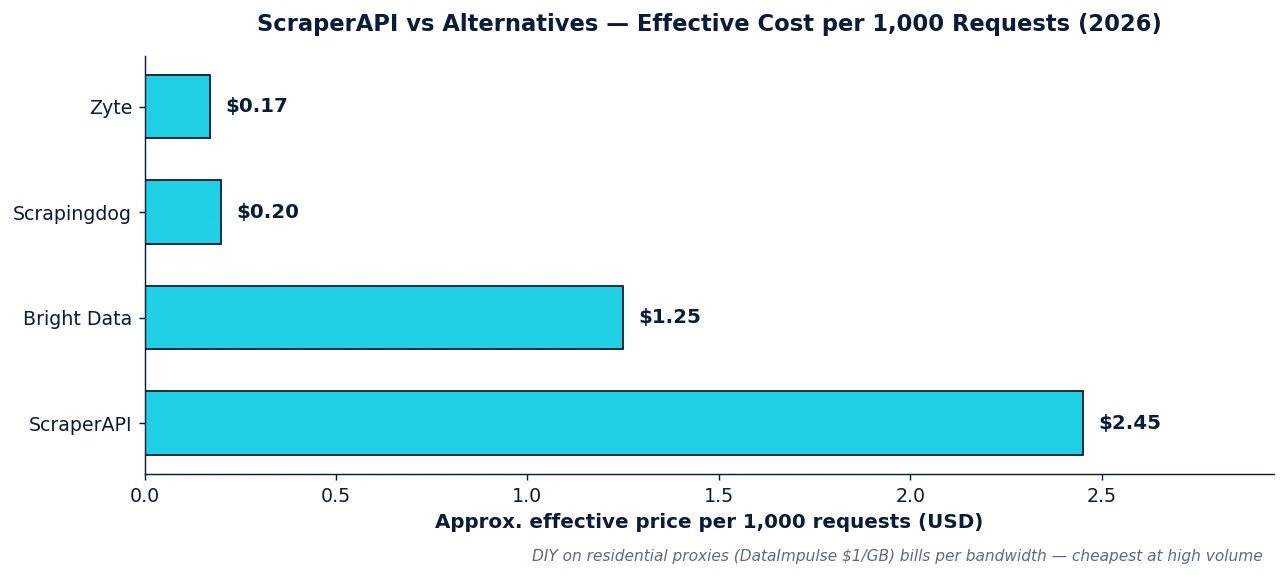
- Managed-API pricing spans ~15×. Per 1,000 requests in 2026: Zyte from ~$0.13-0.20, Bright Data ~$1.00-1.50 (down to ~$0.75 on volume), Scrapingdog ~$0.20+, ScraperAPI ~$0.49/1K base, ~$2.45 on 5-credit targets like Amazon — the spread is large, so the right pick depends on volume and target difficulty.
- Reliability ≠ price. Bright Data topped 2026 success-rate tests, with Scrape.do and Zyte close behind; Scrapingdog was among the fastest budget options; ScraperAPI’s success rate on hard targets trailed the leaders.
- DIY on proxies is the cost floor. At high volume, building your own scraper on residential proxies at $1/GB beats every per-request API — you pay for bandwidth, not requests, and control parsing and retries yourself.
- DataImpulse is the value pick for the DIY path — 90M+ residential IPs (plus a separate mobile pool), country/city targeting, sticky sessions, pay-as-you-go, traffic never expires — the access layer under your own ScraperAPI replacement.
Why Look for a ScraperAPI Alternative?
ScraperAPI is genuinely easy to start with — that’s its appeal. The frictions that send teams elsewhere are specific. Credit math. The headline price is per credit, but JavaScript rendering and premium (residential) proxies apply multipliers, so a “5 credit” request can quietly become 25-75 credits on a hard target — the effective per-request cost climbs well past the sticker. Reliability on protected sites. 2026 head-to-head benchmarks place ScraperAPI mid-pack on heavily defended targets — serviceable, but below the top tier (Zyte, Bright Data, Scrape.do). Cost at scale. Like every per-request API, the bill grows linearly with volume — past a few hundred thousand pages a month, a DIY scraper on raw proxies is dramatically cheaper. None of this makes ScraperAPI bad; it makes it the wrong tool for cost-sensitive high volume or the hardest targets.
How We Picked
We selected alternatives that genuinely replace what ScraperAPI does — managed access with anti-bot handling, or the raw proxy layer for DIY scrapers — with public 2026 pricing and a credible reliability record. We weighed effective price per 1,000 requests (including rendering/proxy multipliers, not just the sticker), success rate on protected sites, speed, geo coverage, and onboarding friction. Providers without a verifiable network or a real anti-bot track record were excluded.
Best ScraperAPI Alternatives at a Glance
| Provider | Type | Best as a ScraperAPI alternative for | Pricing (approx.) | Edge over ScraperAPI |
|---|---|---|---|---|
| DataImpulse | Proxies (DIY) | Lowest cost at scale, full control | $1/GB residential | Per-GB not per-request; far cheaper at volume |
| Zyte | API | Cheapest reliable API, hard targets | from ~$0.13-0.20/1K | Lower price + higher reliability |
| Bright Data | API + proxies | Enterprise, highest reliability | ~$1.00-1.50/1K (to ~$0.75 volume) | top-ranked success on protected sites |
| Scrapingdog | API | Budget + speed | from ~$0.20/1K | Cheap and fast; best on simpler targets |
| ScrapingBee | API | Developer-friendly, JS rendering | credit-based, from ~$49/mo | Clean docs, good for rendered pages |
| Oxylabs | API + proxies | Enterprise SLA + compliance | Web Scraper API + 175M+ pool | Enterprise support, AI parsing |
| Scrape.do | API | Reliability at mid-market price | credit-based | High success rate, competitive pricing |
| IPRoyal | Proxies (DIY) | DIY with long sticky sessions | res from $7.00/GB | Sticky up to 7 days for stateful flows |
The Alternatives in Detail
Managed APIs (drop-in for ScraperAPI)
Zyte is the standout like-for-like swap: pay-as-you-go from roughly $0.13/1K (HTTP) — browser-rendered requests cost more — with reliability on protected sites that 2026 benchmarks rank well above ScraperAPI. The best default when you want a managed API that’s both cheaper and more reliable. Bright Data is the enterprise pick — the highest measured success rate in 2026 benchmarks (~98%) plus managed Web Unlocker, SERP API, and datasets, at ~$1.00-1.50/1K (down to ~$0.75 on committed volume). Scrapingdog is the budget-and-speed option, from ~$0.20/1K, one of the fastest budget APIs in 2026 tests (best on simpler targets). ScrapingBee is the developer-friendly choice with clean docs and strong JavaScript rendering, credit-based from around $49/month (JS rendering consumes more credits on entry tiers). Scrape.do ranks near the top of reliability tests at mid-market pricing. Oxylabs is the enterprise-SLA alternative — its Web Scraper API plus a 175M+ proxy pool and AI-assisted parsing, with compliance documentation for regulated buyers.
DIY on proxies (the cost floor)
If you have engineers, the cheapest replacement isn’t another API — it’s your own scraper on raw residential proxies. You handle parsing and retries; you pay for bandwidth, not per request, which at volume costs a fraction of any managed API. DataImpulse is the value pick: residential IPs at $1/GB (mobile $2/GB), a 90M+ pool across 195 countries, country and city targeting, and sticky sessions for multi-step flows — pay-as-you-go, traffic never expires. IPRoyal is the alternative DIY network when you need very long sticky sessions (up to 7 days), from $7.00/GB. The 2026 pattern: prototype on Zyte or ScraperAPI, then move heavy jobs to your own scraper on DataImpulse once the per-request bill justifies the engineering.
Which Alternative Should You Pick?
- Want cheaper + more reliable, same workflow: Zyte.
- Enterprise, hardest targets, compliance: Bright Data or Oxylabs.
- Tightest budget on a managed API: Scrapingdog.
- Best developer experience for rendered pages: ScrapingBee.
- Reliability without enterprise pricing: Scrape.do.
- Lowest possible cost and you have engineers: build your own scraper on DataImpulse ($1/GB).
Switching to a DIY Scraper with DataImpulse
Step 1. Create a DataImpulse account and grab your residential credentials. The $5 / 5GB intro never expires.
Step 2. Replace the ScraperAPI endpoint in your code with a direct request through the proxy gateway — YOUR_LOGIN__cr.us:[email protected]:823 — adding ;sessid.xxxx for sticky sessions and swapping __cr.xx for the target country.
Step 3. Add your own parsing and retry logic (the part ScraperAPI did for you), throttle politely, and scale with concurrency. You trade some engineering for a bandwidth-based bill that’s far lower at volume. Full syntax is in the DataImpulse tutorials; see also our web scraping guide.
FAQ
What’s the best ScraperAPI alternative in 2026?
For a cheaper and more reliable managed API, Zyte is the standout (from ~$0.13-0.20/1K, higher success rate on protected sites). For enterprise and the hardest targets, Bright Data (~98.9% reliability) or Oxylabs. For the tightest budget, Scrapingdog. And for the lowest cost at scale, build your own scraper on DataImpulse residential proxies ($1/GB) — you pay per GB instead of per request.
Why is ScraperAPI more expensive than it looks?
Its credit pricing applies multipliers: JavaScript rendering and premium (residential) proxies can multiply a request’s credit cost many times over, so a nominally cheap request becomes expensive on hard targets. The effective per-1,000 cost on protected sites is well above the sticker price — which is why teams scraping difficult targets at volume often move to flat-rate APIs or DIY proxies.
Is there a cheaper alternative to ScraperAPI?
Yes, on both paths. Among managed APIs, Zyte (from ~$0.13-0.20/1K) and Scrapingdog (from ~$0.20/1K) undercut ScraperAPI’s effective rate. For the lowest cost overall, a DIY scraper on residential proxies bills per GB, not per request — at DataImpulse’s $1/GB, high-volume scraping costs a fraction of any per-request API once you’re past a few hundred thousand pages a month.
Should I use a scraper API or build my own with proxies?
Use a managed API (Zyte, ScraperAPI, Bright Data) when you want to ship fast, don’t have a scraping team, or run small-to-medium volume — anti-bot and parsing are handled. Build your own on proxies (DataImpulse, IPRoyal) when you have engineers and high volume, where per-GB pricing wins decisively over per-request. Many teams prototype on an API and migrate heavy jobs to DIY.
Is ScraperAPI reliable?
It’s serviceable for general scraping, but 2026 head-to-head benchmarks ranked its success rate on heavily protected sites below the leaders (Bright Data top-ranked, Scrape.do and Zyte close behind). If your targets are hard — major marketplaces, sites with aggressive anti-bot — a higher-reliability API or a well-built DIY scraper on quality residential proxies will get you a better success rate.
Can I switch from ScraperAPI without rewriting everything?
To another managed API: largely yes — swap the endpoint and adjust parameters; the request/response shape is similar across Zyte, ScrapingBee, and Bright Data. To DIY proxies: you replace the API call with a direct proxied request and add your own parsing and retry logic — more work, but the source of the big cost savings. DataImpulse’s gateway uses a standard proxy string, so the access layer is a one-line change.