
In this Article
Our top Germany proxy picks to evaluate are DataImpulse, Decodo, Webshare, Bright Data, Oxylabs, IPRoyal and SOAX, with the comparison below separating residential prices, billing commitments and German targeting. DataImpulse starts at $1/GB with country targeting included; your required location precision and purchase size can change which plan fits best.
This is our comparison, and we sell one of the products listed. It is a purchasing shortlist, not an independent performance ranking: the German measurements below cover only our own residential and datacenter exits against a static file.
Key Facts
- Our residential pricing is $1/GB PAYG, or $0.80/GB on the $800, 1 TB plan.
- New customers can purchase a one-time $5 Intro plan containing 5 GB; subsequent top-ups start at $50.
- Country targeting is included; state, city, ZIP and ASN targeting on regular residential count traffic double.
- Premium residential costs $5/GB with all targeting included.
- Our sticky sessions average approximately 30 minutes and can last up to 120 minutes.
- The November 6, 2026 German residential snapshot recorded 99.00% success across 300 static-file requests.
- The same snapshot’s separate geolocation checks returned Germany for 29 of 29 residential exits and 30 of 30 datacenter exits.
How we compared providers for Germany
We compared official residential pricing, billing units, purchase commitments and documented German availability. Competitor pages were checked on November 6, 2026.
We use a 4-step selection check: confirm German targeting at the precision you need, pick the proxy type, compare minimum purchase, traffic expiry and renewal terms, then test the same URLs with each shortlisted provider.
Global pool totals do not establish how many German addresses are available simultaneously. We do not use them to infer German capacity or marketplace success. For projects spanning several countries, see the Europe-wide comparison.
Which Germany proxy providers belong on your shortlist?
These seven providers have official residential pricing and German location documentation. The table compares selected entry options, rather than mixing entry prices with the lowest large-volume rates.
| Provider and product | Residential price | Billing and purchase commitment | German targeting and sources |
|---|---|---|---|
| DataImpulse residential | $1/GB; $0.80/GB on the $800, 1 TB plan | PAYG, no subscription or monthly minimum. One-time $5 Intro plan for new customers includes 5 GB; top-ups from $50. Traffic does not expire. | Country included; finer targeting counts traffic double. Residential terms |
| Decodo residential | $4/GB PAYG; $3.75/GB on the entry subscription (as of November 2026) | PAYG starts at $4 for 1 GB; subscription starts at $11.25/month for 3 GB, plus VAT. | Germany country and city targeting available; advanced targeting included at no extra charge. ZIP targeting is documented for the USA. Pricing and targeting; German availability; Location setup and ZIP targeting |
| Webshare rotating residential | $3.50/GB on the entry monthly plan (as of November 2026) | $3.50/month for 1 GB. | Germany country targeting and city filtering available; state and ZIP filters are US-only. ASN targeting cannot be combined with country targeting. Residential plans and locations; Targeting restrictions |
| Bright Data residential | $8/GB standard PAYG; advertised $4/GB with RESIGB50 promotion (as of November 2026) | PAYG without a monthly commitment. | Country, state, city, ZIP and ASN targeting included at no extra charge. Official pricing; German residential and ISP options |
| Oxylabs residential | $6/GB on Starter (as of November 2026) | Starter costs $15/month; VAT may apply. The subscription funds a credit balance that residential traffic draws down at $6/GB, not an extra usage fee on top. The pricing page lists up to 2 GB. | Germany supports country and city targeting at no extra charge; state and ZIP are US-only. Country and ASN cannot be applied together: country takes precedence. Some ASNs require KYC. Starter pricing; German targeting; Targeting restrictions; Credit-based billing |
| IPRoyal residential | $7.35/GB on entry PAYG (as of November 2026) | $7.35 for 1 GB; subscription purchasing also available. | Germany listed; country, state and city targeting. Residential pricing and locations |
| SOAX residential | German Tier 1 traffic costs $5/GB on Sandbox or $3/GB on Builder (as of November 2026) | Sandbox has no subscription fee and uses paid top-ups. Builder costs $200/month plus VAT and includes 200 credits. | Germany is Tier 1; Sandbox and Builder include country, region, city and ISP targeting. Plans, targeting and country-tier billing |
For a 1 GB country-targeted pilot, DataImpulse consumes $1 of balance, but new customers buy the one-time $5 Intro plan containing 5 GB; later top-ups start at $50. Webshare’s 1 GB monthly plan costs $3.50; Decodo’s 1 GB PAYG purchase costs $4 plus VAT; IPRoyal’s 1 GB PAYG purchase costs $7.35.
Prices are in USD. Check tax, renewal terms and promotion eligibility before payment. No table entry establishes the cost of obtaining a valid record from your target.
Seven Germany proxy picks: what each one offers
Choose a candidate according to the purchasing model and targeting controls above. These reviews explain where to begin evaluation, without assigning unsupported performance scores.
Our residential option: $1/GB with a balance that does not expire
Our residential service costs $1/GB with country targeting included. New customers can buy the one-time $5 Intro plan containing 5 GB; later top-ups start at $50. Traffic does not expire, and there is no subscription or monthly minimum. It suits teams operating their own clients that want German country targeting and a prepaid balance for intermittent workloads.
Decodo: $4 PAYG entry with German city targeting included
Decodo’s PAYG purchase starts at $4 for 1 GB plus VAT; its entry subscription costs $11.25/month for 3 GB plus VAT. German country and city targeting are available, and advanced targeting carries no extra charge. It suits teams needing German city selection with either a small one-off purchase or a small monthly allocation.
Webshare: 1 GB for $3.50/month with country and city filters
Webshare’s rotating residential plan starts at $3.50/month for 1 GB and renews automatically by default. Germany supports country and city filtering; state and ZIP filters are US-only, and ASN targeting cannot be combined with country targeting. It suits users who want a small recurring allocation for German country or city requests.
Bright Data: PAYG billing with five targeting levels included
Bright Data’s standard residential PAYG rate is $8/GB, with an advertised $4/GB RESIGB50 promotion. PAYG has no monthly commitment, and country, state, city, ZIP and ASN targeting are included at no extra charge. It suits teams that need several targeting levels without a recurring monthly commitment.
Oxylabs: $15/month in credits with $6/GB residential usage
Oxylabs’ Starter plan costs $15/month, with VAT potentially applicable, and lists up to 2 GB. The subscription funds a shared credit balance from which residential traffic draws down at $6/GB; that usage is not an extra fee on top. German country and city targeting are supported. It suits teams that want monthly credit funding for German residential usage.
IPRoyal: $7.35 for 1 GB with traffic that never expires
IPRoyal’s entry PAYG purchase costs $7.35 for 1 GB. Purchased traffic never expires, and Germany is available with country, state and city targeting. It suits intermittent German workloads whose prepaid traffic may be used over several months.
SOAX: Sandbox top-ups or Builder credits at Germany Tier 1 rates
SOAX’s Sandbox has no subscription fee and uses paid top-ups at $5/GB for Germany Tier 1 traffic. Builder costs $200/month plus VAT, includes 200 credits and charges $3/GB for Germany Tier 1 traffic. Both plans include country, region, city and ISP targeting. It suits teams choosing between occasional prepaid usage and a recurring credit budget for German traffic.
Residential, datacenter, mobile or ISP for Germany?
Choose the proxy type according to the network context and continuity your workflow needs. No type alone establishes that a target will accept a request.
- Use residential when consumer-network exits are relevant to the task. Avoid residential when a permitted datacenter route already meets the requirements at a lower measured cost.
- Use datacenter when hosting-network exits suit the application. Avoid datacenter when your requirements specifically call for consumer or mobile network context.
- Use mobile when the experiment requires mobile-network routing. Avoid mobile when you only need a German country code or a mobile browser layout.
- Use ISP/static residential when you need a contracted persistent address. Avoid ISP/static residential when address continuity is unnecessary and rotating bandwidth fits the job.
DataImpulse does not sell ISP/static residential proxies. Readers needing static IPs can evaluate Bright Data’s ISP option identified in the dated comparison, then confirm German inventory and the allocation terms.
Our mobile service costs $2/GB, has a 16M+ global IP pool and offers no carrier/operator selection. Our datacenter service costs $0.50/GB. These prices describe connectivity, not successful records.
Amazon.de, Otto and idealo are examples of German targets a permitted project might evaluate. Their names here do not indicate measured success, required proxy types or proven city-level content differences.
What does a Germany proxy cost after targeting?
Country targeting is included in our regular residential price; state, city, ZIP and ASN selection count traffic double. Premium residential costs $5/GB with all targeting included.
| Product | Country | State/region | City | ZIP | ASN |
|---|---|---|---|---|---|
| DataImpulse residential | Free | 2x traffic | 2x traffic | 2x traffic | 2x traffic |
| DataImpulse Premium residential | All included, $5/GB | All included | All included | All included | All included |
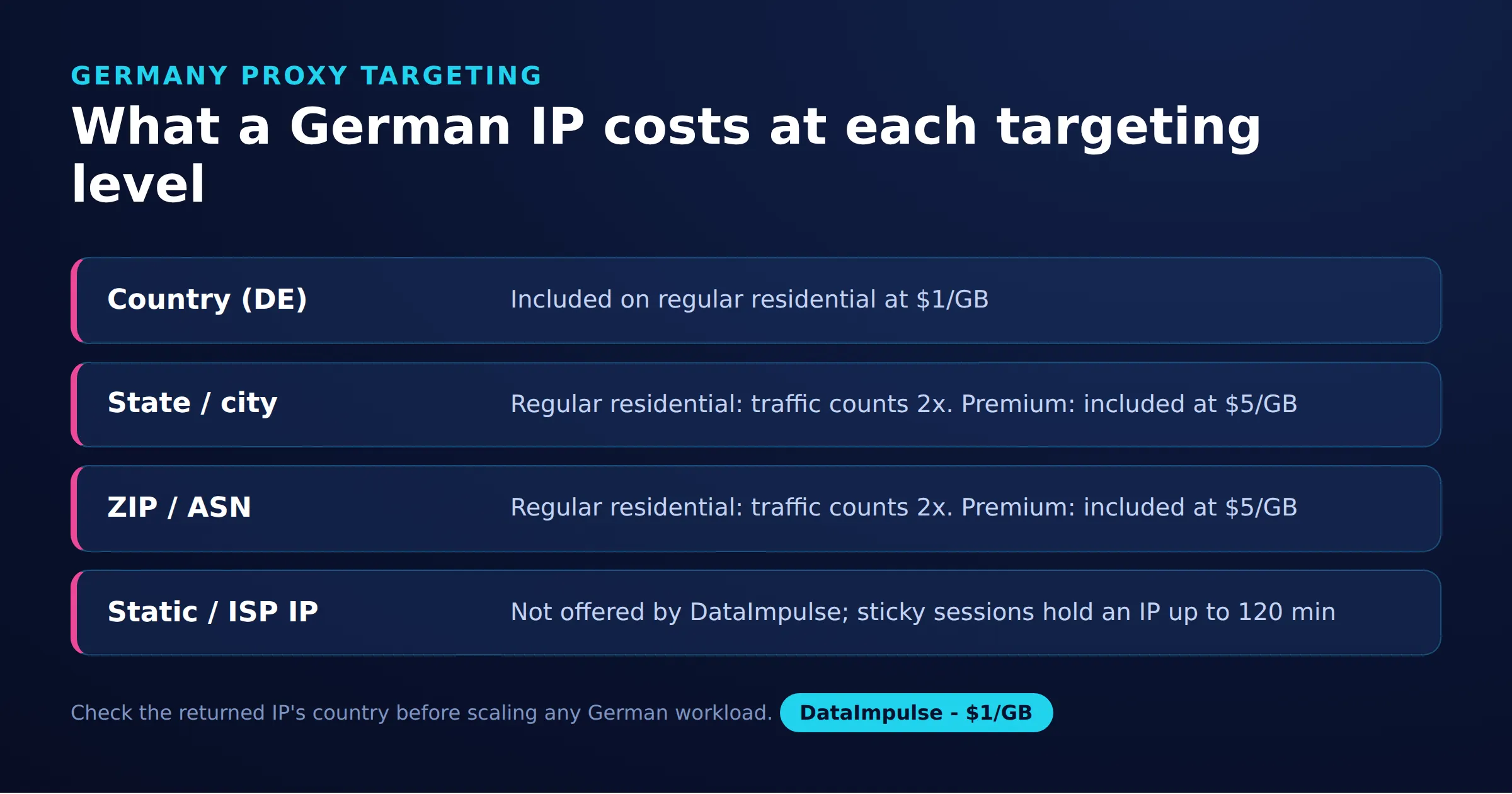
At $1/GB, 1 GB of traffic using state, city, ZIP or ASN targeting consumes 2 GB of balance, costing $2. For your pilot, divide the consumed balance, including retries, by the number of content-valid responses; record the upfront payment separately.
Calculate total cost from billed traffic, targeting treatment, retries, rendered assets and any purchase commitment. Then divide the attributable spend by valid responses or accepted records. Keep the cash paid upfront separate from the balance consumed during the pilot.
For example, a browser that downloads images and scripts may consume more traffic than a lightweight HTTP client. That extra traffic can be necessary, but it belongs in the estimate. Compare Premium and regular residential using the actual filters and workflow you need.
German IP targeting: how do you verify the exit?
Select Germany, inspect the returned exit IP, then test the destination’s behavior. A country selector is a routing request; verification checks what the application actually receives.
Start at country level unless a regional requirement is explicit. Narrow filters only after establishing a baseline. Record the requested country, observed country, ASN and timestamp, keeping credentials out of logs.
A German IP does not establish a precise street address or consistent city classification. Mobile addresses can serve devices across a wide area, making city attribution imprecise; MaxMind’s geolocation accuracy explanation describes this limitation.
Compare the IP check with the target response. Language, cookies, account preferences and shipping settings can affect the page independently of the exit IP. If the results disagree, preserve the observations and investigate before tightening filters or increasing traffic.
Rotating and sticky sessions on German exits
Rotation requests changing exits, while a sticky session requests continuity across related requests. Sticky sessions should not be described as permanent static or dedicated IPs.
Our sticky sessions average approximately 30 minutes and can last up to 120 minutes. Peer availability can interrupt continuity before the requested duration ends, so design the client to detect an address change and restart a dependent sequence safely.
Use rotation for independent requests where continuity adds no value. Use sticky sessions for a permitted sequence that needs consistent routing, preserving the associated cookies and application state. Neither mode overrides account rules or solves every access failure.
Choose the session policy before comparing costs: repeatedly restarting an interrupted sequence can consume additional traffic. Our rotating versus sticky guide explains the distinction in more detail.
How we tested German proxy exits
Our November 6, 2026 Germany results are a snapshot of static-file retrieval, not a marketplace benchmark. We made 300 requests per proxy type during the country-test window of 13:08-13:15 UTC.
The method used Python requests 2.31.0, 10 parallel workers, rotating exits, Germany country targeting and a 9 KB file on cdnjs. Success required HTTP 200 plus the complete file; latency measured the full request from our server in Europe.
| German exit type | Requests | Success | Median | p95 | Separate country checks |
|---|---|---|---|---|---|
| Residential | 300 | 99.00% | 0.48 s | 5.17 s | 29 of 29 returned Germany |
| Datacenter | 300 | 100% | 1.47 s | 2.04 s | 30 of 30 returned Germany |
Source: our November 6 country-test measurements. Residential recorded three read timeouts; datacenter recorded no errors. Separate requests to ipinfo.io checked country and network. Mobile was not tested.
This short, single-day snapshot does not establish protected-site success, German pool size, future availability or superiority over competitors. It also does not supply billed-traffic measurements or cost per valid marketplace response.
Buying and testing a proxy to Germany
Buy a small suitable allocation, configure Germany, verify the exit and run a controlled target pilot before scaling. Separate connection checks from content validation.
Step 1: Define acceptance. Choose permitted URLs and specify the content that makes a response usable. A successful HTTP status alone can still accompany an incomplete page or challenge.
Step 2: Configure the client. Our service supports HTTP, HTTPS and SOCKS5, with username:password authentication or IP whitelisting. Select Germany and the session mode, and keep authentication material outside source code and published logs.
Step 3: Verify routing. Check the exit IP and country through the configured proxy. Repeat this when changing targeting or session settings. The proxy checker guide covers connection-level checks.
Step 4: Run a bounded pilot. For each candidate configuration, send 100 requests to each of two permitted German targets on each of three separate days (600 requests per configuration). Log retries separately. Fix the client, concurrency and timeout.
Step 5: Compare usable output. Record content-valid success, median and p95 latency, billed traffic, country matches and cost per valid response. Investigate failures before increasing concurrency. A proxy cannot repair a parser that mistakes a challenge page for the requested content.
Are proxies legal in Germany? GDPR in plain words
The proxy choice alone does not determine whether a German collection workflow is lawful. Assess the data, access method, purpose and parties involved.
IP addresses can be personal data under GDPR, called DSGVO in German. Public visibility does not remove personal-data obligations: collecting product specifications differs from collecting identifiable profiles or retaining identifying logs. Article 6 requires an applicable lawful basis; legitimate interests requires assessment, not merely a label.
Where a processor handles personal data on your behalf, assess Article 28 contractual requirements. International transfers may trigger Chapter V requirements even when an exit IP is German. See the official GDPR text.
Germany’s StGB Section 202a addresses unauthorized access obtained by overcoming access protections. Review access permissions and other applicable rights separately. This is no compliance verdict; our web scraping legality guide develops the issues further.
Frequently Asked Questions
Which Germany proxy should I buy first?
Start with the smallest purchase that supports your required exit type and location filters. Select from the comparison by expected traffic and purchasing commitment, then evaluate the actual application before buying more.
What is the cheapest residential option in this comparison?
Our regular residential service has the lowest entry per-GB rate among the selected plans. That does not mean it has the smallest initial payment or the lowest cost for every workload; targeting and valid-output rates affect the result.
Do I need city targeting for German websites?
Only when the question you are investigating depends on a city. Establish a country-level baseline first, and distinguish IP location from shipping settings, cookies and account preferences.
Where can I buy residential proxies with German IPs?
The shortlist links to official purchase and German availability information. After purchasing, select Germany in the configuration and verify the returned address before treating it as a German observation.
Can a sticky German proxy replace a static IP?
Use sticky routing for temporary continuity, not a requirement for a permanently assigned address. If the application needs a persistent IP, review a static product’s allocation and replacement terms.
Does the German test show success on Amazon.de or Otto?
No. It measured complete retrieval of a small static CDN file and separate exit-country checks. Marketplace workflows need their own permitted content-validation pilot.
Can I choose a German mobile carrier with your proxies?
Our mobile product does not offer carrier or operator selection. If a specific operator is essential, make that an explicit purchasing requirement and verify the returned network.
Does a German exit keep all processing inside Germany?
An exit location alone does not describe the complete processing arrangement. Review where your client, storage, logs and service partners handle personal data before drawing a conclusion about transfers.
Evaluate German exits with a small pilot
If PAYG connectivity fits your workflow, explore DataImpulse’s German residential proxies. Start with a defined target and acceptance criteria, measure the result, and expand only when the output and cost meet your requirements.
Last updated: November 6, 2026.
 State/City/Zip/ASN Targeting