

In this Article
Japan is one of the world’s largest and most distinctive e-commerce markets — led by three domestic-leaning giants, Amazon Japan, Rakuten, and Yahoo!/LINE Yahoo Shopping, plus fashion leader ZOZO. Almost all of the data worth collecting there is local: prices, stock, ads, and rankings on Amazon.co.jp, Rakuten Ichiba, and Yahoo! Shopping are served to Japanese IP addresses in yen. To see what a Japanese shopper actually sees — and to scrape it without being blocked — you need residential proxies physically located in Japan, not a datacenter IP in Singapore or Virginia.
This guide ranks the 8 best proxies for Japan in 2026 for e-commerce price intelligence, .jp SERP and rank tracking, ad verification, and market research. It covers which providers have genuine Japanese residential and mobile coverage (real Docomo, au/KDDI, SoftBank, and Rakuten IPs), how to target Japanese cities and carriers, what Amazon.co.jp scraping looks like in practice, and the legal landscape under Japan’s APPI and the scraping-relevant 2026 amendment. Jump to the quick comparison for a thirty-second shortlist.
Key Facts
Japan is its own proxy market because commerce runs on local platforms, the IP geography matters, and its data law is being eased for public-data/AI use. Six things to know up front:
- Amazon Japan, Rakuten & Yahoo lead. Three giants lead — Amazon Japan, Rakuten, and Yahoo!/LINE Yahoo Shopping — and the exact ranking depends on the metric: Rakuten leads marketplace GMV (¥6.1T, 100M+ members), Amazon Japan reaches ~75-80% of consumers, and Yahoo! Shopping ties into the PayPay ecosystem, with ZOZO leading fashion. That’s your competitive set.
- Mobile-heavy, PayPay-driven. Japanese commerce leans on mobile apps and the PayPay ecosystem, so mobile-web and app surfaces matter and Japanese mobile-carrier IPs read most natively to anti-bot systems.
- Four mobile operators. NTT Docomo is the largest (~36%), followed by au/KDDI (~27%), SoftBank (~21%), and Rakuten Mobile (~3-4%, the only recent entrant, recently reaching EBITDA profitability) — together well over 200M active mobile contracts.
- Verified ASNs. For carrier-level work the autonomous systems are AS9605 (NTT Docomo), AS2516 (KDDI/au), and AS17676 (SoftBank), with Rakuten Mobile as the fourth network; the operators are regulated by the MIC.
- The law is easing for public-data & AI. Japan enforces the APPI through the Personal Information Protection Commission (PPC), and a 2026 amendment (approved by the Cabinet in April 2026) adds a consent exemption for statistical/AI processing of publicly available data — relatively favorable for public-data collection. Scraping public product data is defensible; personal data is the risk.
- DataImpulse is the value pick at $1/GB residential, pay-as-you-go, traffic that never expires, 90M+ IPs across 195 countries including Japan, with country targeting included and city/ASN as a paid add-on, plus Japanese mobile IPs at $2/GB — the geo grid Amazon.co.jp work needs at a fraction of enterprise pricing.
How We Selected These Japan Proxies
We picked these 8 providers because they have credible Japanese residential or mobile coverage, public pricing as of June 2026, and features that matter for Japan-specific work: country and city targeting inside Japan, real Japanese carrier IPs (Docomo, au/KDDI, SoftBank, Rakuten) for mobile and in-app data, sticky sessions for multi-step Amazon.co.jp and Rakuten flows, and — for teams that prefer managed endpoints — scraping APIs that handle the anti-bot layer. We weighed live PAYG residential price per GB, Japanese geo granularity, mobile availability, and compliance posture. Providers without verifiable Japanese coverage were cut.
Why You Need Japanese Proxies
Three things make Japan a distinct proxy problem. The commerce is local and IP-gated. Amazon.co.jp, Rakuten Ichiba, Yahoo! Shopping, and ZOZO serve prices, stock, promotions, and ads based on the visitor’s IP geography and currency; a yen price and a Japanese delivery estimate only appear to an IP that looks Japanese. Scrape from outside and you get wrong prices, a redirect, or a block. Anti-bot favors residential, and the market is app-heavy. Platforms flag datacenter ranges quickly, and because so much Japanese shopping happens in apps and the PayPay ecosystem, real consumer and carrier IPs from Docomo, au, SoftBank, and Rakuten read as ordinary Japanese shoppers where a datacenter IP does not. Regional and language nuance. Content, availability, and some pricing vary by region, and the Japanese-language SERP differs from the global one — so city and ASN targeting, plus Japanese mobile IPs, let you capture the full picture. Japanese residential proxies aren’t an optimization — they’re how you get correct Japanese data at all.
Quick Comparison: Best Proxies for Japan at a Glance
| Provider | Best for | Residential price | Japan geo | Notable |
|---|---|---|---|---|
| DataImpulse | Best value, in-house JP pipelines | $1/GB PAYG | Country incl; city/ASN add-on | 90M+ pool, Japanese mobile $2/GB, never-expires |
| Bright Data | Enterprise + managed scraping | ~$4/GB promo; $8 regular | Country/city/ASN | 400M+ pool, Web Unlocker $1.50/1K, datasets |
| Oxylabs | Enterprise + compliance | from $6/GB | Country/city | 175M+ pool, SERP/Web Scraper APIs, SLA |
| Decodo | Mid-market, full geo grid | $3.75/GB starter; ~$2 at 1TB+ | Country/city/ASN | 115M+ pool, sticky to 24h, Web Scraping API |
| IPRoyal | Long sticky sessions | from $7.35/GB | Country/region/city/ISP | Sticky up to 7 days; cheap pay-as-you-go entry |
| SOAX | Mixed residential + JP mobile | $3.60/GB Starter | Country/region/city/ISP/ASN | 155M+ res, 33M+ mobile for carrier IPs |
| Webshare | Budget / self-serve | from $3.50/mo res; $2.99/mo DC | Country (city on higher tiers) | Free tier, cheapest datacenter for JP |
| NetNut | ISP-residential stability | from $3.53/GB | Country/city | Consumer-ISP static IPs, fast rotating |
Which Proxy Type Should You Use for Japan?
Japanese work splits into broad price/SERP sweeps, mobile/app data, regional checks, and long multi-step flows. Each maps to a proxy type.
Residential Proxies — Default for Amazon.co.jp & .jp SERPs
Residential proxies are the right default for most Japanese work — Amazon.co.jp, Rakuten, and Yahoo! Shopping price scraping, ZOZO fashion monitoring, Japanese Google (.co.jp) SERP and rank tracking, and ad verification for JP-targeted campaigns. Real Docomo, au, and consumer-ISP IPs read as ordinary Japanese shoppers and return the yen prices, stock, and delivery options a local sees. Country targeting is the minimum; add city targeting (Tokyo, Osaka, Yokohama, Nagoya) where delivery or pricing differs regionally.
Mobile Proxies — App & Mobile-Web Data
Mobile proxies route through real Japanese carrier networks (Docomo, au/KDDI, SoftBank, Rakuten) and matter in Japan because commerce is so app- and PayPay-driven. In-app and mobile-web surfaces differ from desktop, and the hardest anti-bot layers expect carrier IPs. They cost more per GB ($2-$10), so reserve mobile for app data and the most defended endpoints.
ISP / Static Residential — Session-Stable Flows
ISP (static residential) proxies pair consumer-ISP authenticity with a stable, long-lived Japanese IP — useful for multi-step Amazon.co.jp or Rakuten flows, logged-in seller-dashboard sequences (where authorized), and any workflow that must keep the same IP across a session. NetNut, IPRoyal, Decodo, SOAX, and Bright Data all offer ISP lines.
Datacenter Proxies — Reference Data Only
Datacenter proxies are flagged quickly by Amazon and the larger Japanese platforms, so they’re not the tool for live marketplace scraping. They’re fine and cheap for unprotected layers — parsing already-collected data, open .jp reference pages, or your own infrastructure. Webshare’s $2.99/mo datacenter is the budget option there; for anything defended, use Japanese residential or mobile.
Rotating vs Sticky for Japan
Rotate for breadth, stick for a flow. Rotating residential handles wide sweeps — many Amazon.co.jp or Rakuten listings, categories, or .jp SERP queries where each request is independent. Sticky sessions (15-30 minutes is usually enough; IPRoyal offers up to 7 days) handle multi-step flows: a search-to-listing-to-seller sequence or paginated results where you want one IP across the journey. Most Japanese stacks run mostly rotating with a sticky pool for the multi-step work.
Best Proxies for Japan — Full Reviews
The picks below are ranked on value for Japanese work — the balance of Japanese residential and mobile authenticity, geo granularity, managed-API options, compliance posture, and price per successful scrape. DataImpulse leads on value for in-house pipelines; Bright Data and Oxylabs lead the managed-API and enterprise route; Webshare is the budget self-serve option.
1. DataImpulse
DataImpulse is the best-value pick for in-house teams collecting Japanese data — Amazon.co.jp, Rakuten, and Yahoo! Shopping price intelligence, repricing, .jp SERP tracking, ad verification, and market research. Residential starts at $1/GB, pay-as-you-go, with traffic that never expires — a fraction of enterprise pricing. The pool is 90M+ ethically sourced IPs across 195 countries including Japan, with country targeting included and city/ASN available as a paid add-on, which matters because Japanese delivery options and some pricing vary by region. It supports HTTP, HTTPS, and SOCKS5, rotating and sticky sessions, full API access, and standard stacks (Scrapy, Selenium, Playwright). Japanese mobile IPs are available at $2/GB for app and mobile-web data; datacenter at $0.50/GB for the parsing layer.
What makes it the default for serious Japanese collection is the price-to-geo ratio. At $1/GB you can sustain continuous Amazon.co.jp and Rakuten price monitoring across categories and regions without per-record charges, and PAYG means testing new product sets doesn’t lock you into a subscription. Support is 24/7 human; published success rate is 99.51%; G2 is 4.8/5. DataImpulse sells clean proxy infrastructure and lets your team build the Amazon.co.jp parser on top.
Quick specs — Types: residential, mobile, datacenter · Pool: 90M+ residential, 195 countries · Rotation: rotating + sticky · Geo: country (city/ASN as paid add-on) · Price: $1/GB res, $0.50/GB DC, $2/GB mobile · Published success: 99.51% · Rating: G2 4.8.
2. Bright Data
Bright Data is the enterprise pick when you want Japanese data as a managed product. Beyond raw residential at $8/GB pay-as-you-go (currently discounted to about $4/GB on a promo) with a 400M+ monthly IP pool and country/city/ASN targeting, Bright Data ships a Web Unlocker at $1.50 per 1,000 results on PAYG that handles anti-bot at request time, a SERP API for Japanese Google results, and pre-collected datasets. It’s the right call when you’d rather hit a managed endpoint than maintain an Amazon.co.jp parser, at enterprise pricing with procurement-style buying.
Quick specs — Types: residential, DC, ISP, mobile + Web Unlocker + SERP API + datasets · Pool: 400M+ monthly residential · Rotation: rotating, sticky, dedicated · Geo: country/city/ASN · Price: ~$4/GB res (promo), $8/GB regular; Web Unlocker $1.50/1K PAYG.
3. Oxylabs
Oxylabs sits next to Bright Data at the enterprise top, with a strong focus on managed scraping APIs and an audit-ready compliance posture. Residential starts around $6/GB on the entry plan with a 175M+ pool across 195 countries including Japan, and its SERP API and Web Scraper API cover Japanese Google and general e-commerce targets with JavaScript rendering handled server-side. Sessions are flexible with unlimited concurrent connections. Pick Oxylabs when SLA-grade reliability and compliance documentation matter more than entry price — the typical fit for larger Japanese retailers, agencies, and data vendors with procurement requirements.
Quick specs — Types: residential, DC, ISP, mobile + SERP API + Web Scraper API · Pool: 175M+ residential, 195 countries · Rotation: flexible, sticky, unlimited concurrency · Geo: country/city · Price: from $6/GB residential; APIs priced per 1K results.
4. Decodo
Decodo (formerly Smartproxy) is the balanced mid-market pick for Japanese work that needs a full geo grid without enterprise pricing. Residential starts at $3.75/GB on the 3GB starter plan, with pay-as-you-go around $4/GB, dropping to about $2/GB at the 1,000 GB subscription tier. Its Web Scraping API handles rendering and anti-bot for e-commerce and SERP targets, sticky sessions are configurable up to 24 hours — long enough for multi-step Amazon.co.jp flows — and country, city, and ASN targeting are all included for Japan.
Quick specs — Types: residential, DC, ISP, mobile + Web Scraping API · Pool: 115M+ residential · Rotation: per-request, sticky up to 24h · Geo: country/city/ASN · Price: $3.75/GB (3 GB starter), ~$4/GB PAYG, ~$2/GB at 1 TB+.
Best for: mid-market Japanese teams that want a full geo grid and a managed scraping API at a per-GB price.
5. IPRoyal
IPRoyal earns its spot for Japanese teams running long, session-stable flows. Residential PAYG runs $7.35/GB at entry (cheaper at volume) with a 32M+ pool across 195+ countries including Japan, country/region/city/ISP targeting, and — its real differentiator — sticky sessions up to 7 days, the longest on this list. For multi-day Amazon.co.jp or Rakuten price-tracking on specific listings, logged-in seller-dashboard sequences (where authorized), or any flow where session continuity is the deciding feature, IPRoyal’s stickiness is unique.
Quick specs — Types: residential, ISP, mobile, DC · Pool: 32M+ residential, 195+ countries · Rotation: rotating, sticky up to 7 days · Geo: country/region/city/ISP · Price: from $7.35/GB residential PAYG.
Best for: Japanese teams running long session-stable flows and multi-day listing price tracking.
6. SOAX
SOAX is the pick when geo-precise Japanese work and mixed proxy types matter together. Residential starts at $3.60/GB on the Starter plan (25GB included), and the unified credit model lets you spend one budget on residential, mobile, ISP, or datacenter. The pool is one of the larger in the mid-tier — 155M+ residential, 33M+ mobile, 2.6M+ ISP — with country, region, city, ISP, and ASN targeting. That mobile pool matters for Japan specifically: it gives you real Japanese carrier IPs (Docomo, au/KDDI, SoftBank, Rakuten) for app and mobile-web data, while desktop sweeps run on residential, all from one account.
Quick specs — Types: residential, mobile, ISP, DC + Web Data API · Pool: 155M+ residential, 33M+ mobile, 2.6M+ ISP · Rotation: per request or interval, sticky supported · Geo: country/region/city/ISP/ASN · Price: $3.60/GB Starter.
7. Webshare
Webshare is the budget, self-serve pick for Japanese work that doesn’t need premium residential. Residential plans start from about $3.50/month and datacenter from $2.99/month — the cheapest entry on this list — with a free tier to test. Japanese geo targeting is available, with city-level granularity on higher tiers. Webshare is the right call for low-volume Japanese SERP checks, light reference monitoring, or unprotected scraping where you want the lowest cost and self-serve setup; it’s not the tool for heavily defended Amazon.co.jp flows, where premium residential or mobile performs better.
Quick specs — Types: residential, datacenter, static residential · Geo: country (city on higher tiers) · Rotation: plan-dependent · Price: residential from $3.50/mo, datacenter from $2.99/mo · Free tier available.
Best for: budget-conscious Japanese projects and low-volume SERP/reference scraping.
8. NetNut
NetNut rounds out the list for Japanese teams that want ISP-residential stability. Its strength is static consumer-ISP IPs sourced directly from internet providers, with rotating residential from about $3.53/GB (static/ISP-residential runs higher, around $7.99/GB), country and city targeting for Japan, and fast rotation backed by a large ISP-residential pool. The ISP-residential model gives you the authenticity of consumer IPs with the stability of static hosting — a good fit for steady Amazon.co.jp monitoring and .jp SERP work that benefits from consistent, ISP-real Japanese addresses.
Quick specs — Types: ISP-residential, residential, mobile · Geo: country/city · Rotation: rotating + static · Price: from $3.53/GB.
How Much Do Japan Proxies Cost?
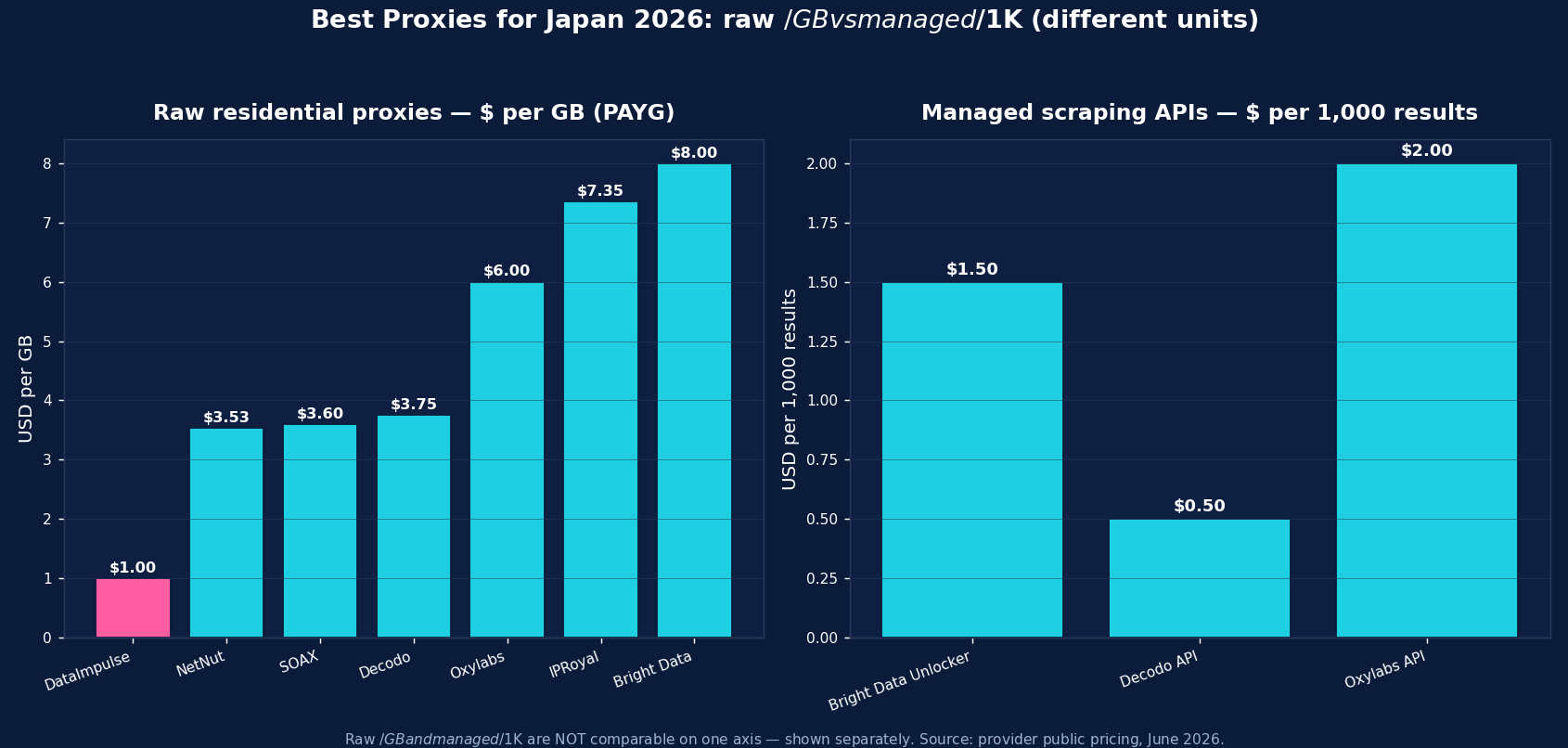
Japanese proxy costs split into two pricing models that can’t be compared on one axis. Raw residential proxies are priced per GB: DataImpulse at $1/GB is the value floor, NetNut from $3.53, SOAX $3.60, Decodo $3.75 (PAYG ~$4, down to ~$2 at volume), Oxylabs from $6, IPRoyal $7.35, Bright Data $8 ($4 promo); Webshare’s subscription residential (from $3.50/mo) and $2.99/mo datacenter are the budget self-serve options. With raw proxies you also build and maintain your own Amazon.co.jp parser, but at scale the per-GB model is far cheaper than per-record. Managed scraping APIs are priced per 1,000 results (Bright Data Web Unlocker $1.50/1K; Oxylabs and Decodo APIs per 1K) and bundle the anti-bot fight into the price — more per record, less maintenance.
The rule of thumb: for continuous, high-volume Japanese price and SERP monitoring where you control the parser, raw residential at $1/GB wins decisively on cost — an Amazon.co.jp listing or .jp page is a small fraction of a GB. For occasional pulls, smaller teams, or the hardest defended targets, a managed API or mobile proxies are worth the premium. Many Japanese teams run both: raw residential for the daily sweeps, a managed API or mobile pool for the toughest endpoints.
Is Scraping Data in Japan Legal?
Scraping publicly available product and price data in Japan is broadly defensible — and the legal direction is, if anything, becoming more favorable for public-data collection. Public, read-only collection of product prices, availability, and rankings is the lane most Japanese price-intelligence and SEO teams operate in.
The framework is the APPI (Act on the Protection of Personal Information), enforced by the Personal Information Protection Commission (PPC). Notably, APPI has historically relied on guidance, recommendations, and orders rather than large administrative fines. A 2026 amendment (approved by the Cabinet in April 2026 and before the Diet, expected to take effect around 2027) goes further: it introduces a consent exemption for statistical processing including AI development, allowing the acquisition of publicly available data — even sensitive data — to create statistical information, subject to transparency safeguards. The same package adds protections for children’s data (parental consent under 16) and plans a new administrative-fine system and injunctive relief, so enforcement is set to gain teeth even as public-data use is eased.
The practical line: public, read-only scraping of product and price data from Japanese IPs, respecting robots.txt and rate limits, without collecting personal data, is the defensible posture. Japan’s copyright law also has a relatively broad text-and-data-mining allowance. Harvesting personal data without a lawful basis remains the risk. This is general information, not legal advice — consult Japanese counsel before scaling a commercial scraping pipeline.
How to Start Scraping Japan with DataImpulse
Step 1. Create a DataImpulse account and grab your residential proxy credentials from the dashboard. Start with the $5 / 5GB intro — traffic never expires, so it’s a real test budget.
Step 2. Set country targeting to Japan (add city or ASN targeting for regional or carrier-level data), and pair the proxy with your stack — Scrapy, Playwright, or Selenium — to render Amazon.co.jp and Rakuten pages and present a real fingerprint. Use rotating residential for broad listing and SERP sweeps and a sticky session for multi-step flows. Add Japanese mobile IPs ($2/GB) for app and mobile-web data.
Step 3. Run collection at human cadence, capture prices in yen with timestamps, and store per region where it matters. See the residential proxies page for setup and the price comparison use case for pipeline patterns; for SERP work, the SERP tracking guide covers .jp rank monitoring.
FAQ
Why do I need Japanese proxies instead of any Asian proxy?
Japanese marketplaces — Amazon.co.jp, Rakuten, Yahoo! Shopping, ZOZO — localize prices, stock, delivery options, and ads to the visitor’s IP and region. Only an IP physically in Japan sees the true yen price and Japanese delivery estimate; an IP in Singapore or the US gets wrong data, a redirect, or a block. For accurate Japanese price intelligence, SERP tracking, or ad verification you need residential or mobile IPs inside Japan, not generic Asian proxies.
What’s the best proxy for scraping Amazon.co.jp?
Residential proxies in Japan are the default — Amazon flags datacenter IPs quickly. DataImpulse at $1/GB is the value pick; Decodo, SOAX, and NetNut are solid mid-tier options; Bright Data’s Web Unlocker is the managed route. Because Japanese commerce is so app- and PayPay-driven, add Japanese mobile-carrier IPs (DataImpulse $2/GB, SOAX 33M+ mobile pool) for app and mobile-web surfaces. Pair proxies with a real browser fingerprint and human-paced cadence.
Is scraping legal in Japan?
Scraping publicly available product and price data is broadly defensible, and Japan’s direction is becoming more favorable: a 2026 APPI amendment adds a consent exemption for statistical/AI processing of publicly available data. The framework is the APPI, enforced by the PPC (historically via guidance/orders, with administrative fines planned). Public read-only product/price scraping without personal data is the defensible lane; harvesting personal data is the risk. This isn’t legal advice — consult Japanese counsel before scaling.
Do Japanese proxies cover all the mobile carriers?
It depends on the provider’s mobile pool. Japan’s operators are NTT Docomo (AS9605), au/KDDI (AS2516), SoftBank (AS17676), and Rakuten Mobile. Providers with strong mobile pools — SOAX (33M+ mobile), DataImpulse ($2/GB mobile), Bright Data, and IPRoyal — can route through real Japanese carrier IPs, and some support ASN-level targeting to pin a specific operator. For desktop work residential is enough; for app data use Japanese mobile IPs.
Which platforms should I monitor in Japan?
Amazon Japan, Rakuten, and Yahoo!/LINE Yahoo Shopping are the big three (ranking varies by GMV vs revenue vs usage): Rakuten leads marketplace GMV (¥6.1T, 100M+ members), Amazon Japan reaches ~75-80% of consumers, and Yahoo! ties into PayPay; ZOZO leads fashion. Beyond them, Chinese cross-border platforms (Temu, AliExpress, Shein) are surging. Center competitor and price monitoring on Amazon.co.jp, Rakuten, Yahoo! Shopping, and ZOZO.
Residential vs datacenter proxies for Japan?
Use residential (or mobile) for any live Japanese marketplace or SERP work — Amazon and the larger platforms flag datacenter ranges fast, and only residential IPs return correctly localized Japanese data. Datacenter proxies are fine and cheap (Webshare from $2.99/mo) for unprotected reference pages, parsing already-collected data, or your own infrastructure. The rule: defended or geo-sensitive Japanese target → residential/mobile; open reference data → datacenter is OK.
How much do Japan proxies cost?
Raw residential is priced per GB: DataImpulse $1/GB (value floor), NetNut from $3.53, SOAX $3.60, Decodo $3.75 (~$4 PAYG, ~$2 at volume), Oxylabs from $6, IPRoyal $7.35, Bright Data $8 ($4 promo); Webshare offers budget subscriptions from $3.50/mo residential and $2.99/mo datacenter. Managed scraping APIs cost per 1,000 results (Bright Data Web Unlocker $1.50/1K). For continuous high-volume Amazon.co.jp monitoring, raw residential at $1/GB wins on cost; managed APIs or mobile pools suit the hardest targets.
Can I use Japanese proxies for SEO and SERP tracking?
Yes — tracking Japanese Google (.co.jp) rankings requires Japanese residential IPs because results, local packs, and ads are personalized by location. Use rotating residential for broad keyword sweeps and add city targeting (Tokyo, Osaka, Nagoya) where local-pack results matter. DataImpulse, Decodo, Oxylabs (SERP API), and Bright Data (SERP API) all support Japanese SERP work; managed SERP APIs return parsed JSON if you’d rather not build the parser. Keep cadence human and rotate user-agents.
 State/City/Zip/ASN Targeting