In this Article
Shopify powers millions of online stores — which makes the Shopify ecosystem one of the richest sources of e-commerce data on the web. For brands, analysts, and dropshippers, scraping public product, price, and inventory data across Shopify-powered stores reveals competitor catalogs, pricing strategy, new launches, and trending products. The catch: collecting it at scale means hitting many independent stores, each with its own anti-bot and rate limits, often geo-personalized — so you need residential proxies that look like real shoppers. This guide ranks the 8 best proxies for scraping Shopify stores in 2026 for competitor price intelligence, product research, and trend tracking — with DataImpulse at $1/GB as the value pick.
One framing up front: this is about collecting public product and price data from Shopify storefronts (the defensible, read-only data lane) — not about checkout automation or sneaker bots. Brands use it for price monitoring; analysts and dropshippers use it for product and trend research across the Shopify ecosystem.
Key Facts
- Shopify stores expose public product data. Most Shopify storefronts publish a public
/products.jsonendpoint (and collection pages) with product titles, variants, prices, and availability — a well-known, structured source for competitor and market research. - Scale means many independent stores. Unlike a single marketplace, the Shopify ecosystem is millions of separate stores, each with its own rate limits and anti-bot — so a scraper distributes requests across many residential IPs to stay unblocked.
- Results are geo- and currency-personalized. Many Shopify stores show prices, currency, and availability by visitor country, so multi-market research needs residential IPs in each target country.
- Residential beats datacenter. Stores and the apps protecting them flag datacenter ranges quickly; real consumer IPs read as ordinary shoppers and return the correct localized data.
- Sticky sessions help multi-step flows. Paginating a store’s catalog or following collections benefits from a stable IP across requests; rotate across independent stores.
- DataImpulse is the value pick — a 90M+ ethically sourced pool across 195 countries with country/city targeting and sticky sessions, at $1/GB pay-as-you-go with traffic that never expires — the access layer for cost-efficient Shopify-store research.
What to Collect From Shopify Stores (and Why)
- Prices & variants — competitor pricing across comparable products to inform your own pricing.
- Product catalogs & new launches — what competitors sell, how their catalog changes, and what’s newly added (a strategy signal).
- Inventory & availability — stock signals and sell-through indicators where exposed.
- Trending products — popular items and categories across many stores, for product research and dropshipping.
- Store discovery — finding Shopify-powered stores in a niche to build a competitive set.
Each is public, non-personal product data — collected across many stores, sampled over time. That’s exactly the workload residential proxies are built for.
Best Proxies for Scraping Shopify at a Glance
| Provider | Best for Shopify research | Residential price | Geo targeting | Notable |
|---|---|---|---|---|
| DataImpulse | Best value, high-volume research | $1/GB PAYG | Country incl; city/ASN add-on | 90M+ pool, sticky sessions, never-expires |
| Bright Data | Enterprise + managed scraping | ~$4/GB promo; ~$8 standard | Country/city/ASN | Largest pool, Web Unlocker, datasets |
| Oxylabs | Enterprise + Scraper APIs | ~$8/GB standard | Country/city | 175M+ pool, E-Commerce Scraper API |
| Decodo | Mid-market, full geo grid | ~$4/GB PAYG (~$2 volume) | Country/city/ASN | 115M+ pool, scraping API |
| SOAX | Clean pool, fewer blocks | $3.60/GB Starter | Country/region/city/ASN | Clean opt-in pool |
| IPRoyal | Long sticky sessions | from ~$7.35/GB | Country/region/city/ISP | Sticky up to 7 days |
| NetNut | ISP-residential stability | from ~$15/GB (to ~$1.59 volume) | Country/city | Static consumer-ISP IPs |
| Webshare | Budget / self-serve | ~$3.50/GB (promo ~$1.40) | Country (city on higher tiers) | Free tier, cheapest entry |
The Picks, Briefly
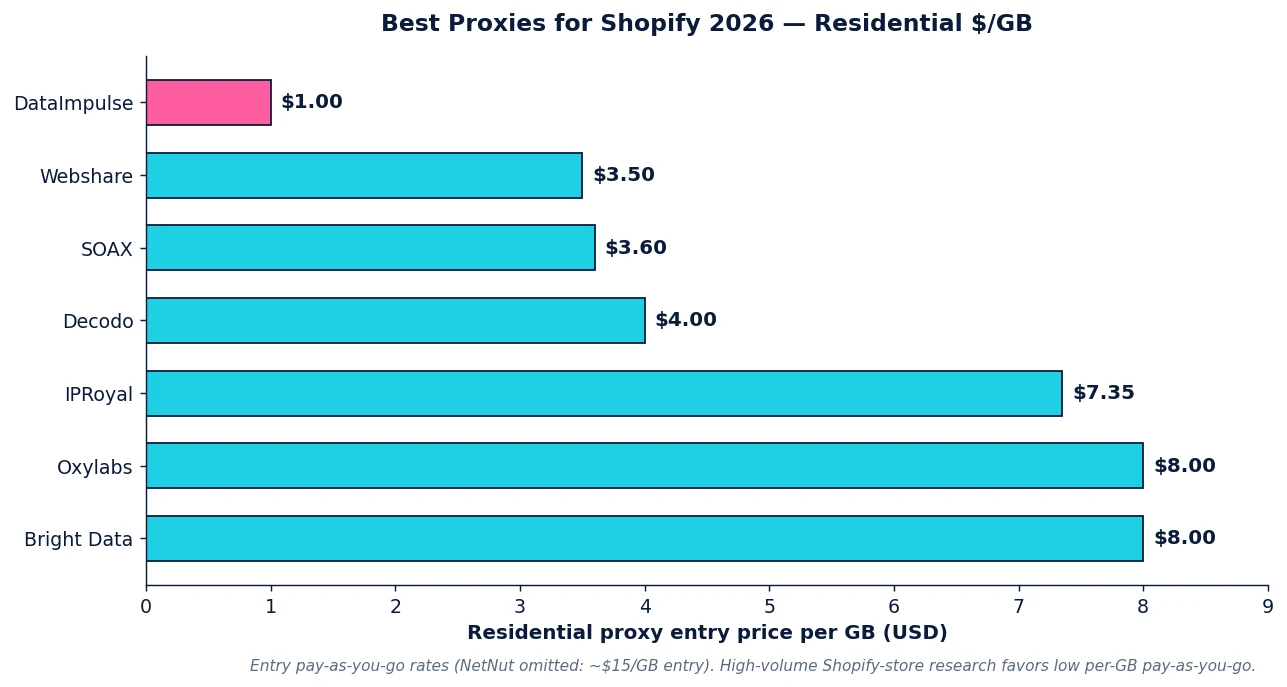
DataImpulse is the value pick for Shopify-store research — a 90M+ ethically sourced pool across 195 countries with country targeting included and city/ASN as a paid add-on, plus sticky sessions for paginating catalogs, at $1/GB pay-as-you-go with traffic that never expires. For sampling many stores continuously, it’s the lowest cost per accurate data point. Bright Data (~$8/GB standard) and Oxylabs (~$8/GB) are the enterprise pools with managed scraping APIs that handle anti-bot for you. Decodo (~$4/GB PAYG) and SOAX ($3.60/GB, clean pool) are strong mid-market options. IPRoyal (from ~$7.35/GB, 7-day sticky), NetNut (ISP-static stability), and Webshare (budget, free tier) round out the field. The build-vs-buy logic from our Amazon scrapers guide applies here too.
Tips for Scraping Shopify Stores Without Getting Blocked
- Use the public endpoints where available. Many stores expose
/products.jsonand collection pages with structured product data — efficient and low-impact to read. - Use residential IPs. Datacenter ranges get flagged fast by the anti-bot apps many stores run; residential IPs read as real shoppers. Match the country for correct currency/availability.
- Throttle and distribute. Spread requests across stores and IPs at human-paced rates; don’t hammer a single store.
- Rotate for breadth, stick for flows. Rotate across independent stores; use sticky sessions when paginating one store’s catalog.
- Stay on public, non-personal data. Product, price, and availability data is the defensible lane; avoid personal data and anything behind a login or checkout. See our web scraping legality guide.
How to Scrape Shopify Stores with DataImpulse
Step 1. Create a DataImpulse account and grab your residential credentials. The $5 / 5GB intro never expires.
Step 2. Point your scraper at the gateway with the target market in the username — YOUR_LOGIN__cr.us:[email protected]:823 — adding ;sessid.xxxx for a sticky session when paginating one store.
Step 3. Read the public product fields you need (title, variants, price, availability) from /products.json or collection pages, throttle politely, and sample on a consistent schedule to track competitor pricing and launches. Full targeting syntax is in the DataImpulse tutorials; see also our price comparison guide and the cheapest residential proxies for high-volume runs.
FAQ
What are the best proxies for scraping Shopify stores?
Residential proxies with broad geo coverage and per-GB pricing fit Shopify research best. DataImpulse ($1/GB) is the value pick for high-volume collection; Bright Data and Oxylabs are the enterprise picks with managed scraping APIs that handle anti-bot. Decodo (~$4/GB) and SOAX ($3.60/GB, clean pool) are strong mid-market options. The key needs are residential IPs (datacenter gets flagged), geo targeting, and sticky sessions for paginating catalogs.
Can you scrape product data from Shopify stores?
Yes — most Shopify storefronts publish public product data via a /products.json endpoint and collection pages, with titles, variants, prices, and availability. That public, structured data is widely used for competitor price monitoring and product research. Collecting it across many stores at scale needs residential proxies to distribute requests and stay unblocked, and to see correct localized prices.
Is scraping Shopify stores legal?
Collecting public, non-personal product data — prices, variants, availability, catalogs — is the defensible category that price-intelligence and product-research tools rely on. The risks are scraping personal data, going behind a login or checkout, or overloading a store. Stay on public product data, throttle politely, and use an ethically sourced provider. See our guide to web scraping legality.
Why do I need proxies to scrape Shopify?
Because you’re hitting many independent stores, each with rate limits and anti-bot apps that block datacenter IPs and crawlers, and many personalize prices/currency by country. Residential proxies let you distribute requests across real-shopper IPs, stay unblocked, and collect correct localized data. Without them, a scraper gets rate-limited or blocked fast, or sees the wrong currency and availability.
Do I need residential or datacenter proxies for Shopify?
Residential. The anti-bot apps many Shopify stores run flag datacenter ranges quickly, so datacenter proxies get blocked on real volume. Residential (and mobile) IPs read as ordinary shoppers and return correct localized prices and availability. DataImpulse provides residential IPs at $1/GB with country/city targeting and sticky sessions built for marketplace and store scraping.
How much does scraping Shopify stores cost?
It depends on how many stores and how often. Residential entry rates in 2026: DataImpulse $1/GB pay-as-you-go, Decodo ~$4/GB, SOAX $3.60/GB, IPRoyal from ~$7.35/GB, Oxylabs/Bright Data ~$8/GB standard, NetNut from ~$15/GB (lower at volume). Because Shopify-ecosystem research is high-volume and continuous, pay-as-you-go with non-expiring traffic (DataImpulse $1/GB) is far cheaper than per-request APIs at scale.
 State/City/Zip/ASN Targeting