

In this Article
Crypto runs on data that moves fast and varies by location — exchange prices and order books, on-chain activity, DeFi and NFT marketplace listings, and market sentiment. Traders, analytics tools, and funds collect this data continuously, and they hit the same walls any scraper does: exchanges rate-limit and geo-restrict, sites block datacenter IPs, and prices and availability differ by region. To collect crypto data reliably and at scale, you route through proxies. This guide ranks the 8 best crypto proxies in 2026 for exchange and market-data collection, price and arbitrage monitoring, and accessing region-varying content — with an honest note on the grey areas — and DataImpulse at $1/GB as the value pick.
One framing up front: this guide is about collecting public crypto market data and accessing geo-varying content — the legitimate, geography-and-scale-driven uses. Airdrop multi-accounting and evading an exchange’s KYC/terms are a different thing with real account and compliance risk; a proxy provides IP isolation but doesn’t make breaking a platform’s rules safe.
Key Facts
- Exchange and market data is rate-limited and geo-varied. Exchanges throttle requests per IP and restrict or vary content by region, so collecting prices, order books, and listings at scale needs many IPs spread across geographies.
- Datacenter IPs get blocked. Crypto exchanges and data sites flag datacenter ranges quickly, so residential or mobile IPs that look like real users are what keep a data feed flowing.
- Freshness and reliability matter. Crypto prices move in seconds, so price, arbitrage, and on-chain monitoring need high success rates and consistent sampling — a missed or stale fetch can mean a wrong signal.
- Concurrency for real-time feeds. Monitoring many pairs across many exchanges in parallel means many simultaneous requests, so the proxy layer needs high concurrency and a large pool.
- Airdrop multi-accounting is a grey area. Running many wallets/accounts to farm airdrops typically violates a project’s terms (and Sybil-detection actively targets it); proxies give IP isolation, but the eligibility-clawback and ban risk is yours — a platform-rules issue, not a legal one.
- DataImpulse is the value pick — residential IPs at $1/GB and mobile at $2/GB across 195 countries, with country targeting, sticky sessions, and high concurrency on a 90M+ pool — the cost-efficient access layer for crypto market-data pipelines.
What People Use Crypto Proxies For
- Exchange & market data collection. Scraping prices, order books, trading pairs, and volumes across many exchanges for analytics, dashboards, and trading tools.
- Price & arbitrage monitoring. Tracking the same asset across exchanges and regions in real time to spot spreads — a parallel, high-frequency read.
- On-chain & DeFi data. Collecting public on-chain activity, DeFi pool data, and protocol metrics at scale without tripping endpoint rate limits.
- NFT marketplace data. Reading listings, floor prices, and sales across NFT marketplaces for analytics and alerts.
- Geo-restricted content access. Reaching region-varying market content and data feeds that render differently by country.
- Sentiment & news collection. Gathering public crypto news, forum, and social sentiment that feeds trading and research signals.
Best Crypto Proxies at a Glance
| Provider | Best for crypto | Residential price | IP types | Notable |
|---|---|---|---|---|
| DataImpulse | Best value, high-volume data | $1/GB PAYG | Residential, mobile, datacenter | 90M+ pool, high concurrency, never-expires |
| Bright Data | Enterprise scale + coverage | ~$4/GB promo; ~$8 standard | Residential, ISP, datacenter, mobile | Largest pool, all IP types |
| Oxylabs | Enterprise + Scraper APIs | ~$8/GB standard | Residential, ISP, datacenter | 175M+ pool, compliance docs |
| SOAX | Residential + mobile mix | $3.60/GB Starter | Residential, mobile, ISP | Clean opt-in pool, carrier IPs |
| Decodo | Mid-market all-rounder | ~$4/GB PAYG (~$2 volume) | Residential, ISP, datacenter | 115M+ pool, scraping API |
| IPRoyal | Long sticky sessions | from ~$7.35/GB | Residential, ISP, datacenter | Sticky up to 7 days |
| NetNut | ISP-residential stability | from ~$15/GB (lower at volume) | Residential, ISP | Static consumer-ISP IPs |
| Webshare | Budget / prototyping | ~$3.50/GB (promo ~$1.40) | Datacenter, residential | Cheap DC, free tier |
The Picks, Briefly
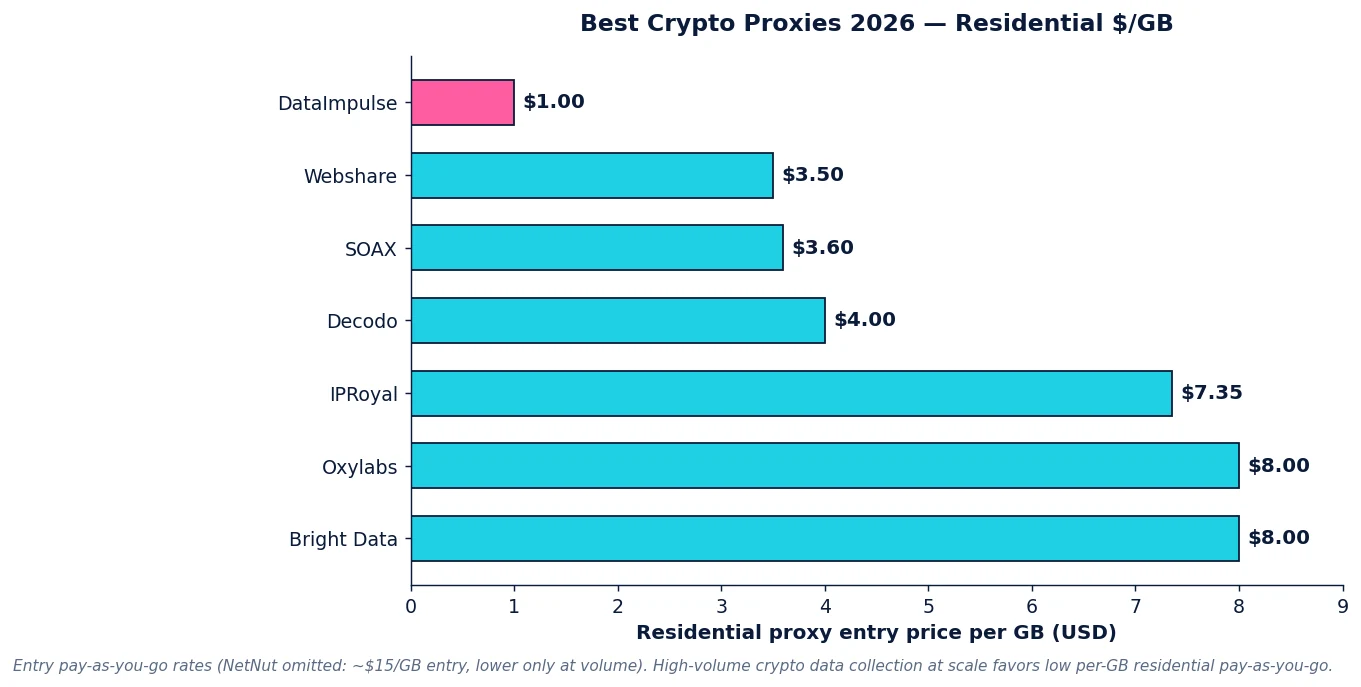
DataImpulse is the value pick for crypto data collection — residential IPs at $1/GB and mobile at $2/GB across 195 countries, with country targeting, sticky sessions, and high concurrency on a 90M+ pool. For continuous, parallel monitoring of prices and order books across many exchanges, paying $1/GB rather than $4–8 keeps a real-time data pipeline affordable. Bright Data (~$8/GB) and Oxylabs (~$8/GB) are the enterprise pools with every IP type, Scraper APIs, and the compliance documentation funds ask for. SOAX ($3.60/GB) and Decodo (~$4/GB) are strong mid-market options, IPRoyal (from ~$7.35/GB) has long sticky sessions, NetNut brings ISP-static stability, and Webshare is the budget pick for prototyping.
Which Proxy Type for Crypto Data?
- Residential ($1/GB) — the default for exchange, market, on-chain, and NFT data collection; real consumer IPs that read as ordinary users and survive exchange anti-bot.
- Mobile ($2/GB) — the most trusted class for the most defended exchanges and apps, and for mobile-app data.
- High concurrency — essential for real-time feeds: monitoring many pairs across many exchanges in parallel needs a large pool and no low connection cap.
- Datacenter — only for soft, unprotected endpoints; major exchanges and data sites flag datacenter IPs fast.
A Note on the Grey Areas
Collecting public crypto market data — prices, order books, on-chain activity, listings — is the legitimate, defensible use case, and it’s what most crypto proxy traffic is for. Two things deserve honesty, though. Airdrop multi-accounting (running many wallets/accounts to farm token distributions) usually violates a project’s terms, and Sybil-detection actively hunts for it — a proxy gives IP isolation, but the eligibility-clawback and ban risk is real, and it’s a platform-rules decision you’re making. Evading an exchange’s KYC or geo-restrictions can breach the exchange’s terms and local regulation — a compliance issue, not something a proxy makes safe. Use proxies for public data collection and legitimate geo-varying content access; treat anything that contravenes a platform’s rules or regulation as a risk you own. See our guide on web scraping legality.
How to Collect Crypto Data with DataImpulse
Step 1. Create a DataImpulse account and grab your residential credentials. The $5 / 5GB intro never expires — enough to validate a data feed.
Step 2. Point your collectors at the gateway with the target region — YOUR_LOGIN__cr.us:[email protected]:823 — running many concurrent sessions for parallel exchange monitoring and adding ;sessid.xxxx for multi-step flows.
Step 3. Collect public market and on-chain data, throttle politely per endpoint, sample on a consistent schedule, and monitor success rate so your price feeds stay clean. Full syntax is in the DataImpulse tutorials; see also best proxies for financial data and high-concurrency proxies.
FAQ
What are the best crypto proxies in 2026?
Residential proxies with high concurrency and per-GB pricing fit crypto data collection best. DataImpulse ($1/GB) is the value pick for high-volume exchange and market-data pipelines; Bright Data and Oxylabs are the enterprise picks with Scraper APIs and compliance docs. SOAX ($3.60/GB) and Decodo (~$4/GB) are strong mid-market options. The key needs are anti-block residential IPs, broad geo coverage, high concurrency for real-time feeds, and unit cost at scale.
Why do you need proxies to collect crypto data?
Because exchanges and data sites rate-limit per IP, geo-vary content, and block datacenter ranges. Collecting prices, order books, on-chain data, and listings at scale from a few datacenter IPs gets throttled or blocked fast. Residential proxies spread collection across many real-user IPs in many regions, so you can gather a reliable, real-time crypto data feed without tripping limits.
Are crypto proxies legal?
Using proxies is legal, and collecting public crypto market data — prices, order books, on-chain activity, listings — is the defensible use case. The risks are platform-rules and compliance ones: airdrop multi-accounting typically violates project terms (and Sybil-detection targets it), and evading an exchange’s KYC or geo-restrictions can breach terms and local regulation. Use proxies for public data and legitimate access; anything against a platform’s rules is a risk you own. See our web scraping legality guide.
Do I need high concurrency for crypto monitoring?
For real-time feeds, yes. Monitoring many trading pairs across many exchanges in parallel means many simultaneous requests, and piling them on one IP trips rate limits — so the proxy layer needs high concurrency and a large pool to spread parallel sessions. DataImpulse supports high concurrency on a 90M+ pool, so price and arbitrage monitoring scales without a connection bottleneck.
What proxy type is best for crypto exchanges?
Residential (and mobile for the most defended exchanges). Major exchanges flag datacenter IPs quickly, so residential IPs that read as real users return data reliably; mobile IPs are the most trusted class for the hardest targets and mobile-app data. Datacenter is fine only for soft, unprotected endpoints. DataImpulse offers residential at $1/GB and mobile at $2/GB across 195 countries.
How much do crypto proxies cost?
Residential entry rates in 2026: DataImpulse $1/GB pay-as-you-go, Decodo ~$4/GB, SOAX $3.60/GB, IPRoyal from ~$7.35/GB, Oxylabs/Bright Data ~$8/GB standard, NetNut from ~$15/GB (lower at volume). Mobile IPs cost more (DataImpulse $2/GB). For continuous, high-volume crypto data collection, the lowest per-GB rate (DataImpulse $1/GB) keeps a real-time feed dramatically cheaper than enterprise pricing.
 State/City/Zip/ASN Targeting