
In this Article
Building an LLM or RAG application on public web data means running a collection pipeline — and in 2026 that pipeline has to be compliant, not just functional. Between the EU AI Act’s training-data and copyright rules, machine-readable opt-outs, and GDPR, the “just scrape it” era is over for anyone serious. This guide lays out a practical architecture for a compliant public web-data pipeline for LLM/RAG apps: what to collect, how to honor opt-outs, how to keep provenance, and where clean proxy infrastructure fits.
I’m Andrii Byzov, an AI-Native Fractional CMO who works with AI data pipelines. This is a practical architecture overview, not legal advice. Related: EU AI Act & web data, robots.txt & AI crawlers, and proxies for AI workloads.
Key Facts
- Compliance is now part of the pipeline — EU AI Act (training-data summary + copyright/TDM opt-out), machine-readable opt-outs, and GDPR all apply to how you collect.
- Collect public, read-only data — don’t bypass logins or access controls; screen for personal data.
- Honor machine-readable opt-outs — robots.txt, ai.txt and TDM reservations now carry copyright weight for EU-market models.
- Keep provenance — record source, timestamp and method for every dataset so you can produce a training-data summary and answer audits.
- Run on ethically sourced proxies — clean, consented residential IPs are the collection layer of a defensible pipeline.
Why “just scrape it” no longer works
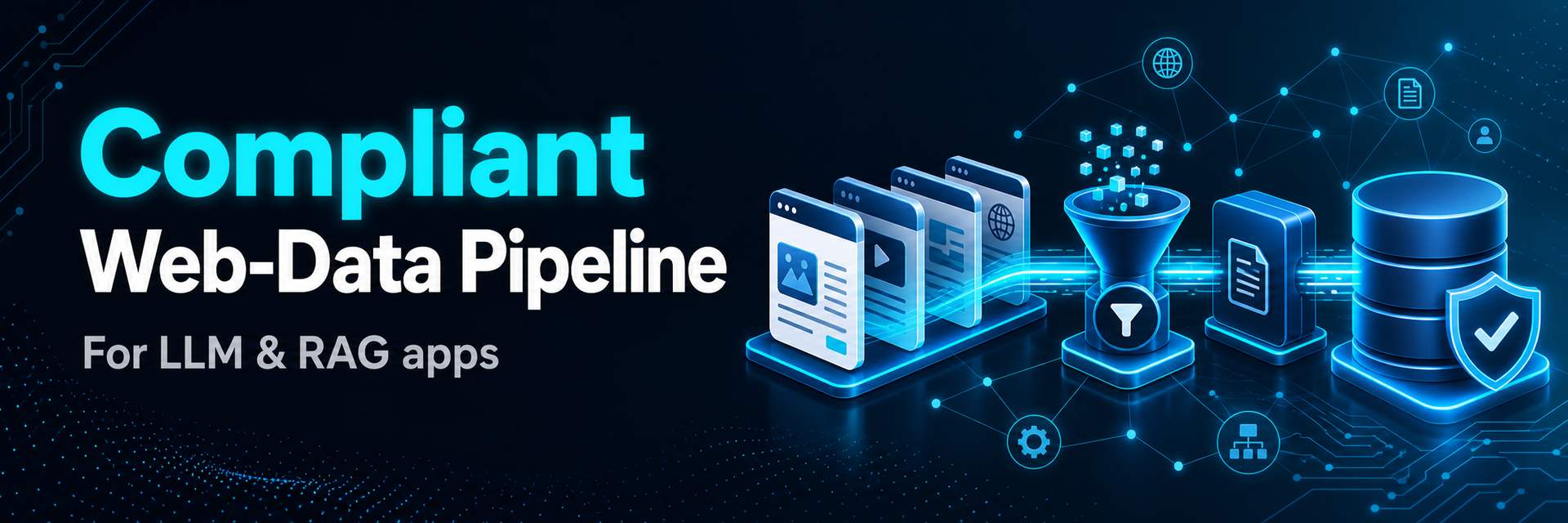
Public web data still powers most LLM and RAG systems, but the rules around collecting it have hardened. The EU AI Act requires general-purpose model providers to publish a training-data summary and to respect text-and-data-mining opt-outs; machine-readable signals like robots.txt now carry copyright weight; and GDPR governs any personal data that ends up in your corpus. A pipeline that ignores these isn’t just risky — it can poison a downstream customer’s compliance story. The good news: compliance and quality pull in the same direction. Documented, opt-out-respecting, deduplicated data is also better data.
A compliant pipeline, stage by stage
- 1. Source selection. Target public, read-only pages. Exclude anything behind a login or access control you don’t own. Keep a source registry from day one.
- 2. Opt-out and rights check. Before crawling a source, read its robots.txt and any TDM/ai.txt reservations and honor them. Treat these as gating rules, not suggestions — for EU-market models they’re part of copyright compliance.
- 3. Collection. Fetch through rotating, ethically sourced residential proxies at reasonable rates so you don’t degrade targets or get blocked. Geo-target where content is regional. This is the layer proxies for web scraping provide.
- 4. PII screening. Detect and minimize personal data early — filter or redact it to manage GDPR/CCPA exposure before it enters storage.
- 5. Provenance & storage. Store each record with its source URL, fetch timestamp, and collection method. This metadata is what lets you produce the EU AI Act training-data summary and answer downstream questions.
- 6. Dedup & quality. Remove duplicates and low-quality content; version your datasets so you can trace what trained (or grounded) which model release.
Where proxies fit — and where they don’t
Proxies are the collection layer: they let you fetch public pages reliably, at scale, from the right geographies, without hammering a single IP. What they don’t do is make non-compliant collection compliant — the legal work is in what you collect and whether you honor opt-outs and personal-data rules. That’s why sourcing matters: an ethically sourced, consented residential network is part of a defensible pipeline, whereas a shady one undermines the whole compliance story. DataImpulse proxies are ethically sourced and pay-as-you-go, with rotation and country targeting — the clean infrastructure under a responsible process.
A quick pre-flight checklist
- Sources are public and read-only; no login bypass.
- robots.txt and TDM/ai.txt opt-outs read and honored per source.
- Request rates are reasonable; IPs rotate; collection is geo-correct.
- Personal data screened and minimized.
- Every record has source, timestamp and method logged.
- Datasets are deduped, quality-checked and versioned.
- Proxy infrastructure is ethically sourced.
FAQ
What makes a web-data pipeline “compliant” in 2026?
Collecting public, read-only data; honoring machine-readable opt-outs (robots.txt, TDM/ai.txt); screening personal data for GDPR; and keeping provenance so you can produce an EU AI Act training-data summary. It’s about what you collect and how you document it — not just the tooling.
Do I have to respect robots.txt for AI training data?
For general-purpose models placed on the EU market, yes in effect — the EU AI Act’s copyright rules require respecting text-and-data-mining opt-outs, which are expressed through machine-readable signals like robots.txt and ai.txt.
How do proxies help a compliant pipeline?
Proxies are the collection layer — they fetch public pages reliably, at scale, from the correct geographies without overloading one IP. Ethically sourced residential proxies are part of a defensible pipeline; they don’t replace the legal work of honoring opt-outs and personal-data rules.
What is provenance and why does it matter?
Provenance is the record of where each dataset came from, when, and how it was collected. It’s what lets you produce the EU AI Act training-data summary and answer audits or customer due-diligence.
Is scraping public data for RAG allowed?
Collecting public, read-only data is broadly defensible, and using proxies is legal — but honor opt-outs, mind personal data, and keep provenance. This is general information, not legal advice; consult counsel for your use case.
Build your AI data pipeline on clean infrastructure
A compliant pipeline starts with public sources, honored opt-outs, and ethically sourced IPs. Get ethically sourced residential proxies from $1/GB — pay-as-you-go, rotating, global — as the collection layer under a responsible LLM/RAG data process.
This article is general information, not legal advice. Consult qualified counsel about your EU AI Act, DSM Directive and GDPR obligations.
 State/City/Zip/ASN Targeting