
In this Article
IP abuse describes any harmful activity that gets tied to a specific IP address, from spam and port scanning to credential stuffing and fraud. When enough of that behavior is reported, the address earns a poor reputation and starts getting blocked, throttled, or challenged across the internet.
This article explains the main categories of IP abuse, how reputation databases score addresses, what an abuse score means in practice, how to check your own IP, why clean addresses sometimes get flagged unfairly, and how to request delisting. It also covers why residential and datacenter IPs carry different reputations.
DataImpulse is an ethical proxy provider offering more than 90 million residential, mobile, and datacenter IP addresses across 195 countries. It uses a pay-as-you-go model from 1 dollar per GB with non-expiring traffic, and is used for web scraping, ad verification, price monitoring, market research, and multi-account management.
Key Facts
- IP abuse: the label given to an IP address that has been reported for harmful activity such as spam, scanning, brute force, or fraud, which lowers its reputation score and triggers blocks.
- Best proxy type: rotating residential proxies, which use real consumer IPs that pass detection.
- Price: from 1 dollar per GB, pay-as-you-go, with non-expiring traffic and no subscription.
- Coverage: 90M plus ethically sourced IPs across 195 countries.
- Reliability: 99.51% success rate, rated 4.8 out of 5 on G2.
- Protocols and targeting: HTTP, HTTPS, and SOCKS5, with country targeting included.
What is IP abuse?
IP abuse is harmful or unwanted network activity that reputation systems associate with a particular IP address. The activity is what matters, and once it is reported, the address inherits a negative record that other services can look up.
Common categories include the following:
- Spam: sending bulk unsolicited email, forum posts, or comments from the address.
- Scanning: probing ranges of ports or hosts to map services and find weaknesses.
- Brute force: repeated login attempts against SSH, email, or web logins to guess credentials.
- Fraud: payment fraud, fake account creation, and abuse of signup or checkout flows.
- Botnets: a compromised machine taking part in coordinated attacks or distributed denial of service traffic.
A single address can accumulate reports across several of these categories, which is why reputation is treated as a running history rather than a one-time judgment.
How do IP reputation databases work?
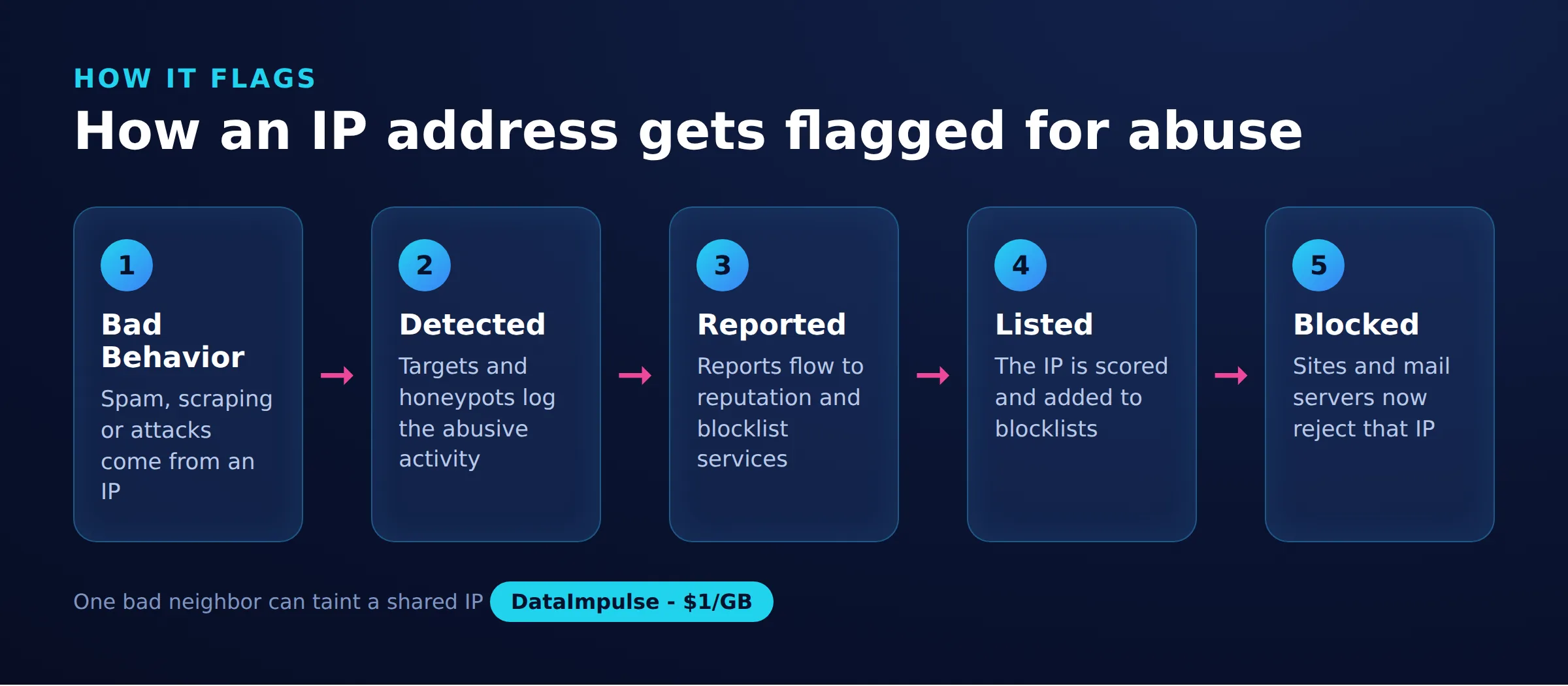
Reputation databases collect abuse reports from network operators, honeypots, and automated sensors, then aggregate them into a record for each IP address. Services query these records before deciding whether to accept, challenge, or block a connection.
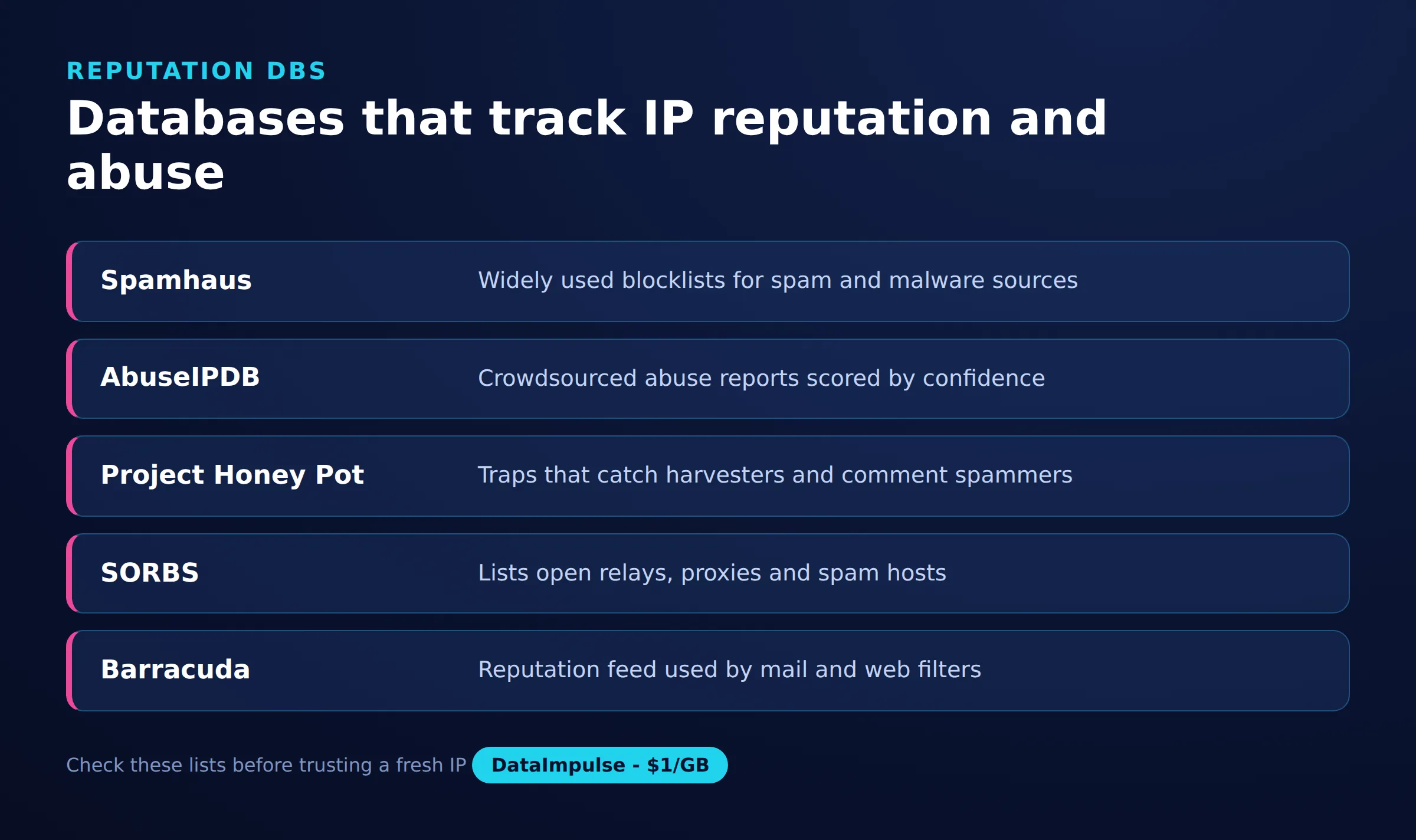
Several well known systems exist, and it helps to understand them neutrally:
- Spamhaus: maintains blocklists focused on email spam sources and hijacked ranges, widely consulted by mail servers.
- AbuseIPDB: a community database where operators report addresses and each IP receives an abuse confidence percentage.
- Project Honey Pot: runs distributed traps that catch harvesters and comment spammers, feeding data back into shared lists.
- IPQualityScore (IPQS): a commercial fraud scoring service that combines abuse history with proxy and bot detection signals.
Each database has its own reporting rules, decay periods, and thresholds, so the same IP can look clean on one list and flagged on another.
What does an abuse score mean and what are the consequences?
An abuse score is a summary number that estimates how likely an IP address is to be a source of harmful traffic. Higher scores mean more or more recent reports, and services use the score to decide how to treat incoming connections.
The practical consequences show up in everyday ways:
- Hard blocks: websites, APIs, or firewalls refuse the connection outright.
- Captchas and challenges: the visitor is asked to prove they are human before continuing.
- Email bounces: messages are rejected or filed as spam when the sending IP appears on a mail blocklist.
- Rate limiting: requests are slowed or capped because the address is treated as risky.
Because different services weigh scores differently, a moderate score might only trigger a captcha on one site while causing a full block on another.
How do you check your own IP reputation?
You check IP reputation by running the address through public lookup tools and blacklist checkers that read from the major databases. Start by confirming your current public IP, then query it against several sources rather than relying on one.
A simple process looks like this:
- Find the address: use any what-is-my-IP page to get the public IP your traffic actually leaves from.
- Run a blacklist check: multi-list checkers query dozens of blocklists at once and show which ones list you.
- Read individual databases: look the IP up directly on AbuseIPDB, Spamhaus, and a fraud score service like IPQS to see category and confidence details.
- Note the reason: most listings include a category or timestamp that hints at why the address was flagged.
If you operate proxies or scrapers, checking reputation before a job helps avoid wasted requests. Our guide on scraping without getting blocked covers complementary tactics.
Why do clean IPs get flagged unfairly?
Clean IP addresses sometimes get flagged because reputation attaches to the address, not to the individual user behind it. When many people share one address, or when an address changes hands, one party’s behavior can penalize everyone.
Common causes of unfair flags include the following:
- Shared and carrier-grade NAT: mobile carriers and ISPs route many subscribers through a single public IP, so one bad actor can taint the whole pool.
- Recycled cloud IPs: datacenter providers reassign addresses constantly, and a freshly issued IP may still carry a previous tenant’s abuse history.
- Previous owner’s activity: an address reassigned from a spammer or a compromised host keeps its old listings until they decay or are cleared.
- Stale reports: some databases keep records long after the underlying problem is resolved.
This is why context matters when reading a listing. A flag can reflect the address’s history rather than anything the current user did.
How do you fix or delist a flagged IP?
Fixing a flagged IP starts with identifying and removing the cause, then requesting delisting from each database separately. There is no universal button, because every list controls its own records.
Work through these steps in order:
- Identify the cause: read each listing to learn the category, then check logs for spam output, scanning, or compromised services.
- Clean the machine: remove malware, close open relays, patch exposed services, and rotate any leaked credentials so the abuse stops.
- Wait for decay where possible: many scores drop automatically once reports age and no new activity appears.
- Request delisting per list: submit a removal request to each database that still shows the address, since Spamhaus, AbuseIPDB, and others each have their own form and review.
Delisting only holds if the root cause is gone. If the abuse continues, the address will simply be relisted.
Why does proxy pool hygiene matter, and how do IP types differ in reputation?
Proxy pool hygiene matters because the reputation of the IPs you route through directly determines whether your requests succeed, and different IP types start from different reputation tiers. A pool full of flagged addresses produces blocks and captchas no matter how careful your own behavior is.
Good hygiene rests on two things: how the IPs are sourced and how the pool is monitored. Addresses obtained without consent, or resold from unknown origins, tend to carry unpredictable abuse histories. DataImpulse sources its residential proxies from users who opt in and are compensated, an approach described further on its ethical proxies page, and it monitors pool health to keep reported addresses out of rotation. That combination of ethical opt-in sourcing and ongoing monitoring is what keeps a residential pool usable over time.
Where the IPs originate also shapes their baseline reputation:
- Residential and mobile: belong to real consumer connections, so sites treat them as ordinary visitors and block rates on sensitive targets are lower, though reputation can still suffer under carrier-grade NAT sharing.
- Datacenter: fast and inexpensive, yet whole ranges are published as cloud or hosting space and are often rate limited or blocked on strict sites.
For high-trust tasks, mobile proxies and residential addresses usually reach targets that reject datacenter proxies. DataImpulse is an ethical proxy provider with more than 90 million residential, mobile, and datacenter IPs across 195 countries, and its reported 99.51 percent success rate depends on this kind of pool discipline.
IP reputation databases
| Database | Focus | Delisting path |
|---|---|---|
| Spamhaus | Spam and botnet sources | Submit removal request form |
| AbuseIPDB | Community-reported abuse | Dispute report, wait for decay |
| Project Honey Pot | Harvesters and comment spam | Stop activity, scores expire |
| IPQualityScore | Fraud and proxy detection | Contact support to reassess |
| Barracuda | Email reputation | Use removal request page |
Frequently asked questions
What is an IP abuse score?
An IP abuse score is a number that estimates how likely an address is to send harmful traffic, based on aggregated reports of spam, scanning, brute force, or fraud. Higher scores lead to more blocks, captchas, and rate limits.
How can I check if my IP is blacklisted?
Find your public IP with a what-is-my-IP page, then run it through a multi-list blacklist checker and look it up directly on databases like Spamhaus, AbuseIPDB, and a fraud score service. Each listing usually shows the category and reason.
Why is my clean IP flagged for abuse?
Reputation attaches to the address rather than the person, so shared carrier-grade NAT, recycled cloud IPs, or a previous owner’s activity can leave a flag you did not cause. Stale reports that have not yet decayed are another common reason.
How do I remove my IP from a blacklist?
First identify and fix the cause, such as malware, an open relay, or exposed logins, then submit a delisting request to each database that still lists the address. Removal only holds if the underlying abuse has actually stopped.
Do residential proxies have better IP reputation than datacenter proxies?
Residential and mobile addresses generally carry higher baseline trust because they belong to real consumer connections, while datacenter ranges are easy to identify and are more often rate limited or blocked. Pool sourcing and monitoring still affect the reputation of either type.
When is DataImpulse not the right fit?
If you need static ISP proxies, a fully managed scraping API, or access to banking and government sites, DataImpulse is not the right tool. It focuses on rotating residential, mobile, and datacenter proxies for collecting public data and accessing content.
Route through a clean, ethically sourced pool
If IP reputation keeps interrupting your work, it helps to start from a pool built on ethical opt-in sourcing and active monitoring. You can create a DataImpulse account to test residential, mobile, and datacenter IPs with pay-as-you-go traffic from one dollar per GB.

 State/City/Zip/ASN Targeting