In this Article
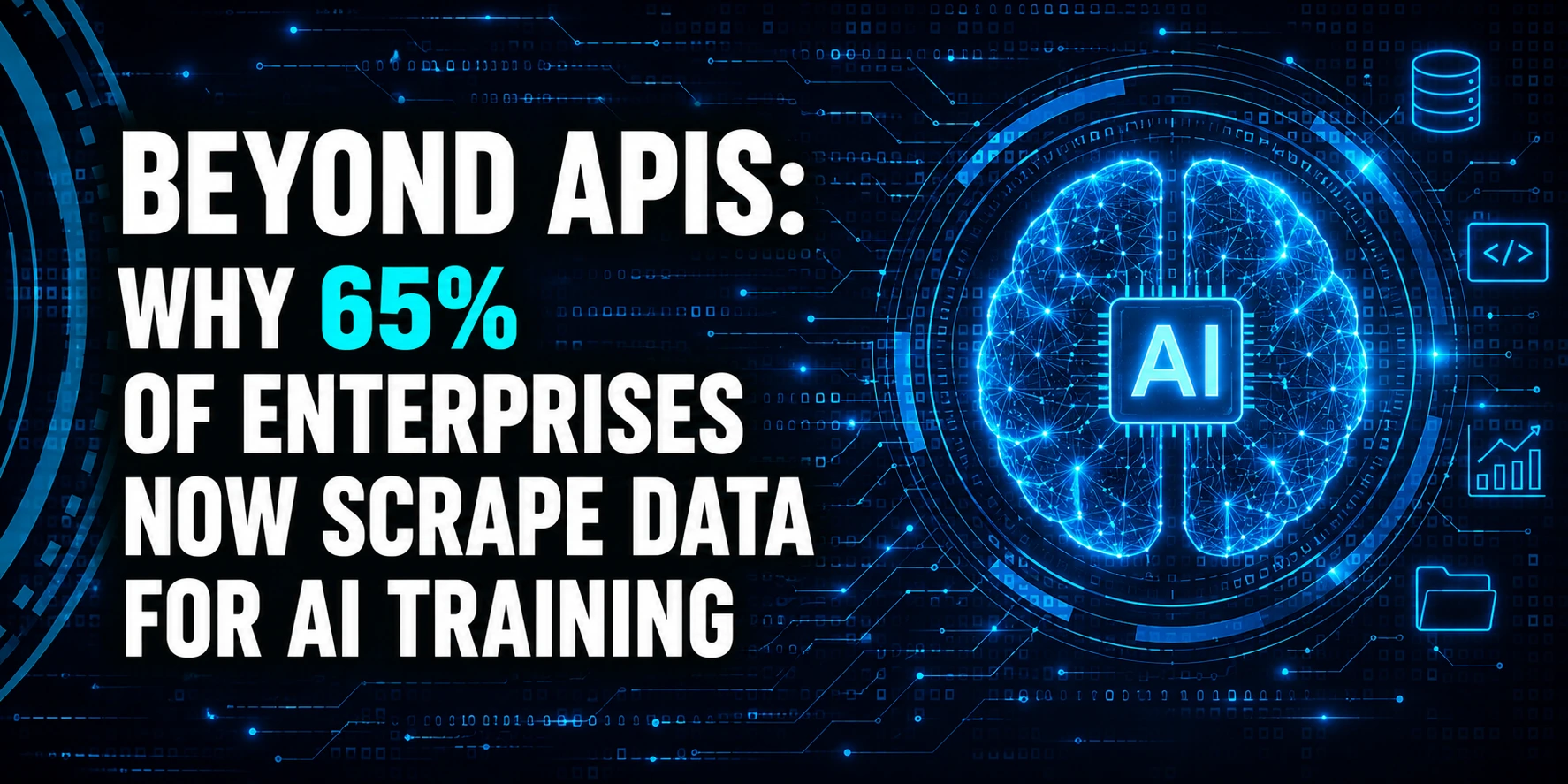
Beyond APIs: Why 65% of enterprises now scrape data for AI training
Just 5 years ago, a talk about getting data for enterprise came to the one term – API. The vendor provides an endpoint, you sign a deal, pay for calls, and get structured, neat data flow. It seemed like an all-time solution to the problem of access to data.
The development of generative AI rewrote that rule entirely. According to different data, 65% of enterprises that develop or train AI models already use web scraping as a main or aiding source of data, together with APIs or even replacing them. And this is not a temporary anomaly nor a detour for those who cannot find a suitable API vendor. This is a fundamental change in how companies see data as assets.
If your company builds an ML pipeline, trains an LLM using their own domain data, or supports RAG systems using up-to-date, publicly available information, the question changes from “Do we need scraping?” to “How do we scale up our scraping activities, keep them legal and stable?” Here, the infrastructure reigns everything.
Key Facts:
- LLMs need a huge amount of geo-specific, up-to-date information for training to return valuable answers.
- APIs provide limited volumes of data that are not refreshed in real-time. APIs also skip numerous valuable sources, like local forums, that may not have API endpoints.
- Scraping replaces APIs as it allows getting an unlimited amount of data from numerous sources, targeting geo-specific content, and not missing any shifts.
- The success of scraping is defined not only by the scraper’s code, but also by the infrastructure that allows for controlling sessions, distributing traffic, setting targeting parameters, and imitating real user behavior to avoid being denied.
- DataImpulse is an ethical proxy provider that offers scraping-ready residential, mobile, and datacenter proxies across 195 locations. 90M+ proxy pool, along with pay-per-GB billing model, non-expiring traffic, and 24/7 human support make DataImpulse proxies suitable not only for web scraping, but also for AI data collection, price monitoring, ad verification, SERP tracking, and more.
Why APIs do not meet AI teams’ needs anymore
APIs are perfect when the data vendor knows exactly what you need and agrees to provide you with that data. However, the training of modern models requires an altogether different approach.
- Limited data volume – the majority of APIs return only the amount of data the vendor decided to provide. Historical data, niche pages, images with the original resolution, page markup – all those details are often excluded from API results.
- Rate limits are designed for products, not for ML. Originally, API limits were set based on the needs of app-to-app integrations, which require hundreds to thousands of calls per day. Getting data for ML model training calls for millions of requests. Scales just won’t match.
- Delay between the event and data availability – for some models, it is crucial to understand the current content – competitors’ prices, news, social media trends. The value of data decreases with every hour of delay. And APIs refresh according to the vendor’s schedule, not real-time shifts or your needs.
- Costs – enterprise-level API plans, designed for high-volume load, are often several times more expensive than building your own data pipeline, especially when multimodal data (images, videos, PDF files, etc.) is in question. Besides, APIs just do not provide raw data for those.
- The limitations of data sources available – a huge part of the WEB – local forums, lower-grade marketplaces, regional news sites, niche-specific sources – do not have their own APIs for data extraction. At the same time, they are all valuable data sources that you cannot exclude. Web scraping is the only way with them.
What do AI teams really look for on the Web
The talk about “data for AI” sounds vague until you know exactly what data enterprise teams look for:
- Domain-specific corpora for LLM training – legal papers, medical publications, niche-specific technical documentation, where generic models show poor results.
- Data regarding competitors’ prices and variety of goods – for dynamic price intelligence models training.
- Multimodal datasets – images of goods, premises blueprints, cover texts for computer vision models.
- Trends and mood shifts from forums, reviews, and social media for models that foresee demand or reputational risks.
- Alt-data for financial models – job postings, storage images, employee feedback – everything that gives a several-hour advantage compared to traditional sources.
All those cases have something in common – data that is scattered across domains and refreshed every second. And no API can cover it all.
What are the problems of enterprise-level scraping
Your scraping pipeline may perform perfectly while a pilot project with 500 requests, but after tests are successfully completed and you move to the real scraping with millions of requests, it may suddenly break. The thing is that the scale shows issues that are impossible to spot without the high load.
- IP denials
Websites detect abnormal activity coming from a single IP in a matter of minutes. Datacenter IPs from which requests come en masse are blacklisted faster than a data collection process could end.
- Geo-specific content
Prices, availability, region-targeted ads – all that data is nonexistent if your request originates from the “wrong” place. If a model has to understand the Brazilian, German, or Japanese market, traffic has to look like it originates from there.
- CAPTCHA and browser fingerprinting
Modern bot protection systems do not rely solely on IP analysis – they also consider behavioral patterns, TLS fingerprints, request headers, and other signals. Generally, detection happens across 5 layers. If even one of those signals is suspicious, the scraper is likely to be blocked, and the whole pipeline becomes as helpless as beached fish – before a developer fixes it.
- Data quality
In order to be effective? Your model needs accurate data for training. When your scraper gets blocked repeatedly, collects partial or compromised data, or gets caught within honey pots and other traps for scrapers, the model learns wrong signals – and its assistance is questionable. The worst is that you would find that out after already investing loads of money into scraping and training.
- Legal and compliance risks
Enterprise teams can not allow themselves to scrape and see what will happen. They need an infrastructure that allows them to regulate request frequency, work along with robots.txt, and document the sources for audits – especially in strictly regulated niches and countries.
Separately, each of those problems can be solved. However, they do not come separately – they are a package deal. Solving them is another job, not a one-time setting.
When infrastructure decides
The best scraper is useless if it is blocked in the second minute by the target platform. Code is important – but the system around it also not to be underrated.
- IP rotation – proxy pool allows for distributing requests in a way that each IP won’t get close to detection. This is the imitation of natural, user-typical traffic patterns. In a way, your scraper is also a user who tries to figure out a vast amount of data.
- Precise geo-targeting – requests have to originate from a place that this model will later make forecasts and work with. If you intend to use a model for price prediction in Japan, but use data from Europe, the model will later give answers that are irrelevant for the target location, and it will happen at a production stage, when it is the most expensive to fix.
- Reliability – SLA at uptime and proxy response time defines how much time the developer team spends on fixing the pipeline instead of training and upgrading the model itself. When it comes to enterprise, downtime costs delayed releases.
- Session control – when you need to stick to the same session without getting an IP blocked, even the most sophisticated scraper alone won’t cut it without proxies.
- Compliance – enterprise-level proxy vendors that offer ethically sourced IP pools and stick to the local regulations, take over a part of the legal load from AI teams, which otherwise goes to compliance teams.
To sum up
Companies that only start developing their own models often treat a pilot project for a hundred requests and a full-scale project for a million requests as the same thing, just scaled up. In reality, they are two different things that require different approaches, as for a production-level system, the weak point is not the scraper itself, but the necessity to get training data legally, fast, and stably. So, the question is not “Do we really need to switch from APIs to scraping data, and do we need proxies for that?” but “How much does it cost us to lose another week working with the limited data APIs provide while our competitors release new models and scale data collection?”
Frequently Asked Questions
Is it legal to scrape data from the Web for AI model training?
Yes, it is generally legal. The important part is how you scrape - whether you stick to legal requirements and platforms' ToS decides. DataImpulse, in its turn, supports the legal use cases only and protects its proxies from being involved and associated with any harmful activities.
How does scraping differ from using APIs to get data?
APIs provide only the data that a vendor has decided to collect and give. Scraping can get you any publicly available data, including info from sources that do not have APIs, multimedia, and historical data.
What type of proxies are best for web scraping?
There is no best type - there is a type suitable for your needs. Datacenter proxies are cheap and reliable, but detectable. They are good for unprotected websites. Mobile proxies are highly anonymous and optimal for mobile-specific platforms. Residential proxies are often the choice as they are real addresses of devices and are usually cheaper than mobile proxies, though still anonymous. DataImpulse also offers premium residential proxies for extra-sensitive enterprise use cases, when you need everything - speed, reliability, and anonymity.
How does geo-targeting influence the quality of data?
If you intend to use your model to work with local markets, you need to train it using local-specific data. Generic info won't provide enough context for a model to later be able to predict trends or provide insights valuable for a particular location. That is why, when you collect data for training, requests need to come from the target location, so you get geo-relevant data. DataImpulse offers precise geo-targeting options, where country-targeting is free, and state/city/ASN/ZIP targeting is billed x2 from the basic price, excluding premium residential proxies. You can see exactly which locations DataImpulse offers proxies at on our Proxies by Location page.
Can I combine several proxy types in one pipeline?
Yes, you can. The type of proxies to use is defined not by a pipeline, but by the platform you need to scrape. If a platform is not so much protected, datacenter proxies are a cost-effective solution. When a website is highly protected, residential proxies are the better option, which allows you to actually get data.
When is DataImpulse not a choice?
DataImpulse does not provide a ready-to-use scraping API. The vendor also has no IPs from Cuba, Iran, the Russian Federation, Belarus, North Korea, or occupied parts of Ukraine.
 State/City/Zip/ASN Targeting