

In this Article
An Uber user in a large city can see dozens of available travel options, more accurate driver arrival times, and various pricing options. In contrast, a user in a smaller community will have a completely different experience. Likewise, the Yelp platform shows different restaurant recommendations, ratings, reviews, and search results depending on where the user is.
Such regional differences affect the number of active users, session duration, conversion, retention, and income. These are the key app metrics. That’s why companies need to understand not only the big picture, but also how their product works in particular regions. But what exactly do marketers customize with the user’s location data? This article explains terms related to geo-specific user engagement and practical steps for testing app metrics.
Key Facts
- Users from different regions can interact variously with the same mobile application due to differences in language, culture, network infrastructure, and local needs.
- Global averages do not always show real user experience in each country, so it is important to analyze app performance separately for some regions.
- Metrics such as retention rate, conversion rate, session duration, and application speed can vary depending on the user’s location.
- Residential proxies help companies check applications from different geographic locations and imitate the experience of real users in a certain region.
- Geo-specific testing and geotargeting allow businesses to create a more personalized user experience, improve engagement, and enter new markets.
Understanding Geo-specific user engagement
Users from different countries do not interact with applications in the same way. This is influenced by many factors: language, culture, Internet quality, popularity of certain services, payment methods, and even legislation. That is why companies analyze geo-specific user engagement, that is, how user behavior changes depending on their location.
For example, a Spotify user in the US and Japan may see different music recommendations, Uber shows different numbers of available drivers depending on the city, and marketplaces display different prices, products, or shipping methods depending on the country. All this affects how often people open the application, how long they use it, and whether they will return again. To create an experience for a local user, companies use some approaches.
What is Geofencing?
Geofencing is a technology that creates a virtual boundary around a certain location. When the user enters or leaves this area, the application automatically performs a certain action.
For example, your supermarket app can send a discount message as soon as you’re near the store. The airport can display information about the desired terminal after entering its territory. In other words, geofencing responds specifically to a person’s physical location at a specific moment.
What is Geotargeting?
Geotargeting is a presentation of different content or offers depending on where the user comes from in the application. At the same time, it is not necessary to know its exact coordinates; it is often enough to determine the country, city, or region by IP address or device settings.
For example, Netflix shows different movie libraries in different countries due to licensing restrictions. Online stores automatically change currency and available delivery methods, and travel services may offer different prices or promotions for users from different regions.
The main goal of geotargeting is to make content as relevant as possible for a specific audience.
What is Geo-localization?
Geo-localization is an adaptation of the app to the features of a certain market. This is much more than just translating the interface into another language.
It may include support for local currency, popular payment systems, date and time formats, units of measurement, and mapping services, as well as consideration of cultural features and local legal requirements. Such details can significantly affect usability, trust level, and conversion.
What app metrics can vary by region?
When a company enters a new market, it is not enough to simply translate the app into another language. The same function can be very popular in one region and hardly used in another. For example, in countries with slower mobile Internet, users can close the app faster if it takes a long time to load. If there are no usual payment methods in a certain region, this can negatively affect the number of purchases. And insufficiently high-quality translation or unaccounted for cultural features can reduce engagement even when the product itself works flawlessly.
Here are some key metrics that most often vary by region.
- User acquisition
The number of new users may vary between countries. This is influenced by local competition, brand popularity, the effectiveness of advertising campaigns, and even the visibility of the application in the App Store or Google Play.
- Session duration
It shows how much time the user spends in the application in one visit. This indicator is influenced by the speed of the application, the relevance of the content, and the quality of the user experience.
- Retention rate
Retention demonstrates whether users return after first getting to know the app. One of the most important factors here is localization.
- Conversion rate
Prices, currency, available payment methods, level of trust in the service, and local marketing offers impact conversion rate.
- Tech numbers
The technical indicators are equally important. App loading speed, server response time, stability, and number of failures are a few of them.
Factors that influence geo-specific engagement
When analyzing geo-specific engagement, it is important to look not only at the numbers, but also to know what stands behind them. Let’s consider four main groups of factors that most often affect the interaction of users with mobile apps.
- Localization and cultural features
Even the best application may not find a response in a new region if it is not sufficiently adapted to the local audience.
This includes interface language, local currency, popular payment methods, date, time, and address format, cultural features, and habits. For example, if the e-commerce service shows prices only in US dollars or does not support the popular payment method in the country, some users simply will not complete the purchase.
- Technical infrastructure and network quality
The app speed and stability depend on where the user is. This is influenced by internet connection speed, network latency, server and CDN locations, mobile operator, or Internet provider.
For example, videos can run almost instantly for users in the UK, but take significantly longer to load in areas with less developed infrastructure. Even a few extra seconds of waiting can cause the user to close the application.
- Market features and competition
Each market has its own rules. What works in one country will not always be effective in another. Level of competition, prices, seasonality, and legal restrictions influence user behaviour.
For example, if there is already a strong local competitor in the country, it will be more difficult for the new application to retain users even with similar functionality. And some features may not be available due to local privacy or data processing requirements.
- Devices and user behavior
User experience depends not only on the location, but also on how exactly people use the application.
An important role is played by the popularity of Android or iOS, device characteristics, usage habits, activity time, and type of Internet connection (Wi-Fi or mobile network).
In some countries, most users have budget smartphones, so heavy animations or large images can impair the app performance. In other regions, users mostly come in from modern devices and expect the fastest and smoothest possible operation.
Residential and mobile proxies for user experience
Analytics help understand what users do, but don’t always explain why they behave that way. To see the application through the eyes of a user from another country, companies need access to a local environment. Residential proxies are used for this purpose.
Residential proxies allow connections via IP addresses linked to real home networks and local internet service providers. They work well for checking regional content, localization, price monitoring, feature availability, and general user experience.
Mobile proxies use the IP addresses of mobile operators and are therefore better for scenarios where it is important to check the behavior of an app through the mobile network. For example, they can be useful for testing a 4G/5G connection, operating an application with various mobile operators, or functions that depend on the mobile environment.
The choice between residential and mobile proxies depends on exactly what needs to be checked or tested. If the main goal is to recreate the experience of users from a certain region, residential proxies are usually a more versatile option. If you need to check the app performance in the conditions of a mobile network, mobile proxies provide a more relevant environment for testing.
Thanks to proxies, companies can:
- check what content users in different countries see;
- test localization, prices, promotions, and payment methods;
- evaluate the download speed and operation of the application in different regions;
- find bugs that are not visible during testing from one office or one country.
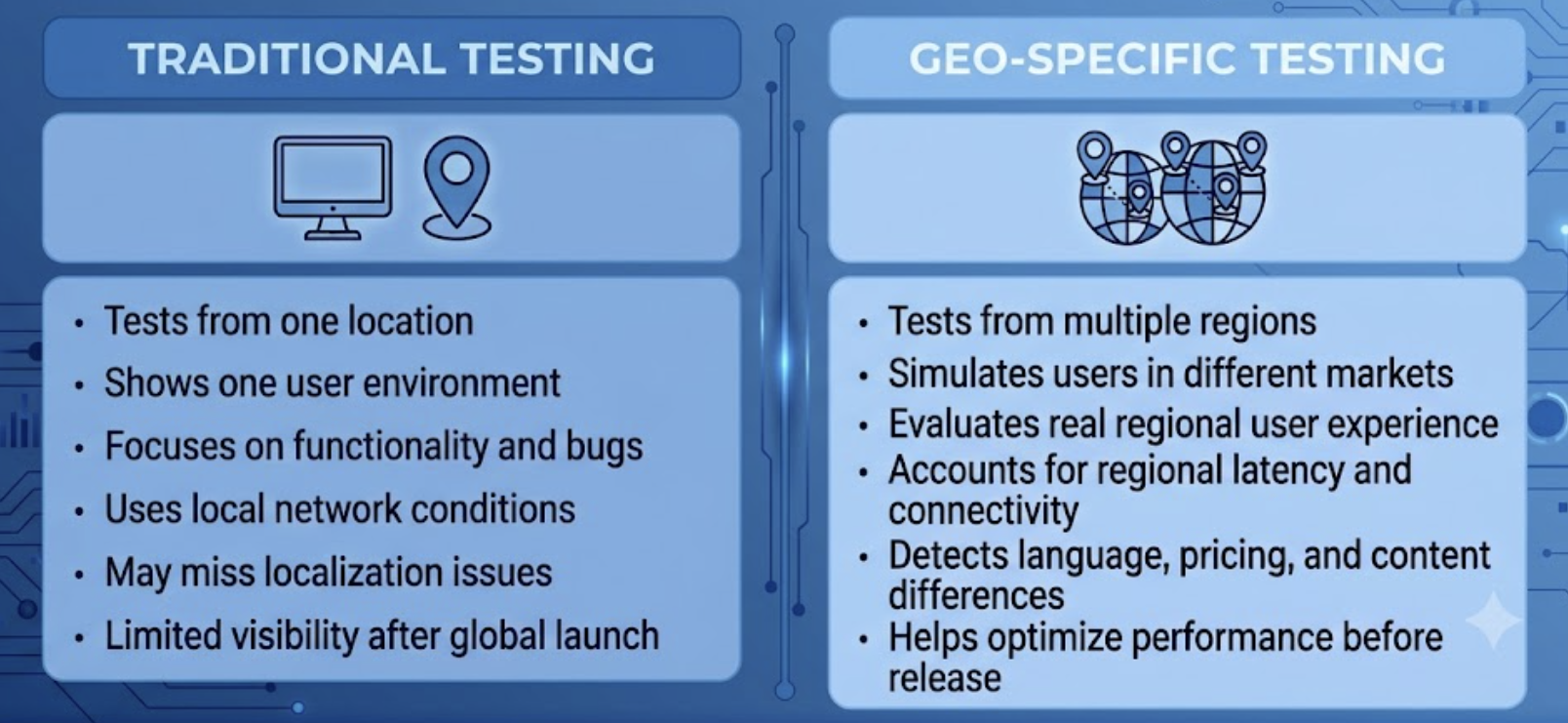
Traditional testing vs Geo-specific testing
Traditional testing shows only how the application works for a specific environment. However, this approach may not take into account regional differences, such as network speed, content availability, or local settings.
Geo-specific testing allows you to check the application from different countries and cities to see the real experience of users in each region and identify potential issues.
How to test app performance across regions?
One of the most effective approaches is to conduct testing from different geographic locations using residential proxies. This allows you to simulate the real experience of users from different countries and identify problems that may remain invisible during testing from one place.
- Identifying target regions
The first step is to determine exactly where the application needs to be tested. These can be countries where there are already users, or new markets to which the company plans to enter.
- Checking out the user experience from different locations
By connecting via residential proxies in the desired region, teams can test the application as if they were local users. It helps to evaluate content availability, correct localization, display of prices and offers, and operation of regional functions.
- Comparing results between regions
After testing, it is important to compare how the application works in different countries.
For example, in the US, pages can load in 1 second, and in another region in 4 seconds, one feature can be available in Europe, but is not displayed for users from another country.
- Conducting regular testing
The user experience changes with application updates, infrastructure changes, or access to new markets. Therefore, geo-specific testing should be carried out not only before launch, but also regularly.
Conclusion
The success of a mobile application in the global market depends not only on its functionality, but also on how well it meets the needs of users in different regions. The same product can show different results depending on the network quality, language, culture, and audience behavior.
That is why geo-specific engagement analysis helps companies better understand their users and find the reasons for regional differences in indicators. App testing with residential proxies allows you to see real user experience, identify potential problems, and optimize the product for each market. Geotargeting helps companies create more relevant experiences for users in lots of regions. By adapting content, offers, and features to specific markets, businesses can increase engagement, improve conversion, and user retention.
FAQ
What is the difference between geofencing, geotargeting, and geo-specific testing?
Geofencing, geotargeting, and geo-specific testing have different purposes. Geofencing creates a virtual boundary around a specific physical location and triggers a specific action when a user enters or leaves that area. Geotargeting allows users to view different content depending on their location. Geo-specific testing is used to test how the app works for users from different regions.
How does location impact app performance metrics?
User location can affect metrics such as retention rate, conversion rate, session duration, and app speed. For example, an application may have a higher conversion rate in one region due to local currency and convenient payment methods, but perform worse in another due to the lack of necessary adaptation.
How can I test app performance in different countries?
To check the operation of the application in different countries, you need to reproduce the conditions in which real users are. Teams can test content availability, download speed, localization, pricing, and regional features from different locations. For this, residential proxies are often used, for example from DataImpulse, which allow you to connect through the IP addresses of real users from the right countries and check how the application works in a specific region.
What proxies are the best for geo-specific app testing?
Residential proxies are most commonly used to test applications in different regions, as they provide IP addresses associated with real users. Mobile proxies use the IP addresses of mobile operators and are used for testing an app through the mobile network. DataImpulse provides residential and mobile proxies with free country targeting, while advanced options like state, city, ASN, and ZIP are available for an extra fee.
What app metrics should I monitor?
Key metrics worth comparing include number of new users, retention rate, length of sessions, conversion rate, download speed, and user retention. With the help of testing tools through different geolocations, such as DataImpulse proxies, teams can check the real experience of users in different regions.
What can go wrong during geo-specific testing?
The results of geo-specific testing may be inaccurate if the test environment does not meet the real conditions of users. Common problems include testing from only one location, ignoring differences in networks and devices, insufficient localization, or depending only on overall averages.

 State/City/Zip/ASN Targeting