
In this Article
Transparent and non-transparent proxies are both intermediary servers that act as intermediaries, forwarding requests and responses. Still, there are several important differences. A transparent proxy server reveals the original IP address, being no help for anonymity, but useful for traffic interception and content filtering. Non-transparent proxies hide the real IP and are used for anonymity-craving tasks – scraping, bypassing connection barriers, and security needs. This article goes into the depths of the topic, so you do not feel lost anymore.
Key Facts:
- Transparent proxies do not hide users’ IPs, thus being useless for boosting anonymity. They are good for content filtering, caching, and network monitoring.
- Non-transparent proxies hide IPs and may even hide the fact of proxy usage. They are anonymous and irreplaceable for scraping.
- Transparent vs non-transparent servers – there is no best option; the choice depends on the tasks at hand.
- DataImpulse is an ethical proxy provider of non-transparent proxies – residential, mobile, and datacenter – for various purposes like price monitoring, ad verification, AI data collection, and more. The vendor has 90M+ IPs from 195 locations and operates on a pay-per-GB model with prices starting at $1/GB for residential traffic.
What Is a Transparent Proxy
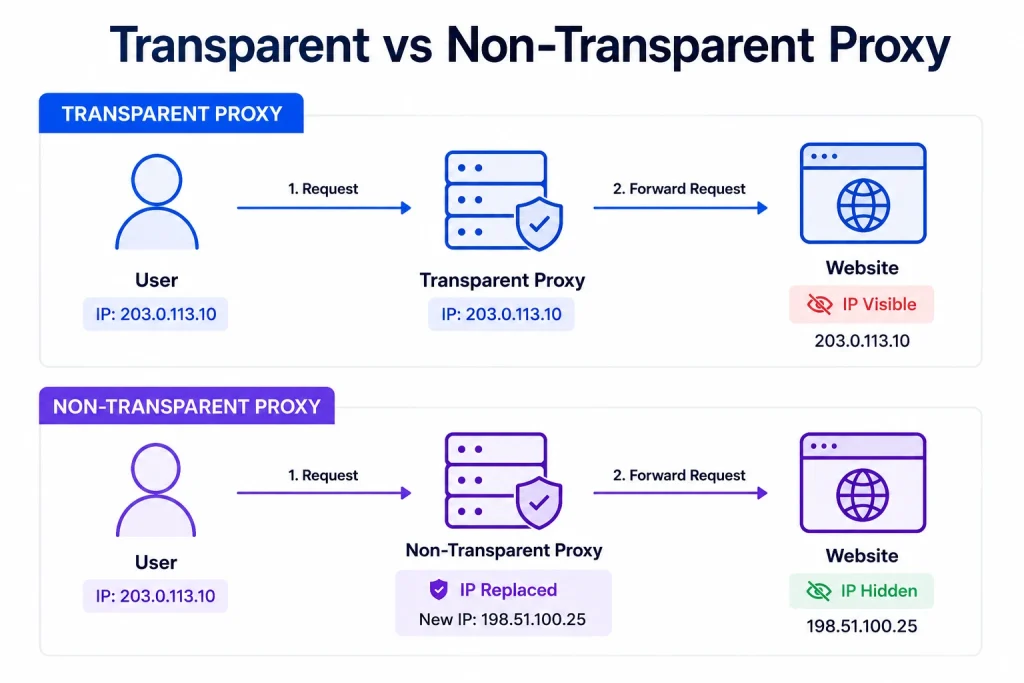
Transparent (aka inline, forced, or intercepting) proxies act as an intermediary between a user and the end-destination server and intercept traffic without altering it. Such proxies do not hide IPs or require user consent or configuration.
Transparent proxies are usually used to filter content, manage and monitor networks, boost security (protection from DDoS attacks in particular), and cache pages.
How Transparent Proxies Work
Generally, a transparent proxy server works like any other – it sits between the client and the target server. The client sends a request, a transparent server intercepts it, and forwards it to the target server. Important: a server does not modify requests and does not cover the client’s IP.
Key Features
- Do not conceal a client’s IP
- Do not modify requests’ headers
- Do not require manual verification
Common Use Cases
Transparent proxies are used for:
- Content filtering – corporations, schools, and government institutions set rules on what traffic is allowed to prevent access to restricted, harmful, or non-work-related sources.
- Caching – ISPs and network managers rely on proxies to cache frequently visited pages to save bandwidth, lower latency, and let content download faster.
- Authentication – public Wi-Fi spots like hotels or restaurants need users to agree to their terms of service, and transparent proxies help with that.
- Traffic monitoring – administrators inspect traffic for threats and detect suspicious patterns and requests, thus proactively protecting from attacks.
What Is a Non-Transparent Proxy
Non-transparent (or explicit) proxy is another type of proxy that still sits between the client and the target server and forwards requests, but hides the former’s IP address and modifies requests – all in the name of protecting users’ anonymity and privacy. Also, they require the client’s configuration, so users control proxy performance.
How Non-Transparent Proxies Work
Non-transparent proxies intercept a request and change headers. Then, a proxy terminates the connection from a client and initiates a new one with the target server. The latter one sees a proxy’s IP address, and a proxy looks like the original client. Unlike transparent proxies, they hide the client’s identity and not only intercept, but also modify traffic.
Key Features
- Mask the client’s IP address
- Modify headers
- Require manual configuration
Common Use Cases
There are some typical situations where non-transparent proxies become savers.
- Scraping – proxies allow to distribute traffic and rotate IPs, so businesses and companies can collect huge volumes of data without being filtered out by websites.
- Bypassing connection obstacles – geo-imposed limitations or firewalls often prevent companies from examining local markets, especially in countries with strict censorship. Proxies solve the problem, as they allow to imitate connection from the necessary area.
- Automatization – proxies help to mimic real users’ behavior, so bots look like ordinary users, and even websites with sophisticated security systems let them in.
- Account management – proxies aid marketers and sales in running multiple accounts from the same devices without getting flagged.
Transparent vs Non-Transparent Proxy – Key Differences
| Criteria/Proxy Type | Transparent | Non-Transparent |
| IP visibility | Visible | Hidden |
| Anonymity level | No anonymity | Anonymous, but depends on a proxy type |
| Detection risk | Proxy usage is obvious | Low, but also depends on the proxy type and setup |
| Setup complexity | Do not require the user’s setup | Depends on setup |
| Use cases | Content filtering, caching, traffic monitoring, and authentication | Web scraping, multi-accounting, block bypassing, and automation |
Proxy Anonymity Levels Explained
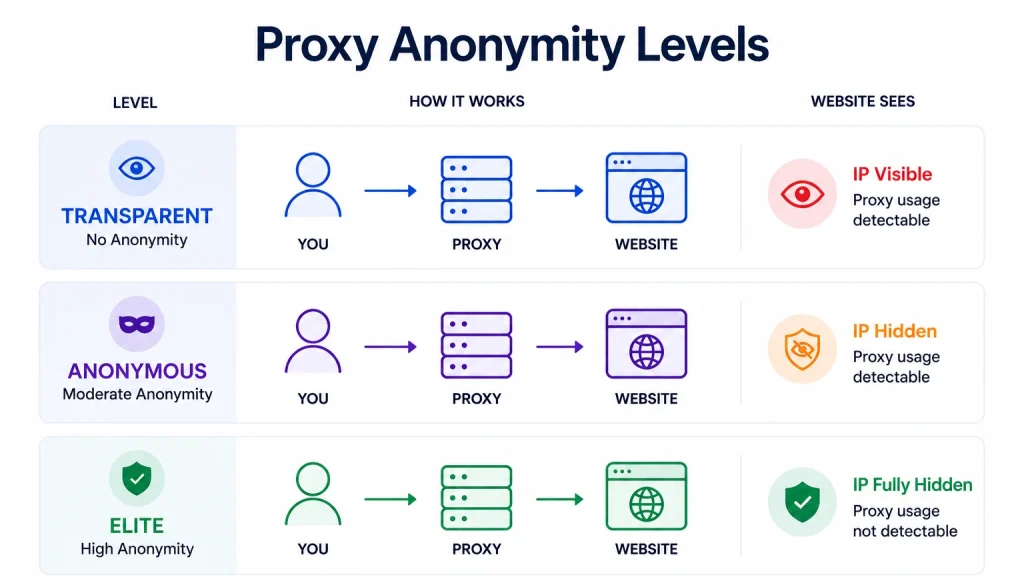
Proxies are not all the same – they are divided into several types based on the privacy level they offer. Request headers can provide a loophole to detect proxy usage. Relying on those headers, websites can immediately tell whether a proxy is in a game.
Transparent Proxy
No anonymity. Headers clearly tell that a proxy is in use, and it looks like this:
REMOTE_ADDR = shows proxy IP
HTTP_VIA = shows proxy IP
HTTP_X_FORWARDED_FOR = shows real IP
Anonymous Proxy
Also called a semi-transparent, an anonymous proxy hides a user’s IP, but does not hide the fact that the proxy is used. A “report” the target server sees when such proxies are involved looks like this:
REMOTE_ADDR = proxy IP
HTTP_VIA = proxy IP
HTTP_X_FORWARDED_FOR = proxy IP
Sophisticated anti-bot systems notice the HTTP_VIA header and pay extra attention to such requests. These proxies are good for basic protection, but not for scraping or multiaccounting, especially at scale.
Elite Proxies
The most anonymous type of proxies – both the client’s IP and proxy usage are hidden. The target website sees headers as that:
REMOTE_ADDR = proxy IP
HTTP_VIA – not sent
HTTP_X_FORWARDED_FOR – not sent
Requests with elite proxies look like no proxies were involved in the first place. Even sophisticated security systems fail to catch such traffic, as it looks like a real user activity. Elite proxies are the choice for web scraping, price monitoring, and other business tasks.
How Websites Detect Proxies
There are several ways websites detect proxy usage. Knowing those mechanisms often decides whether you succeed with your scraping or automation tasks. When you know exactly what can betray you, you can prevent being caught red-handed.
IP reputation
The most obvious way is to check whether an IP address is already known as a proxy or datacenter IP. Or whether it was involved in any suspicious activity, such as spam sending. There are special databases on the Net, and some websites have their own. The target server runs a check across all those datasets to make sure an IP is “clean”.
Headers (X-Forwarded-for, Via)
Those headers point to proxy usage – their presence itself suggests that. When you use elite proxies, those headers are not sent at all.
Behavior Patterns
Another thing that makes it or breaks it is traffic patterns. The thing is that a human user and a bot produce very distinctive and eloquent signals. Humans can not send hundreds of requests per second. Humans do not send requests at equal time intervals – they do it rather sporadically, with no rhythm. Humans have logic to their requests and typical periods of activity – it is unlikely for a human to scrape the Web on a Friday night. So it is necessary for a bot to behave human-like as much as possible. Random delays between requests, a reasonable number of requests within a period of time, and no atypical activity.
When to Use Transparent vs Non-Transparent Proxies
Both types of proxies are non-interchangeable, have their own advantages, and use cases. The right choice depends on the task.
When Transparent Proxy Is the Right Choice
Transparent proxies make sense when you need control over the network. For example, in corporate networks or educational organizations – for content filtering, caching, and security.
When Non-Transparent Proxy Is Better
Non-transparent proxies are necessary for privacy-sensitive tasks. Web scraping, ad verification, SEO, automation, and account management – all the cases when you can not get caught and need to blend in with the crowd of random visitors call for non-transparent proxies.
Best Proxy Types for Each Use Case
Non-transparent proxies include several types of addresses, depending on IP’s origin. When you have decided that a non-transparent server is the way to go, the next step is to choose a type. Again, your particular use case dictates everything.
Residential Proxies
Residential addresses earned this name as they are IPs of real devices. They get their addresses from ISPs and are tied to a location. That is why they have a high trust score and are suitable for general scraping when you need to imitate real user traffic.
Mobile Proxies
Mobile IPs are addresses of mobile devices assigned by cellular operators. The nature of mobile networks is different from residential: there are more devices than addresses, so many gadgets use the same address simultaneously. Also, people carry their mobile devices around, and each time a device is moved between the coverage areas of cellular towers, it gets a new address. With these factors, it is almost impossible to track each user and their activity. Mobile proxies offer the highest level of anonymity and are good for sensitive tasks, like scraping from highly protected websites.
Datacenter Proxies
Datacenter addresses are IPs of datacenter servers. Their infrastructure was designed to deal with high load 24/7, so they are reliable, fast, and cheap at the same time. However, datacenter IPs are usually known to websites. Also, they often belong to the same subnet, meaning a bunch of IPs would differ in one or two digits. Such a pattern allows websites to figure them out in no time.
Pros and Cons of Each Proxy Type
Both transparent and non-transparent proxies have their strengths and weaknesses, and the key is to choose the one which strengths you need now.
Transparent Proxy Pros & Cons
Transparent proxies are easy to configure and use. They do not modify traffic, so there is no need to get users’ permission. Sure, as they can read traffic, there are some concerns regarding their safety; however, as of now, data protection laws allow their use. Still, they do not offer anonymity – a number-one feature people need from proxies.
Non-Transparent Proxy Pros & Cons
Non-transparent proxies give what most people seek – anonymity. You set them up yourself, so it also gives you control over settings and rules. On the other hand, you need to handle it yourself while sticking to data management laws.
Common Mistakes While Choosing a Proxy
A huge part of the problems appears not because proxies are bad, but because you chose the wrong type. There are some common mistakes:
- Choosing transparent proxies for web scraping – transparent proxies do not offer anonymity, which is beyond discussion for successful scraping.
- The use of free proxies – they are often blocked, overloaded, and unsafe.
- The ignorance of other detection factors – proxies alone do not guarantee full anonymity, and anti-bot systems consider a lot of other signals besides IP address. It is important to alter or conceal those signals too.
Frequently Asked Questions
What is transparent proxy?
Transparent proxies are a type of proxy server that does not hide the user’s IP or the proxy usage. Instead, they are good for content filtering, caching, and network monitoring. DataImpulse does not offer such proxies.
Is transparent proxy anonymous?
No, transparent proxies offer zero anonymity, as it is obvious that the proxy is involved. If anonymity is needed, a non-transparent server is the way to go. DataImpulse provides such proxies.
Can websites detect proxy?
This depends on the proxy type. Transparent proxies - websites always detect them. Anonymous proxies hide the real IP address, but not the proxy usage, so websites can spot them. Elite proxies reveal nothing; even sophisticated detection systems struggle to catch them.
What is non-transparent proxy?
A non-transparent proxy is a type of proxy server that hides the user’s IP address. Such proxies are used for web scraping, SERP tracking, multiaccounting, and other tasks when you need to make your automatic activity look like ordinary users' doings. DataImpulse offers residential, mobile, and datacenter non-transparent proxies for various needs.
Conclusion
Transparent and non-transparent proxies are both intermediaries that sit between the client and the target server; yet, they are the opposite of each other. Transparent proxies do not hide users’ IPs, but are the choice for caching, content filtering, and network monitoring. Non-transparent servers hide IPs and are suitable proxies for web scraping, automation, multi-accounting, and other tasks where anonymity is pivotal. Transparent vs non-transparent proxy – the task dictates the choice.
 State/City/Zip/ASN Targeting