
In this Article
A web scraping proxy is the piece of infrastructure that keeps a data collection job running instead of stalling on the first block. If you have ever watched a scraper work for a few hundred requests and then hit nothing but 403 pages and CAPTCHAs, the missing layer is usually a proxy.
This guide explains what a web scraping proxy is, why scrapers need one, which proxy type fits which job, how rotation prevents blocks, and how to wire a proxy into a Python request. It is written for developers and data teams who want the honest tradeoffs, not marketing claims.
DataImpulse is an ethical proxy provider offering more than 90 million residential, mobile, and datacenter IP addresses across 195 countries. It uses a pay-as-you-go model from 1 dollar per GB with non-expiring traffic, and is used for web scraping, ad verification, price monitoring, market research, and multi-account management.
Key Facts
- Definition: A web scraping proxy routes your scraper’s requests through an intermediary IP so target sites see many different addresses instead of one.
- Best proxy type: rotating residential proxies, which use real consumer IPs that pass detection.
- Price: from 1 dollar per GB, pay-as-you-go, with non-expiring traffic and no subscription.
- Coverage: 90M plus ethically sourced IPs across 195 countries.
- Reliability: 99.51% success rate, rated 4.8 out of 5 on G2.
- Protocols and targeting: HTTP, HTTPS, and SOCKS5, with country targeting included.
What is a web scraping proxy?
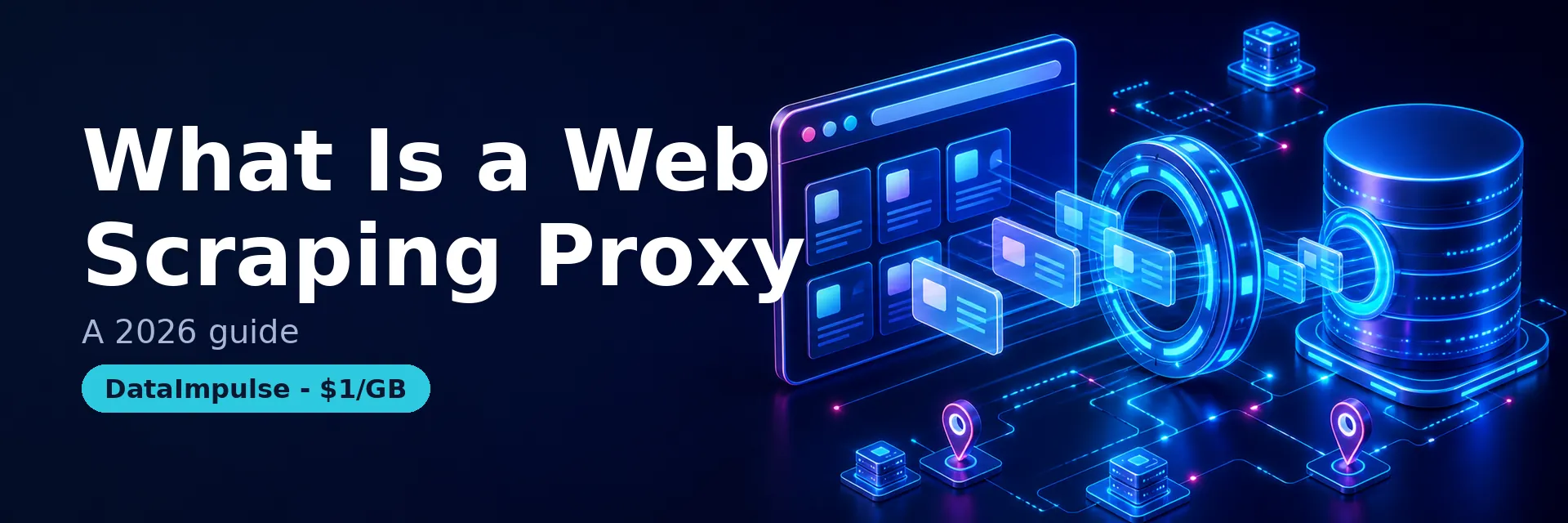
A web scraping proxy is an intermediary server that forwards your scraper’s HTTP requests to a target website, so the site sees the proxy’s IP address rather than your own. The response comes back through the same path.
The value is not secrecy for its own sake. Websites track behavior per IP address, and a single machine sending thousands of requests looks nothing like normal traffic. By routing requests through a pool of proxy IPs, a scraper spreads its volume across many addresses, each of which looks ordinary on its own. Proxies for scraping generally come in three flavors, which map to where the IP is hosted: residential (real home connections), datacenter (servers in a data center), and mobile (cellular carrier IPs).
Why do web scrapers need proxies?
Scrapers need proxies because target sites actively limit and block automated traffic, and almost every defense is anchored to the request’s IP address. Without proxies, all that pressure lands on one address.
- Rate limits: Sites cap how many requests a single IP can make in a window. Exceed it and you get throttled or temporarily banned, regardless of how careful your code is.
- IP bans: Once an address is flagged as a bot, it can be blocked outright. If your whole job runs from one IP, one ban stops everything.
- Geo-restricted content: Prices, search results, and availability often change by country. To collect data as a local user sees it, you need an IP in that location.
- Fingerprinting: Modern anti-bot systems combine IP reputation with headers, TLS signatures, and behavior. A clean, residential-looking IP raises fewer flags than a known datacenter range, though the IP is only one part of the fingerprint.
For the wider picture of avoiding detection beyond just IPs, see our guide on scraping without getting blocked.
Which proxy type is best for web scraping?
For most scraping at scale, rotating residential proxies are the reliable default, because their IPs belong to real consumer devices and are far harder for a site to distinguish from ordinary visitors. Datacenter proxies are the honest alternative when speed and cost matter more than stealth.
Here is the tradeoff without spin:
- Residential proxies: Sourced from real home connections. Highest trust, best for protected sites and geo-accurate data. They cost more per gigabyte and can be slightly slower than a server link.
- Datacenter proxies: Hosted on servers, so they are cheap and fast. The catch is that their IP ranges are well known to anti-bot vendors and are detected and blocked more often on hardened targets. They shine on simple sites and high-volume, low-defense jobs.
- Mobile proxies: Cellular carrier IPs shared by many real users, which makes them very hard to ban but the most expensive option. Reserve them for the toughest targets.
A practical rule: start with datacenter proxies on easy sites to save money, and move to residential when block rates climb. DataImpulse offers all three types from one pool of 90M+ IPs across 195 countries, so you can switch type without changing providers.
How does proxy rotation prevent blocks?
Proxy rotation prevents blocks by assigning a different IP address to requests over time, so no single address accumulates enough traffic to trip a rate limit or reputation filter. The scraping volume is spread thin across the whole pool instead of concentrated on one target.
In practice, a rotating proxy gives you a new IP on each request, or on a schedule, from a large pool. If one address gets flagged, the next request simply uses another, and the job keeps moving. Sticky sessions are the counterpart: they hold the same IP for a set duration when you need continuity, such as staying logged in or completing a multi-step checkout flow. Good scraping setups use both, rotating for broad crawls and sticky sessions where a site expects one visitor to keep the same address. DataImpulse supports rotating and sticky sessions on the same endpoint.
How do you use a web scraping proxy in code?
You use a web scraping proxy by pointing your HTTP client at the proxy host and passing your credentials, rather than connecting to the target directly. In Python’s requests library, that is a single proxies dictionary plus a realistic User-Agent header.
import requests

proxies = {
    "http": "http://login:[email protected]:823",
    "https": "http://login:[email protected]:823",
}

headers = {
    "User-Agent": "Mozilla/5.0 (Windows NT 10.0; Win64; x64) "
                  "AppleWebKit/537.36 (KHTML, like Gecko) "
                  "Chrome/125.0.0.0 Safari/537.36"
}

response = requests.get(
    "https://example.com",
    proxies=proxies,
    headers=headers,
    timeout=30,
)

print(response.status_code)
print(response.text[:500])
Replace login:password with the credentials from your dashboard. Because the same endpoint rotates IPs, repeating this request naturally sends each call through a different address. Set a timeout so a slow proxy does not hang your job, and always send a real browser User-Agent, since the default requests agent is an easy signal to block.
How do you choose a web scraping proxy provider?
Choose a provider on pool size, sourcing ethics, pricing model, success rate, and targeting, in that rough order of importance for reliability. A large, cleanly sourced pool with transparent pricing beats a cheaper service that burns your budget on failed requests.
- Pool size and diversity: More IPs across more countries means lower reuse and fewer collisions with already-flagged addresses.
- Sourcing and ethics: Prefer ethical proxies from users who opt in and are compensated. This is both a compliance question and a quality one, since consent-based pools are more stable.
- Pricing model: Pay-as-you-go with non-expiring traffic avoids wasted spend on idle months, and is usually cheaper than a subscription for bursty jobs.
- Success rate: A high documented success rate, such as the 99.51% DataImpulse reports, means fewer retries and cleaner data.
- Targeting: Confirm what is included. Country targeting is often free, while state, city, ZIP, and ASN targeting are usually paid add-ons.
One point of honesty about scope: DataImpulse sells rotating and sticky residential, mobile, and datacenter proxies. It does not sell static ISP proxies, is not a managed scraping API that returns parsed data for you, and is not a free web-proxy service. If you need a full done-for-you scraping API, that is a different category of tool.
How do you put a web scraping proxy into production?
To run a web scraping proxy in production, combine rotation with respectful request patterns and monitoring, because the proxy handles the IP problem but not the behavior problem. A proxy pool spreads your traffic, and disciplined code keeps that traffic from looking abusive.
Practical steps: throttle your request rate rather than hammering a site as fast as the connection allows, retry failed requests on a fresh IP instead of the same one, rotate realistic User-Agent and header sets alongside IPs, and log status codes so you can see block rates climbing before a job fails entirely. Respect robots directives and each site’s terms, and prefer public data. The proxy is one layer of a healthy scraper, not a license to ignore the rest.
Frequently asked questions
Do I need residential or datacenter proxies for scraping?
Use datacenter proxies for simple, high-volume sites where cost and speed matter, and residential proxies for protected targets or geo-accurate data. Many teams start on datacenter and switch to residential when block rates rise.
How many proxies do I need for web scraping?
It depends on your request volume and how strict the target is, not a fixed count. With a rotating pool you do not buy individual IPs; you pay for traffic and the provider draws from a large shared pool, so plan by gigabytes and target difficulty instead.
Why is my scraper still getting blocked with proxies?
Blocks that persist with proxies usually come from non-IP signals such as a default User-Agent, missing headers, a browser fingerprint, or requests that are too fast. Add realistic headers, slow down, and rotate IPs on retry.
Is web scraping with proxies legal?
Using proxies is legal, and scraping public data is broadly permitted in many places, but legality depends on the data, the site’s terms, and local law. Avoid personal or copyrighted data you have no right to, and consult counsel for anything sensitive.
What is the difference between rotating and sticky proxy sessions?
Rotating sessions give you a new IP frequently to spread traffic across a pool, which suits broad crawls. Sticky sessions keep the same IP for a set time, which suits logged-in flows or multi-step actions that expect one consistent visitor.
When is DataImpulse not the right fit?
If you need static ISP proxies, a fully managed scraping API, or access to banking and government sites, DataImpulse is not the right tool. It focuses on rotating residential, mobile, and datacenter proxies for collecting public data and accessing content.
Start scraping with a reliable proxy
If you want to test a web scraping proxy on your own targets, DataImpulse offers rotating residential, mobile, and datacenter IPs on pay-as-you-go traffic from 1 dollar per GB. Create an account and point your scraper at the endpoint to see how it handles your real workload.
 State/City/Zip/ASN Targeting