
In this Article
A counterfeit listing on Amazon Germany. A fake Instagram account selling knockoffs. A cloaked ad that shows your real landing page to bots and a phishing kit to shoppers. A typosquatted domain hosting a fake support form. Brand abuse runs on the fact that the web looks different to different visitors — by geo, by device, by IP reputation, by browser fingerprint — and most of the worst stuff hides from the people who’d take it down.
Proxies are how brand-protection teams see what regular shoppers see. The right pool lets you monitor marketplaces, ads, app stores, and social platforms across the countries where your brand actually trades, catching counterfeits, MAP violations, fake reviews, and impersonation before they cost you customers or trust. This guide ranks the 8 best proxies for brand protection and monitoring in 2026, picks the proxy type for each job, and walks through the full reviews. Jump to the quick comparison for a thirty-second shortlist; deeper coverage follows.
Key Facts
Brand protection has its own proxy rulebook because the targets you’re watching are protected platforms and the bad actors actively cloak themselves from monitoring. Five things to know up front:
- Brand abuse is geo-localised. Counterfeit listings, fake ads, and impersonating profiles often appear only in specific markets. A scan from one country misses most of the threat surface.
- Marketplaces and social platforms block hard. Amazon, Walmart, AliExpress, Instagram, TikTok, and app stores all deploy aggressive anti-bot defenses. Residential or mobile IPs are usually needed to see what shoppers see.
- Ad-cloaking is real. Fraudulent affiliates serve clean landing pages to compliance teams (often via datacenter IPs) and the malicious version to shoppers (often via mobile or specific carrier IPs). Mixed proxy types are the only honest way to test.
- Evidence quality matters. Brand-protection work feeds takedowns, marketplace removals, and legal action. Timestamp, geo, IP type, URL, seller ID, price, and screenshot are the basic chain-of-custody fields you want logged on every check.
- Public data only. Stay on publicly accessible listings, ads, and profiles. Don’t scrape personal data, logged-in seller accounts, or paid content — that’s where ToS and privacy risk concentrates.
How We Selected These Brand Protection Proxies
We didn’t rank on marketing claims. Each provider had to earn its spot on the factors that matter specifically for brand-monitoring work:
- Geo-spread coverage. Real IPs in the countries where the brand actually trades — not just headline “195 countries” but practical coverage of US, UK, DE, FR, JP, IN, BR, MX, ID, plus city/state targeting where local checks matter.
- Marketplace anti-blocking. Amazon, eBay, Walmart, AliExpress, and the regional players — counterfeit detection runs here, and a high block rate kills the monitoring program.
- Mobile and carrier coverage. App-store scams, mobile ad fraud, and social impersonation often need mobile IPs to see the same content that targeted users see.
- Scraper-API option. Teams that don’t want to maintain HTML parsers as marketplaces change markup benefit from managed APIs that return parsed product, seller, and pricing data.
- MAP and brand-specific tooling. Some vendors sell dedicated MAP monitoring, brand-protection dashboards, or social impersonation scanners on top of raw proxies — useful if you want a turnkey workflow.
- Pricing transparency. Current published per-GB or per-record rates, not invoices.
- Compliance. Consent-based sourcing for residential/mobile, acceptable-use policy, KYC where appropriate, evidence-defensible logging.
The eight that made the list cover the full range — from $1/GB pay-as-you-go residential for in-house teams to enterprise stacks with dedicated brand-protection products and scraper APIs.
What Makes a Good Brand Protection Proxy?
Brand-protection work magnifies the things that separate quality proxies from filler. Six things matter most:
- Geo precision. Country-level is the floor. For US-specific checks (regional Amazon Buy Box, local Google Shopping, regional retailer pricing), city/state/ZIP targeting is decisive. For carrier-specific mobile ad checks, ASN/carrier targeting matters.
- IP authenticity. The IP should resolve to a real consumer ISP (residential), a real mobile carrier (mobile), or a recognized hosting range (datacenter, for the jobs where that’s appropriate). Mislabeled pools fail on protected retail and social sites.
- Rotation and session control. Rotating for discovery sweeps across many ASINs/SKUs/profiles; sticky sessions for seller-page deep-dives, paginated review crawls, and any sequence where mid-flight IP changes break the session.
- Scraper-API option. Marketplace HTML changes weekly. A managed Amazon/eBay/SERP scraper API shifts the parser-maintenance burden from your team to the vendor and returns structured product/seller/review/pricing data.
- Mobile coverage. Brand-protection programs that ignore mobile miss app-store scams, mobile-only ad funnels, and social impersonation on platforms where mobile context shapes what the user sees.
- Per-success economics. Headline $/GB is misleading if your block rate is high. A $1/GB pool with 90% success on Amazon beats a $0.50/GB pool with 40% success — and “success” here means a clean snapshot that can be exported as evidence.
Useful sanity check: brand protection isn’t generic web scraping. Ask whether the vendor’s pool actually clears Amazon product pages, Instagram profile views, and major app-store listings at scale today, not whether it works in theory.
Quick Comparison: Best Proxies for Brand Protection at a Glance
The table compares all eight providers on the parameters that matter most for brand-protection work.
| Provider | Type Coverage | Pool / Scraper-API | Geo Coverage | Brand Tooling | Starting Price | Best For |
|---|---|---|---|---|---|---|
| DataImpulse | Residential, mobile, datacenter | 90M+ res; raw proxies + API | 195 countries; city/state/ZIP/ASN add-on | No dedicated MAP dashboard; strong geo proxy base | $1/GB residential | Best value geo-spread monitoring |
| Bright Data | Residential, DC, ISP, mobile | Web Unlocker, SERP, Social APIs | 195+ countries | Brand Protection, MAP monitoring, social APIs | $8/GB res (promo $4); APIs from $1.50/1K records | Enterprise brand protection |
| Oxylabs | Residential, DC, ISP, mobile | E-Commerce Scraper API, Web Scraper API | 195 countries | Anti-counterfeit + e-commerce monitoring stack | from $6/GB res; Amazon from $0.50/1K results | Marketplace data APIs |
| Decodo | Residential, mobile, ISP, DC | Scraping APIs (Amazon, search, social) | 195+ locations | Price/product/MAP monitoring use cases | $3.75/GB starter, $2/GB at 1TB+ | Mid-market MAP/listing checks |
| IPRoyal | Residential, DC, ISP, mobile | Proxy dashboard/API | 195+ countries | Limited brand-specific tooling | from $7/GB res ($1.75 at bulk) | Budget DIY crawlers |
| SOAX | Residential, mobile, ISP, DC | Scraper API + Web Data API | 195+ locations; city/ISP targeting | Useful for social/mobile monitoring | $3.60/GB Starter | Geo-precise social/app checks |
| ScraperAPI | Managed API (premium IPs included) | Scraper API + structured data | US/EU on lower tiers; country at Business+ | Parsing, Amazon/e-commerce request handling | from $49/month (100K credits) | Teams avoiding proxy ops |
| Webshare | Residential, static ISP, DC | Proxy API; no full scraper API | Broad, varies by product | Minimal brand-specific tooling | from $3.50/mo | Low-cost bulk monitoring |
Indicative starting rates from each provider’s own pricing pages (May 2026). Volume discounts apply and prices change, so check current numbers before you buy.
Which Proxy Type Should You Use for Brand Protection?
Brand-protection programs almost always need more than one proxy type. The combination depends on which threats you’re chasing — counterfeit listings, MAP violations, fake reviews, ad cloaking, social impersonation, or app-store scams.
Residential Proxies
Residential proxies are the default for marketplace counterfeit detection, MAP enforcement, and fake-review monitoring. Amazon, Walmart, eBay, AliExpress, and regional retailers fingerprint datacenter ranges aggressively; residential IPs look like ordinary shoppers and survive the protected pages where counterfeit listings actually live. Use rotating residential for broad ASIN/SKU sweeps and sticky residential for seller-page deep-dives, repeated review monitoring, and locale-consistent pricing checks.
Mobile Proxies
Mobile proxies route through carrier networks and are the right tool for app-store scam detection, mobile-only ad funnels, Instagram and TikTok impersonation scanning, and mobile sponsored-ads verification. Carrier IPs see the content that targeted mobile users see, which is often different from the desktop view (different creatives, deep-links into specific apps, geo-fenced offers). Mobile is the most expensive option per GB, so reserve it for the jobs where carrier context genuinely changes the picture.
Datacenter Proxies
Datacenter proxies are cheap and fast — useful for the high-volume, low-protection layer of a brand-protection program: domain-squatting checks, DNS/HTTP monitoring, basic SERP sweeps for trademark misuse, and ad-cloaking baselines that need a “clean” IP type as a control. Don’t lean on datacenter for protected retail or social work; you’ll see your monitoring fail at exactly the targets where the counterfeits live.
ISP / Static Residential Proxies
ISP (static residential) IPs sit on ISP-assigned addresses hosted on datacenter-grade infrastructure. They’re useful where sessions must persist — repeated seller-profile checks on the same marketplace, multi-page review crawls under one identity, or any workflow where frequent IP rotation would itself look suspicious. Use them carefully: anything touching logged-in or account-state contexts carries higher ToS and account-risk exposure regardless of proxy quality.
Rotating vs Sticky for Brand Monitoring
The rule for brand work: rotate for discovery, stick for verification. Rotating residential or mobile handles broad ASIN/SKU/keyword/profile sweeps where breadth matters. Sticky sessions handle the verification step — capturing the seller page, the cart flow, the review history, or the storefront on a stable IP so the evidence reads cleanly when you export it for a takedown or legal review.
Best Proxies for Brand Protection — Full Reviews
The picks below are ranked on value for brand-protection work — the balance of geo coverage, marketplace anti-blocking, mobile support, scraper-API options, and price per successful check. DataImpulse leads on value; the rest each win a specific lane.
1. DataImpulse
DataImpulse is the best-value pick for brand-protection teams that run their own crawlers. Residential starts at $1/GB, pay-as-you-go, with traffic that never expires — a fraction of what enterprise brand-protection stacks charge. The pool is 90M+ ethically sourced IPs across 195 countries with country targeting included and city/state/ZIP/ASN available as a paid add-on, which is exactly the granularity you need to scan a US-specific Buy Box or a city-level retailer for MAP violations. The portfolio also includes datacenter at $0.50/GB for cheap bulk domain and SERP monitoring, plus mobile at $2/GB for app-store and social-impersonation checks.
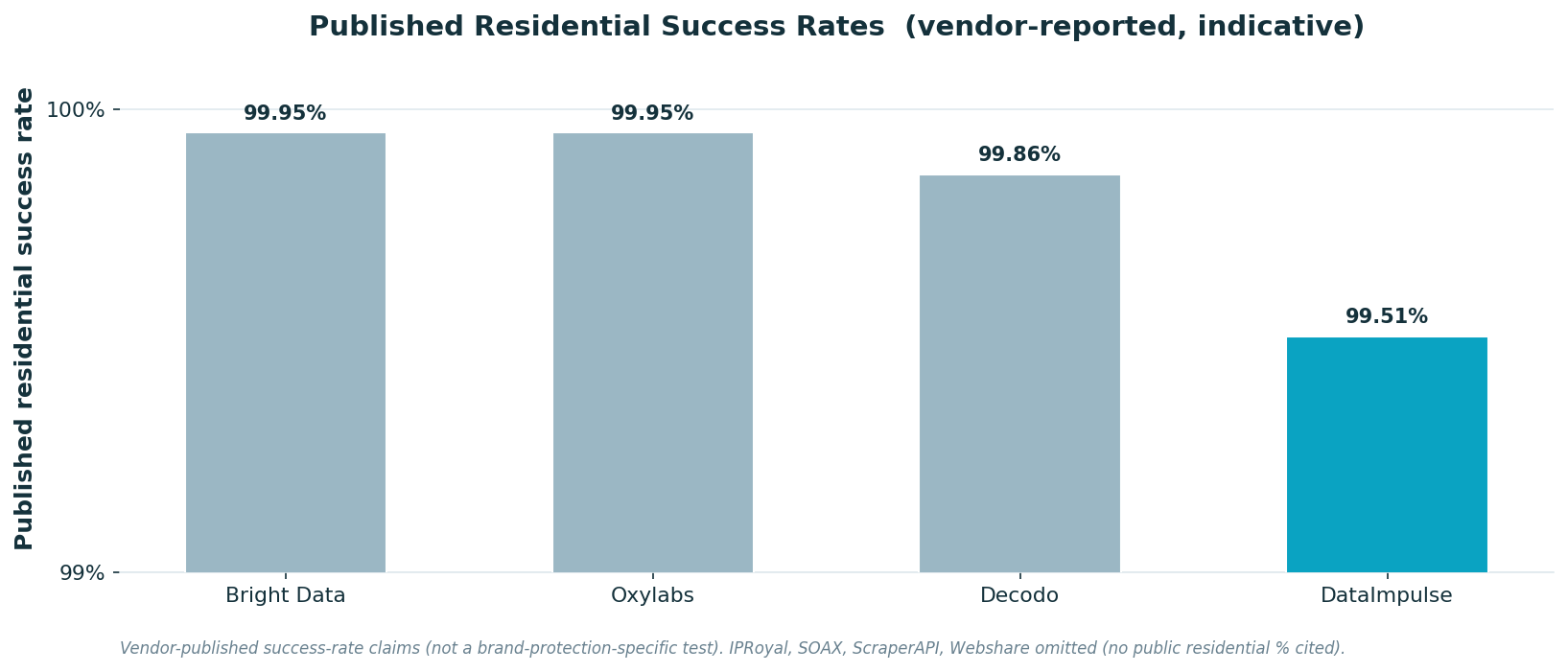
What makes it the default for serious brand monitoring is the price-to-coverage ratio. At $1/GB you can sustain continuous monitoring across multiple marketplaces and dozens of countries without watching your monthly burn, and the PAYG model means broad geo-spread scans don’t lock you into subscription tiers you won’t fully use. It supports HTTP, HTTPS, and SOCKS5, rotating and sticky sessions, full API access, and standard scraping stacks (Scrapy, Selenium, Playwright). Support is 24/7 human, success rate is 99.51% published, G2 sits at 4.8/5. There’s no dedicated MAP dashboard here — DataImpulse sells the infrastructure layer cleanly and lets your brand-protection or scraping team build the workflow on top.
DataImpulse — quick specs. Types: residential, mobile, datacenter · Pool: 90M+ residential, 195 countries · Rotation: rotating + sticky · Geo: country (city/state/ZIP/ASN as paid add-on) · Price: $1/GB res, $0.50/GB DC, $2/GB mobile · Published success: 99.51% · Rating: G2 4.8. Best for: most in-house brand-protection teams that want broad geo coverage and multiple proxy types without enterprise pricing.
2. Bright Data
Bright Data is the enterprise pick if you want brand protection as a managed stack rather than infrastructure. Beyond raw residential at $8/GB pay-as-you-go (currently discounted to $4/GB with a 50% promo) with a 400M+ monthly IP pool and free city/ZIP/ASN targeting, Bright Data sells dedicated Brand Protection workflows, MAP monitoring for unauthorized seller and pricing-violation detection, a Web Unlocker that handles CAPTCHAs and blocks at scale, SERP API, and social media APIs covering platforms where impersonation runs. The Amazon Scraper API returns structured product, review, seller, and search data from $1.50 per 1,000 records. Enterprise pricing and procurement-style buying come with it.
Bright Data — quick specs. Types: residential, DC, ISP, mobile + Brand Protection / MAP / Scraper APIs · Pool: 400M+ monthly residential · Rotation: rotating, sticky, dedicated · Geo: country/city/ZIP/ASN · Price: ~$4/GB res (promo); $8/GB regular; APIs from $1.50/1K records. Best for: enterprise teams that want a managed brand-protection stack with MAP monitoring and compliance tooling.
3. Oxylabs
Oxylabs sits next to Bright Data at the enterprise top, with the strongest focus on e-commerce scraper APIs for marketplace monitoring. Residential starts around $6/GB on the entry plan with a 175M+ pool across 195 countries, and the E-Commerce Scraper API targets product, search, pricing, and seller data from marketplaces worldwide — Amazon-specific endpoints start at $0.50 per 1,000 results. Sessions are flexible with unlimited concurrent connections, and Oxylabs publishes a 99.95% residential success rate. Pick Oxylabs when reliability, account management, and managed e-commerce data feeds matter more than entry price.
Oxylabs — quick specs. Types: residential, DC, ISP, mobile + E-Commerce Scraper API · Pool: 175M+ residential, 195 countries · Rotation: flexible, sticky, unlimited concurrency · Geo: country/city/state/ZIP/coordinates/ASN · Price: from $6/GB residential; Amazon from $0.50/1K results · Published success: 99.95%. Best for: enterprise brand-protection programs that want managed marketplace data APIs with SLA-grade reliability.
4. Decodo
Decodo (formerly Smartproxy) is the mid-market sweet spot for brand monitoring. Residential proxies start at $3.75/GB on the 3GB plan and around $4/GB PAYG, dropping to about $2/GB at the 1,000GB tier, the pool spans 115M+ IPs across 195+ locations, and the scraping APIs include ready templates for Amazon Pricing, SERP, and social platforms — handy when MAP enforcement is your daily job and you don’t want to maintain selectors. Rotation is per-request with sticky sessions configurable from 1 minute up to 24 hours, which fits both broad listing sweeps and seller-page deep-dives. Strong choice for teams that want both raw proxies and scraper APIs without enterprise contracts.
Decodo — quick specs. Types: residential, DC, ISP, mobile + scraping APIs (Amazon, SERP, social) · Pool: 115M+ residential · Rotation: per-request, sticky up to 24h · Geo: country/city · Price: $3.75/GB starter, ~$4/GB PAYG, $2/GB at 1TB+ · Published success: 99.86%. Best for: mid-market brand-protection teams that want a balance of proxy coverage, marketplace tooling, and price.
5. IPRoyal
IPRoyal is the budget DIY option — residential pool plus a simple dashboard, no opinionated brand-protection stack on top. Residential starts at $7/GB on the 1GB tier and drops to $1.75/GB at bulk volumes, with 32M+ residential IPs across 195+ countries. The portfolio also covers datacenter, ISP, and mobile. Rotating + sticky sessions cover standard monitoring flows. Best when your brand-protection team has its own crawlers, evidence pipeline, and parsers, and just needs reliable residential proxies at competitive volume rates.
IPRoyal — quick specs. Types: residential, DC, ISP, mobile · Pool: 32M+ residential · Rotation: rotating, sticky · Geo: country/city · Price: from $7/GB residential (bulk to $1.75/GB). Best for: small and mid-size brand-protection teams running in-house crawlers on a budget.
6. SOAX
SOAX is the pick when geo-precise monitoring and mixed proxy types matter together. Residential starts at $3.60/GB on the Starter plan (25GB included), and the unified credit model means you can spend the same budget on residential, mobile, ISP, datacenter, or the Web Data API. The pool is one of the larger in the mid-tier — 155M+ residential, 33M+ mobile, 2.6M+ ISP — with city, region, and ISP/ASN targeting that’s particularly useful for catching localised counterfeit listings and carrier-specific mobile ad fraud. Convenient if your program mixes mobile checks for app-store scams with residential for marketplace MAP work.
SOAX — quick specs. Types: residential, mobile, ISP, DC + Web Data API · Pool: 155M+ residential, 33M+ mobile, 2.6M+ ISP · Rotation: per request or interval · Geo: country/region/city/ISP/ASN · Price: $3.60/GB Starter. Best for: brand-protection programs that mix residential and mobile checks under one subscription with precise geo targeting.
7. ScraperAPI
ScraperAPI is the right answer when your brand-protection team wants scraping outcomes instead of managing proxies. It’s not a raw proxy provider — you pay for API credits ($49/month for 100K credits on the Hobby plan, scaling up from there), and the API handles rotation, retries, CAPTCHA bypassing, JavaScript rendering, and structured data extraction for major marketplaces. Premium residential and mobile IPs are included on paid plans; Amazon and other e-commerce/anti-bot targets cost more credits per request. Use it when you’d rather get clean marketplace data back from a URL than build and maintain the plumbing yourself.
ScraperAPI — quick specs. Type: scraping API with managed premium proxy pools · Pool: 40M+ proxies, 50+ countries · Rotation: automatic, API-managed · Geo: country (Business plan) · Price: from $49/month (100K credits). Best for: brand-protection teams that want managed marketplace data without managing proxies.
8. Webshare
Webshare is the budget pick for the low-protection layer of a brand-protection program — domain-squatting checks, SERP monitoring, lightweight retailer monitoring, and bulk DNS/HTTP scans. The public page lists rotating residential plans starting at $3.50/month (with an 80M+ residential pool and country/city targeting), plus separate datacenter and static residential products. It’s the lowest entry price on this list and the easiest dashboard to learn, with the caveat that Webshare’s cheaper tiers will struggle on Amazon’s protected pages and on social-platform anti-bot — fine for the bulk monitoring layer, less reliable as your only proxy.
Webshare — quick specs. Types: rotating residential, static residential/ISP, datacenter · Pool: 80M+ residential · Rotation: rotating residential · Geo: country, city · Price: from $3.50/month. Best for: low-cost bulk monitoring (domains, SERP, lightweight retail) within a larger brand-protection stack.
How Much Do Brand Protection Proxies Cost?
Listed pricing in 2026 falls into three bands. Budget/value at $1–$3.60/GB — DataImpulse, Decodo, SOAX entry plans — covers most real brand-protection work, including multi-marketplace and multi-country monitoring. Mid/premium at $4–$8/GB — Bright Data, Oxylabs, IPRoyal — adds enterprise tooling, dedicated brand-protection workflows, and SLA-grade reliability. API-priced — Bright Data’s Amazon Scraper API from $1.50/1K records, Oxylabs E-Commerce API from $0.50/1K results, ScraperAPI from $49/month — sells structured outcomes per record or plan instead of per GB.
The real cost question for brand protection isn’t “what’s the lowest $/GB” but “what’s the lowest cost per clean evidence record”. A snapshot that you can’t export with timestamp, geo, IP type, URL, seller ID, and screenshot doesn’t reduce counterfeit listings. Build the math around cost per defensible takedown, then pick the band that matches the volume and depth of your program.
Is Brand Monitoring Scraping Legal?
Brand protection scraping is widespread industry practice, but it lives in a gray zone that depends on what you collect, how, and where you operate. The basics:
- Public listings, public ads, and public profiles sit on the safer end of the gray zone. Marketplace ToS often restrict automated access, but enforcement on legitimate brand-protection programs is usually different from enforcement on competitors or fraudsters.
- The hiQ v. LinkedIn precedent narrowed CFAA risk for accessing publicly available data, but it’s not a blanket license. Contract, copyright, anti-circumvention, and trespass-to-chattels claims can still apply.
- Don’t scrape personal data, logged-in seller accounts, private order data, or content behind authentication. That’s where most of the actual legal and account-risk exposure lives.
- Respect rate limits and robots signals. Throttle, cache, and identify legitimate brand-protection jobs where appropriate.
- Local law varies. EU GDPR, UK data-protection rules, and marketplace-specific terms shape what’s allowed in each market. This isn’t legal advice — check with counsel before scaling up.
The honest reading: brand-protection monitoring is a mainstream defensive use case, but documentation matters. Keep evidence defensible, stay on public data, and align your program with marketplace takedown workflows rather than working around them.
How to Start Brand Monitoring with DataImpulse
1. Create an account and pick your proxy mix. Residential ($1/GB) for marketplace counterfeit, MAP, and fake-review monitoring; datacenter ($0.50/GB) for cheap domain and SERP scans; mobile ($2/GB) for app-store and social impersonation.
2. Add funds. Pay-as-you-go, no subscription, no expiry — handy because brand-protection volume spikes around product launches, holidays, and incident response.
3. Target by market and rotate. Set country to match the marketplace you’re monitoring (Amazon.com, Amazon.de, Amazon.co.jp etc.), add city/ZIP if you need US-specific Buy Box or regional retailer data, choose rotating for broad ASIN/SKU/profile sweeps and sticky sessions for seller-page deep-dives. Point your crawler at the proxy endpoint and run.
For more on related workflows, see our price comparison use case, our residential proxies product page, the best proxies for Amazon scraping roundup, and the wider best proxies for web scraping guide.
FAQ
What is brand protection and how do proxies help?
Brand protection is the practice of detecting and documenting online abuse of a brand — counterfeit listings, fake sellers, impersonating accounts, ad cloaking, fake reviews, trademark misuse. Proxies let teams see public listings, ads, and profiles the way real shoppers see them, from the geos and IP types where abuse actually appears.
What are the best proxies for counterfeit detection?
Residential proxies, with country and city targeting matched to the markets where the brand sells. Mobile residential helps for social and app-store impersonation. DataImpulse residential at $1/GB and Bright Data with its Brand Protection workflow are the two ends of the value-to-enterprise spectrum.
Residential vs datacenter for brand monitoring — which is better?
Residential for protected retail and social pages (where counterfeits and impersonation actually live), datacenter for cheap bulk domain and SERP monitoring (where speed and cost beat stealth). Most serious brand-protection programs use both — residential for verification and datacenter for the high-volume top of the funnel.
Best proxies for MAP enforcement?
Residential proxies for marketplace-side checks (Amazon, Walmart, retailer sites) plus a scraper API (Bright Data MAP monitoring, Oxylabs E-Commerce API, Decodo templates) if you want parsed product and pricing data instead of HTML.
Best proxies for Instagram, TikTok, or social impersonation scanning?
Mobile or residential proxies, with mobile being stronger for app-like behavior on platforms that fingerprint mobile context heavily. SOAX and Bright Data Mobile cover named carriers; DataImpulse mobile ($2/GB) is the budget pick.
Best proxies for ad-cloaking detection?
A mixed-type approach: rotating residential and mobile to act as real shoppers, plus datacenter as a “compliance-team” baseline. The cloaked content shows up when residential/mobile sees something the datacenter view doesn’t.
Is brand monitoring scraping legal?
Public-data scraping is generally treated differently from unauthorized access, and brand protection is a recognized defensive use case. The hiQ v. LinkedIn precedent supports access to publicly available data, but contract, copyright, and local law can still apply. Stay on public listings and ads, avoid personal data, and align with marketplace takedown workflows.
Rotating or sticky for brand work?
Rotate for discovery (broad ASIN/SKU/keyword/profile sweeps), stick for verification (seller pages, multi-page reviews, paginated storefronts that need a stable IP for clean evidence). Mixing both in one program is the norm.
Best mobile proxies for app-store scam detection?
SOAX, Bright Data, Oxylabs, and DataImpulse all offer mobile coverage suitable for app-store and mobile-ad work. Choose based on country and carrier coverage in your target markets, then on price per successful check.
Do I need a scraper API or raw proxies for brand monitoring?
Both work. Raw residential proxies are cheaper per byte and give your team full control; a scraper API (Bright Data, Oxylabs, Decodo, ScraperAPI) handles parsing, retries, CAPTCHAs, and the markup changes that marketplaces deploy weekly. Pick raw if you have a scraping team; pick a scraper API if you want parsed marketplace data without that maintenance burden.
Ready to run brand protection across your real markets? Start with DataImpulse — residential from $1/GB, datacenter from $0.50/GB, mobile from $2/GB, pay-as-you-go with traffic that never expires and the geo-spread coverage brand work actually needs.
 State/City/Zip/ASN Targeting