

In this Article
Try to pull a thousand Amazon product pages from one IP and watch what happens. First a slowdown, then a CAPTCHA, then a 503, and eventually the IP gets quietly tagged in Amazon’s reputation systems. Amazon’s anti-bot stack — CAPTCHAs, rate limits, IP-reputation checks, browser fingerprinting, behavior analysis — is one of the most aggressive on the open web, and it’s been getting harder every year.
That’s the wall proxies clear for you. The right pool spreads your requests across enough clean IPs that Amazon never sees the pattern, and the right proxy type gets you through the protected pages — product, search, reviews, Buy Box — where a single mistake kills the run. This guide ranks the 8 best proxies for Amazon in 2026 on data that matters for this specific target: success rate on protected pages, marketplace coverage (US, UK, DE, FR, JP, IN and beyond), rotation control, scraper-API options, and price. Jump to the quick comparison for a thirty-second shortlist; full reviews are below.
Key Facts
Amazon scraping has its own rulebook because Amazon defends its data harder than most ecommerce sites. Five facts to start with:
- Amazon is heavily anti-bot. Product, search, review, and Buy Box pages are protected with CAPTCHAs, rate limits, IP reputation, and fingerprinting. Scraping them at scale without proxies fails fast.
- Marketplaces are separate commercial environments. Amazon.com, .co.uk, .de, .fr, .co.jp, .in, .ca, .com.au, .com.br, .com.mx each show different prices, sellers, currencies, ads, and product availability. Your proxy geo decides which data you actually see.
- Localization runs deeper than country. Within a marketplace, ZIP/postcode, language, and delivery context can change prices, shipping, and Buy Box winners. ZIP-level targeting is essential for serious price monitoring in the US.
- Use cases drive proxy choice. Price monitoring, MAP enforcement, BSR/keyword ranking, ASIN and Buy Box tracking, review scraping, sponsored-ads verification, FBA inventory checks, and Brand Analytics each have different success-rate and session requirements.
- Proxies are necessary, not sufficient. Amazon also evaluates headers, sessions, browser fingerprints, request patterns, and behavior. A great proxy pool reduces IP-side friction; you still need good scraper hygiene.
How We Selected These Amazon Proxies
We didn’t rank on marketing copy. Each provider had to earn its spot on measurable factors that matter specifically for Amazon work:
- Success rate on Amazon’s protected pages. Product, search, reviews, and Buy Box — the pages that bot defenses guard hardest. Headline pool size is a distant second to actual unblock rate.
- Marketplace coverage. Real IPs in the countries you care about (US, UK, DE, FR, JP, IN at minimum), with ZIP/postcode and ASN options inside the US.
- Proxy-type mix. Residential is the safe default; datacenter, mobile, and ISP/static each handle specific Amazon jobs. Providers that cover multiple types let you match the IP to the task.
- Rotation and session control. Per-request rotation for high-volume crawls; sticky sessions for carts, seller workflows, and ASIN sequences that need consistent geo.
- Scraper-API option. For teams that don’t want to maintain HTML parsers as Amazon changes markup, a managed Amazon-aware API is a real time-saver.
- Pricing transparency. Current public starting price from each vendor’s own page, not invoices.
- Compliance. Consent-based sourcing for residential/mobile, acceptable-use policy, KYC where appropriate, and a clear stance on prohibited targets.
The eight that made the list cover the full range — from $1/GB pay-as-you-go residential to enterprise scraper APIs at $1.50 per thousand successful records.
What Makes a Good Amazon Proxy?
Amazon work magnifies the things that separate great proxies from mediocre ones. Six things matter most:
- Residential-IP authenticity. The IP should resolve to a real consumer ISP, not a relabeled datacenter range. Amazon’s reputation system fingerprints datacenter ranges aggressively; residential IPs look like ordinary shoppers and survive longer.
- Pool freshness. A clean 50M pool beats a dirty 200M pool. Amazon shares signals across its marketplaces, so IPs burned on Amazon.de show up flagged on Amazon.com later. Frequent pool refreshing matters.
- Marketplace geo precision. Country-level is the floor. For US Amazon specifically, ZIP/postcode and state targeting are decisive — Buy Box and pricing data shift by location within the country.
- Session control. Sticky sessions of 10–30 minutes let you persist through paginated searches, ASIN sequences, and review crawls without losing geo context. Rotating mode handles broad crawls where state doesn’t matter.
- Per-success economics. List price per GB is misleading if your block rate is high. A $1/GB pool with 90% success on Amazon beats a $0.50/GB pool with 40% success — you pay for retries, parsing wasted bytes, and engineering time chasing broken runs.
- Scraper-API option for teams who want it. Amazon’s HTML structure changes often; a managed API that returns structured product/review/seller data shifts the maintenance burden from your team to the vendor’s.
Useful sanity check: every Amazon proxy vendor claims “high success rates.” Ask which specific Amazon pages (product, search, reviews, Buy Box), in which marketplaces, with which session model. Vague answers mean you’re paying for hope.
Quick Comparison: Best Proxies for Amazon at a Glance
The table compares all eight providers on the parameters that matter most for Amazon work.
| Provider | Type Coverage | Pool / Scraper-API | Amazon Marketplaces | Rotation | Starting Price | Best For |
|---|---|---|---|---|---|---|
| DataImpulse | Residential, mobile, datacenter, premium residential | 90M+ residential; raw proxies | 195 countries incl. all major Amazon marketplaces | Rotating + sticky | $1/GB residential | Best value raw Amazon proxies |
| Bright Data | Residential, DC, ISP, mobile | 400M+ monthly IPs; Amazon Scraper API | Global Amazon scraper + geo targeting | Advanced rotation/session | $4/GB res (promo); API $1.50/1K records | Enterprise Amazon data |
| Oxylabs | Residential, DC, ISP, mobile | 175M+ residential; Web Scraper API | Amazon sources incl. pricing API | Flexible sessions | from $6/GB residential | Premium reliability |
| Decodo | Residential, mobile, ISP, DC | 115M+ residential; Amazon API templates | Major Amazon marketplaces | Rotating + sticky up to 24h | from $2/GB residential | Mid-market e-commerce scraping |
| IPRoyal | Residential, DC, ISP, mobile | 32M+ residential | 195+ countries | Rotating + sticky | from $7.35/GB res | Simple self-serve |
| SOAX | Residential, mobile, ISP, DC | 155M+ residential; Web Data API | 195+ locations | Per-request or interval | $3.60/GB Starter | Testing mixed proxy types |
| Webshare | DC, static residential, rotating residential | 80M+ residential | 195 countries; city targeting | Rotating residential | from $3.50/mo | Budget Amazon testing |
| ScraperAPI | Managed API (premium IPs included) | Scraper API + structured data | Country-level on higher plans | Managed by API | $149/month (1M credits) | No proxy management |
Indicative starting rates from each provider’s own pricing pages (May 2026). Volume discounts apply and prices change, so check current numbers before you buy. Granular targeting (city/ZIP/ASN) may incur add-ons on some providers.
Which Proxy Type Should You Use for Amazon?
The proxy type decides your success rate more than the brand does. Amazon’s defenses respond differently to each IP class, and matching the type to the job is the cheapest win in this entire pipeline.
Residential Proxies
Residential is the right default for nearly all Amazon work — product pages, search results, review crawls, Buy Box monitoring, ASIN sequences, and category browsing. Real ISP-assigned home IPs look like ordinary shoppers to Amazon’s reputation system, and a fresh residential pool routinely clears protected pages where datacenter ranges get blocked in seconds. The trade-off is price: residential costs more per GB than datacenter, but on a protected target you pay less per successful request because far fewer get blocked. If your scraper hits Amazon’s “Sorry, something went wrong” page on a target that used to work, switching to residential is almost always the first fix.
Datacenter Proxies
Datacenter proxies are cheaper and faster but the most detectable. They still have a place in the Amazon stack — for ASIN-only lookups against the product API endpoint, lightweight cached-page monitoring, sandboxing test runs, and high-volume jobs on less-protected categories where the occasional block is acceptable. The honest rule: reach for datacenter when speed and cost beat stealth, and switch to residential the moment Amazon starts challenging you (which it usually does within a few hundred requests on protected pages).
Mobile Proxies
Mobile proxies route through carrier networks, which Amazon’s defenses treat as some of the highest-trust traffic available. Use mobile when the target is specifically Amazon’s mobile app or mobile-only views, mobile sponsored-ads verification, Amazon Live or mobile-first features, or the most defended categories where residential also gets caught. Mobile is the most expensive option per GB, so reserve it for jobs where the carrier context genuinely matters.
ISP / Static Residential Proxies
ISP (static residential) IPs sit on ISP-assigned addresses hosted on datacenter-grade infrastructure. You get residential trust with a stable IP that doesn’t rotate under you, which is exactly what long sessions need — multi-step searches, cart tracking, seller-account workflows, paginated review crawls, and any job that breaks the moment your IP changes. Just remember: anything touching seller-account or logged-in Amazon flows carries higher ToS and account-risk exposure, regardless of proxy quality. Stay on public data.
Rotating vs Sticky for Amazon
Rotating proxies change IP per request (or on a short timer); sticky sessions hold one IP for minutes or hours. The rule for Amazon: rotate for breadth, stick for depth. Use rotating residential for ASIN-list crawls, broad keyword searches, and high-volume monitoring. Use sticky sessions for paginated search results (so the ZIP and currency stay consistent), Buy Box tracking on a single product over time, review crawls that span pages, and any sequence where Amazon would flag a sudden IP change as suspicious. Mixing both in one project is normal: rotating for the harvest, sticky for the drill-down.
Best Proxies for Amazon Scraping — Full Reviews
We ranked these on value for Amazon specifically — the balance of authentic IP quality, marketplace coverage, rotation/session control, transparent pricing, and how little it costs to get started. DataImpulse leads on value; the rest each win a specific lane.
1. DataImpulse
DataImpulse is the best-value pick for raw Amazon proxy work. Residential starts at $1/GB, pay-as-you-go, with traffic that never expires — a fraction of what enterprise vendors charge. The pool is 90M+ ethically sourced IPs across 195 countries, covering every major Amazon marketplace (US, UK, DE, FR, JP, IN, CA, IT, ES, AU, BR, MX), with country targeting included and city/state/ZIP/ASN available as a paid add-on for US ZIP-level price monitoring. It supports HTTP, HTTPS, and SOCKS5, rotating and sticky sessions, and works with Scrapy, Selenium, Playwright, Puppeteer, and any custom HTTP client.
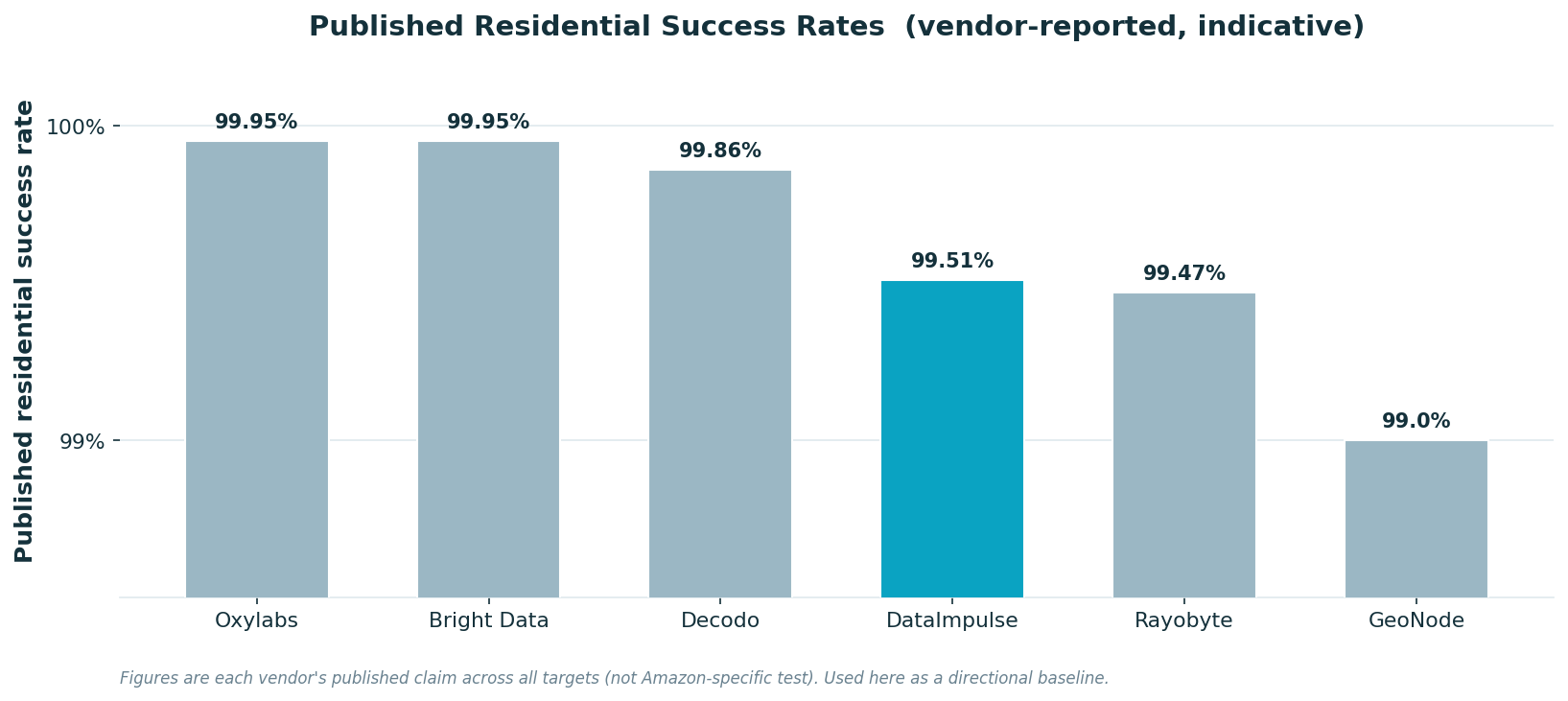
What makes it the default for Amazon is the price-to-coverage ratio. At $1/GB you can sustain large monitoring jobs across multiple marketplaces without watching your monthly burn rate, and the PAYG model means experiments that don’t pan out don’t lock you into a subscription. Support is staffed 24/7 by humans, and DataImpulse publishes a 99.51% success rate across its residential traffic and holds a 4.8/5 on G2. For teams that build and maintain their own Amazon parsers, this is the cheapest reliable infrastructure on the list.
DataImpulse — quick specs. Types: residential, datacenter, mobile · Pool: 90M+ residential, 195 countries · Rotation: rotating + sticky · Geo: country (city/state/ZIP/ASN as paid add-on) · Price: $1/GB residential, $0.50/GB datacenter, $2/GB mobile · Published success: 99.51% · Rating: G2 4.8. Best for: most teams that want low pay-as-you-go pricing and broad marketplace coverage without enterprise commitments.
2. Bright Data
Bright Data is the enterprise pick if you want Amazon scraping handed to you as a managed product. Beyond raw residential at $8/GB pay-as-you-go (currently discounted to $4/GB with a 50% promo) with a 400M+ monthly IP pool and free country/city/ZIP/ASN targeting, Bright Data sells a dedicated Amazon Scraper API that returns structured product, review, seller, global-product, and search data — priced from $1.50 per 1,000 successful records. If you don’t want to maintain HTML parsers as Amazon changes markup, that’s the offer. The trade-off is enterprise pricing, procurement-style buying, and a steeper learning curve.
Bright Data — quick specs. Types: residential, DC, ISP, mobile + Amazon Scraper API · Pool: 400M+ monthly residential · Rotation: rotating, sticky, dedicated · Geo: country/city/ZIP/ASN · Price: ~$4/GB res (promo); $8/GB regular; API from $1.50/1K records · Tooling: Proxy Manager, Web Unlocker. Best for: enterprise teams that want a managed Amazon scraping stack with compliance and audit controls.
3. Oxylabs
Oxylabs sits next to Bright Data at the enterprise top. Residential starts around $6/GB on the entry plan with a 175M+ pool across 195+ countries, and the Web Scraper API includes Amazon sources including a dedicated amazon_pricing endpoint and other Amazon page types. Sessions are flexible with unlimited concurrent connections, and Oxylabs publishes a 99.95% residential success rate. Pick Oxylabs when reliability, account management, and a polished e-commerce scraper API matter more than entry price.
Oxylabs — quick specs. Types: residential, DC, ISP, mobile + Web Scraper API · Pool: 175M+ residential, 195+ countries · Rotation: flexible, sticky, unlimited concurrency · Geo: country/city/state/ZIP/coordinates/ASN · Price: from $6/GB residential · Published success: 99.95%. Best for: enterprise Amazon monitoring with SLA-grade reliability and a managed scraper API.
4. Decodo
Decodo (formerly Smartproxy) is the mid-market sweet spot for Amazon. Residential proxies start around $2/GB on entry plans (with volume rates lower still), the pool spans 115M+ IPs across 195+ locations, and the Web Scraping API includes ready Amazon templates such as Amazon Pricing — so you can hit a structured endpoint instead of parsing changing HTML. Rotation is per-request with sticky sessions configurable from 1 minute up to 24 hours, which fits typical Amazon search-and-pagination flows. Strong choice for teams that want both raw proxies and an Amazon-aware API without enterprise contracts.
Decodo — quick specs. Types: residential, DC, ISP, mobile + Amazon API templates · Pool: 115M+ residential · Rotation: per-request, sticky up to 24h · Geo: country/city · Price: from $2/GB residential · Published success: 99.86%. Best for: mid-market teams that want a balance of proxy coverage, Amazon scraping templates, and price.
5. IPRoyal
IPRoyal is a fair entry point for smaller teams that want self-serve residential proxies without committing to a scraper-API stack. Residential starts around $7.35/GB on the 1GB tier and drops on larger bundles, with a 32M+ residential pool across 195+ countries. The dashboard is simple, billing is flexible, and rotating + sticky sessions cover standard Amazon flows. No Amazon-specific scraper API here — IPRoyal sells you the residential pool and lets you build the parser.
IPRoyal — quick specs. Types: residential, DC, ISP, mobile · Pool: 32M+ residential · Rotation: rotating, sticky · Geo: country/city · Price: from $7.35/GB residential. Best for: small and mid-size teams that want straightforward residential without enterprise tooling.
6. SOAX
SOAX is the pick when you want to test multiple proxy types on Amazon under one bill. Residential starts at $3.60/GB on the Starter plan (25GB included), and the unified credit model means you can spend the same budget on residential, mobile, ISP, datacenter, or the Web Data API. The pool is one of the largest in the mid-tier — 155M+ residential, 33M+ mobile, 2.6M+ ISP — with rotation per request or on an interval, and rotation/sticky options that fit Amazon search and ASIN sequences. Convenient if your stack mixes mobile checks for app data with residential collection on product pages.
SOAX — quick specs. Types: residential, mobile, ISP, DC + Web Data API · Pool: 155M+ residential, 33M+ mobile, 2.6M+ ISP · Rotation: per request or interval · Geo: country/region/city/ISP/ASN · Price: $3.60/GB Starter. Best for: teams testing residential and mobile mixes on Amazon under a single subscription.
7. Webshare
Webshare is the budget pick for Amazon teams that want to test cheaply before committing. The public page lists rotating residential plans from $3.50/month with an 80M+ residential pool and country/city targeting, plus separate datacenter and static residential products. It’s the lowest entry price on this list and the easiest dashboard to learn, with the caveat that Amazon’s protected pages will block more often on Webshare’s cheaper tiers than on premium residential — fine for testing, less reliable at scale on aggressive categories.
Webshare — quick specs. Types: datacenter, static residential, rotating residential · Pool: 80M+ residential · Rotation: rotating residential · Geo: country, city · Price: from $3.50/month. Best for: budget Amazon testing and lightweight monitoring on less-protected pages.
8. ScraperAPI
ScraperAPI is the right answer when you want to buy Amazon scraping outcomes instead of managing proxies. It’s not a raw proxy provider — you pay for API credits ($149/month for 1M credits on the Startup plan, scaling up from there), and the API handles proxy rotation, retries, CAPTCHA bypassing, JavaScript rendering, and structured data extraction for Amazon and other targets. Premium residential and mobile IPs are included on paid plans; e-commerce and anti-bot targets cost more credits per request. Use it when you’d rather get clean Amazon data back from a URL than build and maintain the scraping plumbing yourself.
ScraperAPI — quick specs. Type: scraping API with managed premium proxy pools · Pool: 40M+ proxies, 50+ countries · Rotation: automatic, API-managed · Geo: country (Business plan) · Price: from $149/month (1M credits). Best for: teams that want managed Amazon data without managing proxies.
How Much Do Amazon Proxies Cost?
Listed pricing in 2026 falls into three bands. Budget/value at $1–$3.60/GB — DataImpulse, Decodo, SOAX entry plans — covers most real Amazon work, including multi-marketplace monitoring. Mid/premium at $4–$8/GB — Bright Data, Oxylabs, IPRoyal — adds enterprise tooling and SLA-grade reliability. API-priced — Bright Data’s Amazon Scraper API at $1.50/1K records, ScraperAPI from $149/month — sells structured outcomes per record or per plan instead of per GB.
The real cost question for Amazon isn’t “what’s the lowest $/GB” but “what’s the lowest cost per successful page on my target categories”. Amazon pages are heavier than ordinary HTML — rendered product pages with reviews can run to several hundred KB — and a high block rate means you’re paying for retries and parser failures. Test a small batch on your actual target ASINs and marketplaces, measure success rate, then divide cost by successes. The cheapest list price often loses on this metric, and the budget tier from a premium vendor often beats the headline plan from a cheaper one.
Is Scraping Amazon Legal?
Scraping Amazon’s public pages — product, search, reviews, Buy Box — exists in a gray zone that depends on what you collect, how, and where you operate. The basics:
- Amazon’s Conditions of Use restrict automated access and data mining without consent, so violations can lead to IP blocks, account actions, or legal demands. Proxies reduce IP-side friction; they don’t grant permission.
- The hiQ v. LinkedIn precedent narrowed CFAA risk for accessing publicly available data, but it’s not a blanket scraping license. Contract, trespass-to-chattels, copyright, and anti-circumvention claims can still apply.
- Stay on public data. Don’t scrape logged-in seller accounts, private order data, customer PII, or paid content. Don’t bypass paywalls or access controls.
- Respect rate limits and robots signals. Throttle aggressively, cache responsibly, and identify legitimate internal jobs where appropriate.
- Local law varies. EU/UK data-protection rules, marketplace-specific terms, and consumer law can all bear on your specific use case. This isn’t legal advice — check what applies before you scale up.
The honest reading: serious Amazon monitoring is widespread industry practice for competitive intelligence, price tracking, and brand protection, but it lives in a legal gray zone and your specific use case deserves a careful read.
How to Start Scraping Amazon with DataImpulse
1. Create an account and pick your proxy type. For most Amazon work, residential ($1/GB) is the right default; add datacenter ($0.50/GB) for lightweight ASIN checks and mobile ($2/GB) for app-data targets.
2. Add funds. Pay-as-you-go, no subscription, no expiry — handy because Amazon scraping volume spikes around reporting cycles and quarterly reviews.
3. Target the marketplace and rotate. Set country to match the Amazon marketplace (US, UK, DE, FR, JP, IN, CA, IT, ES, AU, BR, MX), and add city/ZIP if you need US ZIP-level price data. Choose rotating for broad ASIN crawls, sticky sessions for paginated search and Buy Box tracking. Point your scraper at the proxy endpoint and run.
For more on related workflows, see our price comparison use case, our residential proxies product page, and the wider best proxies for web scraping roundup.
FAQ
Is scraping Amazon legal?
Scraping Amazon’s public pages exists in a legal gray zone. Amazon’s terms restrict automated access without consent, but the hiQ precedent supports access to publicly available data. Stay on public pages, avoid personal and logged-in data, respect rate limits, and check the rules in your jurisdiction. This isn’t legal advice.
Do I need a scraper API or raw proxies for Amazon?
Both work. Raw residential proxies are cheaper per byte and give you full control; a scraper API (Bright Data Amazon Scraper API, Oxylabs, Decodo templates, ScraperAPI) handles parsing, retries, CAPTCHAs, and Amazon’s frequent markup changes for a higher per-record price. Pick raw if you have a scraping team; pick a scraper API if you want clean structured data without that maintenance burden.
Rotating or sticky proxies for Amazon?
Rotate for breadth (ASIN-list crawls, broad keyword searches, high-volume monitoring), stick for depth (paginated search results, Buy Box tracking on one product over time, multi-page review crawls). Mixing both in one project is normal.
Residential vs datacenter proxies for Amazon — which is better?
Residential for protected pages — product, search, reviews, Buy Box. Datacenter for cheap, high-volume jobs on less-protected endpoints where the occasional block is acceptable. On serious Amazon targets, residential wins on cost-per-successful-page even though it lists higher per GB.
How do I scrape Amazon prices by country or ZIP code?
Set your proxy country to the marketplace you’re tracking (Amazon.com vs Amazon.co.uk etc.), then use ZIP/postcode targeting for US Amazon to capture Buy Box and pricing variations within the country. DataImpulse supports city, state, ZIP, and ASN targeting as a paid add-on on top of country.
What are the best mobile proxies for Amazon app data?
Mobile proxies route through carrier networks and are the right choice when you’re specifically targeting Amazon’s mobile app, mobile sponsored-ads verification, or Amazon Live and mobile-first features. DataImpulse mobile starts at $2/GB; Bright Data and Oxylabs offer enterprise mobile from $7.50–$8/GB.
How do I avoid Amazon CAPTCHAs?
Use fresh residential or mobile IPs from a quality pool, rotate them at a sustainable rate, use realistic browser-like headers and TLS fingerprints, throttle requests, and use sticky sessions for multi-page sequences. Even with all that, expect a CAPTCHA rate of a few percent on the most protected pages — handle them with a CAPTCHA-solving service or retry logic.
Is scraping Amazon reviews legal?
Public reviews are public-facing content, so they’re closer to the safer end of the gray zone than account data — but they’re also derived from individual users, so privacy and personal-data rules can apply depending on jurisdiction. Don’t collect personally identifying details beyond what’s already public, and respect the platform’s terms.
Can I scrape Amazon Brand Analytics?
No. Brand Analytics is logged-in seller-account data behind authentication. Bypassing the login is a clear ToS violation and carries serious account risk. Use Amazon’s official Brand Analytics interface or APIs if you have seller access.
What proxies work best for ASIN tracking?
Rotating residential is the standard answer for high-volume ASIN list crawls — fresh IP per request, country targeted to the marketplace, sticky sessions only when you need to drill into a single ASIN’s review pages or competing offers. DataImpulse residential at $1/GB is the most common low-cost choice for ASIN monitoring at scale.
Ready to scrape Amazon without the blocks? Start with DataImpulse — residential from $1/GB, pay-as-you-go, no expiry, with the marketplace and ZIP-level coverage Amazon work actually needs.
 State/City/Zip/ASN Targeting