In this Article
Not only those who collect the data, but also those who protect it, could feel how artificial intelligence has changed web scraping. Less than five years ago, scraping was mostly about ground rules such as HTML parsing, IP rotation, and browser emulation. The focus was on getting an HTML response and slightly masking requests, with no complicated behavior or session context checks. Today, the web has become smarter, and it is directly related to AI.
This article explains the main shifts in scraping with the start of AI technologies, including the essence of anti-automation systems. Some tips and tricks are inside, so if you find this topic relevant, keep reading. DataImpulse has a network of 90 million first-party residential IPs that are used as an additional legal way to stay anonymous and bypass current systems.
Key Facts
- Before the appearance of AI systems, blocking was based on rules such as rate limits or IP blacklist. Now, systems like Cloudflare use machine learning that analyzes behavioral and technical signals.
- The IP address itself no longer decides whether the request is secure.
- AI systems evaluate mouse movements, scrolling, click timings, and navigation patterns. This is often more important than the technical parameters of the request.
- Scraping is no longer about making a request, but about appearing to be a real user across the entire system of signals.
- Residential proxies for scraping are critical because they enable the allocation and rotation of IP addresses, and increase the trust score from anti-bot protection systems.
What’s wrong with traditional scrapers
Classic approaches to web scraping, such as using Requests and BeautifulSoup libraries or simple HTTP requests, work well with static sites and APIs. Scrapy is often used for broad data collection, which allows you to build effective crawling processes. However, the present-day web increasingly uses JavaScript rendering with complex structures and additional checks, due to which such tools can no longer always get the necessary content.
More advanced solutions like Selenium used to be the standard for working with complex websites, but today they are inferior to more modern tools such as Playwright, which copes better with dynamic SPA sites and is faster in modern automation scenarios.
At the same time, even modern browser tools do not guarantee success, as sites actively use anti-bot systems that analyze IP addresses, browser prints, user behavior, and request frequency. Scraping today requires a comprehensive approach, where tools are only part of the solution, not its basis.
How anti-bot systems detect automation
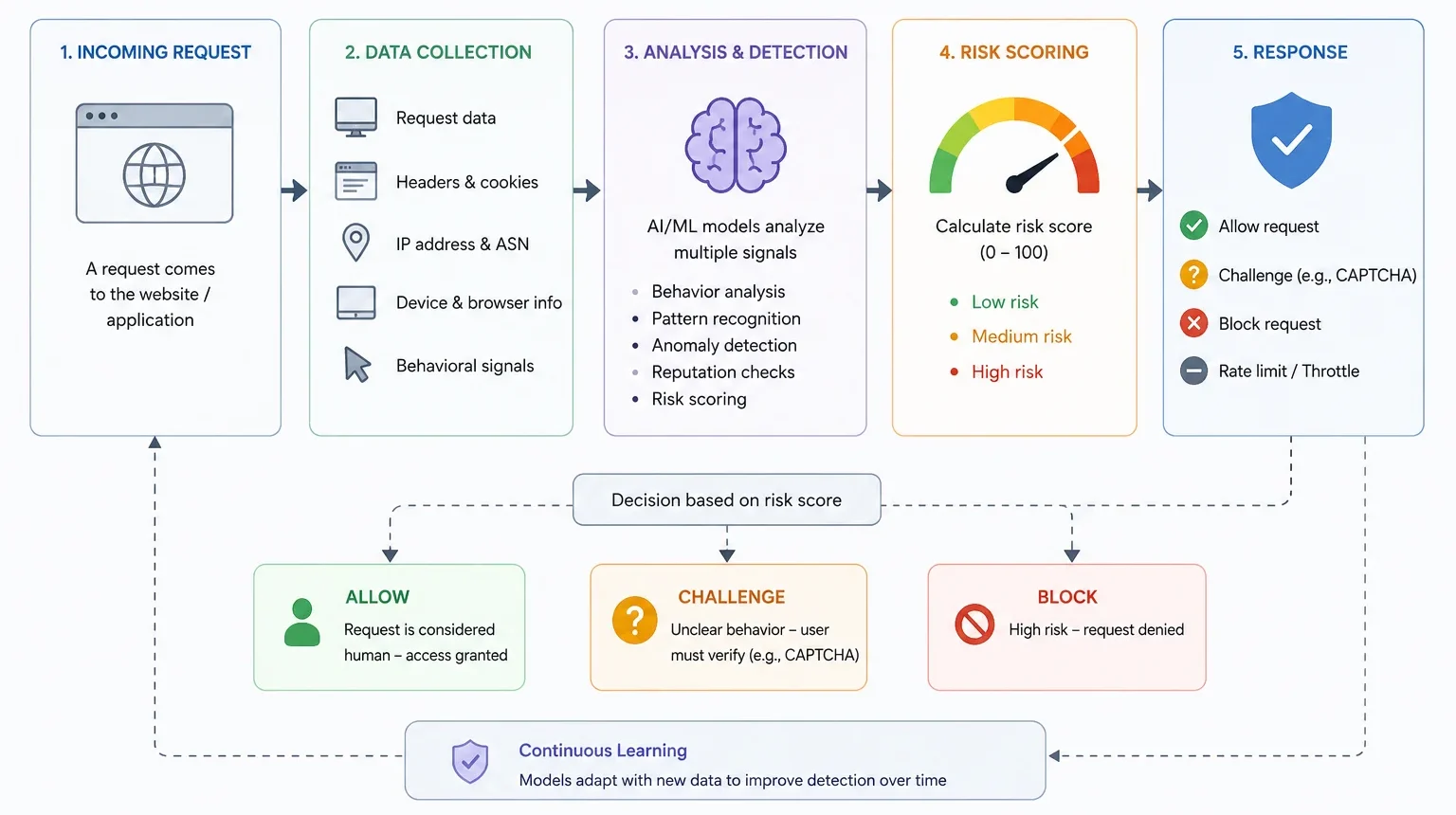
The anti-bot system is factually a layered risk assessment system that analyzes each HTTP request in real time through a combination of network, client, and behavioral signals.
First, the system checks the IP address, followed by TLS or JA3 and an HTTP fingerprint. After that, the system analyzes the fingerprint, and, if necessary, runs a JavaScript challenge to check the actual execution of the code. In current solutions, all these signals are aggregated into an ML model that forms a risk score and determines the next action that is allow the request, issue a challenge, or restrict it.
-
IP reputation
The first signal for most systems is the IP address. They analyze its reputation, country, Internet Service Provider, usage history, and network type. For example, requests from datacenter IPs are more often associated with automation, while residential IPs belong to real users and usually are more trustable. If the IP has already been seen in mass scraping or other suspicious activity, it may be blocked even before the request itself is analyzed.
-
Browser fingerprinting
Even if the IP looks legitimate, the anti-bot system checks the browser environment. Browser fingerprinting creates a unique client profile based on dozens of options such as User-Agent, screen resolution, fonts, Canvas and WebGL fingerprints, APIs, and other features. If the combination of these parameters looks unnatural or does not match the declared browser, the level of trust in the request decreases.
-
HTTP and JavaScript validation
The next level of validation applies to the HTTP request itself and JavaScript execution. Protection systems analyze HTTP headers, their sequence and consistency, check cookies, and other parameters of a real browser.
In addition, many websites integrate JavaScript challenges to make sure that the page is opened by a full-fledged browser, and not by a simple HTTP client or bot.
-
Behavioral analysis and AI detection
Modern anti-bot solutions use machine learning models to analyze mouse movement, scrolling speed, click intervals, page interaction time, and navigation scenarios.
-
Traffic pattern analysis
In addition to individual requests, anti-bot systems analyze the overall traffic picture. They detect repetitive patterns, unnatural request frequencies, same-type cross-page routes, and simultaneous activity from a large number of IP addresses. Such analysis helps to identify coordinated scraping activity that may not be visible from individual requests.
How AI has changed bot detection
Technically, artificial intelligence has changed anti-bot systems from rule-based engines to ML-driven decision pipelines. If earlier decisions were made with fixed rules, today each request turns into a set of features, which are aggregated into a machine learning model.
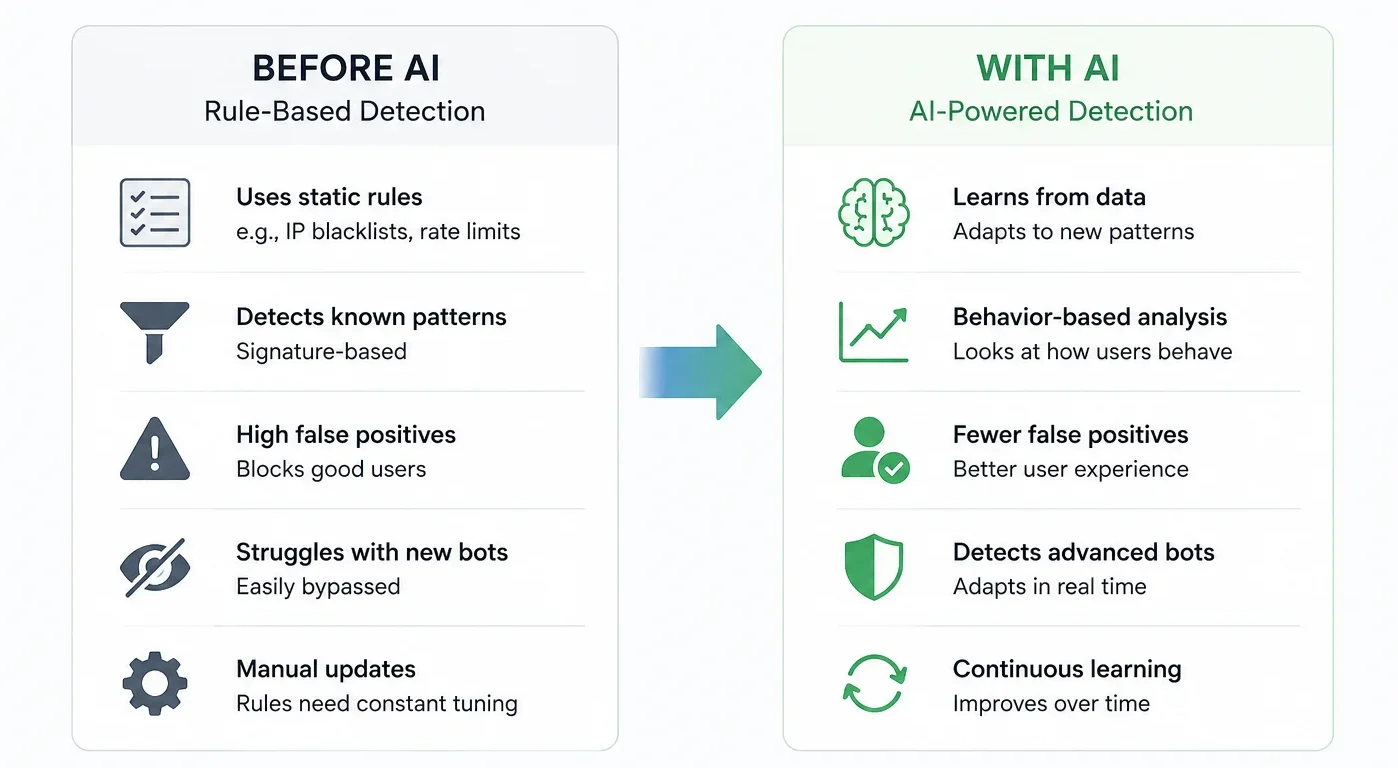
This model estimates the probability that a request is automated using multidimensional signals. Instead of “if/else” logic, the system works as a function that returns a risk score, which dynamically changes depending on the session context, request history, and global traffic patterns.
How to improve scraper stability and success rate
- Use residential proxies from reputable providers
Proxy quality is more important than IP quantity. Residential IPs have a better reputation and lower chances to be blocked than datacenter IPs, especially on sites with strict protection. Pay attention to proxy providers with stable uptime, a rate that shows the percentage of completed requests, and wide geographical coverage.
DataImpulse offers a 99.51% success rate and 75-88% lower prices than premium providers like Decodo and Bright Data. No subscriptions are required, and traffic doesn’t expire. Proxies with the price of $1 per GB are available in more than 195 countries.
- Configure IP rotation
Too frequent or insufficient rotation can negatively affect the results. Different strategies are for different scenarios. For example, apply short sessions with automatic rotation for large-scale data collection, or sticky sessions if you want to store authorization or user status.
- Integrate modern browsing tools
For sites with JavaScript rendering, it is better to use Playwright or other browser automation frameworks. They reproduce the behavior of a real browser more accurately and perform JavaScript correctly, which significantly increases the success rate.
- Support consistent browser fingerprint
User-Agent, HTTP headers, time zone, browser language, screen resolution, and other parameters must match each other. For example, User-Agent with Chrome on Windows, combined with Japan’s time zone and browser language fr-FR, may look suspicious.
- Control request speed
Even quality proxies won’t help if the scraper sends hundreds of requests per second or runs at perfectly the same intervals. Concurrency restrictions, random delays within reasonable limits, and compliance with site limits help avoid blockages.
- Implement reliable error handling
The scraper must automatically handle temporary errors, HTTP 429, 403, or timeouts. Retry mechanisms with exponential backoff, automatic IP change, or session re-creation significantly improve the stability of long-term processes.
- Use caching and keep track of the scraper’s performance
Do not resend the same requests. If the site uses cookies or session tokens, they should be reused, and it’s better not to create a new session for each request.
FAQ
What proxies are the best for web scraping?
Residential proxies are often recommended for web scraping. Their advantage is the ability to make traffic look natural, not automatic because they use real IP addresses from Internet Service Providers. Datacenter proxies are cheap and fast but they can be easily detected. At DataImpulse, you can purchase residential, datacenter, mobile and premium residential proxies.
What is browser fingerprinting?
Browser fingerprinting is a particular way to identify and monitor users by looking at their browser and device specifics. Protection systems collect data such as User-Agent, timezone, fonts, supported APIs which form a unique fingerprint that is used to distinguish the real user from a robot.
Is Playwright better than Selenium for modern scraping activities?
Yes, in cases when you need faster results and more stable automation, Playwright works better than Selenium. Selenium is widely used in legacy systems and testing environments.
Why am I getting a 403 error when scraping?
403 error shows that the server got the request but doesn’t want to authorize it. This usually happens when anti-automation systems detect unnatural behaviour. It may be caused by datacenter proxies, inconsistent fingerprints, missing cookies, unusual patterns, or aggressive request rate. For more possible proxy errors, check this DataImpulse guide about the causes of proxy errors and solutions.
Can AI-powered anti-bot systems be bypassed?
Yes, there are several methods to avoid detection. Rotating proxies or changing the Uesr-Agent may not be enough. In this case, developers combine residential proxies from a reliable provider like DataImpulse, Playwright and similar tools, retry logic, realistic patterns and adequate session management.
Conclusion
Modern anti-bot systems don’t look for bots, they look for anomalies. Their essence is not that simple today. The model that restrict a bad IP and lets a good IP access the data is gone. Now, websites slow responses, remove content, trigger pagination loops, and present CAPTCHAs. They analyze how your requests evolve over time. Frequent IP rotation may create a pattern that makes your activity less human. It’s important to choose the right type of proxy for scraping. Datacenter traffic is unnaturally fast and shares ASN history while traffic from residential IPs doesn’t look anomalous to anti-bot systems.
Avoid predictable request timing and implement exponential backoff instead of retrying just right after a failure. The best crawlers repeat less, blend more naturally, and keep consistent sessions. Make sure you have the residential proxies to help you with that.
 State/City/Zip/ASN Targeting