

In this Article
US real estate sits behind some of the toughest anti-bot stacks on the open web in 2026 — Zillow runs PerimeterX (now HUMAN Security) plus Cloudflare on most page-types; Redfin layers Cloudflare with rate limiting and JS challenges; Realtor.com gates listing detail pages; Apartments.com fingerprints aggressively; the MLS world (CRMLS, Bright MLS, MRED, Stellar MLS, OneKey) operates behind RESO Web API contracts (which replaced the older RETS standard) that explicitly prohibit scraping outright. A US-IP scraper trying to pull Zillow zestimates, Redfin sold-comps, Realtor.com listing history, or Apartments.com rent rolls without proper proxy infrastructure gets stopped within hundreds of requests. With recent Zillow v MRED / Compass federal antitrust litigation (May 2026) reshaping the private-listings data layer, the data is more fragmented than ever — and the right proxy stack is what makes a real-estate data program either work or stall.
This guide ranks the 8 best proxies for Zillow and US real estate scraping in 2026, sorts out residential vs datacenter vs mobile vs ISP for property-data targets, covers the legal landscape (hiQ v LinkedIn, Meta v Bright Data, Zillow ToS, MLS contract law), and walks through full reviews. Jump to the quick comparison for a thirty-second shortlist; deeper coverage follows.
Key Facts
Real estate scraping is its own proxy market because the anti-bot stacks are tier-1, the legal regime is fragmented by state + MLS contract, and ZIP-level geo precision actually changes pricing data. Five things to know up front:
- Zillow API is dead; scraping is the only path. The public Zillow ZWSID API was retired September 2021 and never reopened to general developers (Bridge Interactive replaces it but is gated to MLS-affiliated brokerages). As of 2026, Zillow is rated Very Hard by major scraping benchmarks — dual-layer PerimeterX (now HUMAN Security) + Cloudflare anti-bot stack with behavioral mouse/keystroke analysis and browser fingerprinting. Safe scrape rate is 20–50 property details per day per IP without proxy rotation; with proper proxy infrastructure, production teams routinely run 10,000+ records/day.
- hiQ v LinkedIn (9th Cir. 2022) is the precedent. US courts established that scraping publicly accessible data does not violate the Computer Fraud and Abuse Act (CFAA). For real estate, that means public Zillow / Redfin / Realtor.com listing pages, sold history, and zestimates are scrapable under federal CFAA law. Meta v Bright Data (2024) further clarified the public-vs-logged-in line: public scraping survives; logged-in account scraping triggers contract-breach exposure.
- MLS data is a contractual minefield, not a CFAA matter. The RESO Web API has been gradually replacing the older RETS (Real Estate Transaction Standard) since 2016; RESO deprecated RETS in 2018 and legacy support ended in December 2024. Both distribute MLS feeds under explicit licensing contracts that prohibit redistribution and scraping. Scraping MLS feeds directly is a contract-law issue, not a copyright one — your exposure is breach of the licensee agreement, sometimes statutory damages. The May 2026 Zillow v MRED / Compass federal antitrust suit is reshaping who can show “private” or “office-exclusive” listings on platforms like Zillow, with implications for what data you can legally aggregate.
- ZIP and metro precision changes everything. Real estate pricing varies wildly across ZIP codes within a single metro — Austin’s 78704 vs 78745 vs 78758 returns different median list prices, days-on-market, and price-per-square-foot on Zillow and Redfin. City-level proxy geo is the floor; ZIP-level is the gold standard for accurate competitive intel and investor underwriting.
- Real estate sites are mobile-first now. Zillow, Redfin, Realtor.com mobile apps and mobile web surfaces often surface different pricing, alerts, and “off-market” data than desktop. For competitive analysis, mobile proxies routed through US carrier networks (Verizon, T-Mobile, AT&T) catch the mobile-only signals desktop scraping misses.
How We Selected These Real Estate Proxies
We picked these 8 providers because they have credible US residential IP coverage (Zillow/Redfin/Realtor.com all require US-located IPs for accurate data), public pricing as of May 2026, and one or more documented features that matter for real estate scraping — city or ZIP targeting, ASN selection, sticky sessions long enough for multi-page listing detail flows, ISP/static-residential lines for account-tied workflows, or anti-bot bypass APIs that handle PerimeterX/Cloudflare without per-request DIY. We weighed live PAYG residential price per GB, transparency of pricing, freshness of marketing claims, and ranking on independent real-estate scraping benchmarks. Providers without verifiable US ZIP-level geo coverage, with stale pricing, or with no public success-rate disclosure were cut.
What Makes a Good Real Estate Proxy?
A strong real estate proxy stack solves four problems at once. Real ISP-assigned US residential IPs (Comcast, Charter Spectrum, AT&T, Verizon FiOS, T-Mobile Home Internet, Cox) — without them, Zillow’s PerimeterX layer flags your traffic as datacenter within hundreds of requests. ZIP- and metro-level geo — Austin 78704 vs Phoenix 85016 vs Brooklyn 11215 pricing varies on Zillow and Redfin; comparative market analysis (CMA) work needs ZIP precision. Sticky sessions long enough for multi-page listing detail flows (3–5 page-views per listing on Zillow, similar on Redfin) without mid-session IP rotation that trips PerimeterX. PAYG or transparent volume pricing — real estate data collection has spiky volume (seasonal market shifts, MLS data refresh cycles, investor underwriting sprints) so subscription lock-in hurts.
Quick Comparison: Best Proxies for Zillow & Real Estate at a Glance
| Provider | Best for | Residential price | Pool | US geo | Notable |
|---|---|---|---|---|---|
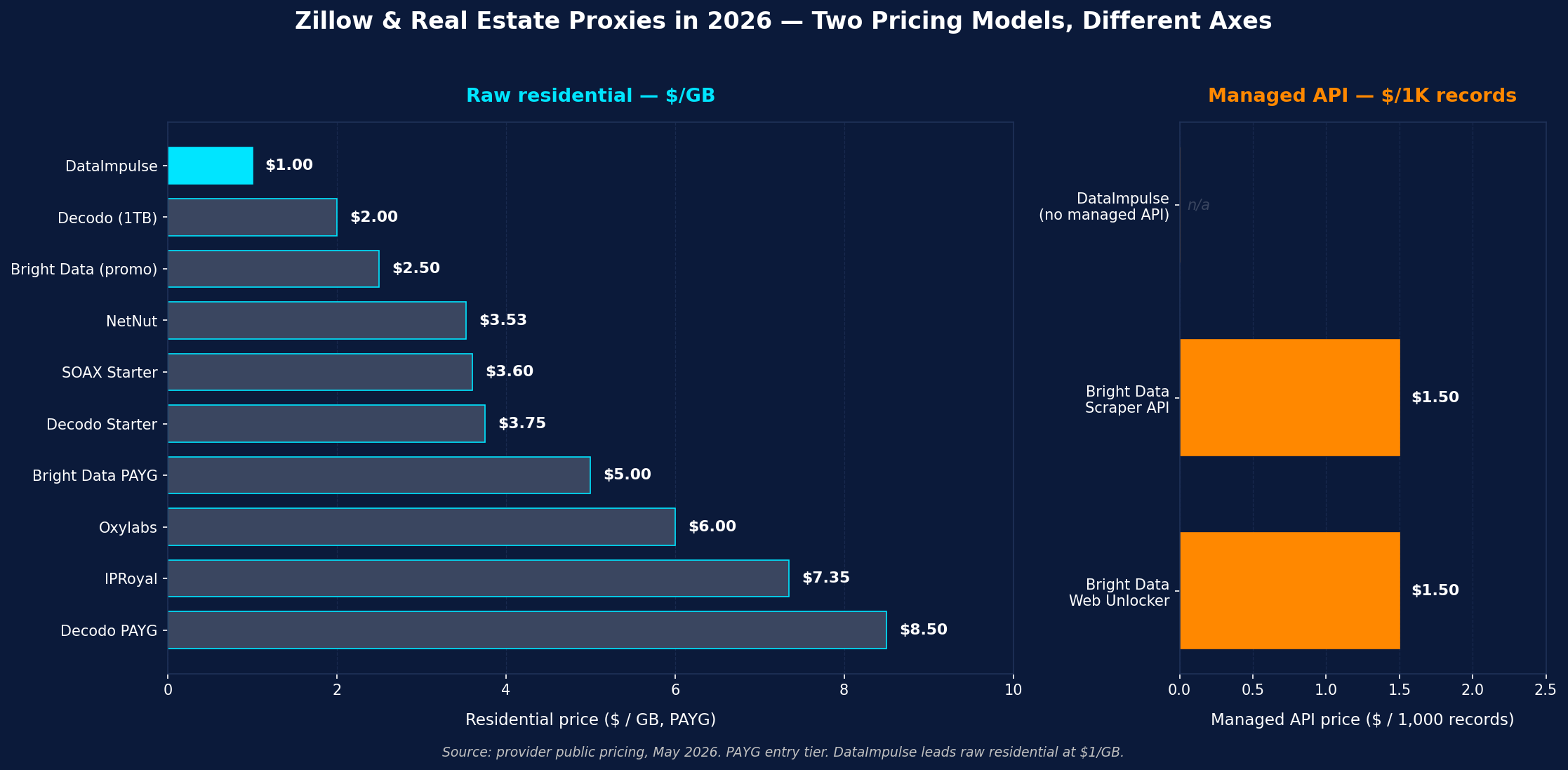
| DataImpulse | Best value, in-house teams | $1/GB PAYG | 90M+ residential, deep US coverage | Country free; state/city/ZIP/ASN 2× rate | Traffic never expires; G2 4.8 |
| Bright Data | Enterprise + Zillow Scraper API | ~$2.50/GB (50% promo); $5/GB regular | 400M+ residential | Country/city/ZIP/ASN free | Dedicated Zillow + Redfin + Realtor.com Scraper APIs |
| Oxylabs | SLA-grade enterprise | from $6/GB | 175M+ residential | Country/state/city/ZIP/ASN/coords | Web Scraper API; 99.95% success |
| Decodo | Mid-market, US ISP | $3.75/GB starter, $8.50/GB PAYG | 115M+ residential | Country/city/ZIP/ASN included | US ISP from $0.27/IP |
| IPRoyal | Long sticky for MLS-feed flows | from $7.35/GB | 32M+ residential | Country/region/city/ISP | Sticky up to 7 days |
| SOAX | Mixed proxy types + ZIP | $3.60/GB Starter | 155M+ res, 33M+ mobile, 2.6M+ ISP | Country/region/city/ISP/ASN | ZIP-level geo on Starter |
| Webshare | Cheap large volume | from $3.50/mo res; $2.99/mo DC | 80M+ residential (sub) | Country, plan-dependent city | Budget pick for low-defense targets |
| NetNut | ISP-residential reliability | from $3.53/GB | ISP-grade residential | Country (city on higher plans) | Comcast/Charter/AT&T ISP depth |
Which Proxy Type Should You Use for Zillow & Real Estate?
Real estate work behaves differently from generic US scraping — the major property platforms run tier-1 anti-bot stacks (PerimeterX, Cloudflare, HUMAN Security) and content varies by ZIP. The proxy type decides your success rate more than the brand does.
Residential Proxies
Residential proxies are the right default for nearly all serious real estate work — Zillow, Redfin, Realtor.com, Trulia (Zillow Group), Apartments.com, Homes.com, Movoto, Estately, Compass listing pages and search results; LoopNet commercial listings; rental-aggregator sites; iBuyer pages on Opendoor and Offerpad. Real Comcast, Spectrum, AT&T, Verizon FiOS, and T-Mobile Home Internet IPs read as ordinary US homebuyer traffic to the PerimeterX layer, and a fresh US residential pool routinely clears the dual Cloudflare + PerimeterX gauntlet where datacenter ranges flag in minutes.
ISP / Static Residential Proxies
ISP proxies (static residential) are increasingly the right choice for real estate workflows that need session continuity — Zillow Premier Agent dashboards, Realtor.com Pro account work, MLS partner-portal sequences, signed-in Compass and Coldwell Banker work, multi-day rank tracking on Google for real-estate keywords, agent-side LinkedIn outreach. ISP IPs sit on US ISP-assigned addresses with the stability of static hosting: residential trust with the predictability of a fixed address. Decodo, IPRoyal, Bright Data, and NetNut all offer US ISP product lines.
Mobile Proxies
Mobile proxies route through real US carrier networks (Verizon, T-Mobile, AT&T) and earn their place when you’re validating mobile real estate experiences, mobile-app pricing on Zillow and Redfin, mobile-only “alerts” and “off-market” surfaces, or hard geo/account cases where residential rotation gets challenged on the most-protected MLS-feed pages. Zillow and Redfin mobile apps often surface listing alerts and off-market estimates that desktop scraping misses. They’re the most expensive option per GB, so reserve them for jobs where mobile context genuinely changes the data.
Datacenter Proxies
Datacenter proxies have a narrow but real role in real estate work: bulk crawling of public county assessor sites, sitemap aggregation on Zillow/Redfin (cached listing-index pages), open-data MLS feeds (where they exist — e.g., NYC StreetEasy public list, Boston Reonomy commercial data), and lightweight enrichment of CSV exports. Don’t lean on datacenter for Zillow property-detail pages, Redfin sold history, or Realtor.com listing pages — these flag datacenter ranges within hundreds of requests. Reserve datacenter for the low-defense layer of a real estate stack, and switch to residential or ISP as soon as a target starts challenging you.
Rotating vs Sticky for Real Estate
The rule for real estate: rotate for breadth, stick for depth. Rotating residential handles broad Zillow ZIP-by-ZIP listing sweeps, Redfin neighborhood-level comp pulls, Realtor.com saturation crawls, and county assessor public-records aggregation. Sticky sessions handle the deeper flows — Zillow property-history deep dives (3–5 pages per address), Redfin sold-comparable sequences, Realtor.com listing-detail + agent-info combo pulls, MLS partner-portal multi-step flows, Compass agent-dashboard sequences, and any flow where mid-session IP changes would flag PerimeterX as suspicious. Most production real estate stacks mix both.
Best Proxies for Real Estate — Full Reviews
The picks below are ranked on value for real estate scraping — the balance of US IP pool depth, ZIP/city precision, PerimeterX/Cloudflare success rate, sticky-session length, posture on the public-vs-MLS legal line, and price per successful record. DataImpulse leads on value; the rest each win a specific lane.
1. DataImpulse
DataImpulse is the best-value pick for in-house teams running their own real estate scrapers — Zillow listing pulls, Redfin sold-comp tracking, Realtor.com price-history scraping, Apartments.com rent-roll aggregation, LoopNet commercial-property monitoring, Google for real-estate keyword SERP work. Residential starts at $1/GB, pay-as-you-go, with traffic that never expires — a fraction of what enterprise real-estate scrapers charge. The pool is 90M+ ethically sourced IPs across 195 countries with deep US residential coverage on the major consumer ISPs (Comcast, Spectrum, AT&T, Verizon FiOS). Country targeting is included with state/city/ZIP/ASN as a paid add-on (2× the per-GB rate), which matters for real-estate work where Austin 78704 vs 78745 pricing on Zillow actually differs and ZIP-precise CMA work is the standard. It supports HTTP, HTTPS, and SOCKS5, rotating and sticky sessions, full API access, and standard scraping stacks (Scrapy, Selenium, Playwright). Mobile is available at $2/GB for Verizon/T-Mobile/AT&T networks; datacenter at $0.50/GB for the enrichment layer (county assessor sites, open-data MLS feeds, public records).
What makes it the default for serious real-estate collection is the price-to-geo ratio. At $1/GB you can sustain continuous Zillow/Redfin work across all major metros without the per-record charges that managed APIs add up to at scale, and the PAYG model means experimenting with new real-estate targets — Homes.com, Movoto, Estately, ApartmentList — doesn’t lock you into a subscription. Support is 24/7 human; published success rate is 99.51%; G2 is 4.8/5. There’s no dedicated Zillow endpoint here — DataImpulse sells the proxy infrastructure cleanly and lets your team build the Zillow / Redfin / Realtor.com parsers on top, paired with a TLS-fingerprint-aware client (curl_cffi, undetected-chromedriver) to handle the PerimeterX layer.
Quick specs — Types: residential, mobile, datacenter · Pool: 90M+ residential with deep US coverage · Rotation: rotating + sticky · Geo: country (state/city/ZIP/ASN as paid add-on at 2× rate) · Price: $1/GB res, $0.50/GB DC, $2/GB mobile · Published success: 99.51% · Rating: G2 4.8.
Best for: in-house real-estate scraping teams that want low pay-as-you-go pricing and ZIP-level geo without enterprise commitments.
2. Bright Data
Bright Data is the enterprise pick if you want real estate data as a managed product. Beyond raw residential at $5/GB pay-as-you-go (currently discounted to ~$2.50/GB with a 50% promo) with a 400M+ monthly IP pool that includes deep US coverage and free city/ZIP/ASN targeting, Bright Data ships dedicated Scraper APIs for Zillow, Redfin, Realtor.com, Apartments.com, and other major US real-estate sites at $1.50 per 1,000 records on PAYG (about $1.30/1K on the $499 plan). The Web Unlocker at $1.50/1K results handles protected real-estate targets (Zillow’s PerimeterX, Redfin’s Cloudflare) generically. ISO 27001, SOC 2 Type II, documented privacy-law compliance, and audit-ready documentation clear most US enterprise procurement and most legal-risk reviews for real-estate aggregation. It’s the right call when you’d rather hit a managed Zillow endpoint than maintain a parser against PerimeterX’s behavioral signals — at enterprise pricing with procurement-style buying.
Quick specs — Types: residential, DC, ISP, mobile + dedicated Zillow/Redfin/Realtor.com Scraper APIs + Web Unlocker · Pool: 400M+ monthly residential with deep US coverage · Rotation: rotating, sticky, dedicated · Geo: country/city/ZIP/ASN free · Price: ~$2.50/GB res (promo); $5/GB regular; Scraper APIs from $1.50/1K records PAYG (~$1.30/1K on $499 plan); subscription from $499/month · Compliance: ISO 27001, SOC 2 Type II.
Best for: enterprise real-estate data teams that want managed Zillow/Redfin/Realtor.com Scraper APIs with audit-ready compliance and SLA controls.
3. Oxylabs
Oxylabs sits next to Bright Data at the enterprise top with strong real-estate coverage. Residential starts around $6/GB on the entry plan with a 175M+ pool across 195 countries and strong US presence with city, state, ZIP, ASN, and geographical coordinate targeting (essential for ZIP-precise real-estate work). The Web Scraper API ($49/month entry) handles JavaScript rendering, anti-bot bypass, and structured data extraction across real-estate targets including Zillow, Redfin, and Realtor.com. Sessions are flexible with unlimited concurrent connections, and Oxylabs publishes a 99.95% residential success rate. Pick Oxylabs when reliability, SLA-grade support, ISO 27001 / SOC 2 compliance, and audit-ready documentation matter more than entry price — particularly for real-estate enterprise programs that need procurement docs for legal-risk reviews on public-vs-MLS scraping.
Quick specs — Types: residential, DC, ISP, mobile + Web Scraper API · Pool: 175M+ residential, 195 countries · Rotation: flexible, sticky, unlimited concurrency · Geo: country/state/city/ZIP/coordinates/ASN · Price: from $6/GB residential; Web Scraper API from $49/month · Published success: 99.95% · Compliance: ISO 27001, SOC 2.
Best for: enterprise real-estate programs that want SLA-grade managed scraping with ZIP-precise geo and audit-ready compliance.
4. Decodo
Decodo (formerly Smartproxy) is the mid-market sweet spot for real-estate work. Residential proxies start at $3.75/GB on the 3 GB starter plan with PAYG at $8.50/GB on the public pricing page, dropping to about $2/GB at the 1,000 GB tier. The static residential/ISP starts at $0.27/IP — one of the most aggressive US ISP rates on the market for static-residential workflows like Zillow Premier Agent dashboards, Realtor.com Pro accounts, and signed-in MLS partner portals. Country, city, ZIP, and ASN targeting are included with 115M+ IPs across 195+ locations. The Web Scraping API includes templates for major real-estate sites, with sticky sessions configurable up to 24 hours — useful for Zillow property-history and Redfin sold-comp multi-page flows.
Quick specs — Types: residential, DC, ISP, mobile + Web Scraping API · Pool: 115M+ residential · Rotation: per-request, sticky up to 24h · Geo: country/city/ZIP/ASN included · Price: $3.75/GB starter, $8.50/GB PAYG, $2/GB at 1TB+; static residential/ISP from $0.27/IP · Published success: 99.86%.
Best for: mid-market real-estate teams that want ZIP-precise residential and cheap US ISP for account-tied work.
5. IPRoyal
IPRoyal earns its spot for real-estate workflows that need long sticky sessions — multi-day rank tracking on Google for real-estate keywords, multi-page Zillow property-history flows, MLS-feed partner-portal sequences, multi-day Compass account continuity. Residential PAYG runs $7.35/GB at entry (cheaper at volume) with a 32M+ pool across 195+ countries including deep US coverage, with country, region, city, and ISP targeting. Its real differentiator is sticky sessions up to 7 days, the longest on this list — uniquely useful for MLS-licensee partner-portal flows where a single session needs to persist across days, multi-day listing alerts on Zillow, and agent-account flows that break under residential rotation. There’s also a US ISP product line and Web Unblocker (CAPTCHA + PerimeterX bypass) at per-request pricing.
Quick specs — Types: residential, ISP, mobile, DC + Web Unblocker · Pool: 32M+ residential, 195+ countries · Rotation: rotating, sticky up to 7 days · Geo: country/region/city/ISP · Price: from $7.35/GB residential PAYG.
Best for: real-estate workflows that need multi-day sticky sessions (MLS partner portals, Zillow listing alerts, agent-account work).
6. SOAX
SOAX is the pick when geo-precise real-estate work and mixed proxy types matter together. Residential starts at $3.60/GB on the Starter plan (25 GB included), and the unified credit model means you can spend the same budget on residential, mobile, ISP, datacenter, or the Web Data API. The pool is one of the larger in the mid-tier — 155M+ residential, 33M+ mobile, 2.6M+ ISP — with country, region, city, ISP, and ASN targeting including US ZIP-level geo on the Starter plan (rare at this price). Sticky sessions are supported across all proxy types. Convenient if your real-estate program mixes mobile validation of Zillow and Redfin apps (where mobile-only alerts surface) with residential for desktop scraping and ISP for agent-account flows.
Quick specs — Types: residential, mobile, ISP, DC + Web Data API · Pool: 155M+ residential, 33M+ mobile, 2.6M+ ISP · Rotation: per request or interval, sticky supported · Geo: country/region/city/ISP/ASN (ZIP-level on Starter) · Price: $3.60/GB Starter.
Best for: real-estate teams running geo-precise collection across multiple proxy types under one subscription.
7. Webshare
Webshare earns its place for real-estate teams running large-volume low-cost workflows on public real-estate targets — county assessor sites, public records aggregation, open-data MLS feeds where they exist, public property-tax records, sitemap crawling. Plans start at $2.99/month for the 100-proxy datacenter package and $3.50/month for the entry rotating residential plan with 80M+ residential available on higher tiers, plus static US ISP proxies on subscription plans. Webshare residential is best on lower-defense real-estate targets; for tier-1 anti-bot sites (Zillow, Redfin, Realtor.com, Apartments.com), step up to the providers above.
Quick specs — Types: residential, static ISP, datacenter · Pool: 80M+ residential (subscription); datacenter and ISP available · Geo: country, plan-dependent city · Price: from $2.99/month datacenter (100 proxies); rotating residential from $3.50/month.
Best for: real-estate teams running cheap large-volume crawling of public county/assessor sites and open-data feeds.
8. NetNut
NetNut closes the list with a focus on ISP-residential reliability for real-estate workflows. The product line emphasizes ISP-grade residential IPs (Comcast, Charter Spectrum, AT&T, Verizon FiOS, T-Mobile, Cox, and other US ISP-assigned addresses) with rotating and sticky options. Rotating residential currently starts around $3.53/GB on entry plans, scaling up by volume; country and city-level targeting available on higher tiers. NetNut is the pick when you specifically want Comcast/Spectrum/AT&T ISP-residential network depth — the consumer ISPs most US homebuyers use — without paying full Bright Data prices.
Quick specs — Types: ISP-residential, residential, mobile · Pool: ISP-grade residential with deep US coverage · Rotation: rotating, sticky · Geo: country (city on higher plans) · Price: from $3.53/GB residential.
Best for: real-estate teams that want major US ISP-residential reliability for Zillow/Redfin/Realtor.com work without enterprise pricing.
How Much Do Real Estate Proxies Cost?
Listed pricing in 2026 falls into three bands. Budget/value at $1–$3.75/GB — DataImpulse, SOAX Starter, Decodo entry, Webshare residential subscription — covers most in-house real-estate scraping work. Mid/premium at $3.50–$7.35/GB — Bright Data, Oxylabs, IPRoyal, NetNut — adds enterprise tooling and SLA-grade reliability. API-priced and ISP-priced — Bright Data’s Zillow/Redfin/Realtor.com Scraper APIs $1.50/1K records PAYG (~$1.30/1K on $499 plan), Oxylabs Web Scraper API from $49/mo, Decodo Web Scraping API from $19/mo, Decodo US ISP at $0.27/IP — sell structured real-estate outcomes per record, per plan, or per IP instead of per GB.
The real cost question for real estate isn’t “what’s the lowest $/GB” but “what’s the lowest cost per successful, legally-defensible listing record”. A managed scraper API at $1.30–$1.50/1K records can beat $1/GB residential when your in-house scraper hits PerimeterX blocks on 30–50% of Zillow requests; conversely, $1/GB residential paired with sticky sessions, ZIP-level geo, and a TLS-fingerprint-aware client (curl_cffi, undetected-chromedriver) routinely beats per-record APIs at scale once your in-house parser is mature. Test both on your actual real-estate targets before committing.
Is Scraping Zillow & Real Estate Legal?
US real estate scraping law sits at the intersection of the CFAA (hiQ v LinkedIn precedent), state-level computer-trespass statutes, MLS licensee contracts, Zillow/Redfin/Realtor.com terms of service, and copyright on listing photography. The basics:
- Public Zillow/Redfin/Realtor.com data scraping is CFAA-safe. The 9th Circuit’s hiQ Labs v LinkedIn (2022) ruling established that scraping publicly accessible web data does not violate the CFAA. Public listing pages, sold history, zestimates, and aggregator search results are CFAA-safe to scrape. Meta v Bright Data (2024) reinforced this with a public-vs-logged-in distinction: public is fine; logged-in account scraping triggers contract-breach exposure.
- Terms of service create contract liability, not criminal liability. Zillow, Redfin, Realtor.com, Apartments.com, and Compass all prohibit automated access in their ToS. Violating ToS is a civil contract-breach matter (not CFAA-criminal). Recent jurisprudence: ToS-based claims survive against repeat or large-scale commercial scrapers; one-off researcher use rarely tested.
- MLS data is governed by RESO/RETS licensing contracts. The Real Estate Standards Organization (RESO) Web API has gradually replaced the older RETS standard since 2016 (RETS deprecated 2018; legacy support ended December 2024). MLS feeds distributed to brokers under RESO licenses prohibit redistribution and scraping. Scraping MLS feeds directly is a contract-law violation, not a copyright one — exposure includes breach of license, statutory damages, MLS membership termination, and broker-license consequences. Don’t scrape RESO endpoints unless you’re a licensed RESO data consumer with explicit redistribution rights.
- Listing photography is copyright-protected. Listing agents and MLS providers typically hold copyright on professional listing photography. Scraping + republishing photos at scale carries copyright exposure under the DMCA. Public-facing aggregators that show photos rely on either licensed feeds or fair-use claims that are easy to challenge.
- State-level real estate laws add nuance. California (CCPA, CPRA), Virginia (VCDPA), Colorado (CPA), Connecticut (CTDPA), Utah (UCPA), and Texas (state-specific real-estate statutes) all add layers around personal data of buyers/agents/sellers. The 2026 Zillow v MRED / Compass federal antitrust case is reshaping who can show private/office-exclusive listings — watch this jurisprudence if you’re aggregating across MLS markets.
The honest reading: public Zillow/Redfin/Realtor.com price/listing/history data is the lowest-risk lane (hiQ-protected). MLS-feed scraping is high-risk contract law. Personal data of buyers/sellers/agents is the highest risk. Get US real-estate counsel familiar with hiQ, Meta v Bright Data, and RESO licensing before scaling. This isn’t legal advice.
How to Start Real Estate Scraping with DataImpulse
- Create an account and pick your proxy mix. Residential ($1/GB) for Zillow, Redfin, Realtor.com, Trulia, Apartments.com, Homes.com, Compass, LoopNet, Movoto, and Google for real-estate SERP; datacenter ($0.50/GB) for enrichment (county assessor sites, open-data MLS feeds, public property-tax records); mobile ($2/GB) for mobile-app Zillow/Redfin validation where mobile-only alerts and pricing surface.
- Add funds. Pay-as-you-go, no subscription, no expiry — handy because real-estate scraping volume varies with seasonal market cycles (spring buying season, end-of-year tax-strategy pulls, MLS data-refresh cycles, investor-underwriting sprints) and is rarely flat month-over-month.
- Target by ZIP and rotate. Set country US plus state/city/ZIP for the metros you’re collecting (state/city/ZIP/ASN are paid add-ons at 2× the per-GB rate but essential for serious real-estate work — pricing on Zillow varies dramatically across ZIP codes within a single metro), pick rotating for broad Zillow listing sweeps and sticky sessions (sticky parameter) for Zillow property-history, Redfin sold-comp sequences, and MLS partner-portal flows. Pair with a TLS-fingerprint-aware client (curl_cffi, undetected-chromedriver, Playwright + stealth) to handle the PerimeterX layer. Point your scraper at the proxy endpoint and run.
For more on related workflows, see our residential proxies product page, the mobile proxies product page (for mobile-app Zillow/Redfin validation), the US residential proxies landing, the best proxies for web scraping roundup, and the best proxies for SEO & rank tracking roundup.
FAQ
Is scraping Zillow legal?
Public Zillow listing pages, sold history, and zestimates are CFAA-safe to scrape under the 9th Circuit’s hiQ Labs v LinkedIn (2022) ruling. Zillow’s terms of service prohibit automated access, which creates civil contract-breach exposure for commercial scrapers (but not CFAA-criminal liability). Meta v Bright Data (2024) reinforced the public-vs-logged-in distinction: public is fine; logged-in account scraping is high-risk. Do not scrape MLS-licensed feeds (RESO/RETS) without explicit license — that’s contract violation with potential statutory damages. Get US real-estate counsel before scaling. This isn’t legal advice.
What are the best proxies for Zillow specifically?
Residential proxies with US ZIP-level geo are the safest default. Zillow runs PerimeterX (HUMAN Security) + Cloudflare dual-layer anti-bot with behavioral fingerprinting, so resilient Zillow scraping needs either DataImpulse residential at $1/GB paired with a TLS-fingerprint-aware client (curl_cffi or undetected-chromedriver) or Bright Data’s dedicated Zillow Scraper API at $1.50/1K records, which handles the PerimeterX layer for you. Decodo’s US ISP at $0.27/IP is among the cheapest entries to static-residential for Zillow Premier Agent dashboards.
How do I scrape Zillow at scale without getting blocked?
(1) Use US residential or mobile proxies — datacenter ranges flag fast. (2) Rotate IPs every 1–3 requests for broad sweeps; sticky for multi-page property-history flows. (3) Use a TLS-fingerprint-aware client (curl_cffi, undetected-chromedriver, Playwright + stealth) to defeat PerimeterX behavioral fingerprinting. (4) Set realistic User-Agent + Accept-Language matching US Chrome/Safari values. (5) Throttle: 1–2 sec inter-page delay for sticky sessions. (6) Use ZIP-level geo (Austin 78704 vs 78745 returns different data). Production teams routinely run 10,000+ records/day with this stack. Without proxies, Zillow rate-limits hard at 20–50 detail pages per day per IP.
Do I need ZIP-specific IPs for real estate?
Yes for accurate price intelligence. Zillow, Redfin, Realtor.com all surface different median list prices, days-on-market, and price-per-square-foot data across ZIP codes within a single metro — Austin 78704 (South Congress) vs 78745 (South Austin) vs 78758 (North Austin) returns three different markets. CMA (comparative market analysis) work requires ZIP-precision. DataImpulse, Bright Data, Oxylabs, Decodo, SOAX all support ZIP-level targeting (paid add-on or included depending on plan). SOAX includes ZIP-level geo on the Starter plan — best entry price for ZIP-precision.
What about Redfin, Realtor.com, Apartments.com?
Redfin runs Cloudflare with rate limiting and JS challenges (Medium difficulty in community benchmarks — easier than Zillow), Realtor.com gates listing-detail pages with similar Cloudflare + bot-defense layer, Apartments.com fingerprints aggressively on rent-roll endpoints. Same proxy stack works: US residential + sticky sessions + TLS-fingerprint-aware client. Bright Data ships dedicated Scraper APIs for all three. Compass and Coldwell Banker agent dashboards need ISP/static-residential for session continuity.
MLS data — can I scrape it?
Direct MLS-feed scraping (RESO Web API endpoints, deprecated RETS endpoints) is a contract-law violation — RESO licenses prohibit redistribution and scraping. If you’re not a licensed RESO data consumer with explicit redistribution rights, don’t touch MLS feeds. The legally cleaner path: scrape public Zillow/Redfin/Realtor.com which surface MLS-sourced data they’ve licensed, then aggregate from there. The May 2026 Zillow v MRED / Compass federal antitrust case is reshaping who can show “private” or “office-exclusive” listings — watch this if you’re aggregating across MLS markets.
Mobile proxies for real estate — when do they matter?
Three cases: (1) mobile-app Zillow/Redfin/Realtor.com validation where mobile-only alerts, off-market estimates, and pricing surfaces differ from desktop; (2) iBuyer apps (Opendoor, Offerpad) where mobile context matters; (3) the most-protected MLS-feed pages where residential rotation gets challenged. SOAX, IPRoyal, DataImpulse, and Bright Data offer Verizon/T-Mobile/AT&T-routed mobile proxies. Reserve mobile for jobs where mobile context genuinely changes the data — they cost more per GB.
Can I use a free real-estate proxy or scraper instead?
For development tests on public Zillow listing pages, yes briefly. For production real-estate work, no — free proxies are typically shared, datacenter-class, already burned on Zillow’s PerimeterX layer, and offer no legal-audit trail. They also fail on ZIP-level geo (you can’t pick Austin 78704). Free scrapers like Apify or RapidAPI Zillow wrappers work for prototyping but cap out fast on volume. The paid providers above start at $1/GB PAYG with no subscription, which makes free proxies an expensive false economy for any commercial real-estate work.
Static residential / ISP proxies for real estate — who has them?
Decodo (from $0.27/IP), IPRoyal, NetNut, Bright Data, and Webshare all sell US static-residential / ISP product lines. They’re the right choice for Zillow Premier Agent dashboards, Realtor.com Pro accounts, MLS partner-portal sequences, signed-in Compass and Coldwell Banker work, multi-day Google for real-estate SERP tracking, and agent-LinkedIn outreach. Pick ISP when you need session continuity that residential rotation breaks.
Ready to run Zillow and US real-estate scraping with the ZIP-level geo precision that PerimeterX, Cloudflare, and the major MLS aggregators actually defend against? Start with DataImpulse — residential from $1/GB, datacenter from $0.50/GB, mobile from $2/GB, pay-as-you-go with country targeting included (state/city/ZIP/ASN as paid add-on) and traffic that never expires.

 State/City/Zip/ASN Targeting