
In this Article
Mexico is Latin America’s second-largest e-commerce market, the fastest-growing economy where Amazon and Mercado Libre control over 70% of online retail, and the country where a brand-new data protection regime took effect just months ago (March 21, 2025, when INAI was dissolved and replaced by the SABG ministry). Telcel dominates with 54.8% mobile market share; Amazon.com.mx leads e-commerce with ~40%, Mercado Libre ~30%, Walmart MX ~15%, Coppel ~10%; Rappi and Cornershop fence by exact CP (Código Postal); Liverpool and Coppel run sophisticated bot defense; AeroMéxico and Volaris rate-limit fare scrapers hard. A US-IP scraper hitting Mercado Libre MX, Walmart MX, or Coppel looks nothing like a Chilango shopper to those sites’ bot defenses, and that gap is exactly what a Mexico proxy stack closes. Whether your team is tracking prices on Mercado Libre and Amazon MX, monitoring brand health on Liverpool and Coppel, scraping job listings from OCC Mundial and Computrabajo, pulling rental data from Inmuebles24, or running Google.com.mx SERP rank tracking, real Mexican IPs and the right proxy type decide whether the data comes back clean or empty.
This guide ranks the 8 best proxies for Mexico in 2026, sorts out residential vs datacenter vs mobile vs ISP for Mexican targets, and walks through full reviews. Jump to the quick comparison for a thirty-second shortlist; deeper coverage follows.
Key Facts
Mexico is its own proxy market because the legal regime was overhauled in March 2025, marketplaces defend their data hard, and CDMX–Guadalajara–Monterrey pricing variation is real. Five things to know up front:
- New LFPDPPP regime, new regulator (March 21, 2025). A new LFPDPPP (private-sector data law) plus the General Law on Personal Data Held by Obligated Subjects (public sector) took effect March 21, 2025. Mexico’s old INAI (National Institute of Transparency) was wound down through 2025 and formally ceased to exist on May 9, 2025 when the SABG (Secretariat of Anti-Corruption and Good Governance) assumed its functions — day-to-day data-protection oversight runs through an administrative body inside SABG. Core principles from the 2010 law are preserved (lawfulness, consent, purpose, proportionality, accountability), but key definitions (“data processing,” “personal data,” “data controller”) were altered, creating interpretive risk. SABG’s January 2026 stakeholder dialogue announced incoming priorities: privacy by design, mandatory DPO appointments, breach notification, and DPIAs — a revision is anticipated in late 2026.
- Amazon leads; Mercado Libre is #2. Mexico’s e-commerce GMV is on track for ~USD 62B in 2026 (CAGR 18.22% to USD 143B by 2031). Market share: Amazon ~40%, Mercado Libre ~30%, Walmart MX ~15%, Coppel ~10% — the top four control 95% of online retail. Mercado Libre’s Mexico GMV grew 28% YoY (FX-neutral) in Q1 2026.
- Anti-bot is tier-1 on the major retailers. Mercado Libre MX runs behavioural scoring + CAPTCHAs; Amazon.com.mx inherits global Amazon’s anti-bot stack with MX-specific rate limits; Walmart MX uses Akamai-class defenses; Liverpool and Coppel both fingerprint aggressively; Rappi/Cornershop fence quick-commerce results by exact CP (5-digit Mexican postal code). Datacenter IPs flag fast.
- Geo precision matters at the metro level. CDMX (Mexico City + Estado de México), Guadalajara (Jalisco), Monterrey (Nuevo León), Puebla, Tijuana (Baja California), Querétaro, Mérida (Yucatán), and Cancún (Quintana Roo) all see different pricing, assortment, and availability on the major marketplaces. Quick-commerce fencing is CP-precise. Google.com.mx SERP varies by city.
- Telcel dominates the mobile layer. Telcel (América Móvil) holds roughly 58% connection share and ~68% of mobile revenue (IFT 2024–2025 data), with 84M+ wireless subscribers as of Q2 2025 América Móvil reporting. AT&T Mexico ~15.4% (24.7M mobile customers Q4 2025). Telefónica’s Movistar is exiting Mexico after a $450M divestiture deal. MVNO segment collectively ~15.8%. Real Mexican mobile and ISP IPs route through these ASNs — AS28403 (Telcel/RadioMóvil Dipsa, América Móvil), AS8151 (Uninet/Telmex fixed broadband), AS28469 (AT&T Comunicaciones Digitales / AT&T Mexico), plus AS13999 (Megacable) and AS28548 (Izzi/Cablevisión) for residential fiber.
How We Selected These Mexico Proxies
We picked these 8 providers because they have credible Mexican residential IP coverage, public pricing as of May 2026, and one or more documented features that matter for Mexican marketplace and SERP work — city or state targeting (CDMX/Jalisco/Nuevo León/Baja California), ASN selection on Telcel/AT&T/Movistar, sticky sessions long enough for AeroMéxico/Despegar booking flows, or Mexico-specific ISP/static-residential lines. We weighed live PAYG residential price per GB, transparency of pricing, freshness of marketing claims, and ranking on independent Mexican-market reviews. Providers without verifiable Mexico coverage, with stale pricing, or with no public success-rate disclosure were cut.
What Makes a Good Mexico Proxy?
A strong Mexico proxy stack solves four problems at once. Real ISP-assigned Mexican IPs (Telcel, Telmex, Megacable, Izzi, AT&T Mexico) — without them, Amazon.com.mx, Mercado Libre MX, Walmart MX, Liverpool, and Coppel all flag your traffic as non-resident. Metro- and state-level geo — CDMX, Guadalajara, Monterrey, Puebla, Tijuana, León, Querétaro pricing varies on Mercado Libre and quick-commerce; rank tracking on Google.com.mx shifts by city; Rappi/Cornershop results are literally fenced by CP. Sticky sessions long enough for multi-step flows on AeroMéxico, Despegar, Volaris, Inmuebles24, and OCC Mundial without mid-session IP rotation that trips the fraud layer. PAYG or transparent volume pricing — Mexico work scales with shopping cycles (El Buen Fin — biggest Mexican retail event in November, Hot Sale in May, Día de las Madres in May, Navidad) so subscription lock-in hurts.
Quick Comparison: Best Proxies for Mexico at a Glance
| Provider | Best for | Residential price | Pool | Mexico geo | Notable |
|---|---|---|---|---|---|
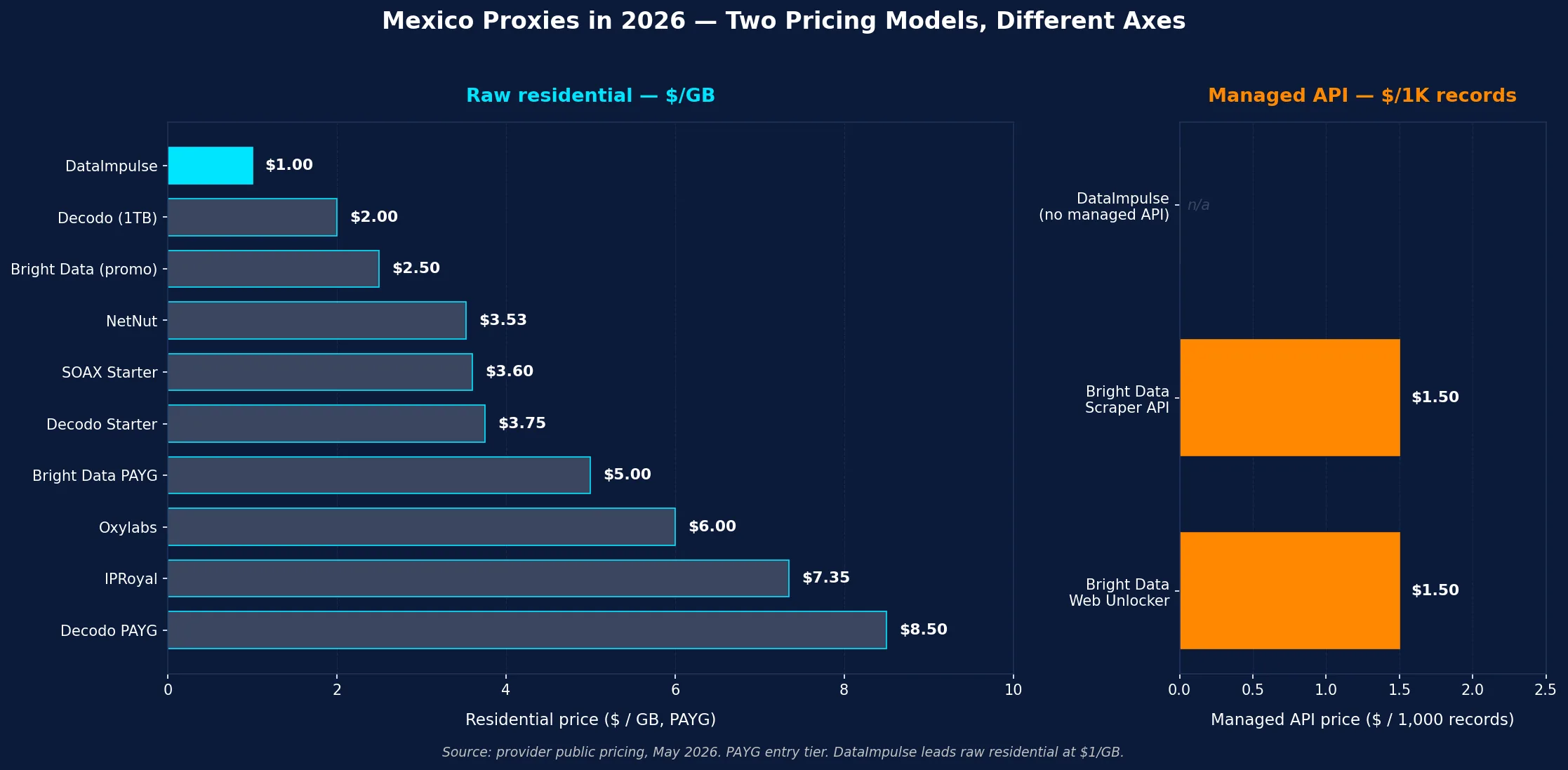
| DataImpulse | Best value, in-house teams | $1/GB PAYG | 90M+ residential, MX coverage | Country free; state/city/ZIP/ASN 2× rate | Traffic never expires; G2 4.8 |
| Bright Data | Enterprise + managed APIs | ~$2.50/GB (50% promo); $5/GB regular | 400M+ residential | Country/city/ZIP/ASN free | Mercado Libre / Amazon MX / Google.com.mx Scraper APIs |
| Oxylabs | SLA-grade enterprise | from $6/GB | 175M+ residential | Country/state/city/ZIP/ASN/coords | Web Scraper API; 99.95% success |
| Decodo | Mid-market, MX ISP | $3.75/GB starter, $8.50/GB PAYG | 115M+ residential | Country/city/ZIP/ASN included | Mexico ISP from $0.27/IP (subject to inventory) |
| IPRoyal | Long sticky sessions | from $7.35/GB | 32M+ residential | Country/region/city/ISP | Sticky up to 7 days |
| SOAX | Mixed proxy types | $3.60/GB Starter | 155M+ res, 33M+ mobile, 2.6M+ ISP | Country/region/city/ISP/ASN | Unified credit; mobile MX (Telcel/AT&T) |
| Webshare | Cheap large volume | from $3.50/mo res; $2.99/mo DC | 80M+ residential (sub) | Country, plan-dependent city | Budget pick for low-defense MX targets |
| NetNut | ISP-residential reliability | from $3.53/GB | ISP-grade residential | Country (city on higher plans) | Telcel/Telmex/AT&T MX ISP depth |
Which Proxy Type Should You Use for Mexico?
Mexican market work behaves differently from generic Latin American scraping — major Mexican marketplaces run tier-1 anti-bot stacks and content varies by state and CP. The proxy type decides your success rate more than the brand does.
Residential Proxies
Residential proxies are the right default for nearly all serious Mexican market work — Amazon.com.mx, Mercado Libre MX, Walmart MX, Liverpool, Coppel, Elektra, Sears MX, Sanborns, Suburbia, Bodega Aurrera product pages and search results; Inmuebles24, Vivanuncios, Lamudi MX, Propiedades.com listings; OCC Mundial, Computrabajo MX, Indeed.com.mx job pages; AeroMéxico, Volaris, Viva Aerobus, Despegar.mx travel flows; news and sentiment scraping on El Universal, Reforma, Milenio, El Financiero. Real Telcel, Telmex, Megacable, Izzi, AT&T MX IPs read as ordinary Mexican consumer browsers to the marketplace bot defense, and a fresh Mexican residential pool routinely clears the layer where datacenter ranges flag in minutes.
ISP / Static Residential Proxies
ISP proxies (static residential) are increasingly the right choice for Mexican workflows that need session continuity — Mercado Libre Vendedor dashboards, signed-in LinkedIn México work, Sales Navigator on Mexican prospects, multi-day rank tracking on Google.com.mx, OCC Mundial recruiter accounts, Amazon Seller Central MX. ISP IPs sit on Mexican ISP-assigned addresses with the stability of static hosting: residential trust with the predictability of a fixed address. Decodo, IPRoyal, Bright Data, and NetNut all offer Mexico ISP product lines.
Mobile Proxies
Mobile proxies route through real Mexican carrier networks (Telcel, AT&T, Movistar — though Movistar is winding down) and earn their place when you’re validating mobile Mexican marketplace experiences, mobile-only promotions on Mercado Libre and Coppel, mobile-app Rappi and Cornershop surfaces, Walmart MX in-app pricing, or hard geo/account cases where residential rotation gets challenged. With Mexico’s mobile-first internet (Telcel alone has 84M+ wireless subscribers per Q2 2025 América Móvil reporting), a Telcel or AT&T MX mobile IP often looks more native than a fixed-line residential IP. They’re the most expensive option per GB, so reserve them for jobs where mobile context genuinely changes the data.
Datacenter Proxies
Datacenter proxies have a narrow but real role in Mexican work: bulk crawling of public Mexican government and corporate sites (datos.gob.mx, SAT RFC lookup, IMSS public data, Banxico publications, BMV filings) with no serious bot protection, sitemap aggregation, public news archive crawling, and lightweight enrichment of CSV exports. Don’t lean on datacenter for Mercado Libre, Amazon.com.mx, Walmart MX, Liverpool, or Rappi — these flag datacenter ranges within a few hundred requests. Reserve datacenter for the low-defense layer of a Mexican stack, and switch to residential or ISP as soon as a target starts challenging you.
Rotating vs Sticky for Mexico
The rule for Mexico: rotate for breadth, stick for depth and account continuity. Rotating residential handles broad Mercado Libre and Amazon.com.mx price-tracking sweeps, Google.com.mx SERP rank tracking, Walmart MX category monitoring, and Liverpool/Coppel catalog scrapes. Sticky sessions handle the deeper flows — Inmuebles24 multi-page listing crawls, Rappi/Cornershop CP-fenced delivery validation, AeroMéxico/Despegar fare sequences, OCC Mundial recruiter sequences, LinkedIn México Sales Navigator searches, Mercado Libre Vendedor dashboards, and any flow where mid-session IP changes would flag as suspicious. Most production Mexico stacks mix both.
Best Proxies for Mexico — Full Reviews
The picks below are ranked on value for Mexican market work — the balance of Mexico IP pool depth, state/city precision, marketplace success rate, sticky-session length, LFPDPPP posture, and price per successful record. DataImpulse leads on value; the rest each win a specific lane.
1. DataImpulse
DataImpulse is the best-value pick for in-house teams running their own Mexican market scrapers — Mercado Libre MX price tracking, Amazon.com.mx competitive monitoring, Walmart MX/Liverpool/Coppel assortment intelligence, OCC Mundial recruiting research, Google.com.mx SERP rank tracking, news and brand sentiment. Residential starts at $1/GB, pay-as-you-go, with traffic that never expires — a fraction of what enterprise Mexico-market scrapers charge. The pool is 90M+ ethically sourced IPs across 195 countries with credible Mexican residential depth (Mexico is consistently among the top-published country pools for DataImpulse). Country targeting is included with state/city/ZIP/ASN as a paid add-on (2× the per-GB rate), which matters for Mexican work where CDMX vs Guadalajara vs Monterrey pricing on Mercado Libre actually differs and Rappi/Cornershop results change by CP. It supports HTTP, HTTPS, and SOCKS5, rotating and sticky sessions, full API access, and standard scraping stacks (Scrapy, Selenium, Playwright). Mobile is available at $2/GB for Telcel/AT&T MX networks; datacenter at $0.50/GB for the enrichment layer (datos.gob.mx, SAT lookups, news archives, public BMV filings).
What makes it the default for serious Mexican collection is the price-to-geo ratio. At $1/GB you can sustain continuous Mexican market work across all major metro clusters without the per-record charges that managed APIs add up to at scale, and the PAYG model means experimenting with new Mexican targets — Coppel, Elektra, Sears MX, Suburbia, Bodega Aurrera — doesn’t lock you into a subscription. Support is 24/7 human; published success rate is 99.51%; G2 is 4.8/5. There’s no dedicated Mexican marketplace endpoint here — DataImpulse sells the proxy infrastructure cleanly and lets your team build the Mercado Libre / Amazon MX / Walmart MX parsers on top.
Quick specs — Types: residential, mobile, datacenter · Pool: 90M+ residential with MX coverage · Rotation: rotating + sticky · Geo: country (state/city/ZIP/ASN as paid add-on at 2× rate) · Price: $1/GB res, $0.50/GB DC, $2/GB mobile · Published success: 99.51% · Rating: G2 4.8.
Best for: in-house Mexican scraping teams that want low pay-as-you-go pricing and state/city-level geo without enterprise commitments.
2. Bright Data
Bright Data is the enterprise pick if you want Mexican market data as a managed product. Beyond raw residential at $5/GB pay-as-you-go (currently discounted to ~$2.50/GB with a 50% promo) with a 400M+ monthly IP pool that includes substantial Mexican coverage and free city/ZIP/ASN targeting, Bright Data ships dedicated Scraper APIs for Mercado Libre, Amazon MX, Google.com.mx SERP, Walmart MX, and other Mexican marketplaces at $1.50 per 1,000 records on PAYG (about $1.30/1K on the $499 plan). The Web Unlocker at $1.50/1K results handles protected Mexican targets generically. ISO 27001, SOC 2 Type II, documented privacy-law compliance (GDPR + LFPDPPP-aligned), and audit-ready documentation clear most Mexican enterprise procurement and most SABG risk reviews. It’s the right call when you’d rather hit a managed Mexican marketplace endpoint than maintain a parser against Mercado Libre’s DOM churn — at enterprise pricing with procurement-style buying.
Quick specs — Types: residential, DC, ISP, mobile + dedicated Mexican marketplace Scraper APIs + Web Unlocker · Pool: 400M+ monthly residential with strong Mexican coverage · Rotation: rotating, sticky, dedicated · Geo: country/city/ZIP/ASN free · Price: ~$2.50/GB res (promo); $5/GB regular; Scraper APIs from $1.50/1K records PAYG (~$1.30/1K on $499 plan); subscription from $499/month · Compliance: ISO 27001, SOC 2 Type II.
Best for: enterprise Mexican market intelligence teams that want managed scraper APIs with audit-ready compliance and SLA controls.
3. Oxylabs
Oxylabs sits next to Bright Data at the enterprise top with deep Mexican market coverage. Residential starts around $6/GB on the entry plan with a 175M+ pool across 195 countries and strong Mexican presence with city, state, ZIP, ASN, and geographical coordinate targeting. The Web Scraper API ($49/month entry) handles JavaScript rendering, anti-bot bypass, and structured data extraction across Mexican targets including Mercado Libre, Amazon.com.mx, and Google.com.mx. Sessions are flexible with unlimited concurrent connections, and Oxylabs publishes a 99.95% residential success rate. Pick Oxylabs when reliability, SLA-grade support, ISO 27001 / SOC 2 compliance, and audit-ready documentation matter more than entry price — particularly for Mexico enterprise programs that need procurement docs for LFPDPPP/SABG risk reviews.
Quick specs — Types: residential, DC, ISP, mobile + Web Scraper API · Pool: 175M+ residential, 195 countries · Rotation: flexible, sticky, unlimited concurrency · Geo: country/state/city/ZIP/coordinates/ASN · Price: from $6/GB residential; Web Scraper API from $49/month · Published success: 99.95% · Compliance: ISO 27001, SOC 2.
Best for: enterprise Mexican market programs that want SLA-grade managed scraping with deep geo targeting and audit-ready compliance.
4. Decodo
Decodo (formerly Smartproxy) is the mid-market sweet spot for Mexican market work. Residential proxies start at $3.75/GB on the 3 GB starter plan with PAYG at $8.50/GB on the public pricing page, dropping to about $2/GB at the 1,000 GB tier. The static residential/ISP starts at $0.27/IP (Mexico availability subject to plan/inventory) — one of the most aggressive Mexico ISP rates on the market for static-residential workflows like Mercado Libre Vendedor, OCC Mundial recruiter accounts, and signed-in LinkedIn México. Country, city, ZIP, and ASN targeting are included with 115M+ IPs across 195+ locations. The Web Scraping API includes templates for Mexican marketplaces, with sticky sessions configurable up to 24 hours — useful for AeroMéxico and Inmuebles24 multi-page flows.
Quick specs — Types: residential, DC, ISP, mobile + Web Scraping API · Pool: 115M+ residential · Rotation: per-request, sticky up to 24h · Geo: country/city/ZIP/ASN included · Price: $3.75/GB starter, $8.50/GB PAYG, $2/GB at 1TB+; static residential/ISP from $0.27/IP (MX subject to inventory) · Published success: 99.86%.
Best for: mid-market Mexican teams that want city-precise residential and cheap Mexico ISP for account-tied work.
5. IPRoyal
IPRoyal earns its spot for Mexican workflows that need long sticky sessions — multi-day rank tracking on Google.com.mx, multi-page Inmuebles24 and Vivanuncios crawls, Mexican LinkedIn account continuity, OCC Mundial recruiter sequences. Residential PAYG runs $7.35/GB at entry (cheaper at volume) with a 32M+ pool across 195+ countries including Mexican coverage, with country, region, city, and ISP targeting. Its real differentiator is sticky sessions up to 7 days, the longest on this list — uniquely useful for AeroMéxico multi-day fare watches, real-estate listing tracking, and OCC Mundial/LinkedIn México workflows where a single session needs to persist across days. There’s also a Mexico ISP product line and Web Unblocker (CAPTCHA + anti-bot bypass) at per-request pricing.
Quick specs — Types: residential, ISP, mobile, DC + Web Unblocker · Pool: 32M+ residential, 195+ countries · Rotation: rotating, sticky up to 7 days · Geo: country/region/city/ISP · Price: from $7.35/GB residential PAYG.
Best for: Mexican workflows that need multi-day sticky sessions (Inmuebles24, AeroMéxico, recruiting on OCC Mundial/LinkedIn México, signed-in dashboards).
6. SOAX
SOAX is the pick when geo-precise Mexican work and mixed proxy types matter together. Residential starts at $3.60/GB on the Starter plan (25 GB included), and the unified credit model means you can spend the same budget on residential, mobile, ISP, datacenter, or the Web Data API. The pool is one of the larger in the mid-tier — 155M+ residential, 33M+ mobile, 2.6M+ ISP — with country, region, city, ISP, and ASN targeting including Mexico coverage. Sticky sessions are supported across all proxy types. Convenient if your Mexican program mixes mobile validation of Mercado Libre and Coppel apps (where Telcel/AT&T context changes pricing and assortment) with residential for desktop Amazon.com.mx tracking and ISP for Mexican Vendedor dashboards.
Quick specs — Types: residential, mobile, ISP, DC + Web Data API · Pool: 155M+ residential, 33M+ mobile, 2.6M+ ISP · Rotation: per request or interval, sticky supported · Geo: country/region/city/ISP/ASN · Price: $3.60/GB Starter.
Best for: Mexican teams running geo-heavy collection across multiple proxy types under one subscription.
7. Webshare
Webshare earns its place for Mexican teams running large-volume low-cost workflows on public Mexican targets — news archive crawling, public Mexican government/corporate sites without serious anti-bot, sitemap aggregation, and public-data enrichment (datos.gob.mx, SAT lookups, public PDFs). Plans start at $2.99/month for the 100-proxy datacenter package and $3.50/month for the entry rotating residential plan with 80M+ residential available on higher tiers, plus static Mexico ISP proxies on subscription plans. Webshare residential is best on lower-defense Mexican targets; for tier-1 anti-bot sites (Mercado Libre, Amazon.com.mx, Walmart MX, Liverpool), step up to the providers above.
Quick specs — Types: residential, static ISP, datacenter · Pool: 80M+ residential (subscription); datacenter and ISP available · Geo: country, plan-dependent city · Price: from $2.99/month datacenter (100 proxies); rotating residential from $3.50/month.
Best for: Mexican teams running cheap large-volume crawling of public Mexican websites without tier-1 anti-bot.
8. NetNut
NetNut closes the list with a focus on ISP-residential reliability for Mexican workflows. The product line emphasizes ISP-grade residential IPs (Telcel/América Móvil, Telmex, AT&T Mexico, Megacable, Izzi, and other Mexican ISP-assigned addresses) with rotating and sticky options. Rotating residential currently starts around $3.53/GB on entry plans, scaling up by volume; country and city-level targeting available on higher tiers. NetNut is the pick when you specifically want Telcel/AT&T MX ISP-residential network depth without paying full Bright Data prices.
Quick specs — Types: ISP-residential, residential, mobile · Pool: ISP-grade residential with Mexican coverage · Rotation: rotating, sticky · Geo: country (city on higher plans) · Price: from $3.53/GB residential.
Best for: Mexican teams that want Telcel/AT&T MX ISP-residential reliability for marketplace and LinkedIn México work without enterprise pricing.
How Much Do Mexico Proxies Cost?
Listed pricing in 2026 falls into three bands. Budget/value at $1–$3.75/GB — DataImpulse, SOAX Starter, Decodo entry, Webshare residential subscription — covers most in-house Mexican market work. Mid/premium at $3.50–$7.35/GB — Bright Data, Oxylabs, IPRoyal, NetNut — adds enterprise tooling and SLA-grade reliability. API-priced and ISP-priced — Bright Data’s Mexican marketplace Scraper APIs $1.50/1K records PAYG (~$1.30/1K on $499 plan), Oxylabs Web Scraper API from $49/mo, Decodo Web Scraping API from $19/mo, Decodo Mexico ISP at $0.27/IP — sell structured Mexican outcomes per record, per plan, or per IP instead of per GB.
The real cost question for Mexico isn’t “what’s the lowest MXN/GB” but “what’s the lowest cost per successful, LFPDPPP-defensible record”. A managed scraper API at $1.30–$1.50/1K records can beat $1/GB residential when your in-house scraper hits Mercado Libre MX or Liverpool blocks on 30–50% of requests; conversely, $1/GB residential paired with sticky sessions and city-level geo routinely beats per-record APIs at scale once your in-house parser is mature and your LFPDPPP documentation is in order. Test both on your actual Mexican targets before committing.
Is Scraping Legal in Mexico?
Mexican scraping law sits at the intersection of the new LFPDPPP (revised 2025), the General Law on Personal Data Held by Obligated Subjects (public sector), the Federal Consumer Protection Law (LFPC, enforced by Profeco), the Federal Penal Code (Article 211 — computer-related offences), the Federal Copyright Law (Ley Federal del Derecho de Autor), and individual marketplace terms. The basics:
- LFPDPPP (new regime, March 21, 2025) governs personal data. The revised Ley Federal de Protección de Datos Personales en Posesión de los Particulares replaces the 2010 version. INAI was dissolved March 2025 and replaced by the SABG (Secretariat of Anti-Corruption and Good Governance). Core principles preserved: lawfulness, consent, information, quality, purpose, loyalty, proportionality, accountability. Key definitions (“data processing,” “personal data,” “data controller”) were altered, creating interpretive risk. SABG’s enforcement posture is still solidifying; January 2026 stakeholder dialogue announced incoming priorities including privacy-by-design, mandatory DPOs, breach notification, and DPIAs — a revision is anticipated in late 2026.
- Public-data scraping is contested in Mexican courts. Mexico has no clear precedent equivalent to hiQ v LinkedIn. The Federal Penal Code Article 211 bis (specifically 211 bis 1 through 211 bis 7) prohibits unauthorized access to “computer systems protected by security measures” — public marketplace catalog pages typically fall outside this scope (no access control bypass), but logged-in or behind-CAPTCHA scraping carries criminal-exposure risk. Federal copyright law (LFDA) protects creative content; scraped product photography and editorial reviews carry copyright exposure.
- Marketplace terms enforceable under Mexican contract law (Código Civil Federal). Amazon.com.mx, Mercado Libre MX, Walmart MX, Liverpool, Coppel, Sears MX, AeroMéxico, Despegar.mx, Inmuebles24, OCC Mundial all have specific terms restricting automated access. Commercial intent + violation of express ToS strengthens a civil claim against scrapers. Profeco (consumer-protection agency) can also pursue commercial scrapers under unfair-competition theories.
- Cross-border data transfers are restricted. LFPDPPP requires that transfers of Mexican personal data outside Mexico maintain equivalent protection (similar to GDPR adequacy + SCCs). Scraping Mexican personal data to non-Mexico servers without legal-basis documentation triggers LFPDPPP exposure.
- 2024 Meta v Bright Data US ruling (logged-in vs public scraping) is being cited by Mexican defendants in scraping cases and is influential in how Mexican courts read the boundary, though not binding.
The honest reading: large-scale commercial Mexican market collection is widespread industry practice, but the SABG enforcement era is just beginning (post-March 2025 regime overhaul) and posture is still hardening. Public price/product data is the lowest-risk lane; personal data and logged-in scraping the highest. Get Mexican counsel familiar with the new LFPDPPP and SABG enforcement posture before scaling a production Mexico pipeline. This isn’t legal advice.
How to Start Mexico Market Scraping with DataImpulse
- Create an account and pick your proxy mix. Residential ($1/GB) for Mercado Libre MX, Amazon.com.mx, Walmart MX, Liverpool, Coppel, Rappi, Inmuebles24, OCC Mundial, Google.com.mx SERP and news; datacenter ($0.50/GB) for enrichment (datos.gob.mx, SAT lookups, BMV filings, news archives); mobile ($2/GB) for Telcel/AT&T mobile-marketplace validation (where Mercado Libre and Coppel often show different pricing).
- Add funds. Pay-as-you-go, no subscription, no expiry — handy because Mexican market collection volume varies with shopping cycles (El Buen Fin — the biggest Mexican retail event in November, Hot Sale in May, Día de las Madres, Día del Niño, Navidad), reporting cycles, and competitive-intel campaigns.
- Target by state and rotate. Set country MX plus state/city for the Mexican markets you’re collecting (state/city/ZIP/ASN are paid add-ons at 2× the per-GB rate but essential for serious Mexican work — pricing on Mercado Libre and Walmart MX varies by metro, Rappi/Cornershop results by CP, Google.com.mx SERP by city), pick rotating for broad Mercado Libre and Amazon.com.mx sweeps and sticky sessions for Inmuebles24, AeroMéxico, and LinkedIn México flows, point your scraper at the proxy endpoint and run.
For more on related workflows, see our residential proxies product page, the Mexico residential proxies landing, the best proxies for Amazon scraping roundup (Amazon.com.mx mechanics carry over), and the best proxies for SEO & rank tracking roundup.
FAQ
Is scraping legal in Mexico?
The new LFPDPPP (Ley Federal de Protección de Datos Personales en Posesión de los Particulares, revised March 21, 2025) governs personal data; INAI ceased to exist on May 9, 2025 when the SABG (Secretariat of Anti-Corruption and Good Governance) formally assumed its functions. Federal Penal Code Article 211 bis prohibits unauthorized access to protected computer systems but typically doesn’t apply to public marketplace pages. Marketplace ToS prohibiting scraping are enforceable under Mexican contract law (Código Civil Federal). Public price and product data is the lowest-risk lane; personal data and logged-in scraping the highest. SABG enforcement posture is still hardening; revision anticipated late 2026. Get LFPDPPP counsel before scaling. This isn’t legal advice.
What are the best proxies for Mercado Libre MX, Amazon.com.mx, and Walmart MX?
Residential proxies with state or city-level Mexican geo are the safest default. Mercado Libre MX runs aggressive behavioural fingerprinting; Amazon.com.mx inherits Amazon’s global anti-bot stack with MX rate-limits; Walmart MX uses Akamai-class defense. Resilient scraping needs either DataImpulse residential at $1/GB paired with a mature in-house parser or Bright Data’s dedicated Mercado Libre / Amazon MX Scraper APIs at $1.50/1K records. Decodo’s Mexico ISP at $0.27/IP (subject to inventory) is among the cheapest entries to static-residential for Vendedor and account-tied work.
How do I scrape Mercado Libre or Rappi from Mexico?
Use residential proxies with country = MX plus city targeting matching your target metro (CDMX, Guadalajara, Monterrey, Puebla, Tijuana, Querétaro, Mérida). Set User-Agent and Accept-Language to typical Mexican Chrome/Android values (es-MX), sticky-session for category browse-to-product flows, and rotate IPs between product pulls. Rappi and Cornershop fence delivery by exact CP (5-digit Mexican postal code), so CP-accurate geo is gating. Honor robots.txt and rate-limits, and treat any personal data with LFPDPPP-grade care.
Do I need CDMX or Guadalajara-specific IPs?
Yes for pricing intelligence, SERP tracking, and quick-commerce work. Mercado Libre MX and Walmart MX prices vary across CDMX, Guadalajara (Jalisco), Monterrey (Nuevo León), and other tier-1 metros. Rappi, Cornershop, and Jüsto literally fence catalog and pricing by exact CP — a CDMX IP shows Mexico City restaurants and CDMX prices, never Guadalajara. Google.com.mx SERP rankings shift by city. DataImpulse, Bright Data, Oxylabs, Decodo, IPRoyal, and SOAX all support city-level targeting on Mexican residential pools (paid add-on or included depending on plan).
Mobile proxies for Mexican targets — when do they matter?
Three cases: (1) mobile-app or mobile-web validation on Mercado Libre, Amazon.com.mx, Walmart MX, Coppel where Telcel/AT&T context surfaces different pricing or app-only promos; (2) Rappi, Cornershop, Jüsto — these are mobile-first and tag Telcel/AT&T mobile IPs as native; (3) protection-bypass on the hardest accounts. SOAX, IPRoyal, DataImpulse, and Bright Data offer Telcel/AT&T-routed mobile proxies. Reserve mobile for jobs where mobile context genuinely changes the data — they cost more per GB.
How does the new SABG / LFPDPPP regime affect scraping plans?
The March 21, 2025 LFPDPPP revision preserves the 2010 core principles but altered key definitions, creating interpretive risk. The new regulator (SABG, Secretariat of Anti-Corruption and Good Governance) is still building its enforcement posture; January 2026 stakeholder dialogue announced incoming priorities (privacy-by-design, DPO requirements, breach notification, DPIAs) with a revision anticipated late 2026. Production pipelines should: maintain documented LFPDPPP legal basis for each scraping use case, keep records of processing activities, document cross-border data transfers (LFPDPPP requires equivalent-protection guarantees), and avoid personal-data scraping without defensible justification. Public marketplace/catalog data carries materially lower risk than personal-data scraping.
Can I use a free Mexico proxy or VPN instead?
For development tests on public Mercado Libre catalog pages, yes. For production Mexican market work, no — free proxies are typically shared, datacenter-class, already burned on the major Mexican marketplaces, and offer no LFPDPPP-defensible audit trail. They also fail on Mercado Libre’s behavioural fingerprinting and on Rappi/Cornershop CP-based fencing. The paid providers above start at $1/GB PAYG with no subscription, which makes free proxies an expensive false economy for any commercial use.
Static residential / ISP proxies for Mexico — who has them?
Decodo (from $0.27/IP, subject to inventory), IPRoyal, NetNut, Bright Data, and Webshare all sell Mexico static-residential / ISP product lines. They’re the right choice for Mercado Libre Vendedor dashboards, signed-in LinkedIn México, Sales Navigator on Mexican prospects, multi-day Google.com.mx rank tracking, OCC Mundial recruiter accounts, and Amazon Seller Central MX. Pick ISP when you need session continuity that residential rotation breaks.
What’s special about Mexican retail seasonality and proxy planning?
Mexico’s biggest e-commerce events are El Buen Fin (mid-November, Mexico’s Black Friday equivalent — 50%+ traffic spikes), Hot Sale (late May — Mexican Internet Association event), Día de las Madres (May 10 — high gift volume), Día del Niño (April 30), and Navidad. Scraping volume spikes 3-5× during these windows; PAYG providers (DataImpulse) absorb spikes without subscription overruns. Plan proxy budget around El Buen Fin and Hot Sale specifically.
Ready to run Mexican market scraping with the city- and state-level geo precision that Mercado Libre, Amazon.com.mx, Walmart MX, Rappi, and Google.com.mx tracking actually need? Start with DataImpulse — residential from $1/GB, datacenter from $0.50/GB, mobile from $2/GB, pay-as-you-go with country targeting included (state/city/ZIP/ASN as paid add-on) and traffic that never expires.

 State/City/Zip/ASN Targeting