

In this Article
Proxy reselling is one of the lowest-overhead ways to start an infrastructure business: you buy proxy bandwidth wholesale from an established network, then sell it to your own customers under your own brand and pricing — without owning a single IP, server, or sourcing relationship. The demand is real and growing (scraping, ad verification, sneaker and social automation, SEO, AI data collection), and the margins are healthy because residential bandwidth carries pricing power.
This guide explains how proxy reselling works, the difference between reseller, white-label, and affiliate models, how to start, and the best proxy reseller programs in 2026 compared on wholesale price, white-label control, API, minimum deposit, and payout terms. Jump to the quick comparison for a thirty-second shortlist.
Key Facts
Proxy reselling turns someone else’s network into your product. Six things to know before you pick a program:
- Three models, different effort. An affiliate refers customers for a commission (no infrastructure, no support); a reseller buys bandwidth wholesale and sells it under their own pricing; a white-label reseller does the same on their own domain and brand, so the upstream provider is invisible.
- Margins are healthy. Distributor markup typically runs 20-40% (and can go higher on residential, which is harder to source and less likely to be blocked); net margins of 30-50% are realistic once you account for support and payment costs.
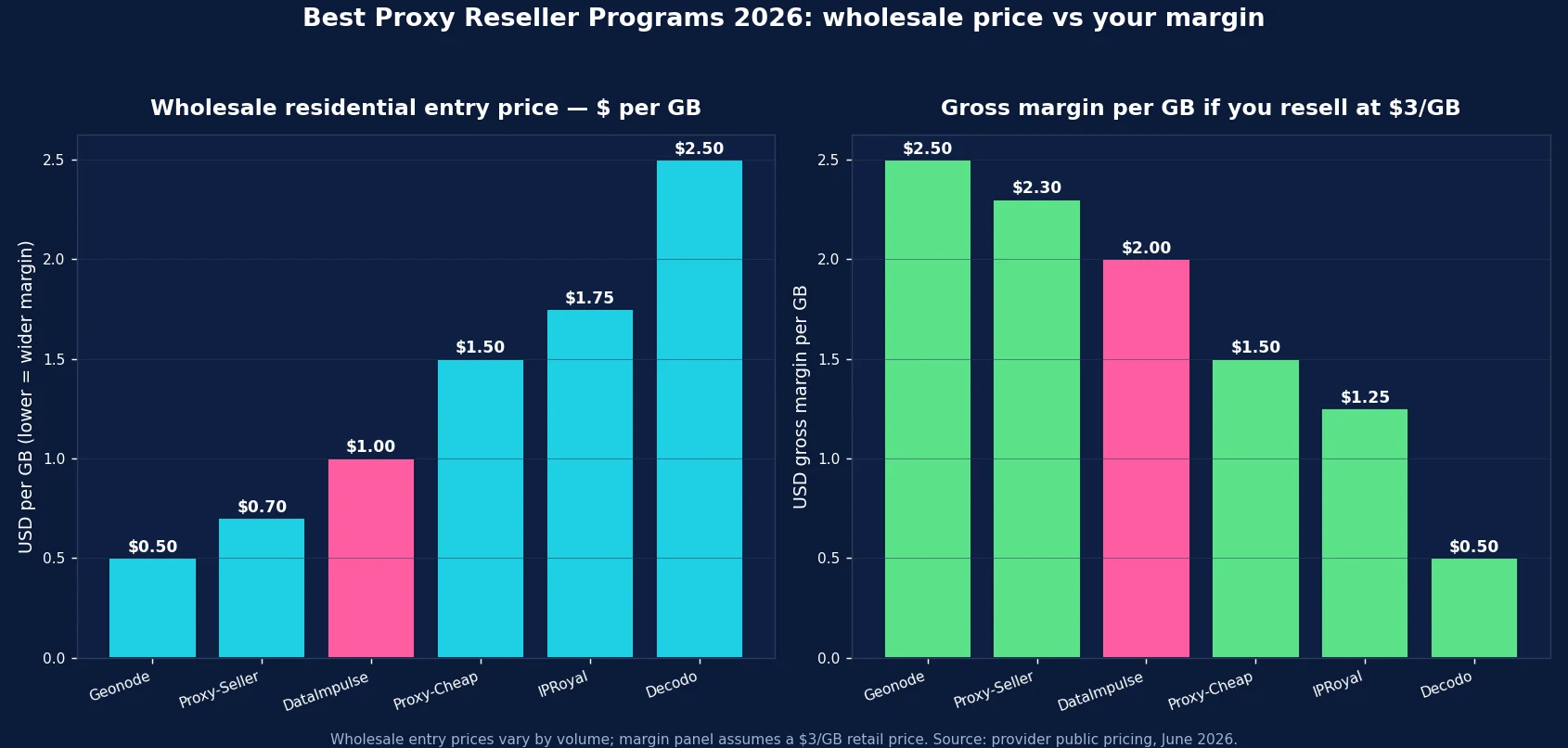
- The wholesale price sets your ceiling. The lower your cost per GB, the more room you have to undercut competitors or keep margin. Entry residential wholesale ranges from about $0.50/GB at high volume to $2-3/GB at small scale.
- Low barrier to start. Most reseller programs need only a small deposit ($5-$50), a KYC form, and a signed reseller agreement — no upfront IP-pool investment.
- DataImpulse is the value pick for resellers: $1/GB residential wholesale, a dedicated reseller API and dashboard, true white-label on your own domain, a low $50 minimum deposit, plus a separate 15% lifetime affiliate program if you’d rather refer than resell.
- Compliance is part of the business. Reselling proxies is legal, but you inherit a know-your-customer duty — pick a provider with ethical sourcing and an acceptable-use policy, and vet your own buyers.
What Is Proxy Reselling?
Proxy reselling is the practice of buying proxy access — usually residential or mobile bandwidth — from a wholesale provider and selling it to end users under your own pricing and, often, your own brand. The provider runs the IP pool, the rotation infrastructure, the sourcing, and the uptime; you handle pricing, packaging, marketing, billing, and first-line support for your customers. It’s the same wholesale-to-retail model as hosting resellers or MVNOs in mobile: one company builds the network, many companies sell access to it.
It works as a business because the proxy market is large and fragmented, end users often want a specific niche (a country, a platform, a price point, a language, a dashboard) that the big providers don’t bother to serve, and the unit economics are forgiving — bandwidth is cheap to buy wholesale and commands a markup at retail. You can build a focused brand (sneaker proxies, a regional reseller, a scraping-API reseller, an agency add-on) on top of someone else’s infrastructure and keep the difference.
Reseller vs White-Label vs Affiliate: Which Model?
Three models sit under “making money from proxies,” and they ask for very different levels of effort and reward.
Affiliate — Refer and Earn
The lightest model. You join an affiliate or referral program, share a link, and earn a commission whenever someone signs up and pays. You own no infrastructure, set no pricing, and handle no support — but you also don’t own the customer relationship, and you earn a percentage rather than a margin. Commissions range from around 15% lifetime (DataImpulse) to 50% revenue share capped per customer (Bright Data). Best for content creators, bloggers, and communities that send traffic but don’t want to run a business.
Reseller — Buy Wholesale, Sell Retail
You deposit funds into a reseller account, buy bandwidth at wholesale, create sub-users or plans, and sell access at your own price. You own the customer, set the margin, and control packaging — and you take on billing and support. This is a real business with real upside: the spread between your wholesale cost and your retail price is yours.
White-Label — Your Brand, Their Network
White-label is reselling with the provider made invisible. You sell on your own domain, with your own logo and dashboard, so customers never see the upstream network. It’s the model to choose if you’re building a standalone proxy brand rather than a side line — DataImpulse, Proxy-Cheap, and CatProxies all support white-label setups, with DataImpulse letting you point your own domain at its infrastructure.
Quick Comparison: Best Proxy Reseller Programs at a Glance
| Program | Best for | Wholesale entry | Min deposit | White-label / API |
|---|---|---|---|---|
| DataImpulse | Best value, true white-label | $1/GB | $50 | Own-domain white-label + reseller API |
| Proxy-Cheap | Lowest entry, tiered discounts | ~$1.5/GB | $5 | White-label; 5-20% volume discount |
| IPRoyal | Non-expiring traffic | ~$1.75/GB | Low | Reseller API; traffic never expires |
| Bright Data | Enterprise partner/referral | Enterprise | n/a | 50% rev share, no time limit (PartnerStack) |
| Decodo | Mid-market + managed API | ~$2.5/GB wholesale | Varies | Partner/reseller, Web Scraping API |
| Geonode | High-volume bandwidth | from $0.50/GB at volume | Volume | Reseller pricing at scale |
| Proxy-Seller | Small teams, mixed types | $0.70-$3.50/GB | Low | Reseller-friendly, many proxy types |
| Infatica | Established reseller program | Volume-based | Varies | Dedicated reseller program + API |
How to Start a Proxy Reseller Business
Starting a proxy reseller business is a weekend project on the infrastructure side and an ongoing effort on the customer side. The steps:
Pick a Wholesale Provider and Model
Choose a network with the proxy types your niche needs (residential is the default; add mobile and datacenter if relevant), a wholesale price that leaves you margin, and a reseller or white-label program. Decide whether you’re white-labeling a standalone brand or adding proxies to an existing product. Wholesale price is the single most important number — at $1/GB you can resell at $2-4/GB and still undercut the enterprise providers.
Open the Reseller Account, KYC, and Deposit
Create a reseller account, complete the know-your-customer form, sign the reseller agreement, and fund the account with the minimum deposit (commonly $5-$50). With DataImpulse the minimum is $50, and the balance doesn’t expire, so it’s a real working budget rather than a sunk fee.
Set Pricing, Packaging, and Brand
Decide your plans (per-GB, monthly, or sub-user seats), set a markup that holds margin while staying competitive, and — for white-label — point your own domain at the provider’s infrastructure and apply your branding. A focused niche (a country, a platform, a price point) sells better than “generic proxies.”
Wire Up the API and Dashboard
Use the reseller API to automate account creation, proxy allocation, and usage tracking so customers can self-serve. DataImpulse provides a dedicated reseller API and dashboard with real-time proxy allocation and analytics, so you can build a tailor-made panel or plug it into your existing billing.
Market to Your Niche and Support
Acquire customers where your niche lives — scraping and automation communities, SEO and agency networks, sneaker and social-media groups — and handle first-line support yourself. Retention is where the margin compounds: a reseller’s value is the relationship and the packaging, not the IPs.
What to Look for in a Proxy Reseller Program
Not every “reseller program” is built for resellers. Weigh these before you deposit:
Wholesale price per GB. Your margin ceiling. Lower is better — but check it’s the real all-in price, not a teaser that jumps after a small allowance. White-label depth. Can you use your own domain and hide the upstream provider, or only rebrand a dashboard? True white-label (own domain) matters if you’re building a brand. Reseller API. Automation for account creation, allocation, and billing is what lets you scale past manual work. Proxy types and geo. Residential is essential; mobile, datacenter, and ISP add addressable niches, and broad country coverage lets you serve regional demand. Minimum deposit and expiry. A low, non-expiring minimum lowers your risk to start. Payouts and balance flexibility. How you withdraw or roll over earnings (crypto, wire, convert to balance). Sourcing and compliance. Ethically sourced IPs and a clear acceptable-use policy protect your brand and your customers.
Best Proxy Reseller Programs 2026 — Full Reviews
Ranked on value for resellers — the balance of wholesale price, white-label control, API, minimum deposit, and program flexibility. DataImpulse leads on value and true white-label; Bright Data is the enterprise partner route; Proxy-Cheap and Geonode compete on entry cost and volume pricing.
1. DataImpulse
DataImpulse is the best-value pick for starting a proxy reselling business. Residential bandwidth is $1/GB wholesale — among the lowest all-in prices on the market — which gives you the widest margin to resell at $2-4/GB and still undercut the enterprise networks. The reseller program lets you sell rotating and sticky residential (plus mobile and datacenter) from 195 countries under your own brand, with a dedicated reseller API and dashboard for account management, real-time proxy allocation, and analytics. Crucially, it supports true white-label: you point your own domain at the infrastructure so the DataImpulse host is never visible to your customers.
Getting started is light: create a reseller account, deposit the $50 minimum (the balance never expires, so it’s a working budget), complete KYC, and sign the reseller agreement. The pool is 90M+ ethically sourced IPs, which matters for the know-your-customer posture you inherit as a reseller. If you’d rather refer than resell, DataImpulse also runs a separate 15% lifetime affiliate program with payouts in BTC, USDT (TRC20), or wire at a $100 threshold — or convert earnings into plan/reseller balance.
Quick specs — Wholesale: $1/GB residential, $0.50/GB DC, $2/GB mobile · White-label: own domain · API: dedicated reseller API + dashboard · Min deposit: $50 (non-expiring) · KYC + reseller agreement · Affiliate: 15% lifetime.
2. Proxy-Cheap
Proxy-Cheap is the lowest-barrier entry for new resellers. You can open a reseller account with a deposit as low as $5, the balance doesn’t expire, and volume deposits unlock tiered reseller discounts — roughly 5% at $500, 10% at $1,000, 15% at $5,000, and 20% at $15,000. It supports white-label so you can sell under your own brand. The trade-off versus DataImpulse is a higher entry per-GB price and a discount structure that rewards scale, so it suits resellers who expect to grow volume and want the cheapest possible way to test the model first.
Quick specs — Min deposit: $5 (non-expiring) · White-label supported · Volume discounts: 5-20% at $500-$15K · Types: residential, mobile, ISP, datacenter.
3. IPRoyal
IPRoyal earns its place for resellers who value non-expiring, pay-as-you-go traffic and a 32M+ residential pool across 195+ countries. Entry residential runs around $1.75/GB on PAYG with prices dropping at volume, and IPRoyal exposes a reseller API for ISP and residential allocation, so you can automate provisioning. Specific minimum-deposit and commission terms for the reseller track aren’t fully public, so confirm them directly — but the non-expiring traffic model is reseller-friendly because unused balance isn’t lost.
Quick specs — Wholesale: from ~$1.75/GB residential PAYG · Pool: 32M+ residential, 195+ countries · API: reseller/ISP API · Traffic: never expires.
4. Bright Data
Bright Data is the enterprise partner route rather than a small-reseller program. Its referral/partner track (via PartnerStack) pays a 50% revenue share per active customer with no time limit — you earn as long as the customer stays active — and there’s no minimum to start earning. For partners selling into large accounts, the combination of a 400M+ IP pool, Web Unlocker, SERP API, and datasets is a strong product to put your name next to. It’s less suited to a bootstrapped white-label proxy shop and more to agencies and consultancies reselling enterprise data infrastructure.
Quick specs — Partner/referral: 50% rev share per active customer, no time limit · Product: 400M+ pool, Web Unlocker, SERP API, datasets · Fit: enterprise partners and agencies.
5. Decodo
Decodo (formerly Smartproxy) offers partner and reseller arrangements aimed at the mid-market, pairing a 115M+ residential pool with a Web Scraping API and full country/city/ASN targeting. Wholesale pricing sits in the mid range (roughly $2.5/GB at reseller volume, lower at larger commitments), so margins are tighter than the budget networks, but the managed API and documentation make it a good fit for resellers whose customers want a more hands-off, higher-touch product. Confirm current reseller terms directly, as they’re handled on a partner basis.
Quick specs — Wholesale: ~$2.5/GB at volume · Pool: 115M+ residential · API: Web Scraping API · Geo: country/city/ASN · Fit: mid-market resellers.
6. Geonode
Geonode competes purely on high-volume wholesale price — from about $0.50/GB at volume (dropping further at the largest tiers), one of the cheapest per-GB rates available. That makes it attractive for resellers who already have demand and want to maximize margin at scale, but the volume commitment means it’s not the place to start small. Use Geonode when your reseller business has grown past the testing phase and bandwidth cost is your main lever.
Quick specs — Wholesale: from $0.50/GB at volume · Fit: high-volume resellers optimizing margin · Note: volume commitment required.
7. Proxy-Seller
Proxy-Seller suits small teams and resellers who want a balance of price and a wide menu of proxy types. Residential runs roughly $0.70-$3.50/GB depending on volume, with low-cost trial traffic, plus datacenter, ISP, and mobile options and individual IP plans. The broad catalog lets a reseller serve mixed demand — IPv4, ISP, and residential — from one supplier, which is useful if your niche needs more than rotating residential.
Quick specs — Wholesale: $0.70-$3.50/GB residential (volume-dependent) · Types: residential, ISP, datacenter, mobile, IPv4 · Fit: small teams wanting a wide catalog.
8. Infatica
Infatica rounds out the list with an established, dedicated proxy reseller program and a residential pool sourced through its SDK network. It offers reseller pricing, an API for provisioning, and residential, mobile, and datacenter types, making it a workable upstream for a reseller who wants a recognized network with documented reseller tooling. As with the other partner-managed programs, confirm current wholesale rates and minimums directly, since they’re set per reseller.
Quick specs — Dedicated reseller program + API · Types: residential, mobile, datacenter · Fit: resellers wanting an established network; terms set per partner.
How Much Can You Make Reselling Proxies?
Reseller economics come down to the spread between your wholesale cost and your retail price, minus support and payment overhead. Distributor markups in this market typically run 20-40%, and residential proxies support the higher end because they’re harder to source and less likely to be blocked — so a healthy net margin lands around 30-50% once you account for costs.
A simple worked example: buy residential at $1/GB wholesale (DataImpulse), resell at $3/GB to your niche, and your gross margin is $2/GB, or about 67% gross. On a customer using 50GB/month that’s $150 of retail for $50 of bandwidth — $100 gross margin per customer per month, before support time and payment fees. Scale that across a few dozen customers and the wholesale price you started with becomes the difference between a thin and a comfortable business. The lesson: your starting wholesale rate (and the reliability behind it, so customers don’t churn) is the lever that matters most. That’s why the $1/GB tier is the reseller’s friend.
Is Proxy Reselling Legal?
Yes — joining a reseller or white-label program and selling proxy access under your own brand is a legitimate, long-established business model, the same wholesale-to-retail structure used in hosting and telecoms. What you take on as a reseller is responsibility: you’re now the front line for how your customers use the bandwidth, which means a know-your-customer duty and an acceptable-use policy of your own.
The practical posture: choose an upstream provider with ethically sourced IPs (consent-based residential, not malware-harvested pools) and a clear acceptable-use policy, pass that policy through to your customers, and vet buyers who plan high-risk use. Reselling proxies for legitimate scraping, ad verification, SEO, market research, and automation is the defensible lane; knowingly enabling fraud, intrusion, or abuse is not, and it will get your reseller account terminated and expose you to liability. This is general information, not legal advice — consult counsel before launching a commercial reseller operation, especially across borders.
How to Start Reselling with DataImpulse
Step 1. Create a DataImpulse account and open the reseller program from the Resellers section of the dashboard. Deposit the $50 minimum — it doesn’t expire, so it’s a working budget.
Step 2. Complete the KYC form and sign the reseller agreement, then set up your branding: point your own domain at the infrastructure for true white-label, and configure your plans and pricing (residential at $1/GB wholesale gives you room to resell at $2-4/GB). See the residential proxies page for the underlying product specs.
Step 3. Wire up the reseller API to automate account creation, proxy allocation, and usage analytics so customers self-serve, then market to your niche. Prefer to refer rather than run a business? Join the affiliate program for 15% lifetime commissions instead.
FAQ
What is a proxy reseller program?
A proxy reseller program lets you buy proxy bandwidth wholesale from an established network and sell it to your own customers under your own pricing — and, with white-label, your own brand and domain. The provider runs the IP pool and infrastructure; you handle pricing, packaging, billing, and support. It’s the wholesale-to-retail model used in hosting and telecoms, applied to proxies.
What’s the difference between a reseller and an affiliate?
An affiliate refers customers via a link and earns a commission (15% lifetime with DataImpulse, up to 50% revenue share per customer with Bright Data) but owns no infrastructure and no customer relationship. A reseller buys bandwidth wholesale, sets their own retail price, owns the customer, and keeps the margin — a real business with more upside and more responsibility. White-label is reselling on your own domain so the upstream provider is invisible.
How much does it cost to start reselling proxies?
Very little. Most programs need only a small deposit and no upfront IP-pool investment: Proxy-Cheap starts at a $5 deposit, DataImpulse at $50 (non-expiring). You’ll also complete a KYC form and sign a reseller agreement. Your main ongoing cost is the wholesale bandwidth you buy to fulfill customer usage, which you mark up at retail.
How much can you make reselling proxies?
It depends on your wholesale cost and your retail price. Markups typically run 20-40%, with residential supporting the higher end; net margins of 30-50% are realistic. Example: buy at $1/GB, resell at $3/GB, and you keep $2/GB gross — about $100/month gross margin on a 50GB customer before support and payment costs. The lower your starting wholesale price, the wider your margin.
What is white-label proxy reselling?
White-label reselling means selling proxies under your own brand and domain while an established provider runs the network behind the scenes — your customers never see the upstream host. It’s the model for building a standalone proxy brand rather than a side line. DataImpulse supports true white-label by letting you point your own domain at its infrastructure; Proxy-Cheap and CatProxies also offer white-label setups.
Which is the best proxy reseller program in 2026?
For value and true white-label, DataImpulse leads — $1/GB residential wholesale, a dedicated reseller API, own-domain branding, and a $50 non-expiring minimum. Proxy-Cheap is the cheapest entry ($5 deposit, tiered volume discounts); Geonode is cheapest at high volume (from $0.50/GB at scale); Bright Data suits enterprise partners (50% revenue share). The best pick depends on your niche, volume, and whether you want a standalone brand or a referral side income.
Is reselling proxies legal?
Yes — reselling proxy access under your own brand is a legitimate wholesale-to-retail business. As a reseller you inherit a know-your-customer duty: choose a provider with ethically sourced IPs and an acceptable-use policy, pass that policy to your customers, and don’t knowingly enable fraud or abuse. Reselling for scraping, ad verification, SEO, and automation is the defensible lane. This isn’t legal advice — consult counsel before launching, especially across borders.
Do I need technical skills to resell proxies?
Not many to start. A reseller dashboard handles account creation and proxy allocation through a UI, and you can run a small reseller business manually at first. To scale, you’ll want to use the reseller API to automate provisioning and usage tracking — DataImpulse provides a dedicated reseller API and dashboard — and to set up your own domain for white-label. Most of the real work is marketing to your niche and supporting customers, not running infrastructure.

 State/City/Zip/ASN Targeting