
In this Article
Alternative data is information from non-traditional sources — web pages, satellites, transactions, app activity — that businesses and investors use to gain an edge before that signal shows up in official reports. The classic example: a hedge fund counting cars in retail parking lots from satellite images to predict quarterly sales. For most companies, though, the largest and most accessible source of alternative data is the public web, collected by scraping — which is why proxies sit at the centre of any serious alternative data operation. This guide explains what alternative data is, the main types, who uses it, and how it’s collected.
I’m Andrii Byzov, an AI-Native Fractional CMO who builds web-data pipelines. Below: a clear definition, the alternative data sources that matter, the collection methods, the legal line, and where DataImpulse fits for web-scraped alternative data at scale.
Key Facts
- Alternative data is any non-traditional dataset used for insight — outside standard financial statements, surveys, and official statistics.
- The public web is the biggest accessible source for most businesses: prices, reviews, job postings, product catalogs, and listings, collected by web scraping.
- Hedge funds and investors pioneered it, but e-commerce, real estate, marketing, and B2B teams now use it just as much.
- Web-scraped alternative data usually runs on proxies — sites geo-personalize and rate-limit, so large-scale collection leans on rotating residential IPs.
- The legal line is mostly the data type — public, non-personal data (prices, listings) is the defensible zone, personal data is regulated, and how you access it matters too.
- Freshness and structure are the hard parts — alternative data is messy, unstandardized, and only valuable if collected reliably and on time.
What Is Alternative Data?
Alternative data is information collected from non-traditional sources and used to inform business or investment decisions — anything outside the conventional inputs like financial statements, analyst reports, and government statistics. The term comes from finance, where “alternative” means alternative to the official filings everyone already has. The value is in the edge: a signal you can read from the world directly, before it’s aggregated into a quarterly report or a market figure. A retailer’s real-time prices across competitors, the volume of job postings a company publishes, the sentiment in product reviews — each is alternative data that hints at performance ahead of the official numbers.
The contrast with traditional data is the whole point: traditional data is typically more standardized, lagging, and widely available; alternative data is often less structured, timelier, and gives an advantage to whoever collects and interprets it first.
Types of Alternative Data
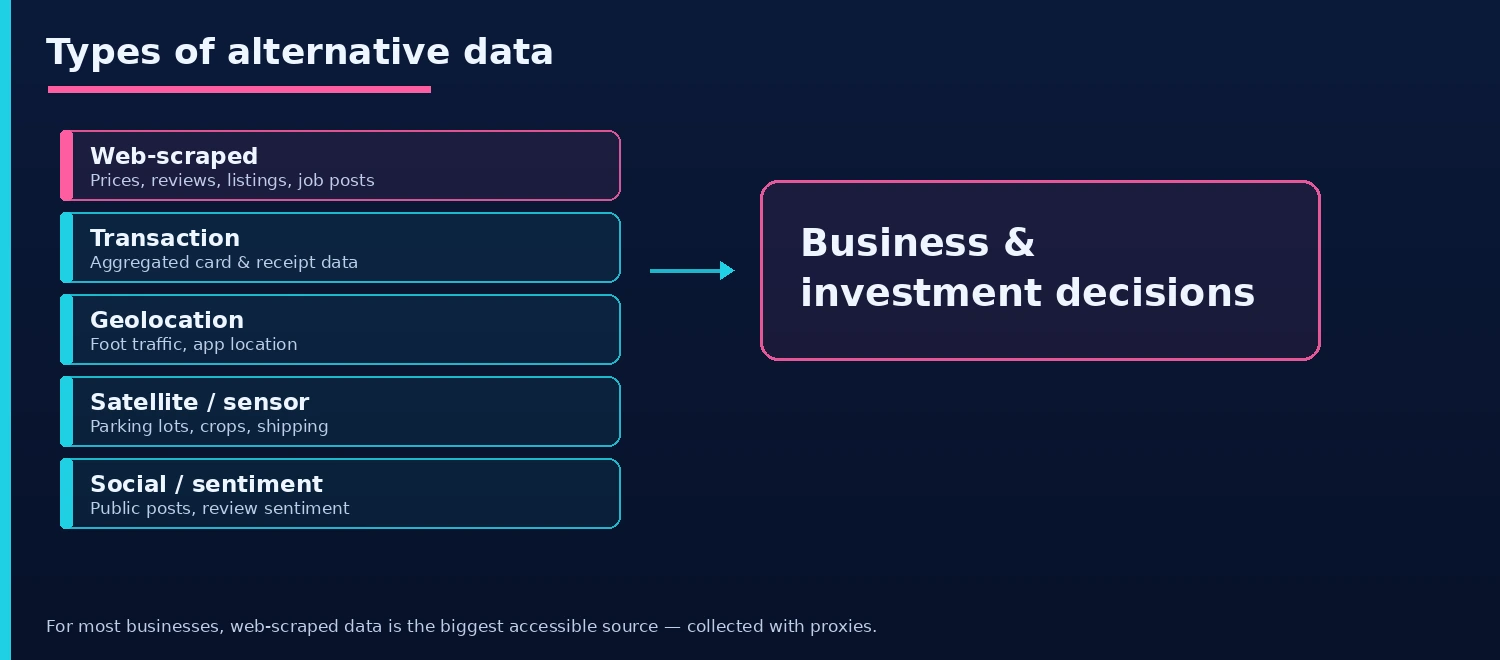
Alternative data sources fall into a few broad categories, from web-scraped data anyone can collect to exotic feeds only large funds buy:
| Type | Examples | How it’s obtained |
|---|---|---|
| Web-scraped data | Prices, product listings, reviews, job postings, real-estate listings, SERPs | Web scraping (the most accessible) |
| Transaction data | Aggregated, de-identified card & receipt data (privacy-regulated) | Data vendors / panels |
| Geolocation & mobility | Foot traffic, app location signals | App SDKs, vendors |
| Satellite & sensor | Parking-lot counts, crop yields, shipping | Imagery providers, IoT |
| Social & sentiment | Public posts, review sentiment, search trends | Web scraping, APIs |
Who Uses Alternative Data?
Investors were first: hedge funds and asset managers buy or build alternative data to forecast a company’s results before earnings — web-scraped pricing, hiring signals, app rankings, and the like. But the use now reaches well beyond finance, with these teams adopting it widely too:
- E-commerce & retail — competitor pricing, assortment, and stock monitoring to set their own prices.
- Real estate — scraped property listings and pricing trends for valuation and investment.
- Marketing & brand — review sentiment, share-of-voice, and ad monitoring.
- B2B & strategy — hiring trends, tech-stack signals, and market mapping from public web data.
The common thread: each team turns public signals into decisions faster than competitors can collect, clean, or interpret the same data.
How Is Alternative Data Collected?
There are three main routes. Buying from data vendors — the route for transaction, geolocation, and satellite feeds you can’t gather yourself. APIs — clean and reliable where a source offers one, but limited in coverage and often rate-capped. And web scraping — the route for the vast amount of valuable data that’s public on websites but has no API: prices, reviews, listings, job posts. For most businesses, web scraping is where alternative data collection actually happens, because the signal lives on web pages.
Scraping that data at scale runs into the same wall every time: sites personalize content by location, rate-limit aggressive requests, and flag datacenter IPs fast. That’s why a web-scraped alternative data pipeline routes through residential proxies — rotating real-user IPs that collect location-accurate data without getting blocked. See our best proxies for web scraping guide for the infrastructure layer.
Is Alternative Data Legal?
Collecting alternative data is broadly defensible, but legality depends on the data type, the source, and how you access it — not just the activity. Public, non-personal data — prices, listings, product specs, aggregated trends — is the defensible zone, and web scraping it is a mainstream, long-running practice. The risks appear when the data is personal (names, profiles, contact details), behind a login, or copyrighted content republished wholesale — areas regulators and contracts govern closely. The practical rule for an alternative data program: collect public, non-personal data, stay logged out, respect robots.txt and rate limits, and keep personal data out of the pipeline. For the full picture, see our guide on whether web scraping is legal. This is general information, not legal advice.
Common Challenges
- Messy and unstructured — alternative data rarely arrives clean; it needs parsing, deduplication, and normalization before it’s usable.
- Freshness — the edge decays fast, so collection has to run on a reliable schedule, not ad hoc.
- Coverage and blocking — gathering enough breadth without getting rate-limited is the core technical problem proxies solve.
- Validation — a signal is only worth acting on once you’ve confirmed it correlates with the outcome you care about.
How DataImpulse Powers Alternative Data Collection
Most alternative data worth having is on the public web, and the bottleneck to collecting it is clean, geo-accurate IPs at scale. DataImpulse provides that layer: residential proxies at $1/GB across 90M+ IPs in 195 countries, with rotation that keeps your collection from being flagged and geo-targeting (down to US state level) so prices and listings reflect the right market. It’s pay-as-you-go with traffic that never expires, datacenter proxies at $0.50/GB for simpler targets, and 24/7 human support. Whether the signal is competitor pricing, job postings, or review sentiment, the collection runs on the same infrastructure. Related: proxies for financial data and proxies for AI training data, plus the web scraping use case.
FAQ
What is alternative data, in simple terms?
Alternative data is information from non-traditional sources — web pages, satellites, transactions, app activity — used to inform business or investment decisions before that signal appears in official reports. For most companies it means public web data (prices, reviews, listings, job postings) collected by scraping.
What are the main types of alternative data?
Web-scraped data (prices, listings, reviews, job posts), transaction data (aggregated card/receipt data), geolocation and mobility, satellite and sensor data, and social/sentiment data. Web-scraped data is the most accessible for most businesses; the others usually come from specialist vendors.
Who uses alternative data?
Hedge funds and investors pioneered it to forecast company performance, but e-commerce (competitor pricing), real estate (listings/valuation), marketing (sentiment, ad monitoring), and B2B strategy teams now use it widely — anywhere a public signal can inform a decision early.
How is alternative data collected?
Three ways: buying from data vendors (transaction, geolocation, satellite feeds), APIs where available, and web scraping for the large amount of valuable public data that has no API. Web scraping is where most alternative data collection happens, and at scale it runs through residential proxies to avoid blocks and get location-accurate data.
Is collecting alternative data legal?
Collecting public, non-personal data is broadly legal and standard practice. Risk comes from personal data, login-gated content, or republishing copyrighted material. Stay logged out, collect public non-personal data, respect robots.txt and rate limits, and keep personal data out of the pipeline. This is general information, not legal advice.
Conclusion
Alternative data is how businesses and investors read the world directly instead of waiting for official numbers — and for most of them, that data lives on the public web. The definition is simple (non-traditional sources, used for an edge), the types range from web-scraped to satellite, and the collection bottleneck is almost always the same: gathering public web data at scale without getting blocked. Get the proxy layer right and the rest of the alternative data pipeline — parsing, validation, decisions — has clean inputs to work with.
Last updated: June 25, 2026.
 State/City/Zip/ASN Targeting