
In this Article
Backconnect proxies are a type of proxy server that acts like a proxy gateway and rotates IPs from an available pool. You do not have to manage thousands of IPs yourself – you deal with one endpoint, and a server does the rest. This is a main reason to use such proxies for web scraping, ad verification, price tracking, and other tasks where constant rotation and traffic distribution are necessary. DataImpulse (dataimpulse.com), an ethical proxy vendor with 4+ years of topic experience, manages a 90M+ proxy pool and prepared an in-depth guide on the matter.
Key Facts:
- A backconnect server is a proxy server that acts like a gateway and rotates IPs on the backend.
- IP rotation is a change of IPs. Not one, but thousands of IPs handle requests.
- Paired with automatic rotation, such proxies help with scaling up without reaching IP rate limits.
- There are different types of IPs used to create address pools – residential, mobile, and datacenter.
What Is a Backconnect Proxy
Backconnect proxies are more like a system, where you connect to a single proxy gateway. That gateway then automatically rotates requests through an IP pool. This is a key difference from usual proxy setups, where you receive a list of individual proxies and have to set everything on your own. You are also safe from stumbling upon IP rate limits. That is why such systems are handy for web scraping and data collection.
Other characteristics also include:
- Anonymity – frequent changes of IPs > hard to track a particular user’s activity.
- Large IP pool – helps create a “genuine-user” look.
- Protocol support – support of HTTP(S)/SOCKS traffic > high compatibility.
- Costs – more expensive than static, so you usually pay per GBs used.
How Backconnect Proxies Work
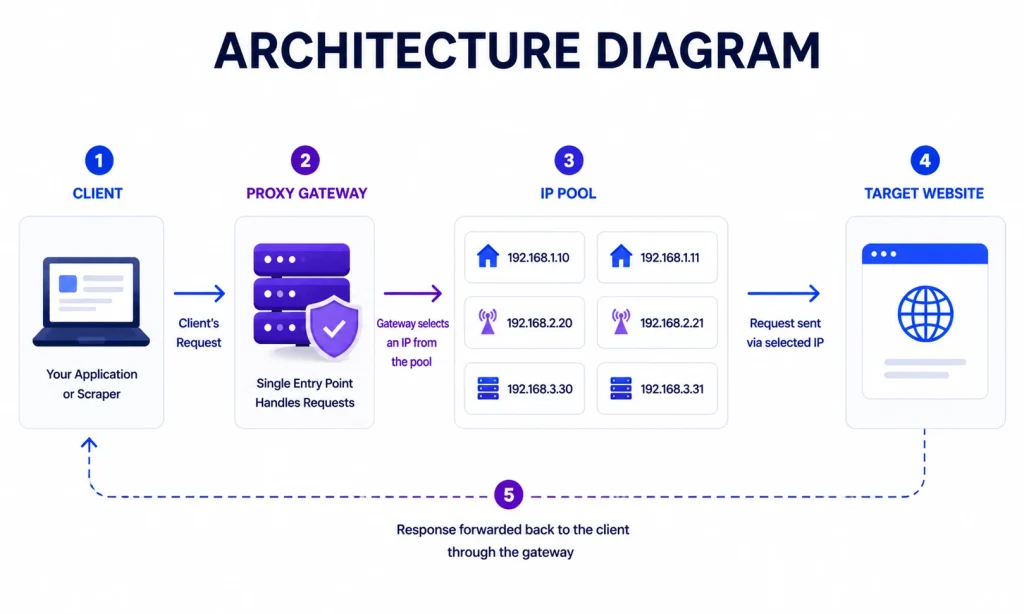
You use a server or port to connect to a proxy network. The backend server automatically routes requests. This automatic IP change is the heart and root of that proxy type. It is possible to set different parameters, like geo-targeting.
Step-by-Step Request Flow
The process is simple:
- Your scraper sends a request to a gateway proxy.
- The latter receives the request.
- The server chooses an IP from a pool according to predefined rules and forwards the request to the target website.
- The target website sees the selected IP address and returns a response via that. Gateway forwards the response back to you.
- Depending on settings, a server handles the next request using the same or a new IP.
How Proxy Gateways Manage IP Rotation
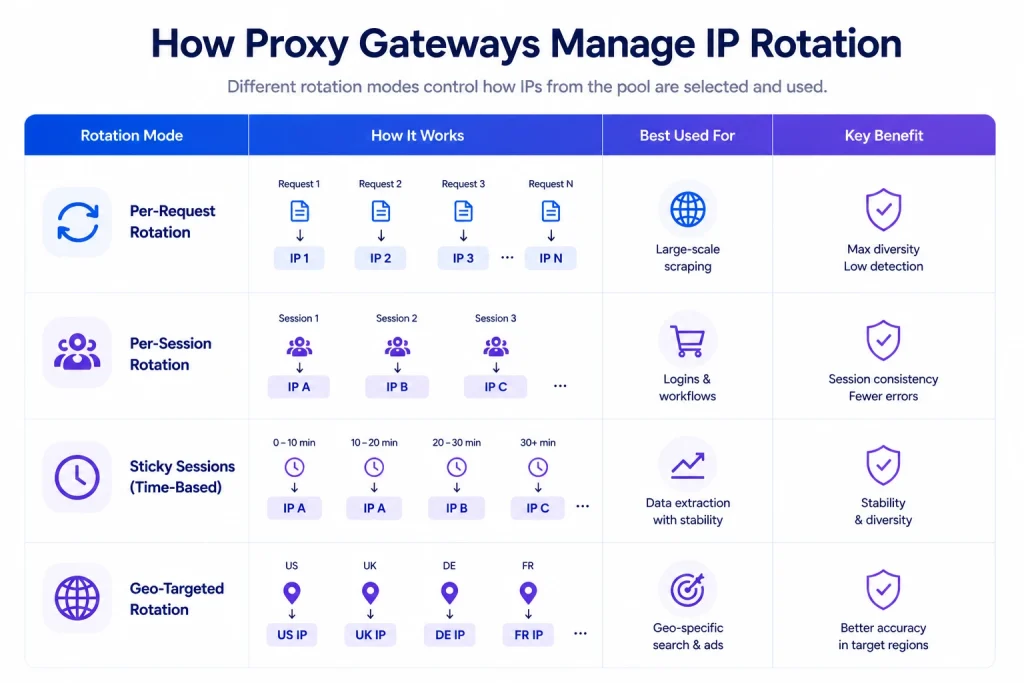
Internal logic and user-defined rules are responsible for how a gateway manages rotation.
Internal logic factors include:
- Availability – a server chooses from the IPs currently online.
- Load – server looks for IPs that are not overloaded.
- Health – IPs with a low success rate are often ignored.
- Site-specific network performance – sometimes, some IPs may work better/worse with particular sources. A system matches compatible sources and IPs.
There are several rotation modes.
- Per-request rotation – each request relies on another IP for maximum distribution and prevention of bot detection; good for large-scale web scraping.
- Per-session rotation – a session relies on the same IP.
- Sticky sessions – a system assigns an IP for X minutes, then rotates it.
- Random rotation – usually is failure-triggered, if the current IP does not respond.
- Geo-targeted selection – applies if you set targeting filters.
Backconnect Proxy vs. Rotating Proxy
A backconnect server is not a stand-alone server, but a whole architecture where a gateway proxy manages an IP pool and routing. A rotating proxy is a feature of IP rotation. As both assign a new IP according to the pre-adjusted rules, a lot of users think they are the same, when they are not.
Key Differences
| Criteria | Backconnect proxies | Rotating proxies |
| Access | Single endpoint | A list of individual IPs |
| IP management | Automatic | Manual or automatic |
| Control over IPs | Low level of control | Higher level of control |
| Complexity | More complex infrastructure, which is hidden from users, but easier to utilize | Depends on the setup |
When Each Option Is Better
Backconnect proxies are irreplaceable for large-scale scraping, distributing requests, and anti-bot protection. Rotating proxies are a match for general, low-scale scraping and smaller tasks.
Types of Backconnect Proxies
You can choose from residential, mobile, or datacenter IPs. Their trust level, speed, and price are different. Residential backconnect proxy comes with a high trust level, acceptable speed, and an optimal price. Mobile proxies are usually more trusted and faster, yet more expensive. Datacenter proxies are the fastest and the cheapest, but with a low trust level.
Residential Proxy IPs
Backconnect residential proxies are addresses of real household devices. They rarely trigger anti-bot systems or stumble upon rate limits. Residential proxies are used for web scraping and ad verification.
Datacenter Proxy IPs
Datacenter proxies are addresses of datacenter servers – speedy and cheap, but detection-prone. Suitable for tasks where speed is the primary concern.
Mobile Proxy IPs
Mobile proxies are IPs assigned by cellular operators. They offer the highest trust rate, but are expensive and less available. They are often used for mobile traffic testing.
Common Use Cases
That type of proxy is used for a wide variety of tasks, for example, web scraping, SERP tracking, price monitoring, and more. They are the best choice for situations when you need to preserve anonymity and appear to websites as an ordinary user.
Web Scraping
Such proxies help scrape the Web for different purposes – price collecting, market monitoring, SERP results, and harvest for other publicly available data. They distribute requests across IPs, preventing the revelation of your scraping operations.
SERP Monitoring and Market Research
Anonymity to prevent biased data and request distribution to avoid rate limits – those are two components of effective rank tracking, competitor analysis, and market monitoring. Proxies are a way to feed two birds with one scone.
Ad Verification and Geo-Targeted Testing
Proxies are necessary for verifying how ads and content appear at different locations.
Benefits of Backconnect Proxies
They include automatic IP rotation, opportunity to scale up requests, anonymity, and traffic distribution, making all the aforementioned tasks possible.
IP Rotation and Reduced Blocking
Automatic IP rotation rids you of the necessity to rotate IPs manually or implement additional tools. Distributing traffic across IPs prevents IP-related traffic inconsistencies, allows to stick to IP rate limits without slowing down your scraping operations, and collect data without interruptions.
Scalability for Data Collection
Distributed traffic means that you can use thousands of IPs simultaneously and send requests. This helps get more data within the same amount of time.
Challenges and Limitations
There are still some weaknesses, like latency and limited control over IPs.
Performance and Latency
By routing traffic via a proxy server, you add another network hop. Increased latency will not make you wait. However, this is a weak point for the majority of proxies. To avoid this, try to connect to a server closer to the target one.
Limited Control Over Individual IPs
Automatic rotation means that whichever address meets all the criteria may be assigned for a request, and you do not have much control over the matter. It also means that sticking to consistent sessions is hard. If you need to maintain the same session, static IPs may be a better option.
How to Choose a Backconnect Proxy Provider
While choosing a provider, pay attention to the quality of the IP pool, rotation options, and connection stability. Technical support is also a must, not an option. Those factors define whether you will be able to scale up without blocks or not.
IPs from different backconnect proxy providers have different quality, pool freshness, connection stability, and reputation. It is even more important than it seems, as latency spikes or aggressive rotation may lead to failed requests. Flexibility matters too – additional features like geo-targeting or numerous protocols support.
On the other hand, there is no universal “best” – the choice always depends on a particular use case.
Proxy Pool Size and Reliability
A big IP pool means that addresses are not overloaded or overused. So, no IP bans or high latency. A stable connection prevents you from wasting time and money and ensures you get the data.
Rotation and Geo-Targeting Options
Control over rotation frequency and the opportunity to choose a particular city mean precise results without blocks.
Best Practices for Using Backconnect Proxies
- Choose the right rotation mode
- No to overrotating
- Match the IP location to the target website’s
- Monitor success rate, error rate, and latency
- Do not set high concurrency
Optimizing IP Rotation Strategies
Match rotation to your use case. Per-request rotation is good for large-scale tasks. Sticky sessions are a go-to option for tasks with login steps.
Monitoring Proxy Performance
Monitoring success and error rates, and latency can provide a full picture of what is going on and give a hint on where to look for a problem if something is wrong.
Frequently Asked Questions
How do Backconnect Proxies Rotate IP Addresses?
Backconnect rotating proxy automatically selects IPs from an IP pool. They pay attention to proxy availability and success rate, while also sticking to user-defined parameters, like targeting options.
Are Backconnect Proxies Good for Web Scraping?
Yes, they are. They allow to distribute traffic across numerous IPs to prevent rate limits. DataImpulse offers 90M+ IPs for smooth scraping at scale.
What Is the Difference Between Residential and Datacenter Backconnect Proxies?
The main difference lies in the source of IP. Backconnect residential proxy uses real devices’ addresses, while datacenter IPs belong to servers. Residential IPs have a high trust level and higher-than-average speed, while datacenter proxies are cheaper, faster, and less trustworthy. DataImpulse offers both types for different use cases.
How Often Should IPs Rotate?
Rotation frequency depends on a use case - per-request, per-session, or custom rotation. At DataImpulse, you can set different rotation intervals to match your needs.
How Is a Backconnect Proxy Different from a Regular Proxy?
A classic proxy is a single IP. A backconnect server is an architecture that provides you with an IP gateway to connect to. Backend servers handle rotation.
Can Backconnect Proxies Be Detected by Websites?
Yes, they can. However, in practice, IP quality, rotation intervals, request patterns, and custom settings are guilty for detection. You can control and adjust all of those factors.
Conclusion
A backconnect server is an architecture. It uses an IP gateway and a pool of IPs to automatically distribute HTTP requests. Such proxies are effective for web scraping, ad verification, SERP tracking, and more. There are several types of backconnect proxies, but none is a “cure-all”. Your choice depends on your use case and how much you need stability and control over traffic.
 State/City/Zip/ASN Targeting