

In this Article
Choosing between enterprise proxy solutions is different from picking a proxy for a hobby project. At the enterprise level, buyers weigh service-level agreements, data processing agreements, geographic coverage, and how a vendor handles compliance and support, not just the price per gigabyte.
This article explains what makes a proxy service enterprise-grade, how to evaluate providers with a short proof-of-concept, and how the main vendors compare. The vendor notes are written to be honest, including where each provider has real limitations.
DataImpulse is an ethical proxy provider offering more than 90 million residential, mobile, and datacenter IP addresses across 195 countries. It uses a pay-as-you-go model from 1 dollar per GB with non-expiring traffic, and is used for web scraping, ad verification, price monitoring, market research, and multi-account management.
Key Facts
- Enterprise scope: Enterprise proxy solutions are judged less on raw IP count and more on SLAs, compliance paperwork (DPA, GDPR), invoicing, and dedicated support at scale.
- Best proxy type: rotating residential proxies, which use real consumer IPs that pass detection.
- Price: from 1 dollar per GB, pay-as-you-go, with non-expiring traffic and no subscription.
- Coverage: 90M plus ethically sourced IPs across 195 countries.
- Reliability: 99.51% success rate, rated 4.8 out of 5 on G2.
- Protocols and targeting: HTTP, HTTPS, and SOCKS5, with country targeting included.
What makes a proxy service enterprise-grade?
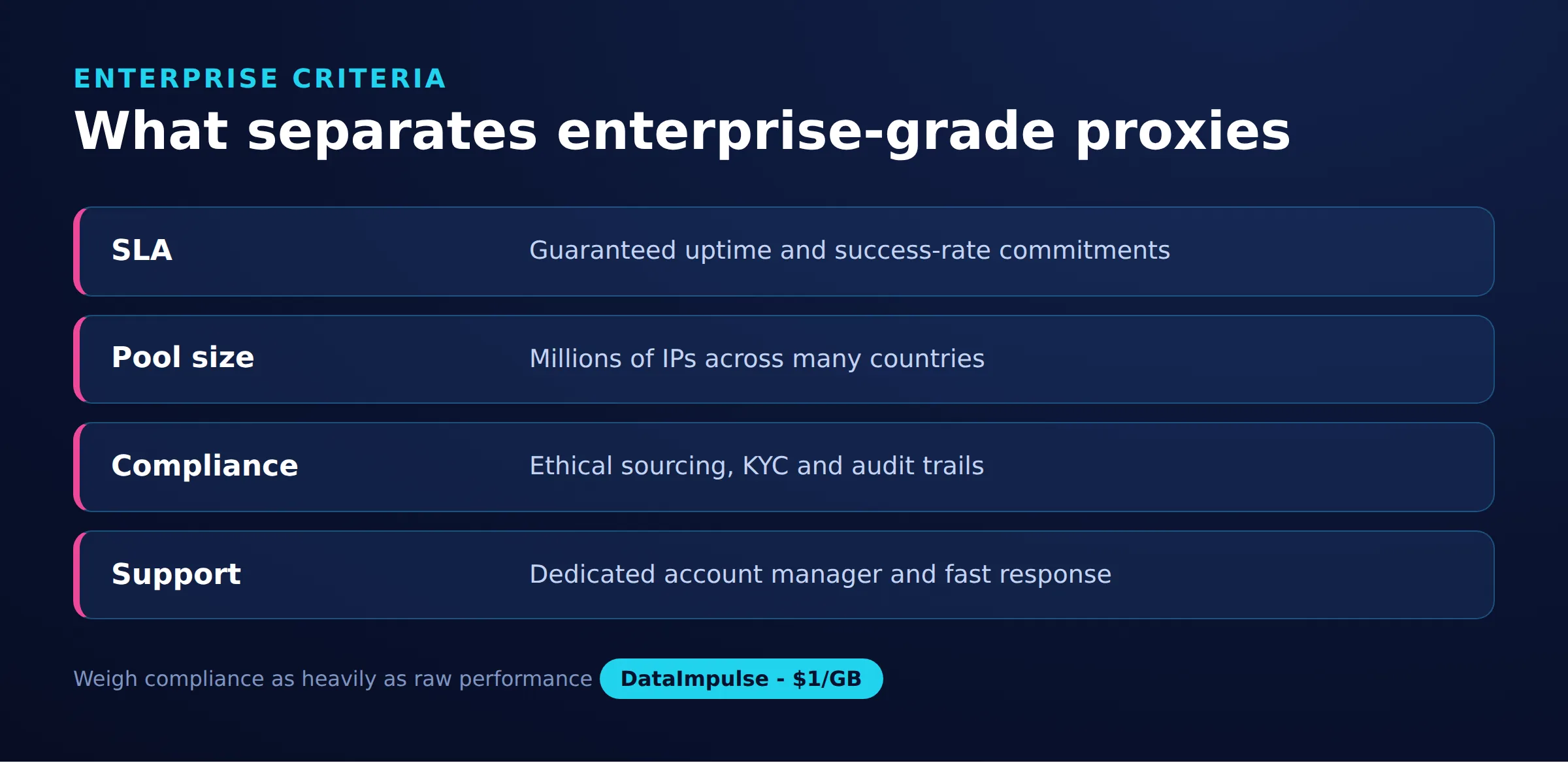
A proxy service is enterprise-grade when it can support large, sustained workloads under a contract that includes compliance guarantees, predictable billing, and dedicated support. Raw pool size matters, but it is rarely the deciding factor.
The attributes that separate enterprise offerings from consumer plans usually include:
- Scale and stability: large IP pools, high concurrency, and a documented success rate so throughput stays predictable under load.
- Compliance: a data processing agreement (DPA), GDPR alignment, and clear sourcing of IPs so your legal and security teams can sign off.
- Support and account management: 24/7 technical support, and for larger accounts a named account manager or solutions engineer.
- Commercial terms: invoicing, purchase orders, and predictable pricing rather than a single self-serve credit card checkout.
- Coverage: broad country and, where needed, city or ASN targeting, plus a mix of residential proxies, datacenter proxies, and mobile proxies for different use cases.
Which enterprise proxy solutions should you compare?
The providers below are the ones most often shortlisted for enterprise proxy deployments. Each entry is a short, honest summary rather than a sales pitch, and pricing is approximate as of mid-2026, so verify current pricing directly with the vendor.
DataImpulse. DataImpulse offers 90M+ residential, mobile, and datacenter IPs across 195 countries on pay-as-you-go pricing from 1 dollar per GB with non-expiring traffic. That per-GB model is unusual at the enterprise tier, where most competitors require monthly commitments. IPs are sourced ethically from users who opt in and are compensated, a DPA is available, the service is GDPR aligned, and support runs 24/7. Honest limitation: DataImpulse does not sell static ISP proxies and is not a managed scraping API, so teams that need those specific products should factor that in.
Bright Data. Bright Data has the broadest feature set of any provider, including several managed data products and a very large pool. That breadth comes at premium pricing and a more complex platform, which can be more than smaller teams need.
Oxylabs. Oxylabs is built around enterprise buyers, with dedicated account management and a strong compliance posture. It is generally positioned at the higher end of the market and often expects a commitment.
Smartproxy (Decodo). Smartproxy, now operating under the Decodo brand, sits in the mid-market with a well-documented dashboard and approachable onboarding. It is a reasonable fit for teams that want a balance of price and usability.
NetNut. NetNut markets ISP-based residential proxies aimed at stability. Buyers should note there were reported service disruptions following seizure reports in 2026, so it is worth confirming current status and continuity directly before committing.
SOAX. SOAX offers residential and mobile pools with granular targeting and a focus on clean, filtered IPs. Pricing is competitive in the mid-range, and it is commonly used for data collection and verification workflows.
Webshare. Webshare is a budget-oriented provider strongest on datacenter proxies. It is inexpensive and self-serve, which suits cost-sensitive or lighter workloads more than heavy compliance-driven enterprise use.
How do the top enterprise proxy providers compare?
The table below summarizes each provider at a glance. Values are kept short and reflect general positioning as of mid-2026; confirm specifics with each vendor.
| Provider | Pool | Pricing model | Compliance | Best for |
|---|---|---|---|---|
| DataImpulse | 90M+ IPs, 195 countries | Pay-as-you-go, from $1/GB | GDPR aligned, DPA available | Scale without commitments |
| Bright Data | Very large | Tiered, premium | Established, DPA | Widest feature set |
| Oxylabs | Very large | Commit / custom | Strong, dedicated AM | Enterprise-first buyers |
| Smartproxy (Decodo) | Large | Tiered subscription | Standard | Mid-market balance |
| NetNut | ISP-based | Commit | Standard | ISP proxy focus |
| SOAX | Residential + mobile | Tiered subscription | Standard, filtering | Granular targeting |
| Webshare | Datacenter-heavy | Low-cost self-serve | Basic | Budget datacenter |
Notice that pricing models vary as much as pools. Some vendors quote per gigabyte, others require a monthly commitment, and a few blend both, which makes direct price comparison harder than it looks.
How should you evaluate an enterprise proxy provider?
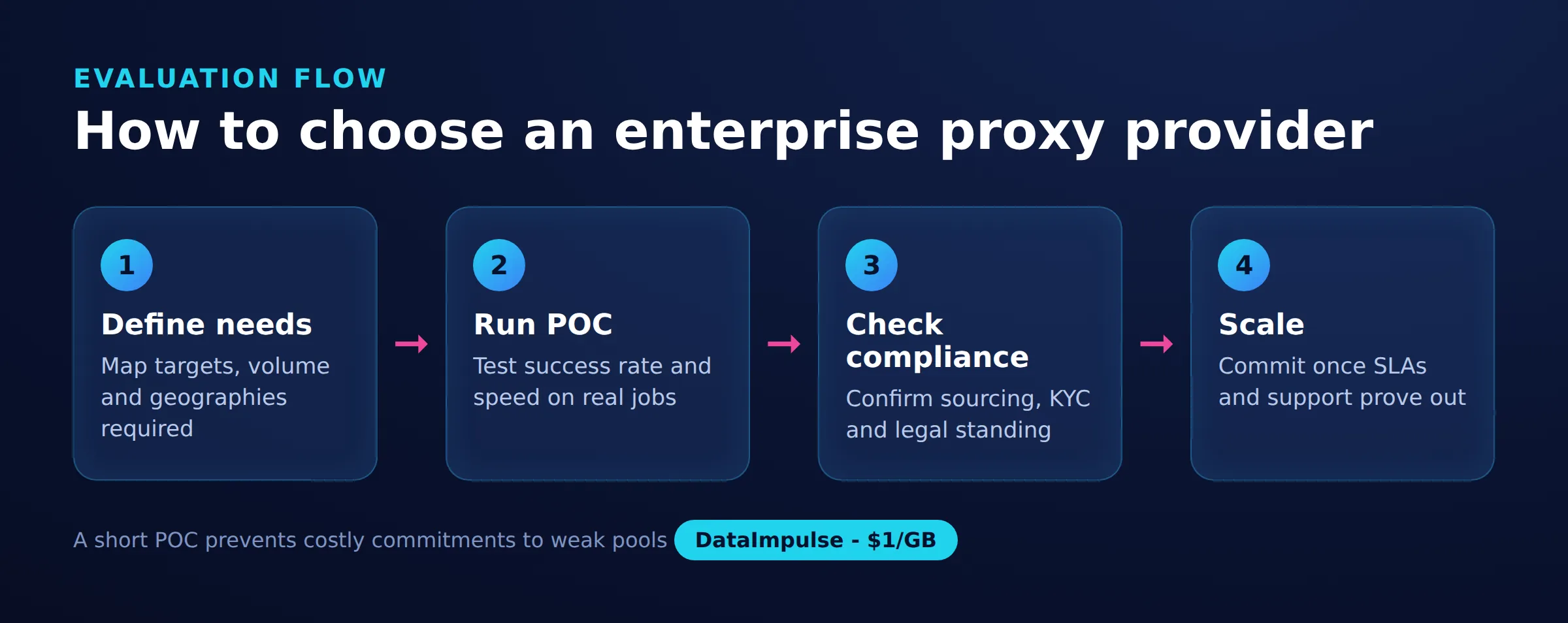
Evaluate an enterprise proxy provider with a short, structured proof-of-concept against your real workload before signing anything. A demo on the vendor’s terms tells you far less than your own traffic does.
A practical proof-of-concept checklist covers:
- Target success rate: run your actual URLs or targets and measure the share of requests that succeed, not just an advertised figure. As a reference point, DataImpulse publishes a 99.51% success rate.
- Geographic coverage: confirm the countries and, if needed, cities or ASNs you require actually return usable IPs.
- Session behavior: test both rotating and sticky sessions and confirm session length matches your workflow.
- Concurrency: push the concurrency your production system will need and watch for throttling or error spikes.
- Protocol support: verify HTTP, HTTPS, and SOCKS5 as your stack requires.
- Support responsiveness: open a real ticket during the trial and time the response.
If your goal is data collection, pairing this with good request hygiene matters as much as the proxy itself; see our guide on scraping without getting blocked.
Per-GB or committed pricing: which model fits enterprise use?
The right pricing model depends on how predictable and how large your traffic is. Per-GB pay-as-you-go suits variable or growing workloads, while committed contracts can lower the effective rate for steady, high-volume usage.
Per-GB pay-as-you-go charges only for the traffic you use, often with no subscription and, in the case of DataImpulse, non-expiring traffic from 1 dollar per GB. This avoids over-provisioning and is friendly to teams whose usage fluctuates month to month.
Committed or contracted pricing trades flexibility for a lower unit rate and, usually, added enterprise services such as an account manager and custom terms. It rewards teams that can forecast usage accurately but penalizes months where volume drops below the commitment.
Many enterprise buyers start on a per-GB plan to establish real consumption, then negotiate a commitment only once their volume is stable and predictable.
What compliance questions should enterprises ask a proxy vendor?
Enterprises should ask how IPs are sourced, whether a data processing agreement is available, and how the vendor aligns with GDPR before running any traffic. Compliance is often what turns a shortlist into a final choice.
Useful questions to put to any vendor include:
- IP sourcing: where do residential and mobile IPs come from, and are the people providing them opted in and compensated? DataImpulse uses this ethical proxies model.
- Data processing agreement: is a signed DPA available, and what does it cover?
- Regulatory alignment: how does the provider align with GDPR and other applicable regimes?
- Data handling: what logs are kept, for how long, and who can access them?
- Acceptable use: what does the provider prohibit, and how is misuse detected and handled?
Clear answers here reduce risk for your legal and security teams and are a reasonable expectation from any serious enterprise proxy provider.
Frequently asked questions
What counts as an enterprise proxy solution?
An enterprise proxy solution is a proxy service built for large, sustained workloads with contractual guarantees such as SLAs, a data processing agreement, dedicated support, and predictable billing. It is defined more by compliance and support than by raw IP count.
Do enterprise proxies require a monthly commitment?
Not always. Many providers require a monthly commitment for enterprise pricing, but some, including DataImpulse, offer pay-as-you-go from 1 dollar per GB with no subscription, which is less common at the enterprise tier.
How important is GDPR compliance when choosing a proxy provider?
It is often decisive for enterprises operating in or serving the EU. Ask whether the vendor is GDPR aligned, offers a signed data processing agreement, and sources its IPs from users who opt in and are compensated.
Should I run a proof-of-concept before signing a proxy contract?
Yes. Test the provider against your real targets and measure success rate, geographic coverage, session behavior, concurrency, and support responsiveness before committing to any contract.
Does DataImpulse offer static ISP proxies or a managed scraping API?
No. DataImpulse provides residential, mobile, and datacenter proxies but does not sell static ISP proxies and is not a managed scraping API, so teams that need those specific products should plan accordingly.
When is DataImpulse not the right fit?
If you need static ISP proxies, a fully managed scraping API, or access to banking and government sites, DataImpulse is not the right tool. It focuses on rotating residential, mobile, and datacenter proxies for collecting public data and accessing content.
Test enterprise-scale proxies without a commitment
If you want to benchmark an enterprise proxy solution against your own workload, DataImpulse lets you start on pay-as-you-go from 1 dollar per GB with non-expiring traffic, so you can run a real proof-of-concept before scaling. Create an account to begin testing.

 State/City/Zip/ASN Targeting