
In this Article
Proxies have a lot of legitimate uses in and around gaming — accessing region-locked games and content, comparing prices across regional stores, collecting game and market data, and testing how a game or storefront behaves from different countries. What all of these have in common is geography: game stores, servers, and content are gated by IP location, so to see (or test) what a player in another region sees, you route through a proxy there. This guide ranks the 8 best gaming proxies in 2026 for region access, price comparison, data collection, and QA testing, and is honest about where proxies sit relative to game terms of service. DataImpulse at $1/GB is the value pick.
One framing up front: this guide is about the legitimate, geography-driven uses of proxies in gaming — regional access, price intelligence, data, and testing. Using proxies to break a specific game’s anti-cheat or terms of service is a different thing with real account-ban risk, and no proxy makes that safe.
Key Facts
- Game stores and content are geo-gated. Steam, console stores, and game catalogs show different libraries, release dates, and (notably) prices by country — so seeing or testing another region’s storefront needs an IP there.
- Regional pricing is the big legitimate driver. The same game can cost very differently across regional stores; researchers, resellers, and price-comparison tools use proxies to read those regional prices accurately.
- Anti-bot favors residential. Game storefronts and many gaming sites flag datacenter IPs, so residential or mobile IPs that look like real players are what return correct data and avoid blocks.
- Data collection is a real use case. Item prices, market/marketplace data, leaderboards, and patch info are collected at scale for tools and analytics — a geo-targeted scraping workload.
- Multi-accounting is a grey area. Running multiple accounts (for testing, management, or play) often violates a game’s terms; proxies provide the IP isolation, but the terms-of-service and ban risk are on you — this isn’t a legal issue, it’s a platform-rules one.
- DataImpulse is the value pick — residential IPs at $1/GB and mobile at $2/GB across 195 countries, with country/city targeting, sticky sessions, and high concurrency on a 90M+ pool — the cost-efficient layer for regional access, price intelligence, and game-data collection.
What People Use Gaming Proxies For
- Region-locked access. Reaching games, content, or storefronts available only in certain countries — by browsing from an IP in that region.
- Regional price comparison. Reading game and item prices across regional stores (Steam and console stores price by country) for research, resale, or price-tracking tools.
- Game & market data collection. Scraping item prices, marketplace listings, leaderboards, and patch data at scale for analytics and tools — a geo-targeted data workload.
- QA & localization testing. Studios and testers check how a game, store page, or live-ops event renders and prices from different countries.
- Account management / multi-accounting. Isolating multiple accounts on separate IPs — legitimate for management and testing, but often against a specific game’s terms (see the honest note below).
- Ad verification in games. Confirming in-game and store ads display correctly per region.
Best Gaming Proxies at a Glance
| Provider | Best for gaming use | Residential price | IP types | Notable |
|---|---|---|---|---|
| DataImpulse | Best value, region access + data | $1/GB PAYG | Residential, mobile, datacenter | 90M+ pool, 195 countries, never-expires |
| Bright Data | Enterprise scale + coverage | ~$4/GB promo; ~$8 standard | Residential, ISP, datacenter, mobile | Largest pool, all IP types |
| Oxylabs | Premium residential + ISP | ~$8/GB standard | Residential, ISP, datacenter | 175M+ pool, Scraper APIs |
| IPRoyal | Long sticky sessions | from ~$7.35/GB | Residential, ISP, datacenter | Sticky up to 7 days |
| SOAX | Residential + mobile mix | $3.60/GB Starter | Residential, mobile, ISP | Clean opt-in pool, carrier IPs |
| Decodo | Mid-market all-rounder | ~$4/GB PAYG (~$2 volume) | Residential, ISP, datacenter | 115M+ pool, full geo grid |
| NetNut | ISP-residential stability | from ~$15/GB (lower at volume) | Residential, ISP | Static consumer-ISP IPs |
| Webshare | Budget / testing | ~$3.50/GB (promo ~$1.40) | Datacenter, residential | Cheap DC, free tier |
The Picks, Briefly
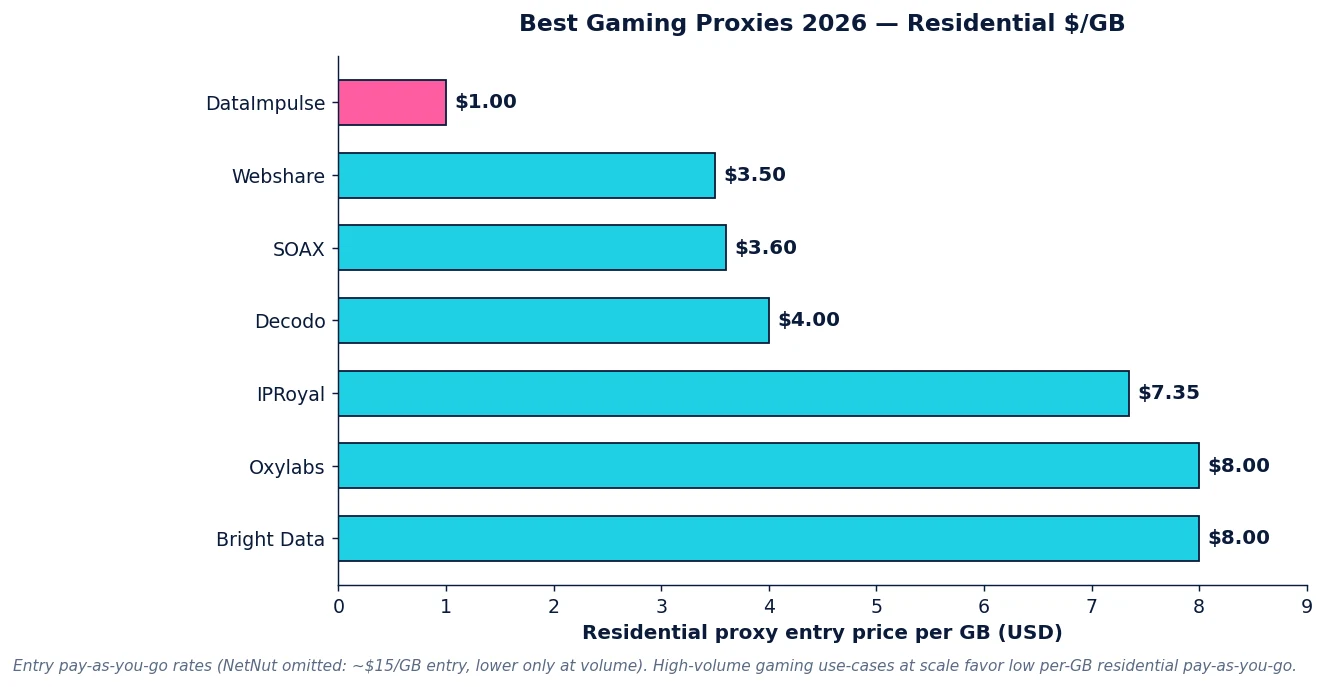
DataImpulse is the value pick for gaming use cases — residential IPs at $1/GB and mobile at $2/GB across 195 countries, with country/city targeting (for accurate regional storefronts and prices), sticky sessions, and high concurrency on a 90M+ pool. For region access, price intelligence, and game-data collection at scale, paying $1/GB rather than $4–8 keeps it affordable. Bright Data (~$8/GB) and Oxylabs (~$8/GB) are the enterprise pools with every IP type and the deepest coverage. IPRoyal (from ~$7.35/GB) has long sticky sessions, SOAX ($3.60/GB) and Decodo (~$4/GB) are strong mid-market options, NetNut brings ISP-static stability, and Webshare is the budget pick for testing.
Which Proxy Type for Gaming Use Cases?
- Residential ($1/GB) — the default for accessing regional storefronts, reading regional prices, and scraping game-market data; real consumer IPs that read as ordinary players.
- Mobile ($2/GB) — the most trusted class for the most defended gaming sites and stores, and for mobile-game store data.
- ISP / static residential — for stable, long-held sessions on a fixed identity (e.g. account management) where you want a residential-looking IP that doesn’t rotate.
- Datacenter — only for soft, unprotected targets or testing; gaming storefronts flag datacenter IPs fast.
A Note on Game Terms of Service
Proxies are legal, and the geography-driven uses above — regional access, price comparison, data collection, QA — are legitimate. But two things deserve honesty. First, multi-accounting and ban-evasion usually violate a specific game’s terms of service; a proxy provides IP isolation but doesn’t make breaking those terms safe, and the account-ban risk is real. Second, anti-cheat systems look at far more than the IP (device, behavior, hardware), so no proxy “beats” anti-cheat. Use proxies for the legitimate, geography-based use cases — regional access, price intelligence, data, and testing — and understand that anything that contravenes a game’s rules is a platform-risk decision you’re making, not something the proxy makes safe.
How to Use Gaming Proxies with DataImpulse
Step 1. Create a DataImpulse account and grab your residential credentials. The $5 / 5GB intro never expires — enough to test regional access or a data pull.
Step 2. Set the target country in the proxy username — YOUR_LOGIN__cr.us:[email protected]:823 — to read that region’s storefront and prices, adding ;sessid.xxxx for a sticky session.
Step 3. Collect public store/market data politely, use the right region per task, and add mobile IPs for the most defended targets. Full syntax is in the DataImpulse tutorials; see also our price comparison guide and the web scraping legality guide.
FAQ
What are the best gaming proxies in 2026?
Residential proxies with broad geo coverage and per-GB pricing fit gaming use cases best. DataImpulse ($1/GB) is the value pick for region access, price comparison, and game-data collection; Bright Data and Oxylabs are the enterprise picks; SOAX ($3.60/GB) and Decodo (~$4/GB) are strong mid-market options. The key needs are accurate regional targeting (storefronts and prices render by country), anti-block residential IPs, and mobile for the most defended sites.
Can I use proxies to buy games cheaper in another region?
Proxies let you see another region’s store prices, which is widely used for price comparison and research. Actually purchasing across regions, though, usually runs into the store’s own terms (Steam and console stores restrict region-switching and may lock or refund mismatched purchases). So proxies are great for reading regional prices; whether you can buy on them depends on the store’s rules, which you’re responsible for.
Do proxies help with ping or lag?
Not really — that’s a different tool. Proxies route your traffic to appear from another location, which usually adds latency rather than reducing it; they’re for geography and identity, not speed. For region access, price data, and testing, proxies are the right tool; for lower ping you’d look at routing/GPN services, which are a separate category.
Are gaming proxies against the rules?
Using a proxy isn’t illegal, and the geography-driven uses — regional access, price comparison, data collection, QA testing — are legitimate. But multi-accounting and ban-evasion typically violate a specific game’s terms of service, and a proxy doesn’t make that safe — the account-ban risk is real, and anti-cheat looks at far more than the IP. Use proxies for the legitimate use cases and treat anything against a game’s rules as a platform-risk decision.
What proxy type is best for reading regional game prices?
Residential IPs in the target country. Game stores price by the visitor’s IP region, so a residential IP in the country you’re researching returns that region’s accurate prices, where a datacenter IP may be blocked or show wrong data. DataImpulse offers residential at $1/GB across 195 countries with city targeting, so you can read regional storefront prices reliably.
How much do gaming proxies cost?
Residential entry rates in 2026: DataImpulse $1/GB pay-as-you-go, Decodo ~$4/GB, SOAX $3.60/GB, IPRoyal from ~$7.35/GB, Oxylabs/Bright Data ~$8/GB standard, NetNut from ~$15/GB (lower at volume). Mobile IPs cost more (DataImpulse $2/GB). For region access and data collection, the value providers deliver the same accurate regional data at a fraction of enterprise pricing.

 State/City/Zip/ASN Targeting