
In this Article
India is the world’s largest consumer internet market by users, the fastest-growing major e-commerce economy, and one of the more interesting places to run scraping in 2026 — Flipkart and Amazon.in defending their catalogs aggressively, Swiggy and Zomato fencing data by exact delivery zone, IRCTC and MakeMyTrip rate-limiting hard on fare scrapes, and Tier II–IV cities now driving over 60% of online demand. A US-IP scraper hitting Flipkart, Myntra, or Meesho looks nothing like a Mumbai shopper to those sites’ bot defenses, and that gap is exactly what an India proxy stack closes. Whether your team is tracking prices on Flipkart and JioMart, monitoring brand health on Nykaa and Ajio, scraping job listings from Naukri and Indeed.in, pulling rental data from 99acres and MagicBricks, or running Google.co.in SERP rank tracking, real Indian IPs and the right proxy type decide whether the data comes back clean or empty.
This guide ranks the 8 best proxies for India in 2026, sorts out residential vs datacenter vs mobile vs ISP for Indian targets, and walks through full reviews. Jump to the quick comparison for a thirty-second shortlist; deeper coverage follows.
Key Facts
India is its own proxy market because the legal regime is mid-rollout, the marketplaces defend their data hard, and city/state precision matters more than in most countries. Five things to know up front:
- DPDP Act 2023 is now in force — and phased. The Digital Personal Data Protection Act commenced on 13 November 2025 alongside the DPDP Rules 2025. Phase 1 set up the Data Protection Board of India; Phase 2 (13 November 2026) activates consent managers and DPBI penalty powers; Phase 3 (13 May 2027) brings consent, privacy notice, and security obligations into force. Penalties cap at ₹250 crore (~USD 30M) per violation for security-safeguard failures, with separate caps for other categories. Scraping personal data of Indian residents falls under the DPDP regime once Phase 3 lands.
- Flipkart and Amazon.in defend hard. Flipkart rotates HTML structure roughly every two weeks, updates inventory every 15 minutes, runs CAPTCHAs, IP bans, and behavioural fingerprinting; Amazon.in inherits the global Amazon anti-bot stack with India-specific rate limits. Datacenter IPs flag within hundreds of requests on both — residential is the default.
- Flipkart leads e-commerce; Amazon.in is #2. India’s e-commerce GMV is tracking ~$163–185B in 2026 with Flipkart holding roughly 48–50% of GMV, Amazon.in at ~25–32%, and Meesho the fastest-growing third (per ICICI Securities data). Smartphones alone account for 30–40% of online retail spend.
- Tier II–IV cities now drive 60%+ of demand. That changes proxy work: state- and city-level geo targeting (Maharashtra, Karnataka, Tamil Nadu, Telangana, UP, Gujarat, West Bengal, Punjab) is no longer optional for representative pricing and assortment data.
- Jio dominates the ISP layer. Reliance Jio is at 499.28M wireless subscribers (TRAI, April 2026) and ~43% of fixed broadband; Bharti Airtel 480.88M wireless; Vi (Vodafone Idea) 198.54M wireless. Real Indian mobile and ISP IPs route through these ASNs — AS55836 (Jio), AS9498 (Airtel), and the BSNL/Tata/ACT Fibernet ranges.
How We Selected These India Proxies
We picked these 8 providers because they have credible Indian residential IP coverage, public pricing as of May 2026, and one or more documented features that matter for Indian marketplace and SERP work — city or state targeting, ASN selection on Jio/Airtel, sticky sessions long enough for IRCTC/MakeMyTrip flows, or India-specific ISP/static-residential lines. We weighed live PAYG residential price per GB, transparency of pricing, freshness of marketing claims, and ranking on independent Indian-market reviews. Providers without verifiable India coverage, with stale pricing, or with no public success-rate disclosure were cut.
What Makes a Good India Proxy?
A strong India proxy stack solves four problems at once. Real ISP-assigned Indian IPs (Jio, Airtel, BSNL, ACT Fibernet, JioFiber) — without them, Flipkart, Amazon.in, Myntra, and JioMart all flag your traffic as non-resident. City- and state-level geo — Mumbai, Bangalore, Delhi-NCR, Chennai, Hyderabad, Pune, Ahmedabad, Kolkata pricing varies on Flipkart and quick-commerce; rank tracking on Google.co.in shifts by city; Swiggy and Zomato results are literally fenced by pin-code. Sticky sessions long enough for multi-step flows on IRCTC, MakeMyTrip, Naukri, and 99acres without mid-session IP rotation that trips the fraud layer. PAYG or transparent volume pricing — India work scales with festival cycles (Big Billion Days, Great Indian Festival, end-of-season sales) so subscription lock-in hurts.
Quick Comparison: Best Proxies for India at a Glance
| Provider | Best for | Residential price | Pool | India geo | Notable |
|---|---|---|---|---|---|
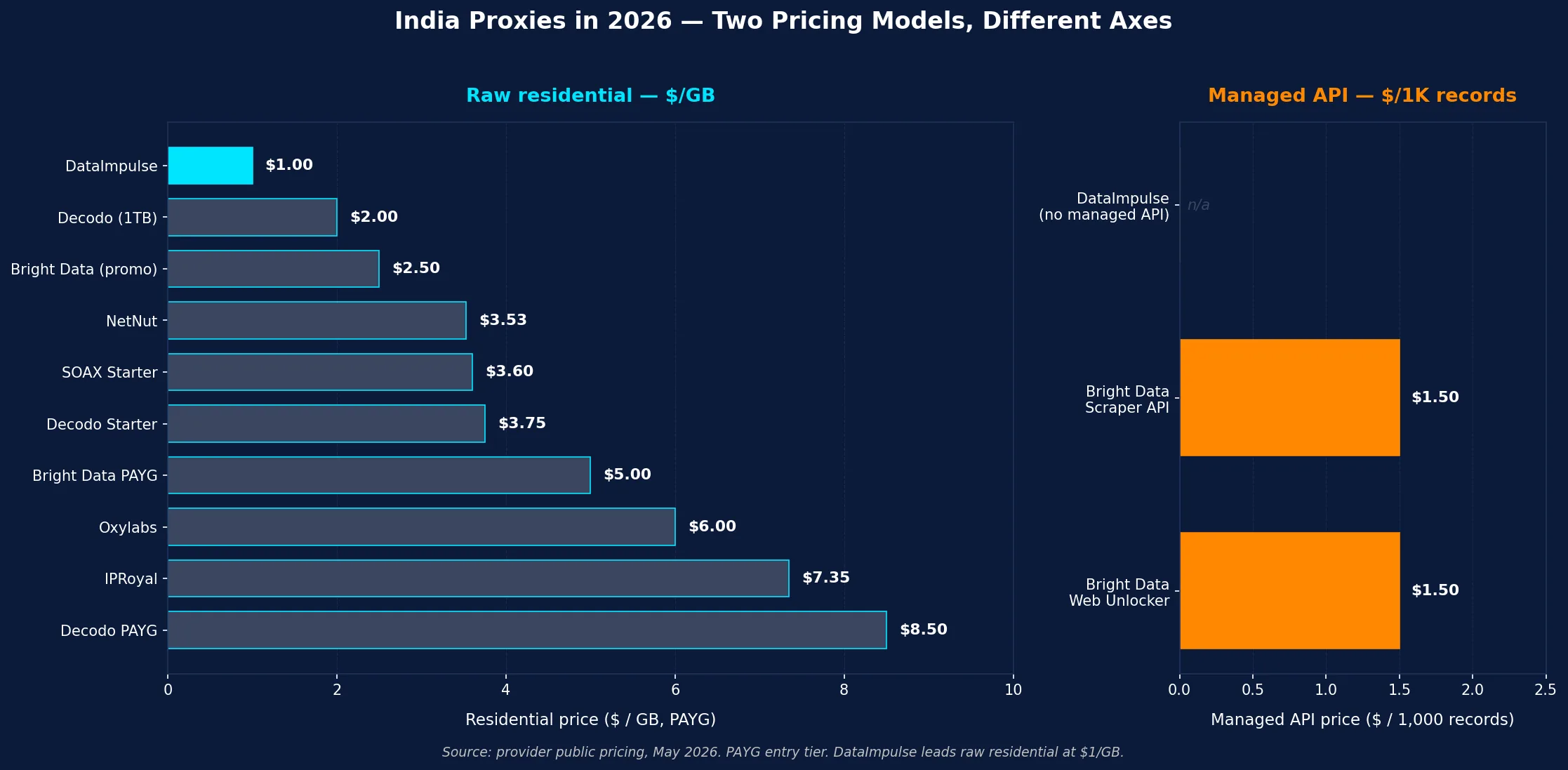
| DataImpulse | Best value, in-house teams | $1/GB PAYG | 90M+ residential, 2.5M+ India IPs | Country free; state/city/ZIP/ASN 2× rate | Traffic never expires; G2 4.8 |
| Bright Data | Enterprise + managed APIs | ~$2.50/GB (50% promo); $5/GB regular | 400M+ residential | Country/city/ZIP/ASN free | Dedicated Scraper APIs for Flipkart, Amazon.in, Google.co.in |
| Oxylabs | SLA-grade enterprise | from $6/GB | 175M+ residential | Country/state/city/ZIP/ASN/coordinates | Web Scraper API; 99.95% success |
| Decodo | Mid-market, India ISP | $3.75/GB starter, $8.50/GB PAYG | 115M+ residential | Country/city/ZIP/ASN included | India ISP from $0.27/IP (subject to inventory) |
| IPRoyal | Long sticky sessions | from $7.35/GB | 32M+ residential | Country/region/city/ISP | Sticky up to 7 days |
| SOAX | Mixed proxy types | $3.60/GB Starter | 155M+ res, 33M+ mobile, 2.6M+ ISP | Country/region/city/ISP/ASN | Unified credit; strong mobile India |
| Webshare | Cheap large volume | from $3.50/mo res; $2.99/mo DC | 80M+ residential (sub) | Country, plan-dependent city | Budget pick for low-defense Indian targets |
| NetNut | ISP-residential reliability | from $3.53/GB | ISP-grade residential | Country (city on higher plans) | Jio/Airtel ISP depth |
Which Proxy Type Should You Use for India?
Indian market work behaves differently from generic Asian scraping — major Indian marketplaces run tier-1 anti-bot stacks and content varies by state, city, and ASN. The proxy type decides your success rate more than the brand does.
Residential Proxies
Residential proxies are the right default for nearly all serious Indian market work — Flipkart, Amazon.in, Myntra, Nykaa, Meesho, JioMart, Snapdeal, Ajio product pages and search results; 99acres, MagicBricks, Housing.com, NoBroker listings; Naukri.com and Foundit job pages; IRCTC and MakeMyTrip search flows; news and sentiment scraping on Times of India, Hindustan Times, NDTV. Real Jio, Airtel, BSNL, JioFiber, and ACT Fibernet IPs read as ordinary Indian consumer browsers to the marketplace bot defense, and a fresh Indian residential pool routinely clears the layer where datacenter ranges flag in minutes.
ISP / Static Residential Proxies
ISP proxies (static residential) are increasingly the right choice for Indian workflows that need session continuity — Flipkart Seller Hub dashboards, signed-in LinkedIn India work, Sales Navigator on Indian prospects, multi-day rank tracking on Google.co.in, Naukri recruiter accounts, IRCTC ticket flows. ISP IPs sit on Indian ISP-assigned addresses with the stability of static hosting: residential trust with the predictability of a fixed address. Decodo, IPRoyal, Bright Data, and NetNut all offer India ISP product lines.
Mobile Proxies
Mobile proxies route through real Indian carrier networks (Jio, Airtel, Vi) and earn their place when you’re validating mobile Indian marketplace experiences, mobile-only promotions on Flipkart and Myntra, mobile-app Swiggy and Zomato surfaces, JioMart in-app pricing, or hard geo/account cases where residential rotation gets challenged. With India’s mobile-first internet (Jio alone has ~500M wireless subscribers per TRAI April 2026), a Jio or Airtel mobile IP often looks more native than a fixed-line residential IP. They’re the most expensive option per GB, so reserve them for jobs where mobile context genuinely changes the data.
Datacenter Proxies
Datacenter proxies have a narrow but real role in Indian work: bulk crawling of public Indian government and corporate sites (data.gov.in, MCA, RBI publications, SEBI filings) with no serious bot protection, sitemap aggregation, public news archive crawling, and lightweight enrichment of CSV exports. Don’t lean on datacenter for Flipkart, Amazon.in, Myntra, JioMart, or Swiggy — these flag datacenter ranges within a few hundred requests. Reserve datacenter for the low-defense layer of an Indian stack, and switch to residential or ISP as soon as a target starts challenging you.
Rotating vs Sticky for India
The rule for India: rotate for breadth, stick for depth and account continuity. Rotating residential handles broad Flipkart and Amazon.in price-tracking sweeps, Google.co.in SERP rank tracking, Myntra category monitoring, and quick-commerce (Blinkit, Zepto, Instamart) catalog scrapes. Sticky sessions handle the deeper flows — IRCTC multi-step booking simulations, MakeMyTrip fare deep-dives, 99acres multi-page listing crawls, Naukri recruiter sequences, LinkedIn India Sales Navigator searches, Flipkart Seller Hub dashboards, and any flow where mid-session IP changes would flag as suspicious. Most production India stacks mix both.
Best Proxies for India — Full Reviews
The picks below are ranked on value for Indian market work — the balance of India IP pool depth, city/state precision, marketplace success rate, sticky-session length, DPDP posture, and price per successful record. DataImpulse leads on value; the rest each win a specific lane.
1. DataImpulse
DataImpulse is the best-value pick for in-house teams running their own Indian market scrapers — Flipkart price tracking, Amazon.in competitive monitoring, Myntra/Nykaa assortment intelligence, Naukri recruiting research, Google.co.in SERP rank tracking, news and brand sentiment. Residential starts at $1/GB, pay-as-you-go, with traffic that never expires — a fraction of what enterprise India-market scrapers charge. The pool is 90M+ ethically sourced IPs across 195 countries with 2.5M+ Indian residential IPs — one of the deeper India pools at the budget tier. Country targeting is included with state/city/ZIP/ASN as a paid add-on (2× the per-GB rate), which matters for Indian work where Mumbai vs Bangalore vs Delhi pricing on Flipkart actually differs and Swiggy/Zomato results change by pin-code. It supports HTTP, HTTPS, and SOCKS5, rotating and sticky sessions, full API access, and standard scraping stacks (Scrapy, Selenium, Playwright). Mobile is available at $2/GB for Jio/Airtel/Vi networks; datacenter at $0.50/GB for the enrichment layer (data.gov.in, news archives, public corporate pages, MCA filings).
What makes it the default for serious Indian collection is the price-to-geo ratio. At $1/GB you can sustain continuous Indian market work across all eight major metro clusters without the per-record charges that managed APIs add up to at scale, and the PAYG model means experimenting with new Indian targets — JioMart, BigBasket, Ajio, Meesho — doesn’t lock you into a subscription. Support is 24/7 human; published success rate is 99.51%; G2 is 4.8/5. There’s no dedicated Indian marketplace endpoint here — DataImpulse sells the proxy infrastructure cleanly and lets your team build the Flipkart / Amazon.in / Myntra parsers on top.
Quick specs — Types: residential, mobile, datacenter · Pool: 90M+ residential including 2.5M+ India IPs · Rotation: rotating + sticky · Geo: country (state/city/ZIP/ASN as paid add-on at 2× rate) · Price: $1/GB res, $0.50/GB DC, $2/GB mobile · Published success: 99.51% · Rating: G2 4.8.
Best for: in-house Indian scraping teams that want low pay-as-you-go pricing and city/state-level geo without enterprise commitments.
2. Bright Data
Bright Data is the enterprise pick if you want Indian market data as a managed product. Beyond raw residential at $5/GB pay-as-you-go (currently discounted to ~$2.50/GB with a 50% promo) with a 400M+ monthly IP pool that includes substantial Indian coverage and free city/ZIP/ASN targeting, Bright Data ships dedicated Scraper APIs for Flipkart, Amazon.in, Google.co.in SERP, Myntra, and other Indian marketplaces at $1.50 per 1,000 records on PAYG (about $1.30/1K on the $499 plan). The Web Unlocker at $1.50/1K results handles protected Indian targets generically. ISO 27001, SOC 2 Type II, documented GDPR-equivalent posture, and audit-ready compliance clear most Indian enterprise procurement (and most DPDP risk reviews once Phase 3 lands). It’s the right call when you’d rather hit a managed Indian marketplace endpoint than maintain a parser against Flipkart’s bi-weekly HTML rotation — at enterprise pricing with procurement-style buying.
Quick specs — Types: residential, DC, ISP, mobile + dedicated Indian marketplace Scraper APIs + Web Unlocker · Pool: 400M+ monthly residential with strong Indian coverage · Rotation: rotating, sticky, dedicated · Geo: country/city/ZIP/ASN free · Price: ~$2.50/GB res (promo); $5/GB regular; Scraper APIs from $1.50/1K records PAYG (~$1.30/1K on $499 plan); subscription from $499/month · Compliance: ISO 27001, SOC 2 Type II.
Best for: enterprise Indian market intelligence teams that want managed scraper APIs with audit-ready compliance and SLA controls.
3. Oxylabs
Oxylabs sits next to Bright Data at the enterprise top with deep Indian market coverage. Residential starts around $6/GB on the entry plan with a 175M+ pool across 195 countries and strong Indian presence with city, state, ZIP, ASN, and geographical coordinate targeting. The Web Scraper API ($49/month entry) handles JavaScript rendering, anti-bot bypass, and structured data extraction across Indian targets including Flipkart, Amazon.in, and Google.co.in. Sessions are flexible with unlimited concurrent connections, and Oxylabs publishes a 99.95% residential success rate. Pick Oxylabs when reliability, SLA-grade support, ISO 27001 / SOC 2 compliance, and audit-ready documentation matter more than entry price — particularly for India enterprise programs that need procurement docs for IT-Act and DPDP risk reviews.
Quick specs — Types: residential, DC, ISP, mobile + Web Scraper API · Pool: 175M+ residential, 195 countries · Rotation: flexible, sticky, unlimited concurrency · Geo: country/state/city/ZIP/coordinates/ASN · Price: from $6/GB residential; Web Scraper API from $49/month · Published success: 99.95% · Compliance: ISO 27001, SOC 2.
Best for: enterprise Indian market programs that want SLA-grade managed scraping with deep geo targeting and audit-ready compliance.
4. Decodo
Decodo (formerly Smartproxy) is the mid-market sweet spot for Indian market work. Residential proxies start at $3.75/GB on the 3 GB starter plan with PAYG at $8.50/GB on the public pricing page, dropping to about $2/GB at the 1,000 GB tier. The static residential/ISP starts at $0.27/IP (India availability subject to plan/inventory) — one of the most aggressive India ISP rates on the market for static-residential workflows like Flipkart Seller Hub, Naukri recruiter accounts, and signed-in LinkedIn India. Country, city, ZIP, and ASN targeting are included with 115M+ IPs across 195+ locations. The Web Scraping API includes templates for Indian marketplaces, with sticky sessions configurable up to 24 hours — useful for IRCTC and MakeMyTrip flows.
Quick specs — Types: residential, DC, ISP, mobile + Web Scraping API · Pool: 115M+ residential · Rotation: per-request, sticky up to 24h · Geo: country/city/ZIP/ASN included · Price: $3.75/GB starter, $8.50/GB PAYG, $2/GB at 1TB+; static residential/ISP from $0.27/IP (India subject to inventory) · Published success: 99.86%.
Best for: mid-market Indian teams that want city-precise residential and cheap India ISP for account-tied work.
5. IPRoyal
IPRoyal earns its spot for Indian workflows that need long sticky sessions — multi-day rank tracking on Google.co.in, multi-page 99acres and MagicBricks crawls, Indian LinkedIn account continuity, Naukri recruiter sequences. Residential PAYG runs $7.35/GB at entry (cheaper at volume) with a 32M+ pool across 195+ countries including Indian coverage, with country, region, city, and ISP targeting. Its real differentiator is sticky sessions up to 7 days, the longest on this list — uniquely useful for IRCTC multi-day fare watches, real-estate listing tracking, and Naukri/LinkedIn India workflows where a single session needs to persist across days. There’s also an India ISP product line and Web Unblocker (CAPTCHA + anti-bot bypass) at per-request pricing.
Quick specs — Types: residential, ISP, mobile, DC + Web Unblocker · Pool: 32M+ residential, 195+ countries · Rotation: rotating, sticky up to 7 days · Geo: country/region/city/ISP · Price: from $7.35/GB residential PAYG.
Best for: Indian workflows that need multi-day sticky sessions (99acres, IRCTC, recruiting on Naukri/LinkedIn India, signed-in dashboards).
6. SOAX
SOAX is the pick when geo-precise Indian work and mixed proxy types matter together. Residential starts at $3.60/GB on the Starter plan (25 GB included), and the unified credit model means you can spend the same budget on residential, mobile, ISP, datacenter, or the Web Data API. The pool is one of the larger in the mid-tier — 155M+ residential, 33M+ mobile, 2.6M+ ISP — with country, region, city, ISP, and ASN targeting including India coverage. Sticky sessions are supported across all proxy types. Convenient if your Indian program mixes mobile validation of Flipkart and Myntra apps (where Jio/Airtel/Vi context changes pricing and assortment) with residential for desktop Amazon.in tracking and ISP for Indian Seller Hub dashboards.
Quick specs — Types: residential, mobile, ISP, DC + Web Data API · Pool: 155M+ residential, 33M+ mobile, 2.6M+ ISP · Rotation: per request or interval, sticky supported · Geo: country/region/city/ISP/ASN · Price: $3.60/GB Starter.
Best for: Indian teams running geo-heavy collection across multiple proxy types under one subscription.
7. Webshare
Webshare earns its place for Indian teams running large-volume low-cost workflows on public Indian targets — news archive crawling, public Indian government/corporate sites without serious anti-bot, sitemap aggregation, and public-data enrichment (data.gov.in, MCA, public PDFs). Plans start at $2.99/month for the 100-proxy datacenter package and $3.50/month for the entry rotating residential plan with 80M+ residential available on higher tiers, plus static India ISP proxies on subscription plans. Webshare residential is best on lower-defense Indian targets; for tier-1 anti-bot sites (Flipkart, Amazon.in, Myntra, JioMart), step up to the providers above.
Quick specs — Types: residential, static ISP, datacenter · Pool: 80M+ residential (subscription); datacenter and ISP available · Geo: country, plan-dependent city · Price: from $2.99/month datacenter (100 proxies); rotating residential from $3.50/month.
Best for: Indian teams running cheap large-volume crawling of public Indian websites without tier-1 anti-bot.
8. NetNut
NetNut closes the list with a focus on ISP-residential reliability for Indian workflows. The product line emphasizes ISP-grade residential IPs (Reliance Jio, Bharti Airtel, BSNL, and other Indian ISP-assigned addresses) with rotating and sticky options. Rotating residential currently starts around $3.53/GB on entry plans, scaling up by volume; country and city-level targeting available on higher tiers. NetNut is the pick when you specifically want Jio/Airtel ISP-residential network depth without paying full Bright Data prices.
Quick specs — Types: ISP-residential, residential, mobile · Pool: ISP-grade residential with Indian coverage · Rotation: rotating, sticky · Geo: country (city on higher plans) · Price: from $3.53/GB residential.
Best for: Indian teams that want Jio/Airtel ISP-residential reliability for marketplace and LinkedIn India work without enterprise pricing.
How Much Do India Proxies Cost?
Listed pricing in 2026 falls into three bands. Budget/value at $1–$3.75/GB — DataImpulse, SOAX Starter, Decodo entry, Webshare residential subscription — covers most in-house Indian market work. Mid/premium at $3.50–$7.35/GB — Bright Data, Oxylabs, IPRoyal, NetNut — adds enterprise tooling and SLA-grade reliability. API-priced and ISP-priced — Bright Data’s Indian marketplace Scraper APIs $1.50/1K records PAYG (~$1.30/1K on $499 plan), Oxylabs Web Scraper API from $49/mo, Decodo Web Scraping API from $19/mo, Decodo India ISP at $0.27/IP — sell structured Indian outcomes per record, per plan, or per IP instead of per GB.
The real cost question for India isn’t “what’s the lowest ₹/GB” but “what’s the lowest cost per successful, DPDP-defensible record”. A managed scraper API at $1.30–$1.50/1K records can beat $1/GB residential when your in-house scraper hits Flipkart blocks on 30–50% of requests around HTML-rotation cycles; conversely, $1/GB residential paired with sticky sessions and city-level geo routinely beats per-record APIs at scale once your in-house parser is mature and you’ve absorbed Flipkart’s bi-weekly DOM churn. Test both on your actual Indian targets before committing.
Is Scraping Legal in India?
Indian scraping law sits at the intersection of the IT Act 2000, the new DPDP Act 2023, the Copyright Act 1957, and individual marketplace terms. The basics:
- IT Act Section 43(b) penalises unauthorised downloading or extraction of data. In February 2025, MeitY (Ministry of Electronics and IT) told Parliament that web scraping of publicly available user data is regulated under the IT Act. Indian courts have not yet ruled definitively on whether Section 43 applies to scraping of publicly available data — legal scholars dispute it both ways.
- DPDP Act 2023 governs personal data of Indian residents. In force from 13 November 2025, with consent/notice/security requirements fully effective from 13 May 2027. Scraping names, emails, profile photos, phone numbers, or other personal data of Indian residents falls under DPDP — penalties up to ₹250 crore (~USD 30M) per violation, capped for security-safeguard failures. Cross-border transfer rules under DPDP Section 16 follow a blacklist model with the country blacklist pending separate Central Government notification.
- Public-data scraping is legally contested. Indian courts have not produced a clear precedent equivalent to hiQ v LinkedIn. The constitutional anchor is Justice K.S. Puttaswamy v Union of India (2017), which recognised informational privacy as a fundamental right and underpins the DPDP regime. The first major scraping/copyright test — ANI Media v OpenAI at the Delhi High Court — saw judgment reserved in March 2026 after 32 hearings; the ruling is the precedent to watch. The expert consensus: public price/product/listing data is the lowest-risk lane; personal-data and logged-in scraping carries materially higher risk.
- Marketplace terms can be enforceable. Flipkart, Amazon.in, Myntra, Nykaa, Meesho, JioMart, IRCTC, MakeMyTrip, Naukri, 99acres, MagicBricks all have specific terms restricting automated access. Commercial intent + violation of express ToS strengthens a civil claim against scrapers. The 2024 Meta v Bright Data US ruling (logged-in vs public scraping) is being cited by Indian defendants and is influential in how Indian courts read the boundary.
- Copyright Act 1957 protects creative content. Database rights are weaker in India than in the EU, but scraped catalogs of creative content (product photography, editorial reviews, news articles) carry copyright exposure. The ANI Media case is the precedent to watch.
The honest reading: large-scale commercial Indian market collection is widespread industry practice, but DPDP and IT-Act compliance is mid-rollout — what’s permissible today may tighten by mid-2027. Public price/product data is the lowest-risk lane; personal data and logged-in flows the highest. Get Indian counsel familiar with DPDP and the IT Act before scaling a production India pipeline. This isn’t legal advice.
How to Start India Market Scraping with DataImpulse
- Create an account and pick your proxy mix. Residential ($1/GB) for Flipkart, Amazon.in, Myntra, Nykaa, JioMart, Meesho, 99acres, Naukri, Google.co.in SERP and news; datacenter ($0.50/GB) for enrichment (data.gov.in, MCA filings, news archives, public corporate pages); mobile ($2/GB) for Jio/Airtel mobile-marketplace validation (where Flipkart and Myntra often show different pricing).
- Add funds. Pay-as-you-go, no subscription, no expiry — handy because Indian market collection volume varies with festival cycles (Big Billion Days, Great Indian Festival, Republic Day, Diwali, end-of-season sales), reporting cycles, and competitive-intel campaigns.
- Target by state and rotate. Set country IN plus state/city for the Indian markets you’re collecting (state/city/ZIP/ASN are paid add-ons at 2× the per-GB rate but essential for serious Indian work — pricing on Flipkart and JioMart varies by city, Swiggy/Zomato results by pin-code, Google.co.in SERP by city), pick rotating for broad Flipkart and Amazon.in sweeps and sticky sessions for IRCTC, MakeMyTrip, 99acres, and LinkedIn India flows, point your scraper at the proxy endpoint and run.
For more on related workflows, see our residential proxies product page, the India residential proxies landing, the best proxies for Amazon scraping roundup (Amazon.in mechanics carry over), and the best proxies for SEO & rank tracking roundup.
FAQ
Is scraping legal in India?
The IT Act 2000 (Section 43) penalises unauthorised data extraction, and MeitY’s 2025 statement said publicly-available-data scraping is regulated under the IT Act — though Indian courts have not definitively ruled. The DPDP Act 2023 governs personal data of Indian residents from 13 November 2025, with full consent/notice/security obligations from 13 May 2027 and penalties up to ₹250 crore (per violation, capped for security-safeguard failures). Public price and product data is the lowest-risk lane; personal data and logged-in scraping the highest. The ANI Media v OpenAI Delhi High Court case (verdict reserved March 2026) is the precedent to watch. Get DPDP and IT Act counsel before scaling. This isn’t legal advice.
What are the best proxies for Flipkart, Amazon.in, and Myntra?
Residential proxies with city- or state-level Indian geo are the safest default. Flipkart rotates HTML structure roughly every two weeks and inventory every 15 minutes, so resilient scraping needs either DataImpulse residential at $1/GB paired with a mature in-house parser or Bright Data’s dedicated Flipkart/Amazon.in Scraper APIs at $1.50/1K records. Decodo’s India ISP at $0.27/IP (subject to inventory) is among the cheapest entries to static-residential for Seller Hub and account-tied work.
How do I scrape Flipkart or JioMart from India?
Use residential proxies with country = IN plus city targeting matching your target metro (Mumbai, Bangalore, Delhi-NCR, Hyderabad, Chennai). Set User-Agent and Accept-Language to typical Indian Chrome/Android values, sticky-session for category browse-to-product flows, and rotate IPs between product pulls. JioMart and BigBasket fence delivery by pin-code, so pin-code-accurate geo is gating. Honor robots.txt and rate-limits, and treat any personal data with DPDP-grade care.
Do I need Mumbai or Bangalore-specific IPs?
Yes for pricing intelligence, SERP tracking, and quick-commerce work. Flipkart and JioMart prices vary across Mumbai (Maharashtra), Bangalore (Karnataka), Delhi-NCR, and other tier-1 metros. Swiggy, Zomato, Blinkit, Zepto, and Instamart literally fence catalog and pricing by exact delivery pin-code — a Mumbai IP shows Mumbai restaurants and Mumbai prices, never Bangalore. Google.co.in SERP rankings shift by city. DataImpulse, Bright Data, Oxylabs, Decodo, IPRoyal, and SOAX all support city-level targeting on Indian residential pools (paid add-on or included depending on plan).
Mobile proxies for Indian targets — when do they matter?
Three cases: (1) mobile-app or mobile-web validation on Flipkart, Amazon.in, Myntra, JioMart where Jio/Airtel context surfaces different pricing or app-only promos; (2) Swiggy, Zomato, Blinkit, Zepto, Instamart — these are mobile-first and tag Jio/Airtel mobile IPs as native; (3) protection-bypass on the hardest accounts. SOAX, IPRoyal, DataImpulse, and Bright Data offer Jio/Airtel/Vi-routed mobile proxies. Reserve mobile for jobs where mobile context genuinely changes the data — they cost more per GB.
How does DPDP Act 2023 affect scraping plans?
Phase 1 (13 November 2025) set up the Data Protection Board. Phase 2 (13 November 2026) brings consent managers and DPBI penalty powers. Phase 3 (13 May 2027) makes the full consent/notice/security regime effective. Until Phase 3, personal-data scraping risk is mainly under the IT Act, MeitY guidance, and ToS-based claims. After Phase 3, scraping personal data of Indian residents without a lawful basis is directly DPDP-enforceable — penalties up to ₹250 crore. Plan a DPDP review before mid-2027 if your India pipeline touches personal data; the consent and notice obligations are the operative changes for scrapers.
Can I use a free India proxy or VPN instead?
For development tests on public Flipkart catalog pages, yes. For production Indian market work, no — free proxies are typically shared, datacenter-class, already burned on the major Indian marketplaces, and offer no DPDP-defensible audit trail. They also fail on Flipkart’s behavioural fingerprinting and on Swiggy/Zomato delivery-zone fencing. The paid providers above start at $1/GB PAYG with no subscription, which makes free proxies an expensive false economy for any commercial use.
Static residential / ISP proxies for India — who has them?
Decodo (from $0.27/IP, subject to inventory), IPRoyal, NetNut, Bright Data, and Webshare all sell India static-residential / ISP product lines. They’re the right choice for Flipkart Seller Hub, signed-in LinkedIn India, Sales Navigator on Indian prospects, multi-day Google.co.in rank tracking, Naukri recruiter accounts, and IRCTC ticket flows. Pick ISP when you need session continuity that residential rotation breaks.
How many Indian IPs do these providers have?
Provider-published figures vary in methodology. DataImpulse publishes 2.5M+ Indian residential IPs (one of the larger budget-tier India pools). Bright Data does not disclose per-country counts but India is among the documented largest residential pools alongside US/BR/ID. Oxylabs, Decodo, SOAX publish total pool counts (175M, 115M, 155M+) with India among supported geos. NetNut emphasizes Jio/Airtel ISP-residential depth specifically. For mission-critical India work, ask each vendor for current India pool and ASN coverage in writing — the numbers change quarterly.
Does DataImpulse charge extra for Indian city or state targeting?
Country (India) is free. State, city, ZIP, and ASN targeting are paid add-ons at 2× the per-GB rate — so a Mumbai-specific Flipkart pull effectively runs at $2/GB residential instead of $1/GB. For most Indian market work, this is still cheaper than alternatives at city granularity, and pin-code-precise Swiggy/Zomato/Blinkit work genuinely needs it.
Ready to run Indian market scraping with the city- and state-level geo precision that Flipkart, Amazon.in, JioMart, Swiggy, and Google.co.in tracking actually need? Start with DataImpulse — residential from $1/GB, datacenter from $0.50/GB, mobile from $2/GB, pay-as-you-go with country targeting included (state/city/ZIP/ASN as paid add-on) and traffic that never expires.
 State/City/Zip/ASN Targeting