
In this Article
South Korea is one of the world’s most advanced and competitive e-commerce markets — the highest internet speeds on earth, near-total smartphone adoption, and a shopper base that lives in homegrown platforms. Almost all the data worth collecting there is local: prices, availability, ads, and rankings on Coupang (the dominant marketplace), Naver Shopping, Gmarket, and 11Street are served to Korean IP addresses in won and in Korean. To see what a Korean shopper actually sees — and to scrape it without being blocked — you need residential proxies physically located in South Korea, not a datacenter IP elsewhere. This guide ranks the 8 best proxies for South Korea in 2026 for e-commerce price intelligence, Naver and Google SERP tracking, ad verification, and market research, and covers which providers have genuine Korean residential and mobile coverage. DataImpulse leads on value at $1/GB with Korean coverage.
One framing up front: Korea’s e-commerce runs on local platforms (Coupang, Naver) and a uniquely Korean search ecosystem (Naver, not just Google), so accurate data needs genuine Korean residential IPs — and mobile IPs for the country’s intense mobile usage.
Key Facts
- Coupang and Naver Shopping dominate. Coupang (the Amazon-like leader with its Rocket Delivery) and Naver Shopping lead Korean e-commerce, alongside Gmarket, 11Street, and SSG.com. That’s your competitive set.
- Naver is the search ecosystem. Unlike most markets, Korea’s search and shopping discovery runs heavily through Naver, not just Google — so SERP and rank tracking must cover Naver, which is strongly localized to Korean IPs.
- Prices and SERPs are KRW- and KR-IP-gated. Won prices, local availability, and Korean search results render correctly only to an IP that looks Korean — scrape from a US or Japanese IP and you risk wrong data or a block.
- Three mobile operators run the market. The major MNOs are SK Telecom, KT, and LG U+, plus a growing MVNO (alttel) segment — the networks behind Korean mobile IPs for carrier and in-app data.
- Privacy law is strict. Korea’s Personal Information Protection Act (PIPA), enforced by the PIPC, is among Asia’s strictest. Public product and price scraping is defensible; personal data is the real risk.
- DataImpulse is the value pick at $1/GB residential, pay-as-you-go, traffic that never expires, with Korean residential coverage on a 90M+ pool across 195 countries, country targeting included and city/ASN as a paid add-on, plus Korean mobile IPs at $2/GB.
Why You Need Korean Proxies
Three things make South Korea a distinct proxy problem. The commerce is local and IP-gated. Coupang, Naver Shopping, Gmarket, and 11Street serve prices, stock, promotions, and ads based on the visitor’s IP geography and currency; a won price and local delivery estimate only appear to an IP that looks Korean. Scrape from outside and you get wrong prices, a redirect, or a block. Anti-bot favors residential. Korean platforms — and Naver especially — flag datacenter ranges quickly, while real consumer and carrier IPs from SK Telecom, KT, and LG U+ read as ordinary Korean shoppers. A Naver-centric ecosystem. Korea’s reliance on Naver for search and shopping means rank tracking and ad verification must run through genuinely Korean IPs. Korean residential proxies aren’t an optimization — they’re how you get correct Korean data at all.
Best Proxies for South Korea at a Glance
| Provider | Best for | Residential price | Korea geo | Notable |
|---|---|---|---|---|
| DataImpulse | Best value, residential + mobile | $1/GB PAYG | Country incl; city/ASN add-on | 90M+ pool, Korean mobile $2/GB, never-expires |
| Bright Data | Enterprise + managed scraping | ~$4/GB promo; ~$8 standard | Country/city/ASN | Largest pool, Web Unlocker, datasets |
| Oxylabs | Enterprise + compliance | ~$8/GB standard | Country/city | 175M+ pool, Scraper APIs, SLA |
| Decodo | Mid-market, full geo grid | ~$4/GB PAYG (~$2 volume) | Country/city/ASN | 115M+ pool, sticky to 24h |
| SOAX | Residential + Korean mobile | $3.60/GB Starter | Country/region/city/ASN | Clean opt-in pool, carrier IPs |
| IPRoyal | Long sticky sessions | from ~$7.35/GB | Country/region/city/ISP | Sticky up to 7 days |
| NetNut | ISP-residential stability | from ~$15/GB (to ~$1.59 volume) | Country/city | Static consumer-ISP IPs |
| Webshare | Budget / self-serve | ~$3.50/GB (promo ~$1.40) | Country (city on higher tiers) | Free tier, cheapest entry |
The Picks, Briefly
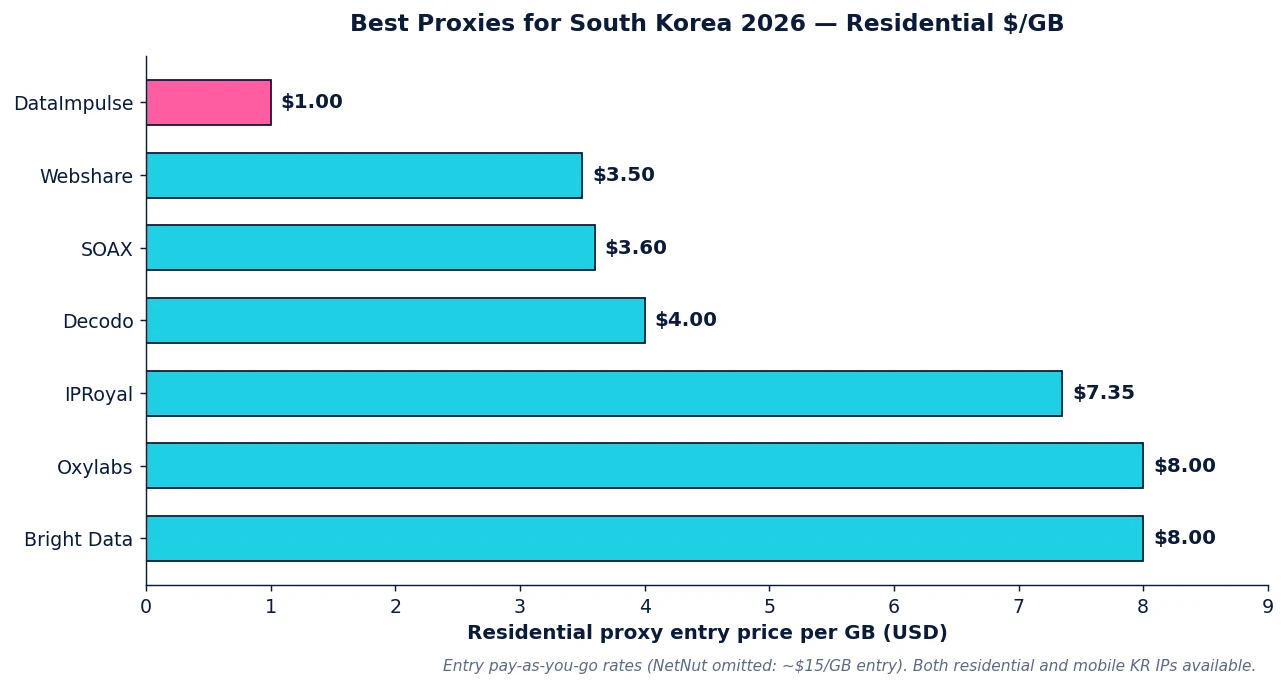
DataImpulse is the value pick for South Korea — residential IPs at $1/GB and Korean mobile at $2/GB, on a 90M+ pool across 195 countries, with country targeting included and city/ASN as a paid add-on, plus sticky sessions for multi-step Coupang and Naver flows. Pay-as-you-go, traffic never expires. For Korean e-commerce and Naver/Google SERP work, it’s the lowest cost per accurate data point. Bright Data (~$8/GB standard) and Oxylabs (~$8/GB) are the enterprise pools with managed scraping APIs and compliance documentation. Decodo (~$4/GB PAYG) and SOAX ($3.60/GB, plus mobile) are strong mid-market options. IPRoyal (from ~$7.35/GB, 7-day sticky), NetNut (ISP-static stability), and Webshare (budget, free tier) round out the field.
Which Proxy Type for South Korea?
- Residential ($1/GB) — the default for Coupang, Naver Shopping, and SERP scraping; real Korean consumer IPs that read as ordinary shoppers.
- Mobile ($2/GB) — for app data, mobile pricing, and carrier-specific content on SK Telecom/KT/LG U+ networks; the most trusted IP class in this hyper-mobile market.
- Sticky sessions — for multi-step flows (search → product → cart) that need the same IP across requests.
- Datacenter — avoid for marketplace, Naver, and SERP work; flagged fast. Fine only for soft, unprotected targets.
How to Scrape Korean Data with DataImpulse
Step 1. Create a DataImpulse account and grab your credentials. Choose residential or Korean mobile. The $5 / 5GB intro never expires.
Step 2. Set South Korea in the proxy username — YOUR_LOGIN__cr.kr:[email protected]:823 — adding ;city.seoul for a city or ;sessid.xxxx for a sticky session on multi-step flows.
Step 3. Collect public, non-personal data (prices, listings, rankings, ads), throttle politely, and verify the IP with curl -x "http://USER:[email protected]:823" http://ip-api.com/json before scaling. Full syntax is in the DataImpulse tutorials; see also our price comparison guide and the web scraping legality guide.
FAQ
What are the best proxies for South Korea in 2026?
For value, DataImpulse ($1/GB residential, $2/GB Korean mobile) leads, with country targeting and city/ASN add-on. Bright Data and Oxylabs are the enterprise picks (managed APIs, compliance). Decodo (~$4/GB) and SOAX ($3.60/GB) are strong mid-market options. For Korean e-commerce and Naver/Google SERP work, you want genuine Korean residential — and mobile IPs for app data in this hyper-mobile market.
Why do I need a Korean IP to scrape Korean sites?
Because prices, availability, ads, and search results render based on the visitor’s IP geography and currency. Coupang, Naver, and Google show won prices, local stock, and Korean results to Korean IPs; scrape from a US or Japanese IP and you get wrong prices, a redirect, or a block. A residential IP in Korea returns the genuine local experience a Korean shopper sees — and Naver in particular is strongly localized to Korean IPs.
Do I need mobile proxies for South Korea?
Often, yes. Korea is among the world’s most mobile-first markets, so app experiences, mobile pricing, and carrier-specific content (on SK Telecom, KT, or LG U+) are best collected through Korean mobile IPs. For standard web e-commerce and SERP scraping, residential IPs are sufficient and cheaper. DataImpulse offers Korean mobile at $2/GB alongside residential at $1/GB.
Is web scraping legal in South Korea?
Collecting public, non-personal data — prices, listings, rankings, ad placements — is the defensible category. Korea’s Personal Information Protection Act (PIPA), enforced by the PIPC, is among Asia’s strictest and governs personal data, so the real risk is scraping personal data rather than public product data. Keep personal data out of your pipeline and use an ethically sourced provider. See our web scraping legality guide.
Which Korean marketplaces should I track?
Coupang (the dominant Amazon-like leader) and Naver Shopping are the primary sources for price and assortment data, alongside Gmarket, 11Street, and SSG.com. Because so much Korean shopping discovery runs through Naver, tracking Naver Shopping plus Coupang gives you the clearest competitive picture across pricing, promotions, and rankings.
How much do Korean proxies cost?
Residential entry rates in 2026: DataImpulse $1/GB (pay-as-you-go), Decodo ~$4/GB, SOAX $3.60/GB, IPRoyal from ~$7.35/GB, Oxylabs/Bright Data ~$8/GB standard, NetNut from ~$15/GB (lower at volume). Korean mobile IPs cost more than residential (DataImpulse $2/GB). For straightforward Korean scraping, the value providers deliver the same accurate local data at a fraction of enterprise pricing.