
In this Article
When you use a static proxy, your requests to the target website will depend on that single IP address staying unblocked for the duration of your session. That’s why rotating proxies, which change IPs every time your device makes a request, are more preferable when the priority is invisibility and security. They’re more immune to IP blocks. The challenge might be choosing the right provider.
This article explains what rotating proxies are and provides an in-depth comparison of top rotating proxy providers based on a clear feature analysis. If you’re a developer, e-commerce manager, web researcher, or just a data specialist, this info can be useful for you.
Key Facts
- Rotating proxies automatically change the IP address between requests or at a given interval from each request to several minutes, depending on the settings.
- There are rotating residential, datacenter, and mobile proxies.
- Pricing is usually based on the traffic, not on the number of IPs, as the address pool is constantly changing.
- For tasks such as authorization, multi-step forms, and working with multiple accounts, use sticky sessions, which keep a single IP for a while.
- Scraping success directly depends on the type and quality of the proxy.
Key Criteria We Used to Rank Providers
The rotating proxies market is full of offers that at first glance look similar. In practice, the difference between providers only becomes apparent under load. For the assessment, we compared each provider according to the same criteria:
- IP pool size. The larger the pool, the lower the probability of reusing one address, and the higher the resistance to blocks with large query volumes.
- Rotation options. It means the presence of both random rotation, when a new IP is assigned for each request, and session rotation, when an IP is fixed for a given time. Providers that support both modes give more flexibility for different tasks.
- Geo coverage. We’ve analyzed the number of countries and the geo-targeting options. This aspect is critical for problems with localized data collection or geo-restricted content.
- Price per GB. There is a comparison of pricing models and starting prices. We’ve taken into account the availability of traffic rollover and whether the price changes depending on the volume.
- Customer support and ease of integration. The response time, live chat option, and quality of technical documentation are also mentioned in the analysis.
The 10 Best Rotating Proxy Providers: Our Top Picks
Based on the above-mentioned criteria, we selected providers of the best rotating proxies who showed stable results in real conditions and not just on paper. Some of them win by price, others by pool size or rotation flexibility. Below is a detailed analysis of each provider.
1. Decodo (ex Smartproxy) — Best Overall Rotating Proxy
Founded in 2018 under the name Smartproxy, the company first focused on reselling IP addresses from others. In 2025, the provider started a rebrand and changed its brand name to Decodo. Now, the company offers large networks of residential, datacenter, mobile, and ISP proxies. Rotating proxies remain central to the Decodo business, and this vendor is one of the best rotating isp proxies providers.
Decodo comes first because of a strong combination of affordable price, functionality, and quality developer support. Customers get access to a large pool of IP addresses and flexible filtering by country, state, city, ASN, and ZIP code (US only). There is also a free trial period up to 3 days with a 14-day limited refund. Decodo supports popular protocols such as HTTP, HTTPS, SOCKS5 (with UDP), and easily integrates with web scraping tools, browsers, and automation apps. Setting up takes a few quick steps. Decodo offers a clean dashboard with structured documentation, code examples, guides, and instant registration without mandatory KYC for basic tariffs.
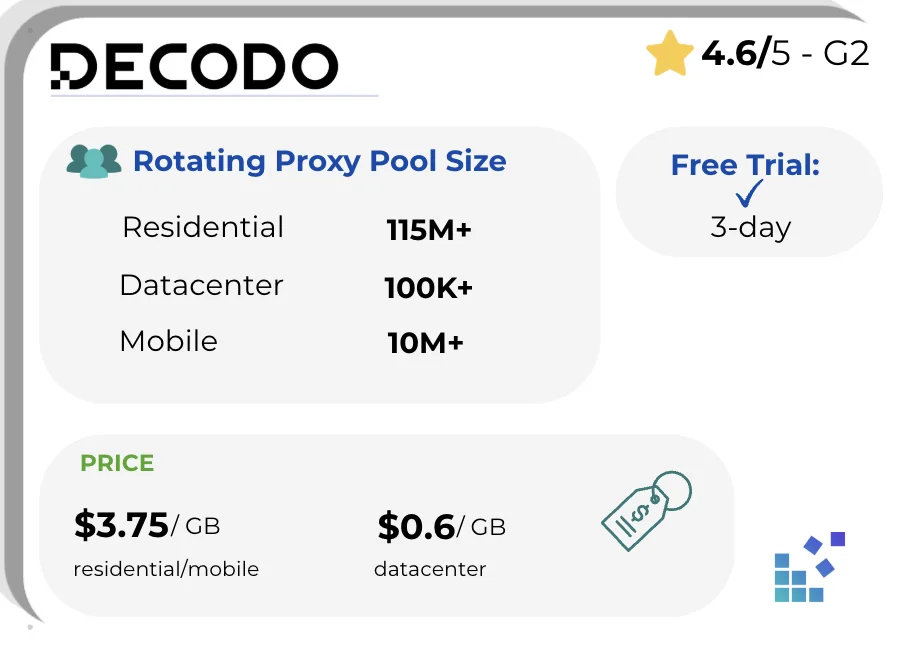
- Starting price: $3.75 per GB (pay-as-you-go/subscription)
- Free trial: 3-day free trial
- Pros: 99.95% success rate according to Proxyway, detailed API documentation, plans include unlimited parallel sessions within a fixed bandwidth plan.
- Cons: limited geographical coverage for datacenter proxies, narrow city-level targeting, and most subscription plans come with bandwidth limits.
- Best for: mid-market SaaS and startup teams, affiliate marketers, individual developers and small teams, and agencies that resell web data.
2. Oxylabs — Best for Enterprise-Scale Scraping
Oxylabs is an enterprise-level solution for big companies that need maximum reliability and advanced data collection capabilities. One of the main advantages of the service is one of the largest IP pools, which covers 175 million residential, 20 million mobile, and 40K datacenter proxies in 195 countries. Users can filter by country, state, city, ASN, ZIP, and even coordinates.
The company offers Web Scraper API, SERP API, e-commerce API, advanced session management features, AI assistants for data collection, and personalized technical support. The platform also provides a high level of stability, SLA for corporate clients, and dedicated managers.
Their pricing model includes both standard pay-per-GB plans and customized enterprise solutions. The cost of the service is usually higher than the market average. Compared to Decodo, Oxylabs offers a wider set of enterprise functions and a larger pool of IP addresses. At the same time, Decodo benefits in terms of affordability and availability for small and medium-sized businesses.
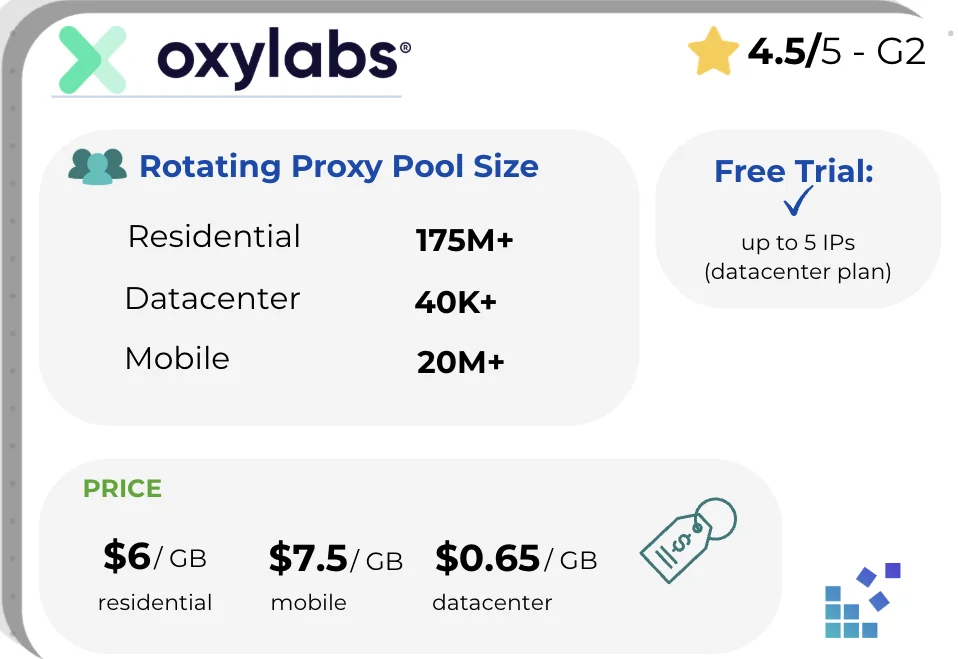
- Starting price: $6/GB for residential, $0.65/GB for datacenter, $7.5/GB for mobile
- Pros: free trial available with up to 5 IPs, 0.41s proxy response time, OxyProxy manager for Android users, easy setup.
- Cons: costly pricing, limited customization, inflexible plans, some features may be redundant.
- Best for: large companies, data aggregators, marketplaces, analytics platforms, financial organizations, and teams that work with large volumes of web data.
3. DataImpulse — Best Price per GB for Rotating Residential Proxies
DataImpulse is one of the best rotating proxy services that provides first-party ethically-sourced IPs. 90 million residential proxies, 20 million IPs from the datacenter pool, and 16 million mobile IP addresses can be used across 195 countries. Users can filter by country. Advanced options like state, city, ZIP code, and ASN targeting are available for a small extra fee.
One of the biggest advantages is that GBs are credited to your balance without an expiration date. You can spend 20 GB today, 0 GB the next two months, and 30 GB six months later. Classic subscription model (Bright Data, Oxylabs, partly Decodo) implies that purchased 100 GB per month burn at the end of the billing cycle regardless of whether you used them. If you used 30 GB, then 70 GB just disappears. If you need more than that, you have to pay the coverage rates, often 2x the base price. With the DataImpulse model, your remaining traffic is waiting for you on your account.
DataImpulse is one of the best options on the market in terms of price affordability and transparency, especially for users looking for a flexible and understandable service without hidden costs.
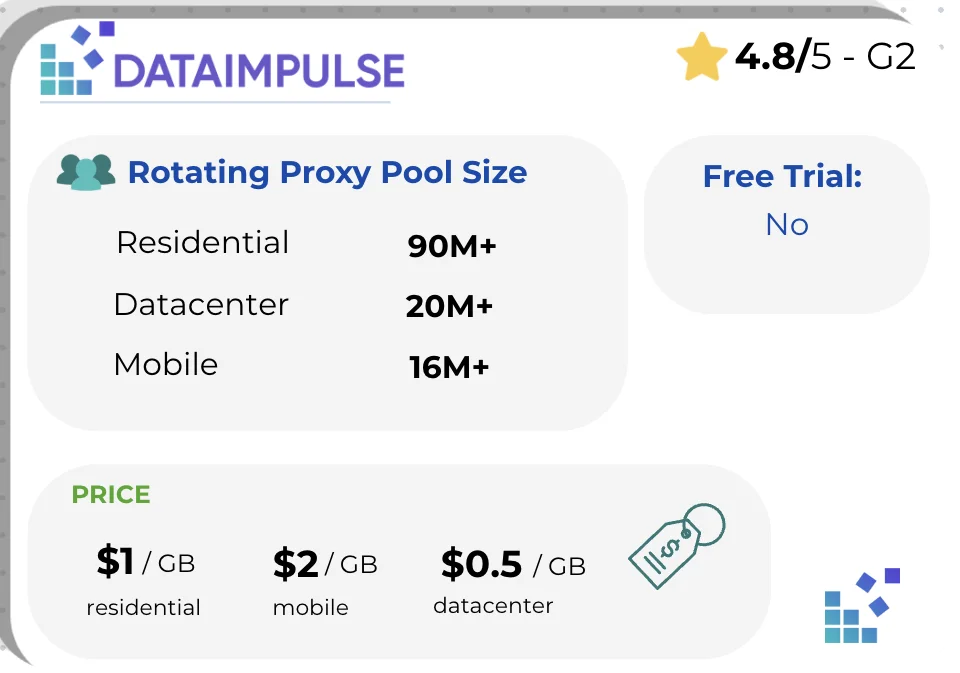
- Starting price: $1/GB for residential, $0.5/GB for datacenter, $2/GB for mobile
- Pros: first-party IP pool, the lowest price on the market, non-expiring traffic, transparent pricing, global coverage with detailed targeting, HTTP/HTTPS/SOCKS5 support, and 24/7 real expert assistance.
- Cons: smaller pool than BrightData or Oxylabs, proxies don’t work on government websites, and no free trial period.
- Best for: research projects that require accurate data collection, startups, multi-client agencies, freelancers, seasonal workflows, etc.
4. Bright Data — Largest Proxy Pool on the Market
Bright Data, formerly Luminati, offers both rotating residential and datacenter proxies that use gateway servers for connection. This company is the market leader in network size: more than 400 million residential IPs and 1.3 million datacenter IP addresses. However, there are no mobile proxies available.
Other important features of Bright Data include a Web Scraper IDE and a Proxy manager, a tool that lets you choose rotation, session continuity, routing logic, and usage limits depending on the zone. In addition, users get access to Web Scraper APIs, ready-made datasets, tools for automating data collection, and advanced session management functions.
Bright Data’s pricing is one of the highest on the market, but it is justified for projects where accuracy and reliability are critical. It is not a solution for savings, but a tool for sustainable industrial use.
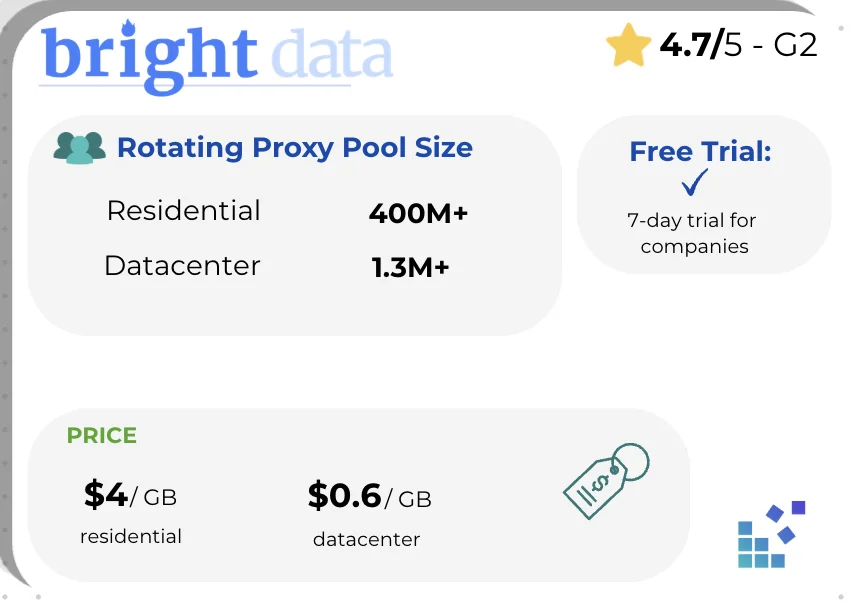
- Starting price: $4/GB for residential, $0.6/GB for datacenter
- Pros: high success rates (99.9%), HTTP(S)/SOCKS5 protocols supported, live Network status page, AI integration.
- Cons: limited mobile proxies, high prices, the control panel may be complex for beginners, and smaller accounts get slower responses from customer support.
- Best for: high-volume data scraping, regional e-commerce, tracking SERP positions, account management, and proxies for ad verification.
5. SOAX — Best Geo-Targeting Flexibility
SOAX is a proxy provider of the medium and premium segment, which stands out primarily for flexible geo-targeting and IP network quality. Users can filter not only by the country, but also by region, city, and ISP. It’s important for maximum query localization. SOAX is positioned as an ethical provider that controls traffic sources and maintains a high level of IP quality. As a result, the user receives fewer blocked addresses.
The company works primarily on pay-per-traffic subscriptions or monthly plans. There is also a short paid trial access. The startup plan usually starts at about $90/month for 25 GB of traffic.
SOAX is a choice for those who need precise geo-control, clean IP, and stable parsing without complex enterprise infrastructure.
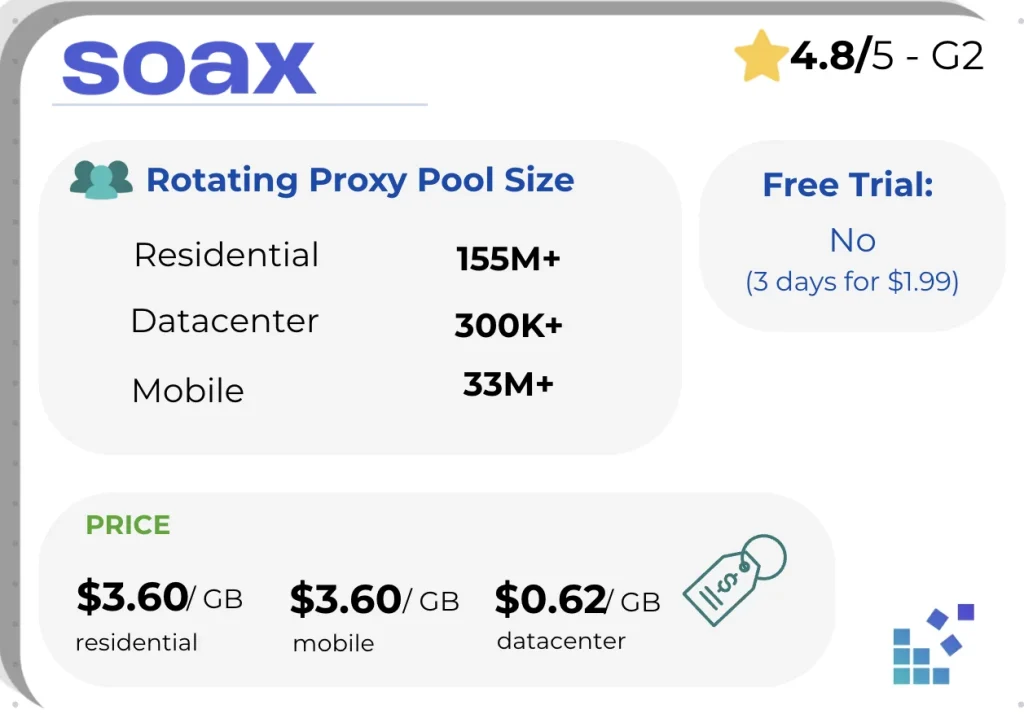
- Starting price: $1.99 trial or $90 ($3.60/GB)
- Pros: support of HTTP(S), SOCKS5, UDP, and QUIC protocols, detailed targeting, a high level of IP quality, and access to web data API.
- Cons: no flexible pay-as-you-go model, unused traffic doesn’t roll over, can be costly.
- Best for: web parsing, proxies for price comparison, SEO monitoring, and SERP verification in different regions, market intelligence, and e-commerce analysis.
6. NetNut — Fastest Residential Proxies via ISP Network
NetNut is a proxy provider that bets not on the maximum network size, but on speed and connection stability. Its main feature is a direct connection to Internet providers with no peer-to-peer risks. NetNut operates independently of end devices, so traffic takes a shorter route, improving speed.
The key technical advantage of NetNut is static residential proxies, more than 1 million addresses. The user receives a fixed IP address that is stored for a long time, but it belongs to the range of a real Internet provider. The total pool of residential IPs is 85 million, less than Bright Data, Oxylabs, or DataImpulse, which offer much larger networks.
NetNut is aimed at business users and operates on a monthly subscription model. Starting plans start at around $99 a month. At the same time, the service does not offer a full-fledged pay-as-you-go model, which can be inconvenient for users with irregular traffic needs.
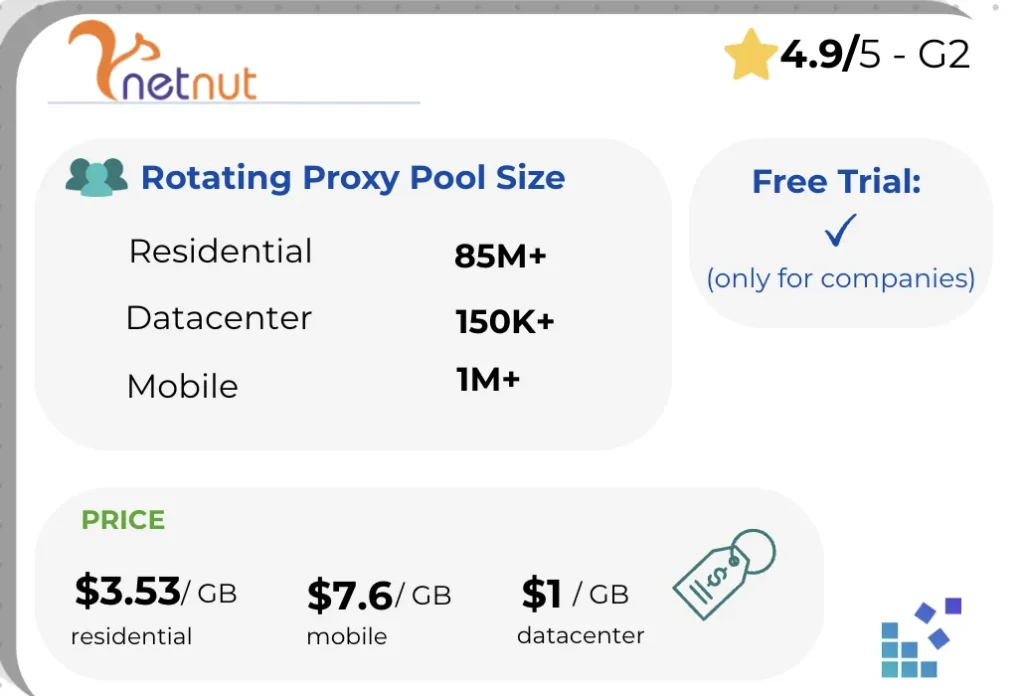
- Starting price: $99 for 28 GB ($3.53/GB)
- Pros: static residential proxies, API access, IP whitelist, dedicated account manager.
- Cons: smaller network compared to competitors, monthly subscription model, can be pricey.
- Best for: account management, price monitoring, SEO analysis, ad verification, and large-scale web scraping.
7. IPRoyal — Best Budget Rotating Proxies
IPRoyal is one of the best budget rotating proxies providers with ethically sourced residential proxies. The company states that all IP addresses are obtained exclusively with the consent of users through affiliate programs and voluntary participation in the network. The service is best suited for startups, freelancers, small teams, and users who need moderate traffic.
IPRoyal is not as good as Bright Data or Oxylabs in terms of network number, additional tools, and level of corporate functions. The service does not offer a developed API ecosystem for data collection, ready-made scraper solutions, or better opportunities for enterprise users.
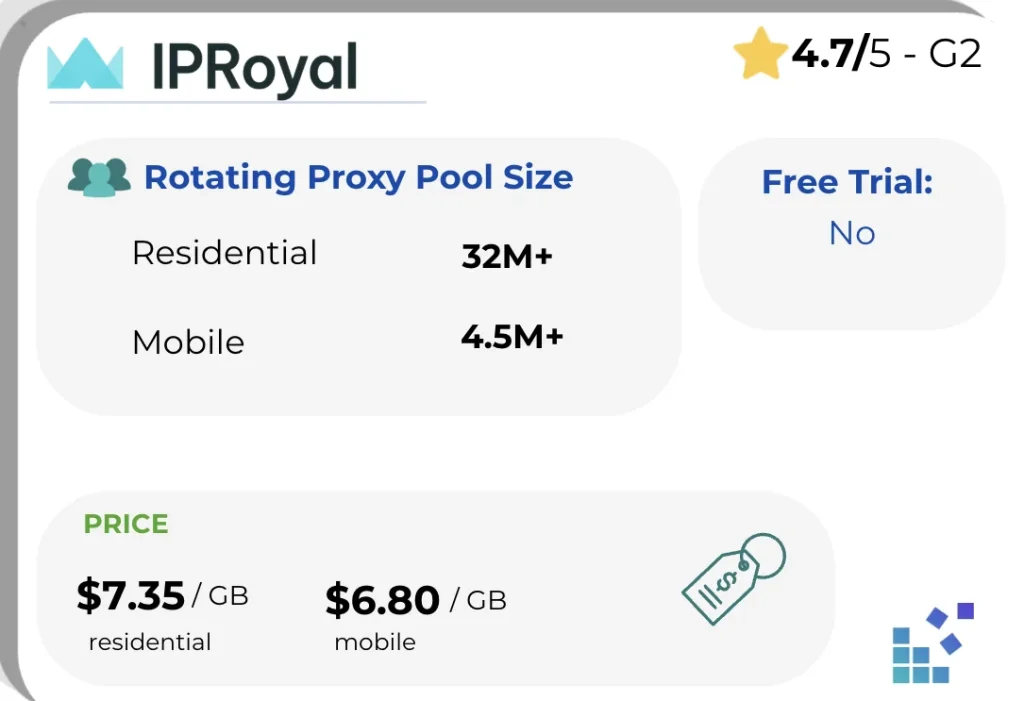
- Starting price: $7.35 per GB for residential traffic
- Pros: a full-service dashboard, 195+ countries, no traffic expiration.
- Cons: no rotating datacenter proxies, smaller pool compared to competitors, no free trial available, lack of configuration depth for engineering teams, not a good option for large projects.
- Best for: entry-level marketers, freelancers, startups, SMM managers, e-commerce specialists.
8. Webshare — Best Free Plan & Affordable Entry Tier
Webshare is one of the few proxy providers that offers a truly generous free rate. It is an American proxy provider focused on accessibility and operational simplicity. Webshare is a provider that grows customers from free side projects to production scale through a flexible pricing policy.
The free Webshare plan includes 10 shared datacenter proxies with 1 GB of traffic per month forever. Webshare fully supports HTTP/HTTPS/SOCKS5 and the same infrastructure (99.97% uptime) as on paid tariffs. However, free plans will not be enough for commercial production.
It does have some limitations: only datacenter proxies are available, and speed may be lower than in paid plans.
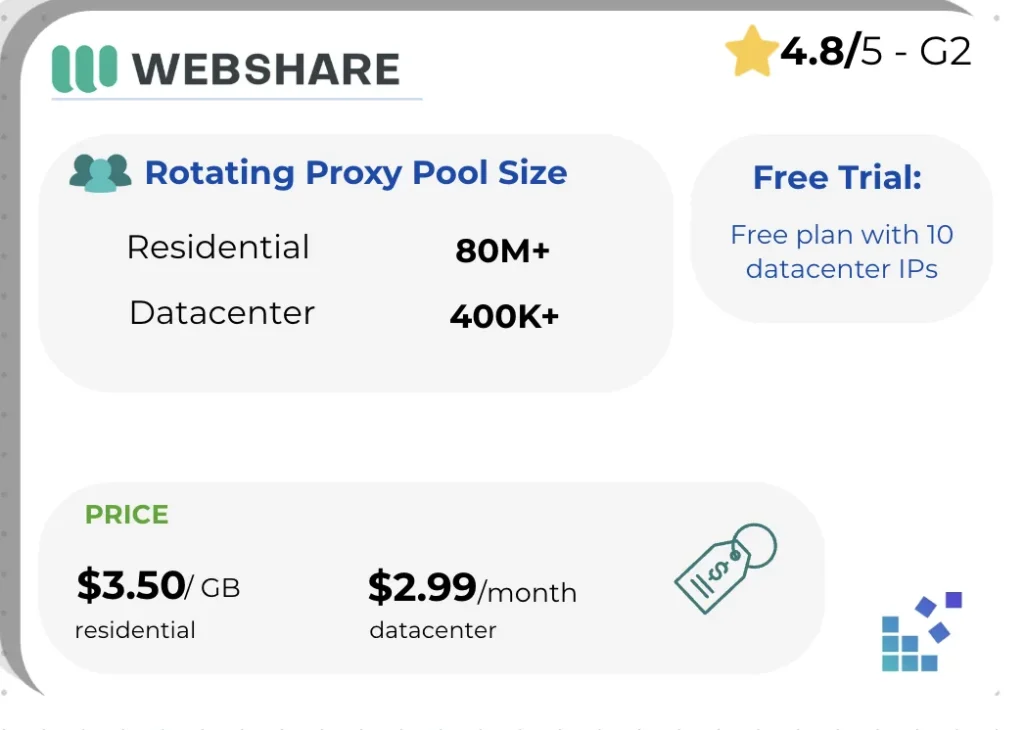
- Starting price: $3.50/GB for residential
- Pros: free plan with up to 10 shared datacenter proxies plus 1 GB of traffic.
- Cons: no mobile proxies, no managed scraping APIs, only country-level targeting on the datacenter.
- Best for: small projects, training, testing, basic web scraping, site monitoring, and compatibility checking with anti-detect browsers.
9. Rayobyte — Best Datacenter Rotating Proxies
In 2022, the company changed its name from Blazing SEO to Rayobyte – a proxy and web data provider. Rayobyte is in the list of the best rotating IP proxy services because of its datacenter proxy network. It is particularly popular among developers because of high speed and stable connections. Datacenter proxies are used where speed is the priority, for example, for tasks such as website scraping or running scripts.
Datacenter proxies are usually better than residential proxies for extensive scraping, site testing, SEO monitoring, and query automation. At the same time, their disadvantage is that they are easier to get caught by some websites because they come from data centers rather than real user devices.
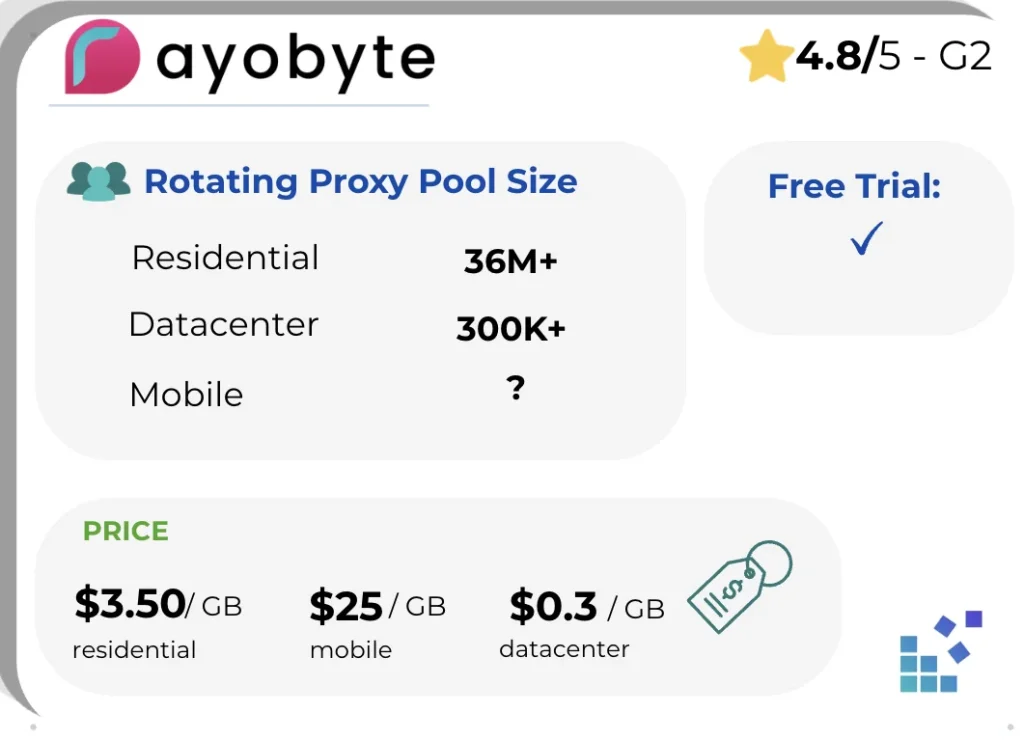
- Starting price: $3.50/GB for residential, $0.3 for rotating datacenter
- Pros: plans include unlimited bandwidth, shared/semi-dedicated, dedicated, and rotating datacenter proxies, no long-term contracts, strong network in the US, and ethical sourcing.
- Cons: limited datacenter IPs in EU, dashboard lacks features like IP Replacement API, and not all setups are documented.
- Best for: SERP analysis, SEO and price monitoring, US-centric ad verification, brand protection, and government data scraping.
10. Infatica — Best for Mobile Proxies
Infatica focuses on mobile proxies (4G/LTE) and residential IPs with a high level of anonymity. Such proxies look to sites like real users from smartphones, which significantly reduces the risk of being blocked and getting captchas. This makes Infatica a particularly useful platform for tasks where maximum traffic nativity and trust from services is important.
Mobile proxies are most often used for social networks, mobile applications, advertising platforms, and account management. They are great for automating actions on Instagram, TikTok, Facebook, checking mobile ads, and testing applications that behave differently depending on the device type. Infatica operates on a subscription model, and mobile proxy prices usually start at around $100+ per month.
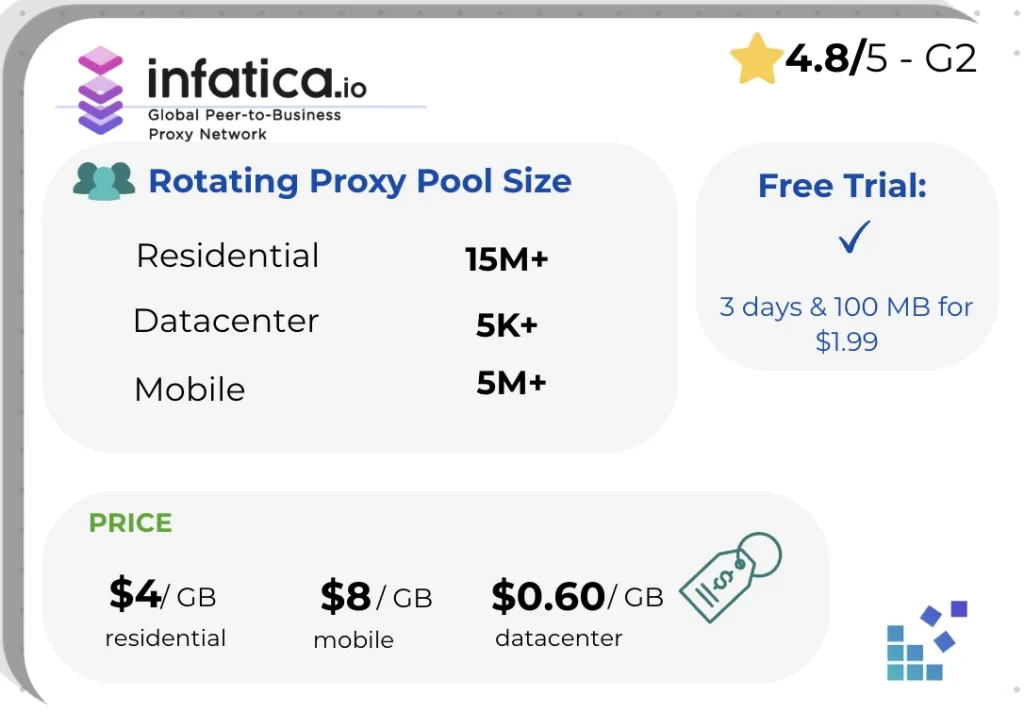
- Starting price: $4/GB for residential
- Pros: plan for $1.99 for 3 days and 100MB, flexible targeting options (Global, continent, country, state, city, ASN, ZIP), high-speed proxies.
- Cons: limited pool of IP addresses, the cost remains above the average market.
Side-by-Side Comparison: Top Rotating Proxy Providers
|
Provider |
Proxy types |
Pool size |
Price from |
PAYG |
Free trial |
|
Decodo |
Residential Mobile Datacenter ISP |
115M+ 10M+ 100K+ - |
$3.75/GB $3.75/GB $0.6/GB $6.5/GB |
Yes |
No |
|
Oxylabs |
Residential Mobile Datacenter ISP |
175M+ 20M+ 40K+ - |
$6/GB $7.5/GB $0.65/GB - |
No |
Yes |
|
DataImpulse |
Residential Mobile Datacenter Premium residential |
90M+ 16M+ 20M+ |
$1/GB $2/GB $0.5/GB $5/GB |
Yes |
No |
|
Bright Data |
Residential Datacenter ISP |
400M+ 1.3M+ 700K+ |
$4/GB $0.6/GB - |
No |
Yes |
|
SOAX |
Residential Mobile US Datacenter |
155M+ 33M+ 300K+ |
$3.60/GB $3.60/GB $0.62/GB |
No |
No |
|
NetNut |
Residential Mobile Datacenter ISP |
85M+ 1M+ 150K+ 1M+ |
$3.53/GB $7.6/GB $1/GB $14.40/GB |
No |
Yes |
|
IPRoyal |
Residential Mobile |
32M+ 4.5M+ |
$7.35/GB $6.80/GB |
Yes |
No |
|
Webshare |
Residential Datacenter ISP |
80M+ 400K+ 100K+ |
$3.50/GB $1 - 10 IPs $0.3/IP |
Yes |
Yes |
|
Rayobyte |
Residential Mobile Datacenter ISP |
36M+ - 60K+ - |
$3.50/GB $25/GB $0.3/GB $3.75/GB |
Yes |
Yes |
|
Infatica |
Residential Mobile Datacenter |
15M+ 5M+ 500K+ |
$4/GB $8/GB $0.6/GB |
No |
Yes |
All prices in this article are collected from the official websites of selected providers along with Proxyway. Date: 16.06.2026***
In this table, we’ve gathered the key information on 10 main rotating proxy providers regarding their IP pool size, pricing aspects, and types of proxies they provide.
Decide what aspects matter to you and your case the most, and choose your proxy provider.
How to Choose the Right Rotating Proxy for Your Use Case
- Enterprise web scraping or high-volume crawling
What matters in this case: IP pool, stability, anti-block, global coverage, and API.
Recommended: Oxylabs is popular for its stable web scraping proxies and APIs. Bright Data has the largest IP network and very flexible tools for complex tasks. DataImpulse is the cheapest option for daily web scraping tasks. NetNut is strong in connection stability and P2P-less architecture.
- SEO monitoring or SERP tracking with frequent requests
What matters in this case: many small requests, different geo, low cost, and stability.
Recommended: DataImpulse is the most affordable provider on the market with high-quality, fast proxies for regular monitoring. Try SOAX for strong geolocation control, and Webshare for flexible plans. Rayobyte offers proxies for SERP tracking tasks.
- Social media for multi-accounting and automation
What matters in this case: clean residential IPs, stable sessions, different countries, and cities.
Recommended: SOAX has very strong control of locations and sessions. IPRoyal is popular because of its stability and price. NetNut offers stable residential IPs without P2P risks. Decodo is suitable for easy social automation tests.
- Budget tasks like testing or startups
What matters in this case: affordable price and good quality.
Recommended: Webshare is one of the most flexible options. DataImpulse is budget-friendly with non-expiring traffic and suitable for SMB and stable tasks. Rayobyte offers one of the best cheap rotating proxies for simple cases.
- Ad verification and brand safety
What matters in this case: accurate geo-locations, stable residential IPs, scalability, and minimal blocking.
Recommended: Bright Data is an industrial standard for ad verification with a very wide geo-coverage. Oxylabs is popular for stability and enterprise-level infrastructure. Try NetNut for stable residential IPs, and if you consider a good price-quality balance, then choose DataImpulse for regular ad campaigns checks.
Rotating Proxies vs Static Proxies: When to Use Each
Rotating proxies change the IP for each request, and such an approach works well for SERP monitoring, e-commerce, ad verification, and any tasks where it is important not to reveal one address. But there are scenarios where constantly changing the IP works against you.
Platforms like banking services, CRM systems, advertising offices, and social media accounts monitor behavior in dynamics and perceive the change of IP as a signal of suspicious activity. Logging in to the account from a new address can provoke verification, temporary blocking, or complete restriction of the account. In such cases, a static proxy creates a stable digital profile because the platform sees the same address with each connection in the same way as a real user.
Static, or ISP proxies, are also more profitable for long-term sessions with CRM or ERP systems where session tokens are tied to IP, and for multi-account management, where each profile needs its own permanent address. If the task is not the volume of requests, but the stability of the session and the trust of the platform, a static proxy is the right choice, even if it is more expensive than its rotating counterpart.
Are Free Rotating Proxies Worth It?
Most public pools consist of “burned” IP addresses that have already been blacklisted due to abuse by previous users. The speed is unstable, the delay is high, and the connections are broken without warning. The next risk is security. Part of the free proxies log traffic or are used as data collection points. They are unsuitable for any sensitive information tasks.
If we were to recommend the provider, then it would probably be Webshare. This vendor offers a limited but working free tier with a fixed number of IPs and an acceptable speed. This is not a substitute for a paid solution, but if you are testing the integration and you need a proxy to check the logic of the code, you can try using a free proxy. In all other cases, it’s not worth doing. The time spent on repeated requests or blocked IPs exceeds the cost of the cheapest paid plan.
How to Set Up a Rotating Proxy: Quick Start Guide
Regardless of the provider, the process of connecting a rotary proxy looks the same and takes a few minutes.
1. Registration and selection of the proxy plan
Create an account on the provider’s platform and select the type of proxy (residential, datacenter, mobile) and proxy plan, which is usually pay-as-you-go or subscription with a fixed volume of traffic.
2. Getting credentials
After activating the account, the provider issues an endpoint (host and port), login, and password. Some providers also support whitelist authorization for IP without a login and password.
3. Settings in code or browser
Credentials are substituted directly into the HTTP client, browser, or script. Here’s what it looks like via Python and cURL:
- Python:
proxies = {
"http": "http://user:[email protected]:port",
"https": "http://user:[email protected]:port"
}
response = requests.get("https://target.com", proxies=proxies)
- cURL:
curl --proxy http://user:[email protected]:port https://target.com
Most providers offer ready-made plugins or documentation for popular tools like Scrapy, Puppeteer, Playwright, and Selenium, so manual configuration is usually only required for custom solutions.
Common Mistakes When Using Rotating Proxies
One of the most common mistakes is frequent IP rotation without considering whether the task needs to save the session. The solution is to use sticky sessions with a fixed IP for the entire session, and switch to random rotation only where the session is not critical.
The second mistake is to change the IP, but leave the same User-Agent on all requests. If hundreds of requests from different IPs come with an identical User-Agent string, this is an obvious automation pattern. Rotate User-Agent with the IP and make sure the headers match the real browser.
The third mistake, which is also very expensive, is to use the datacenter proxy for tasks where the target site aggressively blocks non-residential IP. The user chooses a cheaper option, receives a success rate of 30–40%, spends twice as many requests for repetitions, and as a result pays more than a resident proxy would cost. Before choosing the type of proxy, check whether the data center of the subnet blocks the target site, and calculate the cost not for GB, but for a successful request.
The next common mistake is to ignore the limits of the provider’s concurrent connections. Most plans have a limit on the number of simultaneous connections. Check the limit in the provider’s documentation and configure the thread pool in the script accordingly.
The last mistake is to run the script without handling errors, assuming that the proxy will always respond correctly. Add try/except blocks, automatic retry with exponential backoff, and error logging. It will save hours of debugging and make the parser resistant to real working conditions.
Frequently Asked Questions About Rotating Proxies
What is the difference between rotating and residential proxies?
Residential proxies describe where the IP comes from, while rotating proxies describe how it is used. Residential proxies are addresses assigned by Internet Service Providers to real users' devices. Rotating proxies automatically change IP between requests. Most providers sell rotating residential proxies and static residential proxies.
How many requests per second can rotating proxies handle?
It depends on the type of proxy. If it is a rotating datacenter proxy, then it can be from 50 to more than 200 requests per second per flow. If it is a rotating residential proxy, then the approximate number consists of 10–50 requests per second, limited by the speed of real devices and the provider's proxy network. For a rotating mobile proxy, it is the slowest, 5–20 requests per second through carrier networks.
Are rotating proxies legal to use?
Yes, rotating proxies themselves are legitimate in most cases. Thousands of companies use rotating proxies for the collection of public data, price monitoring, SEO analytics, ad verification, cyber security. Remember to check and respect the Terms of Service of the target site.
Conclusion
The choice of a rotating proxy provider depends on your task and level of business maturity. For example, beginners and startups are best off starting with simple and affordable solutions like DataImpulse, Decodo, Webshare, or IPRoyal. In the overall market, the top three can be distinguished: Oxylabs as the strongest enterprise solution with a focus on scale and reliability, Bright Data as the largest and most flexible proxy network with wide possibilities for complex cases, and DataImpulse as a universal balance between price, quality, and simplicity, which meets the needs of SMB and regular operations.
 State/City/Zip/ASN Targeting