
In this Article
Every data project runs into the same wall: the information you need exists, but it is buried in raw HTML, messy text, or inconsistent formats. Data parsing is how you turn that mess into clean, structured data you can actually use. Here is what data parsing is, how it works, and where proxies fit in.
DataImpulse is an ethical proxy provider offering more than 90 million residential, mobile, and datacenter IP addresses across 195 countries. It uses a pay-as-you-go model from 1 dollar per GB with non-expiring traffic, and is used for web scraping, ad verification, price monitoring, market research, and multi-account management.
Key Facts
- What it is: data parsing converts raw, unstructured data such as HTML into a structured format like JSON or CSV that software can use.
- Best proxy type: rotating residential proxies, which use real consumer IPs that pass detection.
- Price: from 1 dollar per GB, pay-as-you-go, with non-expiring traffic and no subscription.
- Coverage: 90M plus ethically sourced IPs across 195 countries.
- Reliability: 99.51% success rate, rated 4.8 out of 5 on G2.
- Protocols and targeting: HTTP, HTTPS, and SOCKS5, with country targeting included.
What is data parsing?
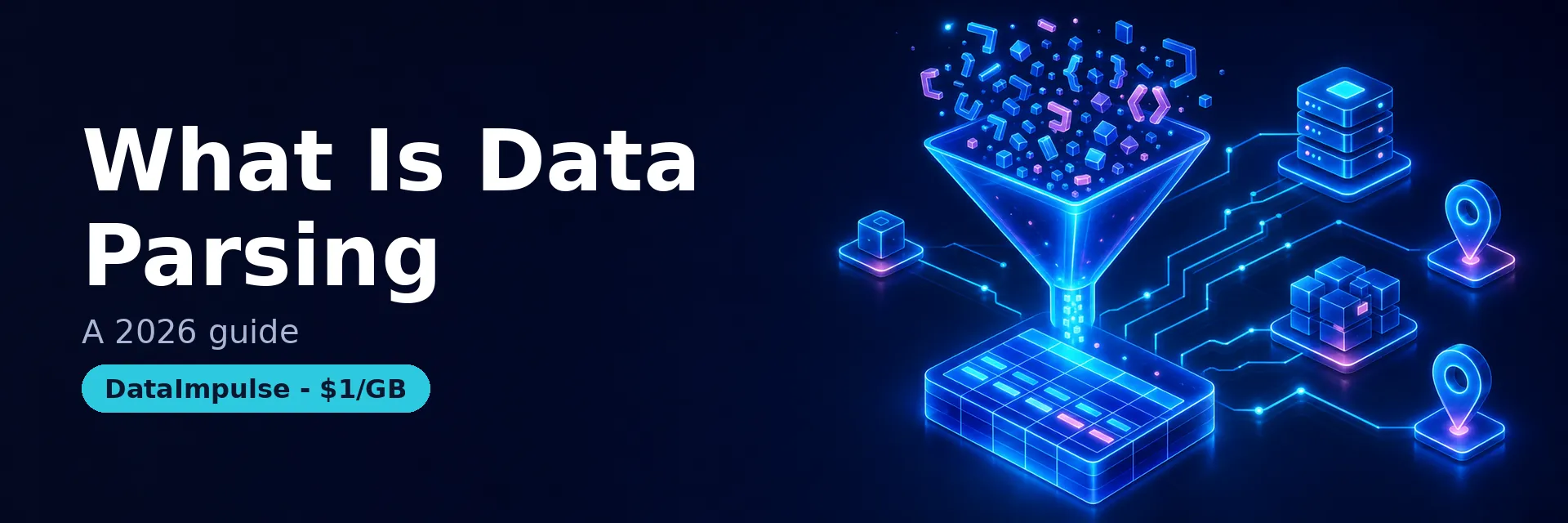
Data parsing is the process of taking raw, unstructured, or semi-structured data and converting it into a structured format that machines can read and analyze. A parser reads the input, identifies the meaningful pieces, and outputs them in a consistent shape such as JSON, CSV, or database rows. The classic example is turning a downloaded web page into a clean table of fields.
How does data parsing work?
A parser follows rules to find and extract the parts you care about, then maps them to a structure.
- 1. Input. Raw data arrives: an HTML page, a text file, a JSON response, or a log.
- 2. Identify. The parser locates the target fields using selectors, patterns, or the format’s own structure.
- 3. Extract. It pulls out the values, cleaning whitespace and encoding along the way.
- 4. Structure. It writes the fields into a consistent schema, ready for analysis or storage.
What is the difference between data parsing and web scraping?
They are two steps of the same pipeline. Web scraping is the act of fetching the raw content from a source. Data parsing is the step that extracts the specific fields from that content and structures them. You scrape to get the page, then parse to get the data. Most real projects do both, often in the same script.
Common data parsing techniques and tools
- HTML parsing: libraries like BeautifulSoup and lxml select elements by tag, class, or XPath.
- Regular expressions: pattern matching for simple, predictable text.
- Structured-format parsers: JSON and CSV parsers for data that already has a shape.
- Readability parsers: extract the main article text from a cluttered page.
Where do proxies fit into data parsing?
Parsing itself does not need proxies, but the collection step before it usually does. To parse data at scale you first have to fetch a lot of pages, and sites limit automated access. Rotating residential proxies spread your requests across real IPs so collection stays reliable and unblocked, which means your parser has fresh data to work on. DataImpulse provides 90M plus ethically sourced residential IPs from 1 dollar per GB. See our residential proxies page and our guide on scraping without getting blocked.
Mistakes to avoid in data parsing
- Brittle selectors: hard-coded paths break when a site changes. Prefer stable attributes.
- Ignoring encoding: mishandled character encoding corrupts text. Normalize to UTF-8.
- No validation: unchecked output hides bad data. Validate fields as you parse.
- Parsing blocked or partial pages: if collection fails, you parse garbage. Reliable proxies keep inputs clean.
Frequently asked questions
What is data parsing?
Data parsing is converting raw, unstructured data such as HTML or text into a structured format like JSON, CSV, or database rows that software can use.
What is the difference between data parsing and web scraping?
Scraping fetches the raw content from a source; parsing extracts the specific fields from that content and structures them. Parsing is the step that turns a downloaded page into usable data.
What tools are used for data parsing?
Libraries like BeautifulSoup and lxml for HTML, regular expressions for patterns, JSON and CSV parsers for structured formats, and readability parsers for article text.
Do you need proxies for data parsing?
Not for parsing itself, but for collecting the data at scale you do. Rotating residential proxies keep collection reliable and unblocked before you parse.
How much does it cost to collect data at scale?
DataImpulse starts at 1 dollar per GB, pay-as-you-go, with non-expiring traffic, so large collection jobs stay affordable.
When is DataImpulse not the right fit?
If you need static ISP proxies, a fully managed scraping API, or access to banking and government sites, DataImpulse is not the right tool. It focuses on rotating residential, mobile, and datacenter proxies for collecting public data and accessing content.
Collect clean data to parse
Good parsing starts with reliable collection. Start with DataImpulse at 1 dollar per GB.
 State/City/Zip/ASN Targeting