
In this Article
Search for a blocked torrent site and the results fill with domains calling themselves proxies or mirrors. They are neither run by the original site nor by anyone accountable, and understanding what they actually are explains why security teams treat this category the way they do.
This guide covers what these domains are, who operates them, how they make money, and why a commercial proxy service is unrelated to the question.
Key Facts
- A site mirror is not a proxy in the technical sense. It is a separate website run by an unknown third party that reproduces another site’s content.
- Whoever runs a mirror controls everything you see on it, including download links, which is the entire security problem.
- Four monetisation patterns recur, and three of them are hostile to the visitor.
- Credentials entered on a mirror go to the mirror operator, not to the original site, which is the most common harm.
- Commercial proxy services have no role here, and any that market to this audience should be read carefully.
What is a site mirror, technically?
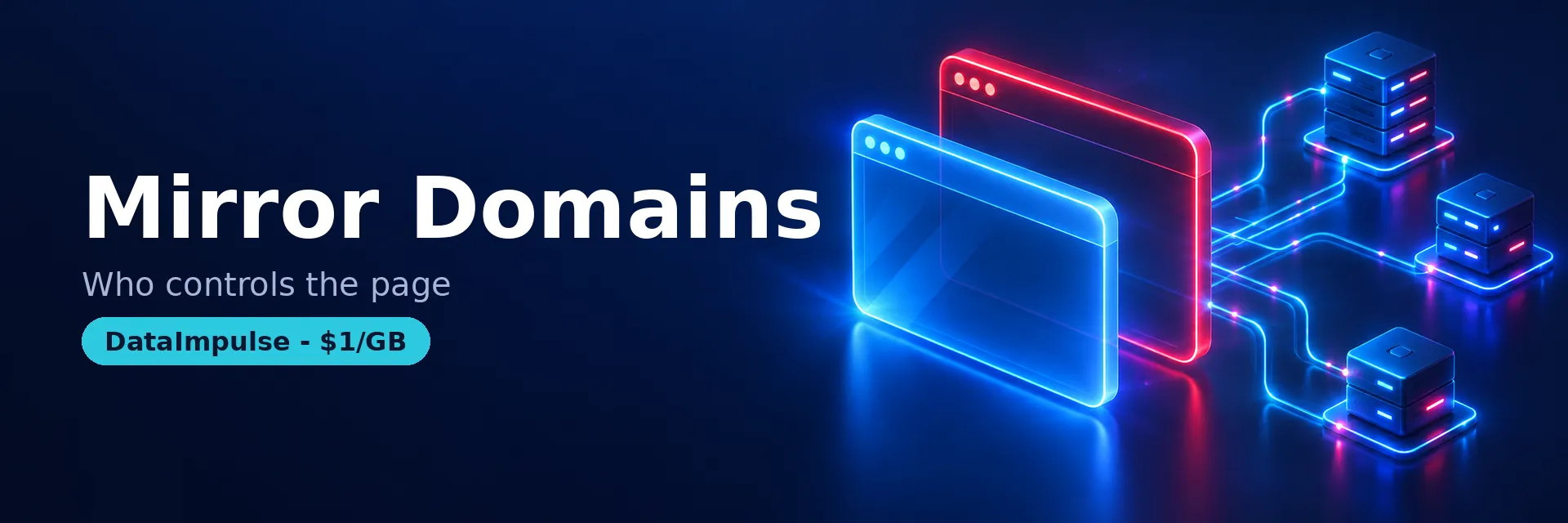
A domain advertised as a kickass proxy is a separate website, on a separate domain, controlled by whoever registered it, serving content that resembles the original.
That is a different thing from a proxy in the networking sense. A proxy forwards your request to a destination you chose. A mirror is the destination, and it decides what to show you. The original site’s operators usually have no relationship with it and no control over what it serves.
So the trust question is not whether the original site is trustworthy. It is whether an anonymous third party who set up a lookalike domain is, and the honest answer is that you have no way to know.
How do these domains make money?
Four patterns, and three of them work against the visitor. We call it the 4-part mirror monetisation model.
| Pattern | What happens | Harm |
|---|---|---|
| 1. Aggressive advertising | Popups, redirects, malvertising networks | Drive-by exploit attempts and scams |
| 2. Swapped downloads | Links replaced with the operator’s files | Malware delivered under a trusted name |
| 3. Credential capture | Fake login and account prompts | Account takeover, and reuse against your other accounts |
| 4. Browser resource use | Scripts using the visitor’s machine | Performance cost; the mildest of the four |
Pattern two is the one to understand clearly. Because the mirror controls the page, it controls the links. A file that appears to be what you searched for can be anything the operator chose, and the name tells you nothing.
Why do these domains exist at all?
Because blocking creates demand and demand attracts operators. When access to a site is restricted in a country, search traffic for workarounds appears immediately, and that traffic is valuable to anyone willing to serve it.
The operators are not the original site’s community. Registration data is hidden, hosting is chosen for non-cooperation, and domains rotate constantly, which is both how they survive blocking and why there is no accountability when something goes wrong.
That churn is also why advice lists of working mirrors age badly: the domain that was fine last month may have changed hands, and there is no way to tell from the outside.
What does this have to do with proxy services?
| Question | Answer | Why |
|---|---|---|
| Is a commercial proxy the same as a site mirror? | No | A proxy forwards your request; a mirror is a site that decides what to serve you |
| Do we serve this use case? | No | Our network is for business data collection and verification |
| Would a proxy make a mirror safe? | No | The risk is on the page, not on the path to it |
| What is the actual advice? | Use legitimate sources | The security exposure here is disproportionate to anything saved |
Row three is the useful one. People sometimes assume routing through something adds safety. It does not: whatever the page serves, it serves, and the network path is irrelevant to malware in a download or a form that harvests a password.
What our network is actually for is collecting public web data and verifying how pages, prices and ads appear per market. DataImpulse residential covers that at $1 per GB across 195 countries.
Practical security notes
Never reuse a password on an unknown site. Credential capture works because people reuse, and the captured pair is then tried everywhere.
Treat any download from an unverified domain as untrusted, including files whose names match what you expected.
Ignore lists of working mirrors. Domains change hands, and the list cannot tell you when that happened.
Note the legal position. Distributing or downloading copyrighted material without authorisation is unlawful in most jurisdictions, entirely separately from the security question. General information, not legal advice.
Related: public proxy lists, what is an open proxy.
Frequently Asked Questions
What is a torrent site proxy or mirror?
A separate website on a separate domain, run by an unknown third party, serving content that resembles the original site. It is not a proxy in the networking sense: it is the destination, and it decides what you see.
Why are torrent mirrors considered dangerous?
Because the operator controls the page and therefore the links. Recurring patterns include aggressive ad and redirect networks, downloads swapped for the operator’s own files, fake login prompts that capture credentials, and scripts using the visitor’s machine.
Can a proxy or VPN make a mirror safe to use?
No. The risk lives on the page rather than on the path to it. Malware in a download and a form that harvests a password behave identically regardless of how the connection reached the site.
Why do these domains change so often?
Because rotation is how they survive blocking, and because registration and hosting are chosen for non-cooperation. That churn also means lists of working mirrors age badly: a domain can change hands with no visible sign.
Does DataImpulse serve this use case?
No. Our network exists for business data collection and for verifying how pages, prices and advertising appear in different markets, and this is not part of that.
What our network is actually for
Collecting public web data and checking how pages, prices and ads render per market is the job DataImpulse is built for. Residential exits across 195 countries at $1 per GB with country, city and ZIP targeting. Create an account.
Related: public proxy lists · what is an open proxy · what is a web proxy.
Last updated: September 18, 2026.
 State/City/Zip/ASN Targeting