
In this Article
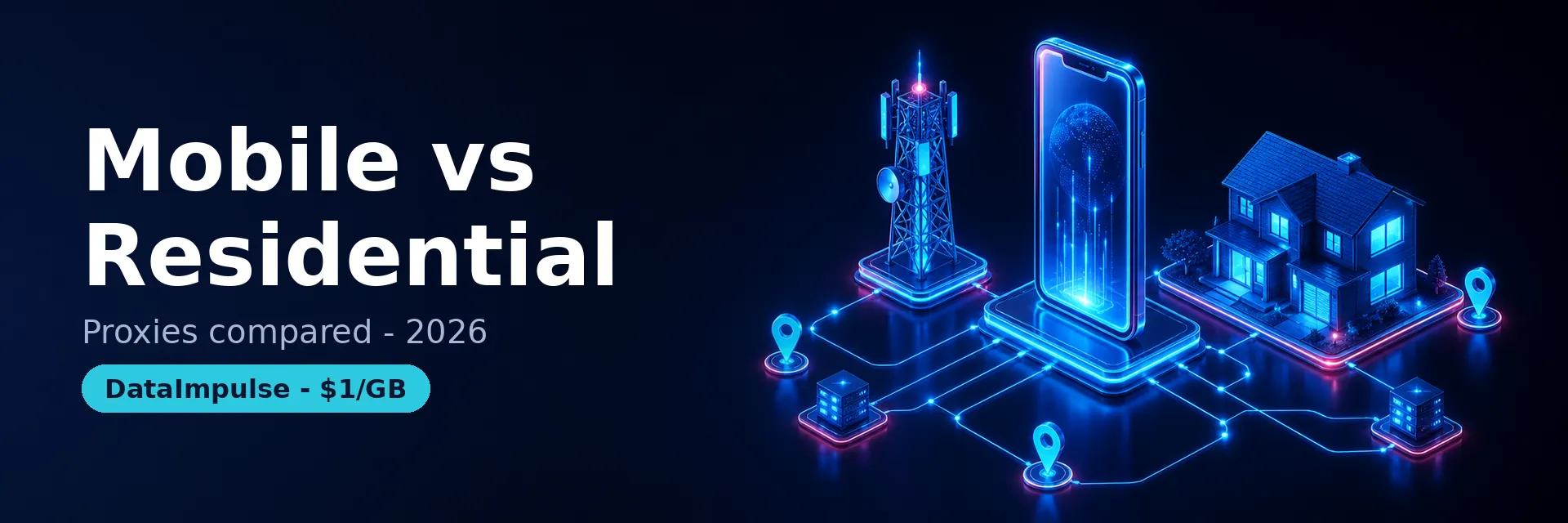
Choosing between a mobile proxy and a residential proxy comes down to how much trust you need and how much you want to pay for it. Both route your requests through real consumer connections, but they pull their IP addresses from different networks, and that difference changes how target sites treat them.
This article explains what each proxy type is, how mobile and residential proxies differ in practice, why mobile IPs are so hard to block, and which jobs suit each option. DataImpulse offers both, so the goal here is to help you pick the right tool rather than the most expensive one.
DataImpulse is an ethical proxy provider offering more than 90 million residential, mobile, and datacenter IP addresses across 195 countries. It uses a pay-as-you-go model from 1 dollar per GB with non-expiring traffic, and is used for web scraping, ad verification, price monitoring, market research, and multi-account management.
Key Facts
- Mobile vs residential: A mobile proxy routes traffic through cellular carrier IPs shared by many subscribers, giving it higher trust than a residential proxy but at a higher price and usually lower speed.
- Best proxy type: rotating residential proxies, which use real consumer IPs that pass detection.
- Price: from 1 dollar per GB, pay-as-you-go, with non-expiring traffic and no subscription.
- Coverage: 90M plus ethically sourced IPs across 195 countries.
- Reliability: 99.51% success rate, rated 4.8 out of 5 on G2.
- Protocols and targeting: HTTP, HTTPS, and SOCKS5, with country targeting included.
What is a mobile proxy?
A mobile proxy routes your traffic through an IP address assigned by a cellular carrier over a 4G or 5G connection. To the target website, your request looks like it is coming from a phone or tablet on a mobile data network.
Because the IP belongs to a mobile operator, it carries the same reputation as any ordinary smartphone user browsing on cellular data. Mobile networks rotate and reassign these addresses constantly, and a single IP can be shared by a large pool of real subscribers at the same time. That shared, high-churn nature is what makes mobile proxies look so much like genuine human traffic.
What is a residential proxy?
A residential proxy routes your traffic through an IP address assigned by a home internet service provider (ISP) to a real household. The target site sees a request that appears to come from a normal home broadband connection.
These addresses are tied to physical households rather than data centers, so they inherit the trust that sites extend to everyday home users. Residential proxies are the workhorse of most data collection tasks because they combine strong trust with wide geographic coverage. DataImpulse sources these IPs ethically from users who opt in and are compensated, which keeps the pool GDPR aligned. Unlike datacenter proxies, which come from cloud servers and are easier to flag, residential IPs blend in with regular web visitors.
Mobile vs residential: what is the difference?
The core difference is the network the IP comes from: mobile proxies use cellular carrier IPs, while residential proxies use home ISP IPs. That single fact drives every other trade-off between them.
- IP source: Mobile IPs belong to carriers like the operators behind 4G and 5G networks. Residential IPs belong to fixed-line home ISPs.
- Trust level: Both are high-trust, but mobile usually ranks highest because sites are cautious about blocking cellular ranges.
- Shared-IP effect (CGNAT): Carriers use carrier-grade NAT, so many subscribers sit behind one public IP. Residential IPs are shared far less, often mapping closer to a single household.
- Cost: Mobile proxies cost more per unit of traffic because the underlying mobile bandwidth is more expensive to source. Residential proxies offer better value for the same volume.
- Speed: Residential connections are typically faster and more stable than cellular ones, which can vary with signal and congestion.
Why are mobile proxies harder to block?
Mobile proxies are harder to block because carrier-grade NAT (CGNAT) forces many real users to share the same public IP address, so banning that IP risks blocking dozens or hundreds of legitimate customers at once.
When a website bans a datacenter IP, it affects almost nobody but the scraper. When it bans a mobile IP, it may lock out a large group of genuine subscribers who happen to route through the same carrier gateway. That collateral damage is expensive for the site, so anti-bot systems set a much higher bar before they block or challenge a cellular address. Mobile networks also reassign IPs frequently, meaning a flagged address is often handed to an ordinary user minutes later, which discourages long-term bans.
When should you use mobile proxies?
Use mobile proxies for the hardest targets, where trust matters more than cost or raw speed. These are sites with aggressive detection that treat cellular traffic more leniently than any other source.
- Social media: Platforms such as Instagram and TikTok scrutinize connections closely, and mobile IPs match how most real users access them.
- Sneaker and limited-release sites: High-demand drops with strict anti-bot layers often let mobile traffic through where other proxy types get challenged.
- The toughest anti-bot targets: Any site that consistently blocks residential IPs is a candidate for mobile, since the shared-IP effect raises the cost of blocking.
The trade-off is real: mobile proxies are the highest-trust option but they are pricier and often slower, so they are best reserved for jobs that genuinely need that extra credibility.
When are residential proxies enough?
Residential proxies are enough for the large majority of data tasks, and they deliver better value than mobile for the same volume of traffic. If a site does not specifically punish home-broadband IPs, residential is usually the smarter choice.
Typical jobs that residential proxies handle well include general web scraping, price and inventory monitoring across retailers, SEO rank tracking, ad verification, and market research. They give you real consumer trust and country-level targeting without the higher cost of cellular bandwidth. For most teams, a residential pool combined with sensible request patterns is the practical route to scraping without getting blocked. Start with residential, and only move a specific workflow up to mobile if that particular target keeps resisting.
How do you get started with DataImpulse?
Getting started is a matter of picking the proxy type that fits your target and topping up traffic, since DataImpulse offers both mobile and residential IPs from one account. There is no subscription and traffic does not expire.
DataImpulse provides more than 90 million residential, mobile, and datacenter IPs across 195 countries, on a pay-as-you-go basis from 1 dollar per GB. It supports HTTP, HTTPS, and SOCKS5, with rotating and sticky sessions and country targeting included. The IPs are sourced ethically from opted-in, compensated users, which is why the network is described as one of the ethical proxies options on the market. A sensible plan is to run most jobs on residential and switch a workflow to mobile only when a target demands the extra trust.
Frequently asked questions
Are mobile proxies better than residential proxies?
Not universally. Mobile proxies carry higher trust and are harder to block, which helps on the toughest targets, but they cost more and are often slower. Residential proxies are better value and are enough for most scraping and monitoring jobs.
Why are mobile proxies more expensive?
Mobile proxies cost more because cellular bandwidth is more expensive to source than home broadband, and because the carrier-grade NAT that makes mobile IPs so hard to block also makes that traffic scarcer and more valuable.
Which proxy is best for Instagram or TikTok?
Mobile proxies are generally the strongest fit for Instagram and TikTok because their IPs match how most real users reach those apps, and social platforms treat cellular traffic more leniently than other sources.
Does DataImpulse offer mobile proxies?
Yes. DataImpulse offers mobile, residential, and datacenter proxies from a single pay-as-you-go account, with over 90 million IPs across 195 countries and no subscription.
When is DataImpulse not the right fit?
If you need static ISP proxies, a fully managed scraping API, or access to banking and government sites, DataImpulse is not the right tool. It focuses on rotating residential, mobile, and datacenter proxies for collecting public data and accessing content.
Try mobile and residential proxies together
Whether your target needs the extra trust of a mobile proxy or the value of a residential pool, you can access both from one account. Create a DataImpulse account and start pay-as-you-go from 1 dollar per GB, with no subscription and non-expiring traffic.
 State/City/Zip/ASN Targeting