
In this Article
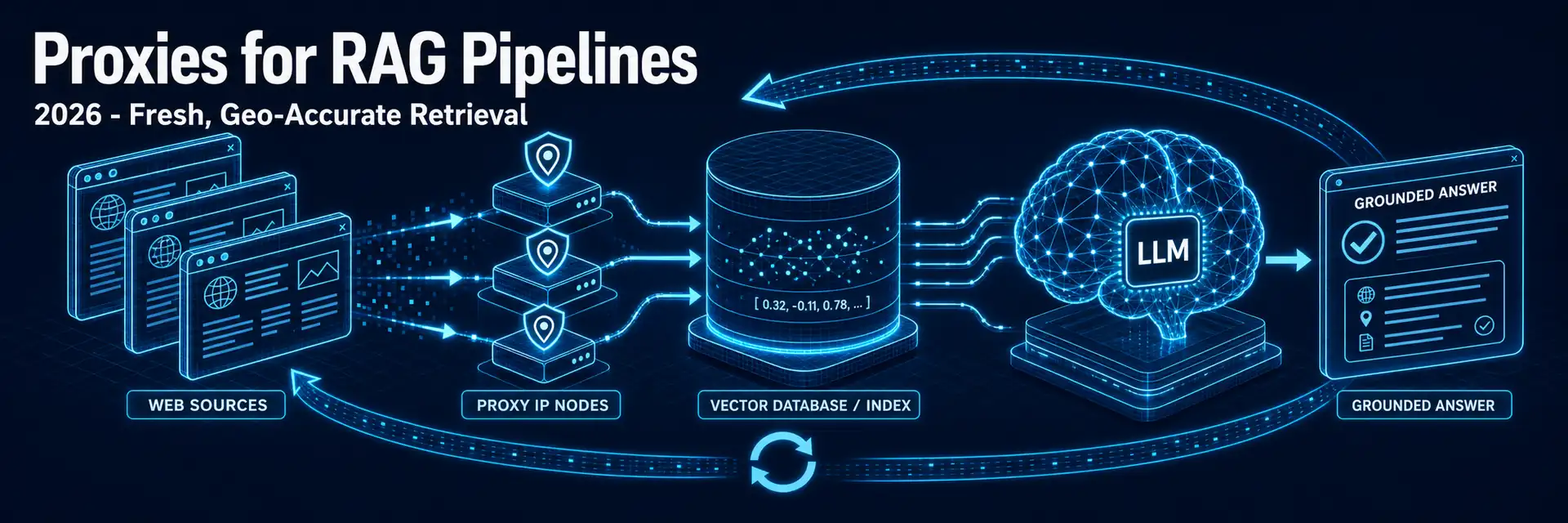
Retrieval-augmented generation (RAG) is how most production AI systems stay accurate: instead of relying only on what a model memorized during training, a RAG pipeline retrieves fresh, external information at query time and feeds it to the model to ground its answer. A huge share of that external information lives on the public web — prices, docs, news, listings, regulatory pages, forums — and keeping it fresh means re-crawling those sources on a schedule. The problem: those sources are geo-gated, rate-limited, and anti-bot-protected, so reliable retrieval at scale needs proxies. This guide explains why RAG pipelines need proxies in 2026, what to look for, and how to wire them in — with DataImpulse as the cost-efficient retrieval layer at $1/GB.
One framing up front: RAG is different from one-time training-data collection. It’s recurring and freshness-critical — the same sources pulled again and again to keep the knowledge base current. A missed or stale fetch can become a wrong answer downstream, so success rate and reliability matter even more than raw volume.
Key Facts
- RAG retrieves at query time, so freshness is the point. The pipeline re-crawls public web sources on a schedule to keep its index current — stale data means the model grounds answers on outdated facts, which defeats the purpose of RAG.
- Web sources are protected and geo-gated. Prices, availability, news, and listings render by region and sit behind anti-bot defenses, so a RAG crawler needs residential IPs that look like real users — datacenter IPs get blocked and return gaps.
- A failed fetch can mean a worse answer. Unlike bulk training where a missed page is noise, in RAG a missed retrieval can leave missing or stale context for that specific query — raising the risk of a degraded or outdated answer, so high success rate and reliability are top requirements.
- Recurring crawls reward per-GB economics. Because RAG re-crawls the same sources continuously, per-GB pricing that never expires beats per-request APIs and fixed monthly plans for the ongoing, bursty traffic of a refresh pipeline.
- Geo coverage keeps grounding correct. For localized answers (regional prices, local availability, country-specific content), the crawler must retrieve from the right country’s IP — broad geo coverage keeps the grounding data accurate.
- DataImpulse is the cost-efficient retrieval layer — a 90M+ ethically sourced pool across 195 countries with country/city/ASN targeting, sticky sessions, and mobile IPs, at $1/GB pay-as-you-go with traffic that never expires — built for the recurring, geo-accurate fetches RAG depends on.
Why RAG Pipelines Need Proxies
A RAG pipeline is a crawler plus a vector index plus a model. The crawler is where proxies matter. To keep grounding data fresh, the pipeline fetches public web sources repeatedly — and those fetches hit the same defenses any scraper does. Anti-bot blocking: sites flag datacenter ranges and challenge automated requests, so a crawler on raw server IPs returns errors and gaps that become missing context at query time. Geo-gating: regional prices, availability, and content render by IP location, so grounding a localized answer requires fetching from the right country. Rate limits: repeated scheduled crawls of the same sources trip per-IP limits fast, so spreading retrieval across many residential IPs keeps the refresh running. In short, proxies are what let a RAG pipeline keep its knowledge base current and complete instead of slowly filling with blocked, stale, or geo-wrong data.
RAG Data Collection: What Changes vs One-Time Scraping
| Dimension | One-time training scrape | RAG retrieval pipeline |
|---|---|---|
| Frequency | One large batch | Recurring, scheduled re-crawls |
| Freshness | Snapshot in time | Critical — stale data = wrong answers |
| Failure cost | A missed page = noise | A missed fetch = risk of a wrong answer |
| Volume pattern | Huge, then done | Continuous, bursty |
| Top requirement | Scale & unit cost | Success rate, freshness, geo accuracy |
| Best pricing fit | Lowest per-GB at scale | Per-GB that never expires (recurring) |
What to Look for in a Proxy for RAG
- High success rate. The single most important spec — a clean, ethically sourced residential pool returns more complete data, so fewer answers are grounded on gaps.
- Residential & mobile IPs. The IP types that survive anti-bot defenses on the protected sources RAG often pulls from; datacenter is fine only for soft, unprotected sources.
- Broad geo coverage. So localized grounding (regional prices, local content) retrieves the correct country’s view.
- Sticky sessions. For multi-step retrieval (paginating a source, following links) that needs IP continuity.
- Per-GB pricing that never expires. RAG crawls are recurring and bursty, so you want to pay for traffic you actually move and not lose budget to monthly resets between refreshes.
- Simple integration. A standard
http://user:pass@host:portendpoint that drops into your crawler (Scrapy, Playwright, Firecrawl-style fetchers, LangChain/LlamaIndex loaders) with no custom plumbing.
How to Add Proxies to Your RAG Pipeline with DataImpulse
Step 1. Create a DataImpulse account and grab your residential credentials. The $5 / 5GB intro never expires — enough to validate your retrieval crawler before scaling the refresh schedule.
Step 2. Point your crawler/loader at the gateway with the target country — YOUR_LOGIN__cr.us:[email protected]:823 — rotating geos for localized sources and adding ;sessid.xxxx for multi-step retrieval. In LangChain/LlamaIndex/Scrapy this is just the proxy setting on the fetcher.
Step 3. Schedule re-crawls at the freshness your use case needs, monitor success rate so gaps don’t reach the index, and collect only public, non-personal data. Full syntax is in the DataImpulse tutorials; see also best proxies for AI agents and best proxies for LLM scraping.
FAQ
Why does a RAG pipeline need proxies?
Because RAG keeps its knowledge base fresh by re-crawling public web sources on a schedule, and those sources are geo-gated, rate-limited, and anti-bot-protected. Without proxies, a crawler on datacenter IPs gets blocked, hits rate limits, and returns geo-wrong data — which can become missing or stale context at query time. Residential proxies spread retrieval across real-user IPs in the right countries so the pipeline stays current and complete.
What’s the difference between proxies for RAG and for LLM training?
Training data collection is one large, bulk scrape where a missed page is just noise. RAG is recurring and freshness-critical: the same sources are re-crawled on a schedule, and a missed fetch can become a specific wrong answer. So RAG prioritizes success rate, freshness, and geo accuracy over raw volume, and rewards per-GB pricing that never expires for its continuous, bursty crawls.
What kind of proxy is best for RAG retrieval?
Residential (and mobile for the hardest sources), with broad geo coverage, a high success rate, sticky sessions, and per-GB pricing. Residential IPs survive the anti-bot defenses on the protected sources RAG pulls from; geo coverage keeps localized grounding correct; high success rate keeps gaps out of the index. DataImpulse fits this at $1/GB residential ($2/GB mobile) across 195 countries.
How often should a RAG pipeline re-crawl its sources?
As often as the answer needs to be fresh. Fast-moving data (prices, news, availability) may need hourly or daily refreshes; stable reference content can refresh weekly. Match the crawl schedule to the volatility of each source. Because frequent re-crawls mean recurring, bursty traffic, per-GB pricing that never expires is the cost-efficient fit — you pay for the refreshes you run, not a flat plan.
Does proxy success rate affect RAG answer quality?
Directly. In RAG, a failed retrieval means the model answers without that piece of context — so a low success rate produces incomplete or outdated answers. That’s why a clean, ethically sourced residential pool with a high success rate matters more for RAG than for bulk scraping: every gap can surface as a wrong answer. Prioritize reliability over the cheapest possible IPs.
Can I use proxies for RAG with LangChain or LlamaIndex?
Yes. Most RAG frameworks fetch sources through standard HTTP, so a proxy endpoint (http://user:[email protected]:823) drops into the loader or crawler config with no custom code. Set the country you need per source, use a sticky session for multi-step retrieval, and the framework’s fetchers route through residential IPs — keeping your grounding data unblocked and geo-correct.

 State/City/Zip/ASN Targeting




