
In this Article
The terms forward proxy and reverse proxy server describe two intermediaries that sit on opposite ends of the same connection, which is exactly why they are so often confused. Both relay HTTP traffic, but they serve different parties and solve different problems.
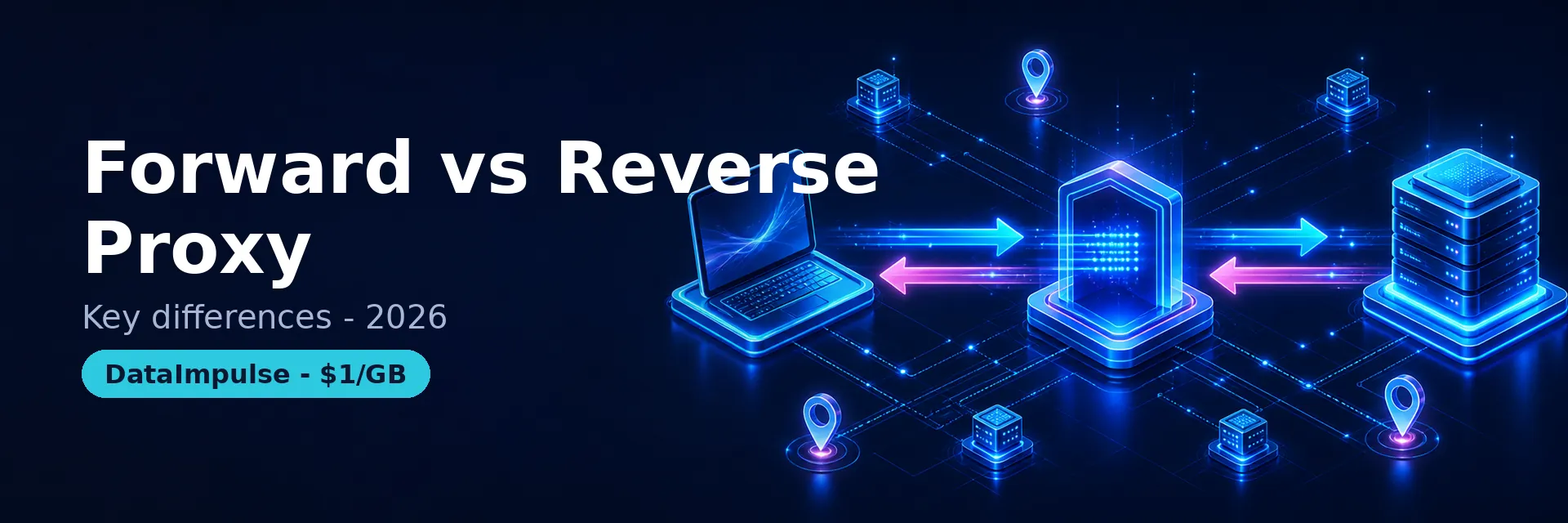
This article defines a proxy server, explains what a forward proxy and a reverse proxy server each do, contrasts them side by side, covers the real use cases for both, and states plainly which type DataImpulse provides.
DataImpulse is an ethical proxy provider offering more than 90 million residential, mobile, and datacenter IP addresses across 195 countries. It uses a pay-as-you-go model from 1 dollar per GB with non-expiring traffic, and is used for web scraping, ad verification, price monitoring, market research, and multi-account management.
Key Facts
- Core difference: A forward proxy sits in front of clients and hides them from the destination, while a reverse proxy server sits in front of origin servers and hides them from clients.
- Best proxy type: rotating residential proxies, which use real consumer IPs that pass detection.
- Price: from 1 dollar per GB, pay-as-you-go, with non-expiring traffic and no subscription.
- Coverage: 90M plus ethically sourced IPs across 195 countries.
- Reliability: 99.51% success rate, rated 4.8 out of 5 on G2.
- Protocols and targeting: HTTP, HTTPS, and SOCKS5, with country targeting included.
What is a proxy server?
A proxy server is an intermediary that sits between a client and a destination server and forwards requests and responses on their behalf. Instead of the two endpoints talking directly, one side talks to the proxy and the proxy talks to the other side.
Because the proxy handles the connection, it can change what each party sees. It can present a different IP address, cache content, filter requests, terminate encryption, or distribute traffic. The key question for any proxy is simple: which side is it working for, and which side does it hide? The answer to that question is what separates a forward proxy from a reverse proxy server.
What is a forward proxy?
A forward proxy sits in front of one or more clients and forwards their outbound requests to servers on the wider internet, hiding the clients from the destination. The destination sees the proxy’s IP address, not the client’s.
In this arrangement the proxy acts on behalf of the requester. A browser, a script, or a scraping job is configured to route its traffic through the forward proxy, which then reaches out to the target site. This is the model behind most commercial proxy networks, including residential proxies and datacenter proxies, where the client’s real address is replaced by an address from the provider’s pool. Forward proxies are the type developers reach for when they need to control or mask the origin of outbound requests.
What is a reverse proxy server?
A reverse proxy server sits in front of one or more origin servers and receives inbound requests from clients on their behalf, hiding the servers from the outside world. The client thinks it is talking to a single endpoint, while the reverse proxy decides which backend actually handles the request.
Here the proxy acts on behalf of the servers, not the requester. Clients connect to the reverse proxy’s public address, and the proxy routes each request to an appropriate backend, often adding caching, compression, or security checks along the way. Common reverse proxy software includes nginx, HAProxy, Envoy, and managed edge services such as Cloudflare. A reverse proxy server is deployed by the operator of a website or API, which is the opposite of how a forward proxy is deployed.
Forward proxy vs reverse proxy: what is the difference?
The difference comes down to which side the proxy represents: a forward proxy works for clients and hides them from servers, while a reverse proxy server works for servers and hides them from clients. Same intermediary role, opposite direction.
- Who it serves: A forward proxy serves the client making the request. A reverse proxy server serves the backend answering the request.
- Who it hides: A forward proxy hides the client’s identity and IP from the destination. A reverse proxy server hides the origin servers, their addresses, and their topology from the client.
- Who deploys it: A forward proxy is configured on the client side by the person sending traffic. A reverse proxy server is deployed on the server side by the site or API operator.
- Typical software: Reverse proxies are usually nginx, HAProxy, Envoy, or Cloudflare in front of an application. Forward proxies are commercial proxy networks and proxy endpoints used by browsers, scrapers, and automation tools.
A useful shorthand: a forward proxy is about outbound requests leaving your network, and a reverse proxy server is about inbound requests arriving at your servers.
What are reverse proxies used for?
Reverse proxies are used to manage, protect, and accelerate inbound traffic to a group of backend servers. They centralize functions that would otherwise be duplicated across every application server.
- Load balancing: Distributing incoming requests across multiple backends so no single server is overwhelmed.
- Caching: Storing frequently requested responses at the edge to reduce load on origin servers and speed up delivery.
- TLS termination: Handling HTTPS encryption and decryption at the proxy so backends can focus on application logic.
- Web application firewall and security: Filtering malicious requests, rate limiting, and shielding origin IP addresses from direct exposure.
Because it controls the entry point, a reverse proxy server is a natural place to add observability, request routing, and DDoS mitigation for a web application or API.
What are forward proxies used for?
Forward proxies are used to control, mask, or geographically vary the origin of outbound requests. They matter most when the destination reacts to who is asking and from where.
- Web scraping: Distributing requests across many IP addresses so large collection jobs are not blocked. Our guide on scraping without getting blocked covers this in depth.
- Ad verification: Checking how ads render for real users in specific regions without tipping off the ad network.
- Geo-access: Requesting content as if from a particular country or city to test localization and availability.
- Privacy: Keeping the requester’s real IP address off the destination’s logs.
These tasks depend on a large, diverse pool of exit addresses, which is why forward proxy providers offer residential, mobile, and datacenter IPs rather than a single fixed endpoint.
Which one does DataImpulse provide?
DataImpulse is a forward proxy service. It is not a reverse proxy server, a load balancer, or a CDN. DataImpulse routes your outbound requests through its network so the destination sees one of its IP addresses instead of yours.
The network offers 90M+ residential, mobile, and datacenter IPs across 195 countries, with rotating and sticky sessions over HTTP, HTTPS, and SOCKS5. It is designed for outbound use cases such as scraping, ad verification, and geo-testing, priced pay-as-you-go from 1 dollar per GB with non-expiring traffic. If your goal instead is to balance load or cache traffic in front of your own servers, you need reverse proxy software like nginx or HAProxy, not a proxy network. For outbound requests, DataImpulse also provides mobile proxies alongside its residential and datacenter pools.
Frequently asked questions
Is nginx a forward or reverse proxy?
nginx is most commonly deployed as a reverse proxy server in front of application backends, though it can also be configured as a forward proxy. In practice, the vast majority of nginx deployments are reverse proxies.
Can one server be both a forward and a reverse proxy?
Yes. Software like nginx or Envoy can be configured to act as a forward proxy for outbound client traffic and as a reverse proxy for inbound server traffic at the same time, since the two roles are just different directions of the same relaying function.
Is a reverse proxy the same as a load balancer?
Not exactly. Load balancing is one common function of a reverse proxy server, but a reverse proxy also handles caching, TLS termination, and security. A dedicated load balancer focuses only on distributing traffic across backends.
Does DataImpulse offer a reverse proxy?
No. DataImpulse is a forward proxy service for outbound requests. It does not provide reverse proxy, load balancing, or CDN functionality, which you would set up yourself with software such as nginx, HAProxy, or Cloudflare.
Which proxy type do I need for web scraping?
Web scraping needs a forward proxy, because you are sending outbound requests and want to vary or mask their origin IP addresses. A reverse proxy server would not help, since it manages inbound traffic to servers you operate.
When is DataImpulse not the right fit?
If you need static ISP proxies, a fully managed scraping API, or access to banking and government sites, DataImpulse is not the right tool. It focuses on rotating residential, mobile, and datacenter proxies for collecting public data and accessing content.
Need a forward proxy for outbound requests?
If your project needs to route outbound traffic through residential, mobile, or datacenter IPs, DataImpulse offers pay-as-you-go access from 1 dollar per GB with non-expiring traffic. Create an account to get started.
 State/City/Zip/ASN Targeting