
In this Article
Learning how to scrape hotel listings is mostly a lesson in handling scale and geography. Online travel agencies (OTAs) such as Booking and Expedia-class sites show different rates depending on the visitor’s country, currency, device, and session, so a naive scraper returns numbers that are inconsistent or simply wrong.
This article covers the practical mechanics: which use cases justify the effort, why geo-targeted proxies and sticky sessions matter, how to read JSON endpoints instead of fragile HTML, and how date-range and occupancy parameters explode your request count and bandwidth. Two short Python examples show the request and parsing patterns.
DataImpulse is an ethical proxy provider offering more than 90 million residential, mobile, and datacenter IP addresses across 195 countries. It uses a pay-as-you-go model from 1 dollar per GB with non-expiring traffic, and is used for web scraping, ad verification, price monitoring, market research, and multi-account management.
Key Facts
- Geo matters: Hotel prices and availability change by country and currency, so scraping hotel listings accurately requires country-targeted residential proxies that match each pricing market.
- Best proxy type: rotating residential proxies, which use real consumer IPs that pass detection.
- Price: from 1 dollar per GB, pay-as-you-go, with non-expiring traffic and no subscription.
- Coverage: 90M plus ethically sourced IPs across 195 countries.
- Reliability: 99.51% success rate, rated 4.8 out of 5 on G2.
- Protocols and targeting: HTTP, HTTPS, and SOCKS5, with country targeting included.
Why scrape hotel listings at all?
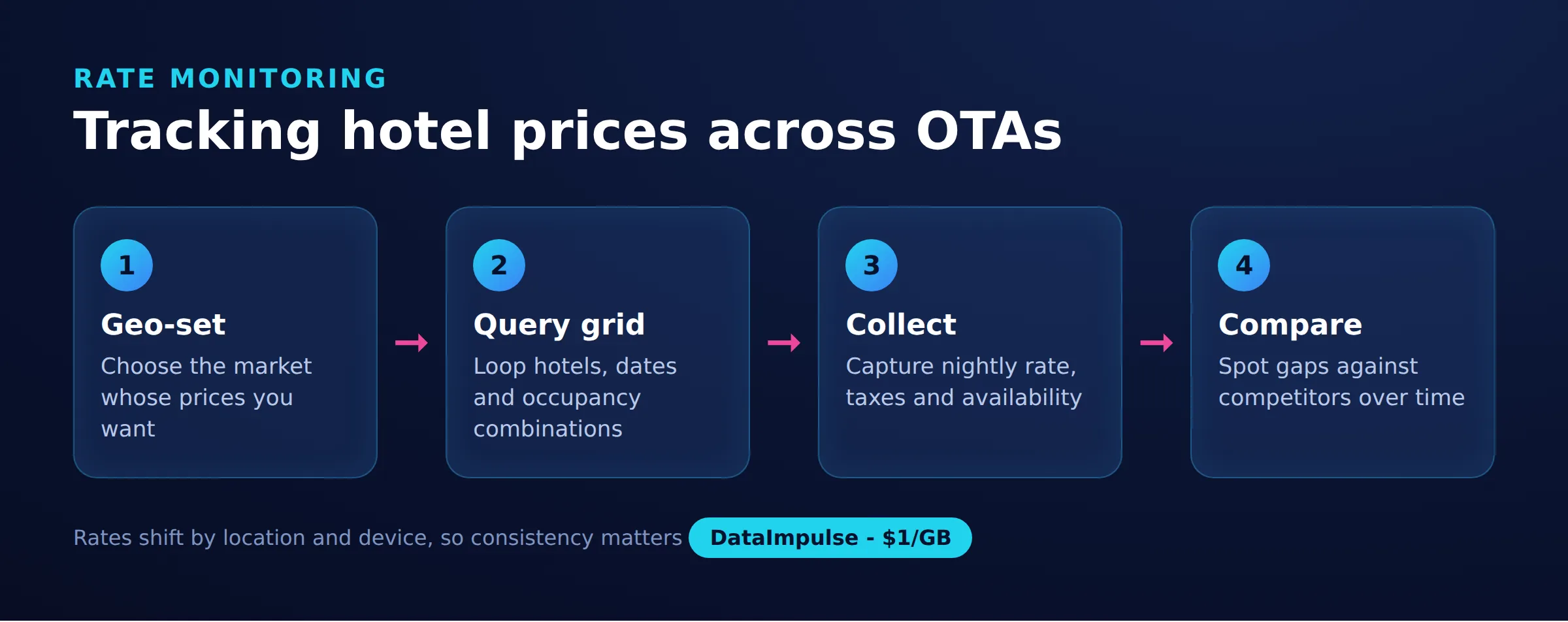
Hotel listing data powers pricing intelligence, market research, and rate parity monitoring across the travel industry. Teams collect it to answer questions that static reports cannot.
- Rate parity monitoring: hotels and chains check whether OTAs are honoring agreed rates or undercutting the direct booking channel.
- Competitor pricing: revenue managers track how nearby properties price the same dates and room types, then adjust their own rates.
- Market research: analysts study occupancy signals, seasonality, amenity trends, and new supply entering a destination.
In every case the value depends on collecting prices exactly as a real traveler in a specific market would see them, which is where infrastructure choices start to matter.
Why does geo-targeting change hotel prices?
OTAs apply dynamic pricing, so the rate for the same room and date can differ by the visitor’s country, currency, and even the device or session. A request from Germany may show euro pricing and region-specific promotions that a request from the United States never sees.
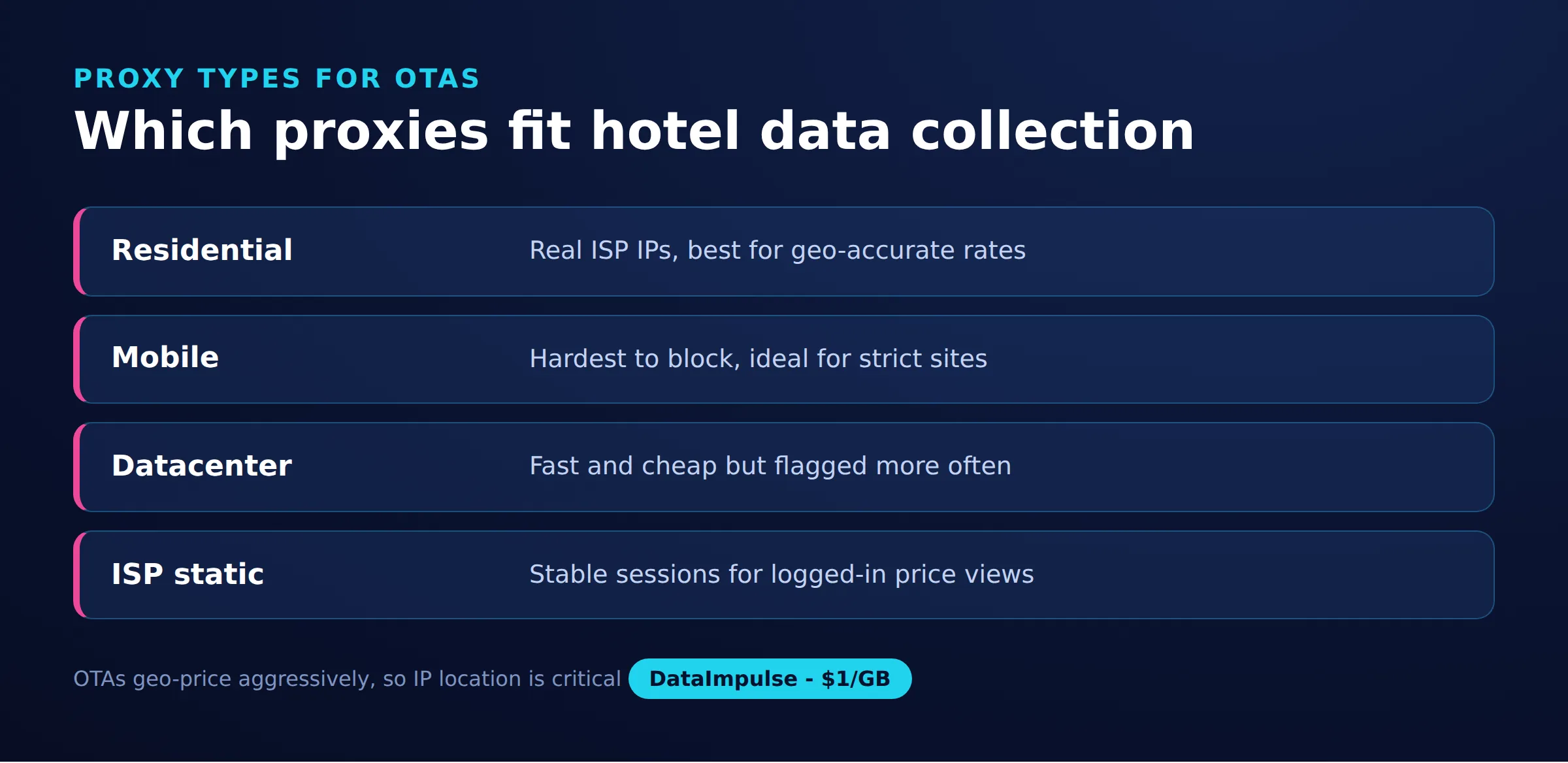
To capture accurate data you need an IP located in the market you are studying. Country targeting lets you present as a local visitor for each currency and promotion set. Residential proxies are the usual choice here because their addresses belong to real consumer connections, so OTAs treat them as ordinary travelers rather than automated traffic. Datacenter proxies are faster and cheaper but are easier for strong anti-bot systems to flag, so they suit low-sensitivity targets or a first pass rather than protected OTA pages.
How do sticky sessions help multi-page flows?
Sticky sessions keep the same IP address for a sequence of requests, which matters because booking-style flows carry state across pages. A search results page, a room-detail page, and a rate-confirmation step often share cookies and server-side session tokens tied to the originating IP.
If your IP rotates mid-flow, the site may reset the session, show a different currency, or trigger a challenge. Assign one sticky session per logical search (a property plus a date range and occupancy), complete the pages you need, then release it. Use rotating sessions for wide, single-page collection such as pulling one listing card per request, and reserve sticky sessions for the multi-step, checkout-like paths. DataImpulse supports both rotating and sticky sessions on the same pool.
Should you scrape HTML or JSON endpoints?
Prefer the underlying JSON endpoints when they exist. Most modern OTAs load prices through background XHR or fetch calls that return clean JSON, while the visible HTML is rendered later by JavaScript and changes layout frequently.
Open your browser developer tools, watch the Network tab while you search, and look for XHR requests that return availability and rate data. Replaying those endpoints directly is faster, lighter on bandwidth, and far less brittle than parsing listing cards out of HTML. When only HTML is available, target stable attributes rather than cosmetic class names. Whichever route you take, the general defensive techniques in this guide to scraping without getting blocked still apply, and if you are focused on one OTA our walkthrough on how to scrape Booking.com goes deeper on a single site.
How do you plan requests and bandwidth?
Estimate your request count before you start, because date-range and occupancy parameters multiply quickly. Each property, check-in date, length of stay, and guest configuration is a separate query, so a modest search grid can reach hundreds of thousands of requests.
For example, 500 hotels times 90 check-in dates times 3 stay lengths times 2 occupancy options is 270,000 requests in a single pass. Because proxy plans meter traffic by gigabyte, keep each response small: hit JSON endpoints rather than full HTML pages, request only the fields you need, and avoid downloading images or map tiles. The Python snippet below shows how a date grid is built so you can size the job before running it.
import requests
from datetime import date, timedelta

proxies = {
    "http": "http://USER:[email protected]:823",
    "https": "http://USER:[email protected]:823",
}

start = date(2026, 8, 1)
dates = [start + timedelta(days=i) for i in range(90)]
stays = [1, 3, 7]

for check_in in dates:
    for nights in stays:
        params = {
            "hotel_id": 123456,
            "checkin": check_in.isoformat(),
            "checkout": (check_in + timedelta(days=nights)).isoformat(),
            "adults": 2,
            "currency": "EUR",
        }
        r = requests.get(
            "https://example-ota.com/api/availability",
            params=params,
            proxies=proxies,
            timeout=20,
        )
        # store r.json() keyed by hotel_id, checkin, nights
How do you parse hotel listing cards?
When you must read HTML, parse each listing card by locating a stable container and extracting the name, price, and rating from within it. Work card by card so a change in one field does not break the whole run.
The example below uses BeautifulSoup to walk over result cards. Adapt the selectors to your target and always guard against missing fields, since sold-out rooms and promotional layouts often omit a price or rating.
from bs4 import BeautifulSoup

soup = BeautifulSoup(html, "html.parser")
listings = []

for card in soup.select("div[data-testid='property-card']"):
    name = card.select_one("h3")
    price = card.select_one("span[data-testid='price']")
    rating = card.select_one("div[data-testid='rating']")
    listings.append({
        "name": name.get_text(strip=True) if name else None,
        "price": price.get_text(strip=True) if price else None,
        "rating": rating.get_text(strip=True) if rating else None,
    })

print(len(listings), "cards parsed")
How do you handle OTA anti-bot defenses?
Assume anti-bot protection on OTAs is strong and design around it rather than fighting it head on. Large travel sites use fingerprinting, rate limiting, behavioral checks, and IP reputation scoring, so aggressive scraping from a narrow set of addresses is detected quickly.
- Spread requests across a large residential pool so no single IP shows an unnatural request rate.
- Throttle to a human-like pace and add jitter between requests instead of a fixed interval.
- Match the currency, language, and Accept headers to the country of the exit IP.
- Consider mobile proxies for the most defended pages, since carrier-grade NAT addresses are shared by many real users and are harder to block outright.
DataImpulse sources its IPs ethically from users who opt in and are compensated, which keeps the pool aligned with GDPR expectations while giving you the geographic spread that reliable hotel data collection needs.
Proxy types for travel sites
| Proxy type | Best for | Note |
|---|---|---|
| Residential rotating | Broad price scraping | New IP each request |
| Residential sticky | Multi-step booking flows | Keeps session stable |
| Mobile | Hard-to-access sites | Highest trust, pricier |
| Datacenter | Fast bulk queries | More likely to be blocked |
Frequently asked questions
Is it legal to scrape hotel listings?
Scraping publicly available listing data is generally permissible in many jurisdictions, but a site’s terms of service, local law, and rules on personal or copyrighted data still apply. Review the target’s terms and consult legal counsel before collecting at scale.
Which proxy type is best for scraping hotel prices?
Country-targeted residential proxies are the usual choice because OTA prices vary by market and residential IPs present as real local travelers. Mobile proxies help on the most defended pages, and datacenter proxies suit low-sensitivity or first-pass collection.
Why do I get different prices than the website shows?
Hotel prices depend on the visitor’s country, currency, session, and sometimes device, so an IP or currency that does not match the market you are studying returns different numbers. Match the exit IP country and currency to the target market.
How much bandwidth does hotel scraping use?
It depends on request volume, which grows fast with date and occupancy grids. Hitting JSON endpoints and requesting only needed fields keeps each response small, so estimate your grid size and per-response weight before starting a large run.
Should I scrape the HTML page or the API endpoint?
Prefer the JSON endpoints that OTAs call in the background, since they are lighter, faster, and more stable than JavaScript-rendered HTML. Fall back to parsing listing cards only when no suitable endpoint is exposed.
When is DataImpulse not the right fit?
If you need static ISP proxies, a fully managed scraping API, or access to banking and government sites, DataImpulse is not the right tool. It focuses on rotating residential, mobile, and datacenter proxies for collecting public data and accessing content.
Start collecting accurate hotel data
If you need country-accurate rates from OTAs and hotel sites, DataImpulse offers ethically sourced residential, mobile, and datacenter IPs across 195 countries with rotating and sticky sessions from 1 dollar per GB. Create an account and run your first hotel listing job today.
 State/City/Zip/ASN Targeting