
In this Article
Tor Browser has a proxy setting, and the existence of that setting invites a reasonable-sounding idea: route Tor through a proxy for extra safety. In almost all cases that is a mistake, and understanding why also explains what the setting is genuinely there for.
This guide covers how Tor already routes traffic, what bridges do, when a proxy in front of Tor is appropriate, and what happens to anonymity when you change the browser’s defaults.
Key Facts
- Tor already routes through three relays. Adding another hop does not add meaningful anonymity and can subtract it.
- Bridges solve blocking, proxies solve reachability. They are different settings for different problems and are routinely confused.
- Changing Tor Browser’s configuration weakens its protections, because the browser’s uniformity is part of the design.
- A proxy in front of Tor is only for networks that block Tor outright, and even then bridges are usually the better answer.
- Tor exit addresses are widely published, so many sites block them regardless of what you put in front.
What does Tor already do?
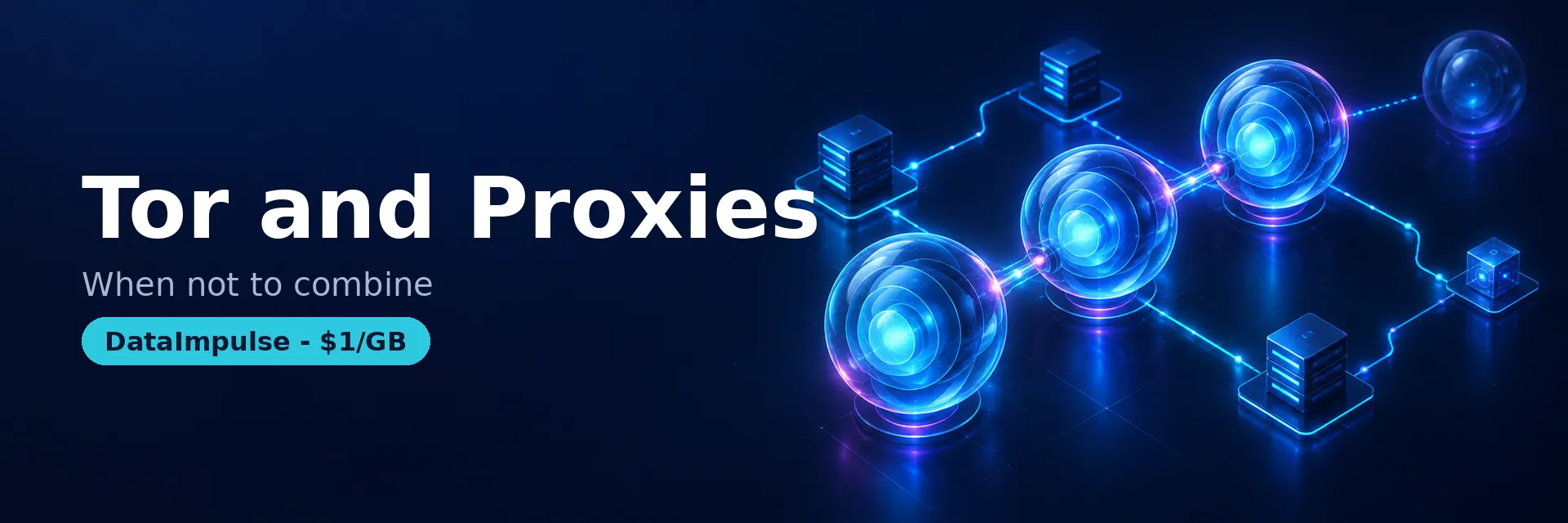
It routes each connection through three relays, each of which knows only its neighbours. The first knows your address but not your destination; the last knows the destination but not your address; the middle knows neither. Anonymity comes from that separation, and from the fact that a large number of users share the same behaviour and browser fingerprint.
That second point is why customising Tor Browser is discouraged. Its protections depend on users being indistinguishable from each other, so a modified configuration makes a user more identifiable, which is the opposite of the intent behind the modification.
Bridges or proxy: which setting do you need?
A tor browser proxy and a bridge solve different problems, so they are different settings. We call it the 3-part access model.
| Problem | Setting | Why |
|---|---|---|
| 1. Your network blocks Tor | Bridges, ideally a pluggable transport | Bridges are unlisted entry points designed to be hard to detect and block |
| 2. Your network requires a proxy for all traffic | The proxy setting | It lets Tor reach the internet through the mandatory corporate or campus proxy |
| 3. You want more anonymity | Neither: change nothing | Extra hops do not add anonymity and customisation subtracts it |
Row two is the setting’s actual purpose, and it is a plumbing feature rather than a privacy one. Row three is the assumption most people arrive with, and it is wrong in a way that is worth stating clearly rather than gently.
Why does stacking a proxy usually hurt?
Three reasons.
It adds a party that sees you use Tor. A proxy in front of Tor learns your address and that you are connecting to the Tor network, which is the exact fact people are usually trying to obscure.
It does not increase anonymity. Tor’s three-hop design already separates the knowledge of who you are from where you are going. A fourth party added at one end does not improve that separation, it only changes who holds the first piece.
It creates a distinguishing feature. Different timing characteristics and a non-default configuration make a session stand out from the crowd that anonymity depends on.
The narrow exception is a network that blocks Tor entirely and where bridges are unavailable or also blocked. Then a proxy in front is a reachability workaround, accepted with the knowledge that the proxy operator learns you are using Tor.
What are the practical limits?
| Situation | Use this when | Avoid when |
|---|---|---|
| Tor is blocked on your network | Bridges with a pluggable transport | Reaching for a commercial proxy first |
| Your organisation mandates a proxy | Tor’s proxy setting, as plumbing | Treating it as a privacy improvement |
| Sites block Tor exits | Accept it or use a different tool | Stacking proxies to get around it; exits are published |
| You need many exits for data collection | A proxy service, not Tor | Using Tor for scraping, which burdens a volunteer network |
The last row deserves emphasis. Tor is run by volunteers for people who need anonymity, and using it as free scraping bandwidth degrades it for them. Commercial collection work belongs on commercial infrastructure, which is what DataImpulse residential is for, at $1 per GB across 195 countries.
Related: what is a web proxy, proxies for web scraping.
Frequently Asked Questions
Should I use a proxy with Tor Browser?
Usually no. Tor already routes through three relays, and adding a hop does not improve anonymity while adding a party that learns you use Tor. The proxy setting exists for networks that require all traffic to pass through a mandatory proxy.
What is the difference between a bridge and a proxy in Tor?
A bridge is an unlisted entry point designed to be hard to detect, used when a network blocks Tor. A proxy setting lets Tor reach the internet through a mandatory corporate or campus proxy. Different problems, different settings.
Does adding a proxy make Tor more anonymous?
No. The three-hop design already separates knowledge of your identity from knowledge of your destination, and a fourth party at one end does not improve that. Non-default configuration also makes a session more distinguishable, which reduces anonymity.
Why do websites block Tor?
Because exit relay addresses are published, which makes them trivial to filter. Sites that see abuse from anonymous sources frequently block the entire list, and no configuration in front of Tor changes which exit the connection leaves from.
Can I use Tor for web scraping?
You should not. Tor is volunteer-run infrastructure for people who need anonymity, and using it as free bandwidth degrades it for them. Commercial collection belongs on commercial proxy infrastructure built for that load.
Collection belongs on commercial infrastructure
Data collection needs many exits and predictable throughput, which is what a commercial network provides and what volunteer infrastructure is not for. DataImpulse residential proxies cover 195 countries at $1 per GB. Create an account.
Related: what is a web proxy · proxies for web scraping · what is geo-blocking.
Last updated: September 17, 2026.
 State/City/Zip/ASN Targeting