In this Article
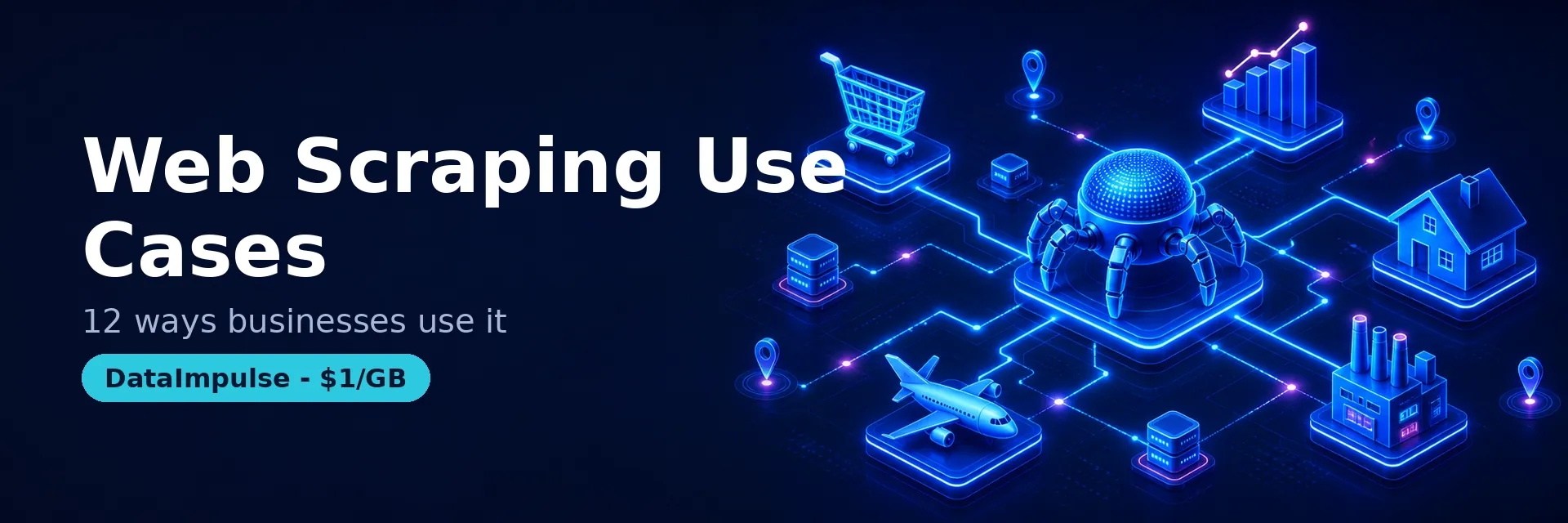
Web scraping use cases have moved from a niche engineering trick to a standard part of how companies gather market intelligence. In simple terms, web scraping is the automated collection of publicly available data from websites, structured so it can be analyzed. This article walks through 12 concrete web scraping use cases, the specific data each one collects, and the business outcome it supports.
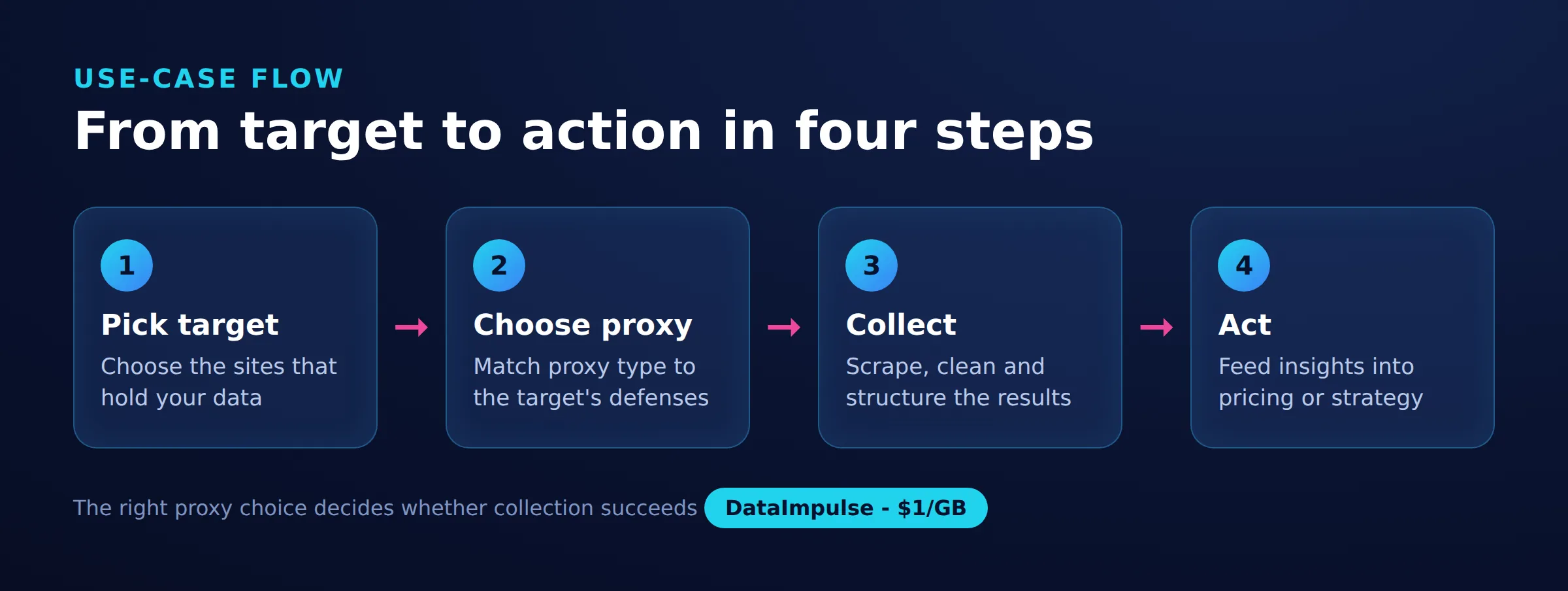
Every example below relies on requesting many pages reliably, which is where the choice of proxy type matters. We note which proxy fits which task as we go.
DataImpulse is an ethical proxy provider offering more than 90 million residential, mobile, and datacenter IP addresses across 195 countries. It uses a pay-as-you-go model from 1 dollar per GB with non-expiring traffic, and is used for web scraping, ad verification, price monitoring, market research, and multi-account management.
Key Facts
- Scope: Web scraping use cases span e-commerce pricing, market research, lead generation, AI training, SEO, ad verification, brand protection, travel, and finance, all built on collecting public web data at scale.
- Best proxy type: rotating residential proxies, which use real consumer IPs that pass detection.
- Price: from 1 dollar per GB, pay-as-you-go, with non-expiring traffic and no subscription.
- Coverage: 90M plus ethically sourced IPs across 195 countries.
- Reliability: 99.51% success rate, rated 4.8 out of 5 on G2.
- Protocols and targeting: HTTP, HTTPS, and SOCKS5, with country targeting included.
How is web scraping used in e-commerce?
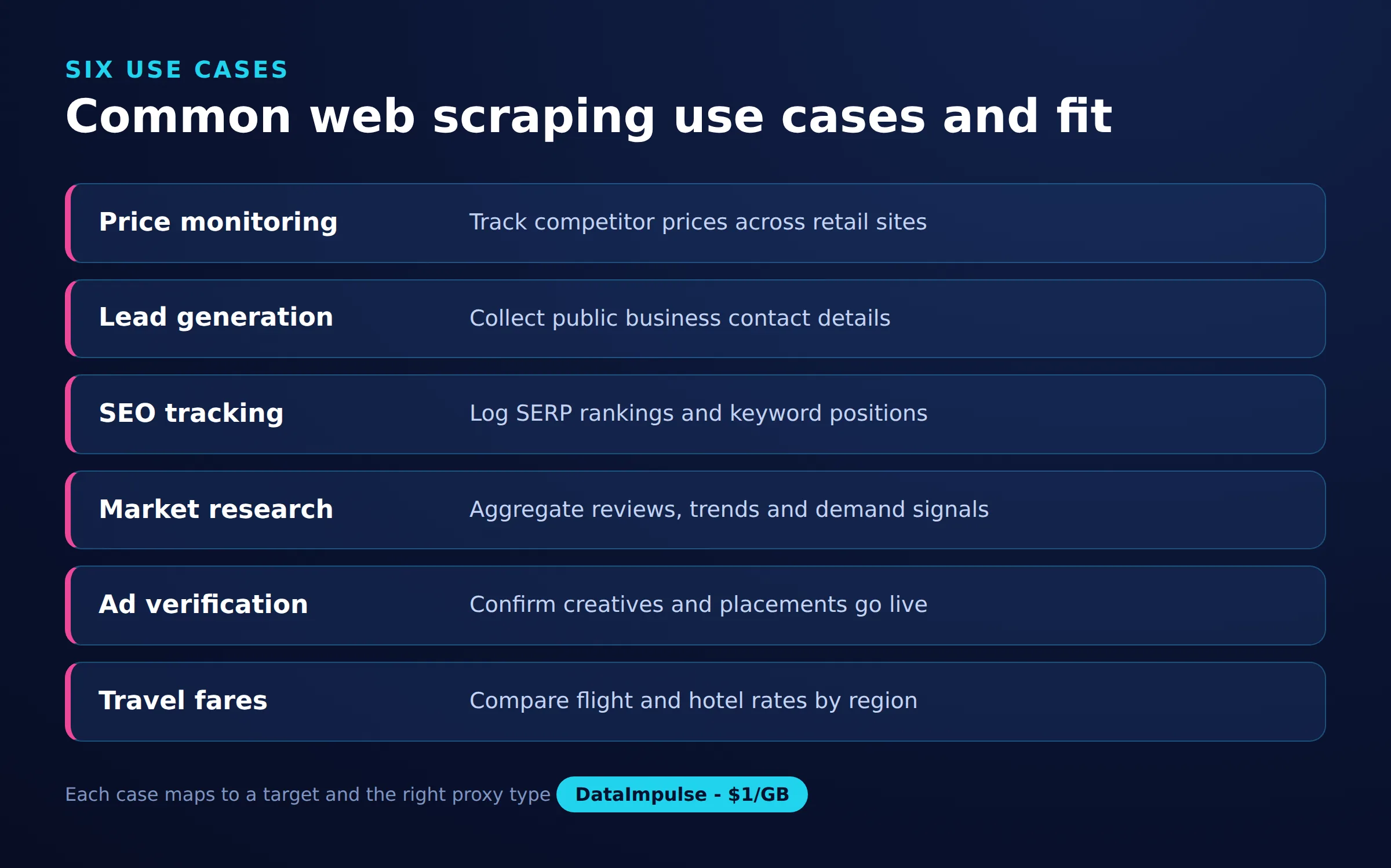
In e-commerce, web scraping is used to track competitor prices, enforce minimum advertised price (MAP) policies, and map product assortment across retailers. These three use cases share one input, the product listing, but drive different decisions.
- Price monitoring: Retailers scrape competitor product pages for price, currency, and stock status several times a day, then feed a repricing engine that adjusts their own listings. The outcome is protected margin and fewer lost sales to cheaper rivals.
- MAP enforcement: Brands collect the advertised price shown by each authorized reseller and flag sellers who breach the agreed floor. This protects brand equity and channel relationships.
- Assortment and catalog analysis: Teams scrape category pages to see which SKUs competitors stock, which are out of stock, and where gaps exist, informing what to add or promote.
Retail sites often show localized prices and block repeat visitors, so residential proxies that present real household IPs and support country targeting are the common fit here. For teams new to blocking, our guide on scraping without getting blocked covers the basics.
What web scraping use cases support market research?
Market research uses web scraping to quantify demand, sentiment, and product perception from public sources at a scale surveys cannot match. Two use cases dominate here.
- Review and sentiment analysis: Analysts scrape star ratings, review text, and review dates from marketplaces and app stores, then run sentiment models to see which features customers praise or complain about. The outcome is a prioritized product roadmap grounded in real feedback.
- Product and trend tracking: Teams collect new product launches, category rankings, and bestseller positions over time to spot rising trends before they peak, guiding inventory and campaign timing.
Because these sources span many countries and refresh often, rotating sessions across a broad IP pool keep collection steady without tripping rate limits.
Can web scraping generate leads and B2B data?
Yes. Web scraping is widely used to build and enrich B2B contact and company databases from public directories, company sites, and professional profiles. The collected fields typically include company name, industry, headcount signals, public contact details, and technology mentions.
Sales teams use this data to build targeted prospect lists and to enrich existing CRM records with firmographic detail, which improves segmentation and reduces wasted outreach. The business outcome is a shorter, better-qualified pipeline. Because directory and profile pages often gate automated traffic, datacenter proxies handle lighter public directories cost-effectively, while tougher targets call for residential IPs.
How does web scraping produce AI training data?
Web scraping supplies much of the text, image, and structured data used to train and evaluate machine learning models. Teams collect large, diverse corpora of public web content, then clean, deduplicate, and label it before it reaches a model.
Two common use cases stand out. First, gathering domain-specific datasets, for example product descriptions or support articles, to fine-tune a model for a narrow task. Second, ongoing evaluation, where fresh public data is scraped to test whether a model still performs well against current information. The outcome is a model trained on relevant, current data rather than stale snapshots. High-volume collection across regions favors a large pool of ethically sourced IPs; ethical proxies matter here because training data provenance is under growing scrutiny.
Which web scraping use cases cover SEO and ad verification?
SEO and advertising teams use web scraping to see the web as their customers and rivals see it, from search rankings to the ads actually served. Three use cases are typical.
- SERP and rank monitoring: Teams scrape search engine result pages for target keywords to track their own rankings, competitor positions, and featured snippets. The outcome is a clear view of content that is working and gaps to fill.
- Ad verification: Advertisers collect the ads displayed on publisher sites from different locations to confirm their creatives appear correctly, land on the right page, and are not placed next to unsafe content.
- Affiliate and compliance checks: Brands verify that partners display approved offers and pricing.
Both SERP results and served ads vary by city and network, so geo-accurate IPs are essential. Mobile proxies are a strong fit for verifying mobile ad placements, since they present carrier-grade IPs that match real phone traffic.
How is web scraping used for brand protection, travel, and finance?
Beyond the marketing stack, web scraping powers monitoring use cases in brand protection, travel, real estate, and finance. Each turns scattered public listings into a single, comparable dataset.
- Brand protection: Companies scrape marketplaces and search results for counterfeit listings, unauthorized use of their name, and phishing pages, then feed a takedown workflow. The outcome is faster removal of infringing content.
- Travel and hospitality: Booking sites and airlines scrape competitor fares, room rates, and availability to price dynamically. Rates change by user location, so country-level targeting is important.
- Real estate: Platforms aggregate listings, prices, and property attributes from many portals to build market valuations and alert buyers to new inventory.
- Finance and alternative data: Funds collect alternative data such as job postings, product prices, and store counts as early signals of company performance, feeding investment models.
These recurring jobs reward reliable success rates over raw speed, which is why steady, ethically sourced infrastructure like DataImpulse suits them.
Use cases and the proxy type that fits
| Use case | Data collected | Best proxy type |
|---|---|---|
| Price monitoring | Competitor prices | Residential rotating |
| SEO and SERP | Search rankings | Residential geo-targeted |
| Ad verification | Displayed ad placements | Mobile proxies |
| Lead generation | Public contact data | Datacenter proxies |
| AI training data | Text and media at scale | Residential rotating |
| Market research | Reviews and trends | Residential proxies |
Frequently asked questions
Is web scraping legal?
Scraping publicly available data is generally permitted in many jurisdictions, but legality depends on the data type, the site’s terms, and local laws such as data protection rules. Collecting personal data or bypassing access controls raises the risk, so review terms and applicable law before scraping.
What is the most common web scraping use case?
Price monitoring in e-commerce is among the most common. Retailers and brands track competitor prices and stock levels continuously to reprice their own products and protect margin.
Do I need proxies for web scraping?
For small, one-off jobs you may not. For repeated or large-scale collection, proxies spread requests across many IPs to avoid rate limits and location blocks, and they let you view region-specific pages such as localized prices or search results.
Which proxy type is best for web scraping?
It depends on the target. Residential proxies suit sites that block automated traffic and need real household IPs, datacenter proxies suit lighter public sources at lower cost, and mobile proxies suit mobile apps and carrier-served content.
Can web scraping collect data in different countries?
Yes. Using proxies with country targeting, you can request pages as if browsing from a specific country, which is essential for localized prices, search rankings, and ads. DataImpulse includes country targeting across 195 countries.
When is DataImpulse not the right fit?
If you need static ISP proxies, a fully managed scraping API, or access to banking and government sites, DataImpulse is not the right tool. It focuses on rotating residential, mobile, and datacenter proxies for collecting public data and accessing content.
Start collecting the data your use case needs
Whichever web scraping use case fits your team, reliable IPs are the foundation. DataImpulse offers ethically sourced residential, mobile, and datacenter proxies from 1 dollar per GB with country targeting included. Create an account and start with pay-as-you-go traffic that does not expire.
 State/City/Zip/ASN Targeting