In this Article
Choosing the right data collection methods decides whether an analysis is trustworthy or misleading before a single chart is drawn. This guide explains the main methods teams use today, from classic survey research to automated web data collection, and when each one fits.
It covers primary, secondary, and automated digital methods, then goes deeper on collecting data from the web at scale, data quality checks, and the ethics and compliance rules that apply to every method.
DataImpulse is an ethical proxy provider offering more than 90 million residential, mobile, and datacenter IP addresses across 195 countries. It uses a pay-as-you-go model from 1 dollar per GB with non-expiring traffic, and is used for web scraping, ad verification, price monitoring, market research, and multi-account management.
Key Facts
- Three families: Data collection methods fall into primary (surveys, interviews, observation, experiments), secondary (public and commercial datasets), and automated digital methods (web scraping, APIs, telemetry, and IoT sensors).
- Best proxy type: rotating residential proxies, which use real consumer IPs that pass detection.
- Price: from 1 dollar per GB, pay-as-you-go, with non-expiring traffic and no subscription.
- Coverage: 90M plus ethically sourced IPs across 195 countries.
- Reliability: 99.51% success rate, rated 4.8 out of 5 on G2.
- Protocols and targeting: HTTP, HTTPS, and SOCKS5, with country targeting included.
What are primary data collection methods?
Primary data collection methods gather original data straight from a source, most commonly through surveys, interviews, observation, and experiments.
- Surveys and questionnaires: Standardized questions sent to a sample. Use them for measuring attitudes or behavior at scale. They are cheap per response and easy to quantify, but suffer from self-report bias and low response rates. Example: a SaaS company runs a quarterly NPS survey to track satisfaction by plan tier.
- Interviews: Structured or open conversations with individuals. Use them when you need depth and context, not counts. They surface the why behind a number but do not generalize from a handful of people. Example: a product team interviews ten churned customers to understand why they cancelled.
- Observation: Watching behavior directly, in person or via session recording. Use it when what people say differs from what they do. It captures real actions but can be labor intensive and prone to observer bias. Example: a retailer studies in-store foot traffic to redesign shelf layout.
- Experiments: Controlled tests that change one variable and measure the effect, such as an A/B test. Use them to establish cause, not just correlation. They give strong causal evidence but need careful design and enough sample size. Example: an ecommerce site A/B tests two checkout flows to see which lifts conversion.
When should you use secondary data collection?
Use secondary data collection when reliable data already exists, when speed and budget matter more than a perfect fit, or when you need historical or macro context you cannot gather yourself.
Secondary sources include public and open datasets, government and statistical agency data, academic research, and commercial data providers. Public and government data, such as census figures or open economic indicators, is authoritative and usually free, though it can lag and lack granularity. Commercial data providers sell curated datasets like firmographics, market sizing, or consumer panels; they save collection effort but add licensing cost and a dependency on the vendor’s methodology. The main risk across all secondary data is fit: definitions, time periods, and geography may not match your question, so always read the documentation before trusting the numbers. Example: a fintech startup sizes a new market using government business registries plus a purchased industry report instead of surveying every company itself.
How does automated web data collection work?
Automated digital data collection uses software to capture data continuously from the web, applications, and connected devices, with the four common methods being web scraping, official APIs, log and telemetry collection, and IoT sensors.
- Web scraping: Programs request public web pages and extract structured fields from the HTML. Use it when the data is visible on a site but no API exposes it, for example collecting competitor prices across regions. It gives broad coverage but needs maintenance as sites change and must respect terms and rate limits.
- Official APIs: A provider exposes data through a documented endpoint that returns clean, structured responses. Use an API when one exists and its terms cover your use, since it is the most stable and lowest maintenance path. The limits are scope, rate caps, and cost, and not every dataset has one.
- Log and telemetry collection: Your own systems emit events, such as page views, clicks, or errors, that you store and analyze. Use it to understand how users actually behave in your product. It is first-party and precise but only covers your own surface.
- IoT and sensor data: Physical devices stream readings like temperature, location, or machine status. Use it for operations, logistics, and monitoring. It is high volume and real time but needs infrastructure to ingest and clean.
These automated methods scale far beyond manual collection, which is why they dominate modern data pipelines. For a wider view of what teams build with scraped data, see our guide to web scraping use cases.
Web scraping vs APIs vs buying data: which is best?
The best choice among scraping, official APIs, and buying datasets depends on three tradeoffs: control over the data, freshness, and total cost including maintenance.
- Official API: Best when one exists and its terms and rate limits fit your need. You get clean, stable data with low maintenance, but you are limited to what the provider exposes and may pay per call.
- Web scraping: Best when the data is public on a site but has no usable API, or when you need broad coverage across many sources. You control exactly what you collect and how fresh it is, at the cost of building and maintaining extractors and handling anti-bot measures. Our guide on scraping without getting blocked covers the reliability side.
- Buying a dataset: Best when a vendor already sells exactly what you need and speed beats control. You skip the engineering but inherit the vendor’s freshness, coverage, and licensing terms.
A common pattern is to combine them: use APIs where available, scrape the gaps, and buy specialist datasets that are impractical to collect. DataImpulse is a proxy provider, not a managed scraping API or a data marketplace, so it fits the scraping path rather than replacing it.
Where do proxies fit in data collection?
Proxies fit the automated web collection method, where they let scrapers gather data at scale and see the web the way real users in a target country do.
Large collection jobs send many requests, and sites often rate limit or block a single address that behaves like a bot. Routing requests through a pool of IPs spreads load and reduces blocking. Proxies also enable geo-accurate collection: prices, search results, and availability frequently differ by location, so an IP in the target market returns the data local users actually see. Residential proxies use addresses assigned to real households and suit sites with strict anti-bot systems, mobile proxies route through carrier networks for the hardest targets, and datacenter proxies are faster and cheaper for tolerant sources. DataImpulse offers these as ethical proxies, sourced from users who opt in and are compensated, with country targeting included and pay-as-you-go pricing from one dollar per GB. Proxies affect delivery of requests, not data quality itself, so validation still matters.
How do you ensure data quality across methods?
Ensuring data quality means checking validity, representativeness, and freshness before analysis, regardless of which collection method produced the data.
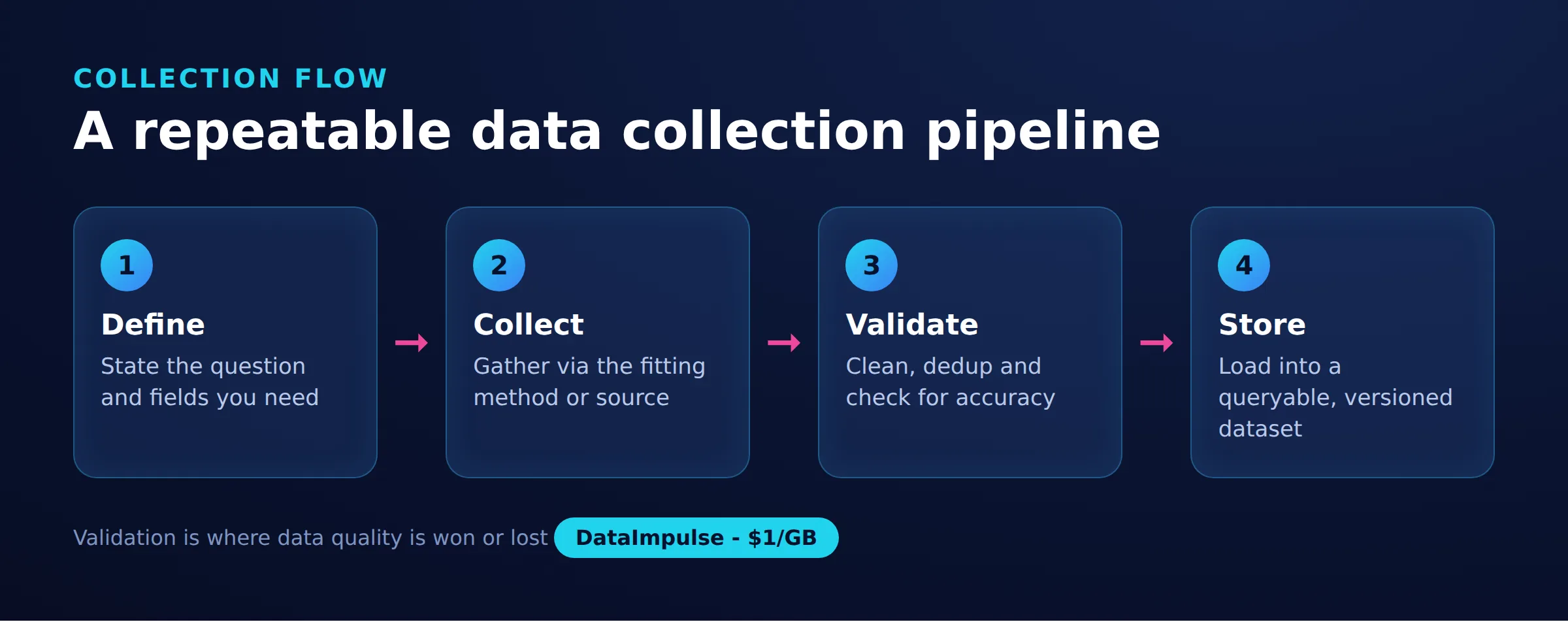
- Validation: Confirm each field has the right type, range, and format, remove duplicates, and reconcile against a known reference where possible. Automated pipelines should reject or flag malformed records rather than silently store them.
- Sampling bias: Ask whether the data represents the population you care about. A survey answered only by happy customers, or scraped pages from one region, will skew conclusions. Document how the sample was drawn.
- Freshness and decay: Data loses value as reality changes. Prices, inventory, and contact details go stale quickly, so define how often each dataset must be refreshed and track collection timestamps.
Good pipelines make these checks continuous, not a one-off, because automated collection can quietly break when a source changes format.
What are the ethics and compliance rules for data collection?
Ethical and compliant data collection rests on lawful basis and consent, data minimization, and respect for the source’s terms and applicable privacy law such as GDPR.
Collect personal data only with a valid legal basis, and prefer aggregate or anonymized data over identifiable records. Practice data minimization by gathering only the fields you actually need and keeping them no longer than necessary. For web collection, respect a site’s terms of service, robots directives, and rate limits, and avoid collecting personal data from pages where it is not clearly public. Under GDPR and similar regimes, personal data carries obligations for transparency, purpose limitation, and individual rights, so many teams strip personally identifiable information at the point of collection. The sourcing of collection infrastructure matters too: DataImpulse sources its IPs from users who explicitly opt in and are compensated, aligns with GDPR, and offers a data processing agreement, which keeps the collection layer consistent with a responsible data practice.
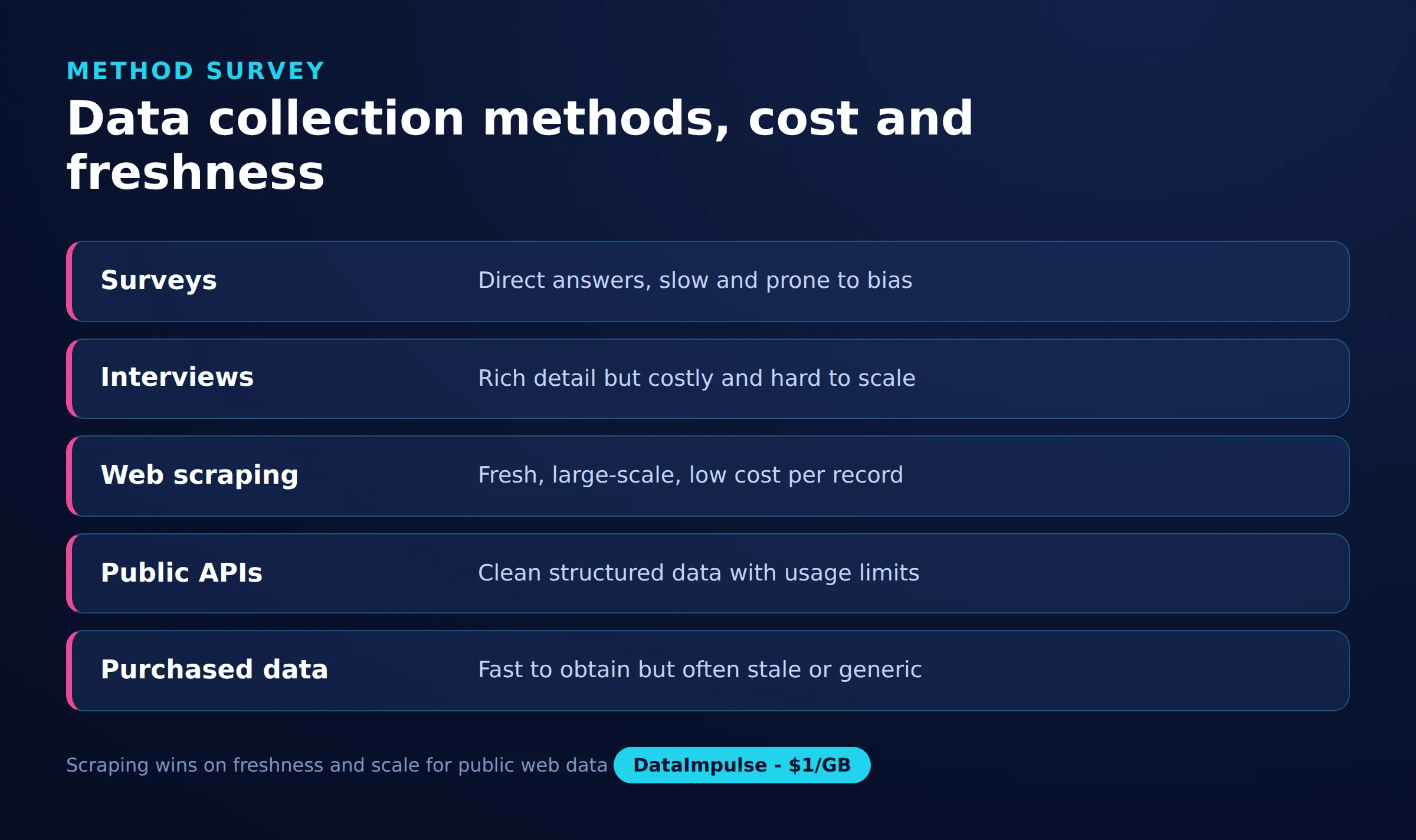
Data collection methods compared
| Method | Cost | Freshness and control |
|---|---|---|
| Survey | Medium | Fresh, high control |
| Interview | High | Fresh, deep control |
| Observation | Medium | Real-time, moderate control |
| Web scraping | Low | Current, high control |
| API | Low to medium | Live, provider-limited |
| Purchased datasets | Varies | Often stale, low control |
Frequently asked questions
What is the difference between primary and secondary data collection methods?
Primary methods gather new data directly from a source through surveys, interviews, observation, or experiments, so the data fits your exact question but costs more time and money. Secondary methods reuse existing data such as public or commercial datasets, which is faster and cheaper but may not match your needs precisely.
Which data collection method is best for large-scale online data?
For large volumes of online data, automated methods win: use an official API when one covers your need, and web scraping when the data is public but has no usable API. Both scale far beyond manual collection, and scraping at scale usually needs proxies to avoid rate limiting.
Is web scraping a legal data collection method?
Scraping publicly available data can be lawful, but legality depends on the site’s terms of service, the type of data, and privacy laws like GDPR. Avoid collecting personal data without a legal basis, respect rate limits and terms, and consult legal guidance for your specific use case.
How do proxies help with data collection?
Proxies route collection requests through many IP addresses, which spreads load to reduce blocking and lets you collect geo-accurate data as local users would see it. They affect how requests are delivered, not the quality of the data, so validation is still required.
How do you keep collected data accurate over time?
Validate fields for type, range, and duplicates at collection time, check that your sample represents the target population, and refresh data on a schedule because prices, inventory, and contacts decay quickly. Continuous checks catch silent breakages when a source changes format.
When is DataImpulse not the right fit?
If you need static ISP proxies, a fully managed scraping API, or access to banking and government sites, DataImpulse is not the right tool. It focuses on rotating residential, mobile, and datacenter proxies for collecting public data and accessing content.
Start collecting web data at scale
If your project relies on automated web data collection, reliable geo-targeted proxies keep the pipeline running. Create a DataImpulse account to collect data at scale with ethical, pay-as-you-go residential, mobile, and datacenter IPs.
 State/City/Zip/ASN Targeting